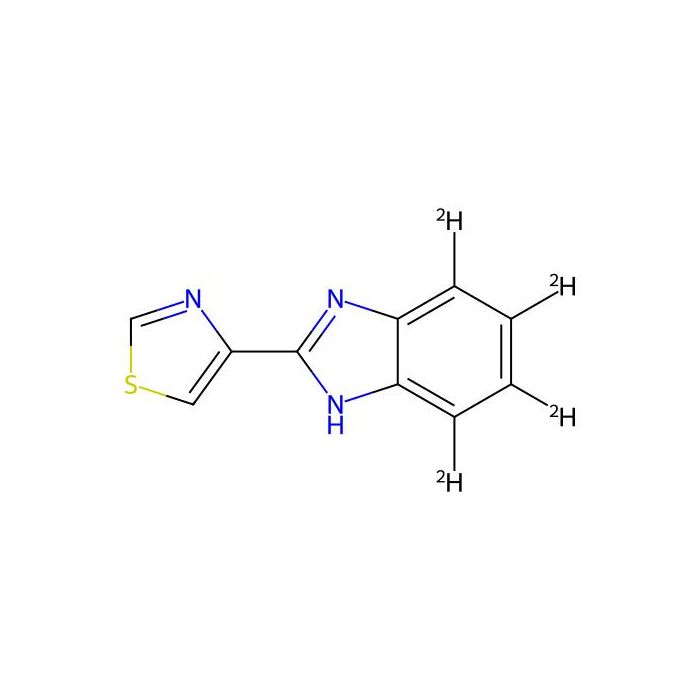
Thiabendazole-d 4 is a deuterated form of Thiabendazole, which is an antiseptic, antifungal and antiparasitic agent.
In Vitro
Stable heavy isotopes of hydrogen, carbon, and other elements have been incorporated into drug molecules, largely as tracers for quantitation during the drug development process. Deuteration has gained attention because of its potential to affect the pharmacokinetic and metabolic profiles of drugs [75] . MCE has not independently confirmed the accuracy of these methods. They are for reference only.
Form:Solid
Spezifikationen
Spezifikationen & Reinheit
≥98%
Biochemische und physiologische Mechanismen
Thiabendazole-d 4 is a deuterated form of Thiabendazole, which is an antiseptic, antifungal and antiparasitic agent.
Storage
Store at -20°C
Verschickt in
Ice chest + Ice pads
Dieses Produkt erfordert Kühlkettenversand. Grundversand und andere Economy-Optionen sind nicht verfügbar.
Zertifikate (CoA, COO, BSE/TSE und Analyse-Diagramm)
C of A & Other Certificates(BSE/TSE, COO):
Analytical Chart:
Chemische und physikalische Eigenschaften
Molekulargewicht
205.270 g/mol
XLogP3
2.500
Hydrogen Bond Donor Count
1
Hydrogen Bond Acceptor Count
3
Rotatable Bond Count
1
Exact Mass
205.061 Da
Monoisotopic Mass
205.061 Da
Topological Polar Surface Area
69.800 Ų
Heavy Atom Count
14
Formal Charge
0
Complexity
212.000
Isotope Atom Count
4
Defined Atom Stereocenter Count
0
Undefined Atom Stereocenter Count
0
Defined Bond Stereocenter Count
0
Undefined Bond Stereocenter Count
0
The total count of all stereochemical bonds
0
Covalently-Bonded Unit Count
1
Lösungsrechner
Molarity Calculator
Determine the necessary mass, volume, or concentration for preparing a solution.
Dilution Calculator
Determine the dilution needed to prepare a stock solution.
Reconstitution Calculator
Bewertungen
Kundenbewertungen
Application Protocols
Example protocol: LC–MS/MS quantitation of thiabendazole using Thiabendazole-d4 as internal standard (general guidance)
Materials
Thiabendazole-d4 stock (e.g., 1 mg/mL in MeOH) and native thiabendazole standard.
Mobile phase A: water + 0.1% formic acid; B: acetonitrile + 0.1% formic acid (or volatile ammonium buffer).
QuEChERS or SPE materials appropriate to sample matrix (produce, serum, etc.).
Calibration
Prepare serial dilutions of native analyte in matrix extract or diluent to cover expected range.
Add a constant concentration of Thiabendazole-d4 to all calibrators and QC samples (e.g., 10–100 ng/mL final; optimize to your detector).
Sample preparation (illustrative QuEChERS for food matrices)
Homogenize sample; weigh aliquot (e.g., 10 g).
Add MeOH:water (80:20) containing Thiabendazole-d4 at the target IS level.
Perform salt-out extraction; vortex/shake and centrifuge.
Cleanup supernatant with dispersive SPE (PSA/C18 as appropriate); filter 0.2 µm PTFE.
LC–MS/MS
Column: C18, 2.1 × 100 mm, 1.7–3 µm.
Gradient: 5–95% B over 6–10 min; adjust for resolution.
Ionization: ESI+, monitor MRM transitions specific to TBZ and TBZ-d4 with ~4 Da separation; optimize CE and dwell.
QA/QC
Include matrix spikes, duplicates, and continuing calibration verification.
Acceptance: recovery 70–120% with RSD ≤15% (method-dependent). Investigate ion suppression via post-column infusion if necessary.
This protocol is an example; adapt to your laboratory’s validated method and regulatory requirements.
Biological Roles
This section summarizes general, literature-based information about the non-deuterated parent compound (thiabendazole). It is provided for context only; Thiabendazole-d4 is intended for research and analytical use.
Mechanistic class (literature)
Thiabendazole is a benzimidazole heteroaromatic known to interact with β-tubulin in certain organisms, disrupting microtubule assembly. In fungi and helminths, benzimidazoles commonly impair cell division and essential intracellular transport.
Biotransformation (literature)
Typical metabolic pathways include oxidation and conjugation to more polar metabolites; phase I transformations often yield hydroxylated products, followed by phase II glucuronidation/sulfation. These features are useful for designing LC–MS assays that monitor both parent and metabolites.
Physicochemical determinants of biointeraction (literature)
Moderate lipophilicity (logP ~2.7–2.9) supports membrane permeability; weak basicity influences protonation state around physiological pH, affecting binding and distribution.
Relevance of d4 isotopologue
The d4 label preserves the parent’s binding and physicochemical profile while enabling mass-spectrometric discrimination. It is thus suitable as an internal standard in studies probing uptake, distribution, and residue analysis in biological matrices.
No medical or clinical claims are made. All uses are for laboratory research and analytical purposes only.
Buffer Applications
Not typically applicable. Thiabendazole-d4 is a deuterated small-molecule standard rather than a buffering reagent. When used in bioanalytical assays, it is dissolved in organic solvents (MeOH/ACN/DMSO) and diluted into volatile LC–MS mobile phases or extraction buffers. If aqueous buffers are required for sample preparation, choose volatile systems (e.g., ammonium formate/acetate with formic acid) to maintain MS compatibility.
Green Alternatives
As a deuterated analytical standard, the principal sustainability levers lie in solvent choice, sample throughput, and waste minimization rather than substituting the analyte itself.
Prefer methanol or ethanol (where analytically acceptable) over acetonitrile for reduced environmental impact; confirm chromatographic performance and ionization efficiency.
Use volatile aqueous buffers (ammonium formate/acetate, formic acid) to facilitate waste treatment; avoid non-volatile salts.
Process optimization
Miniaturize sample prep (micro-QuEChERS, microSPE) to cut solvent volumes while preserving method performance.
Implement on-line extraction or at-column dilution to reduce off-line solvent consumption.
Consolidate multi-residue methods to limit duplicate extractions when analyzing multiple benzimidazole fungicides.
Comparison (general)
Conventional: ACN-heavy workflows with large-volume liquid–liquid extraction.
ACN often affords sharper peaks and lower backpressure; switching to MeOH may require longer gradients or elevated column temperatures.
Ethanol can be acceptable for stock solutions but may alter ESI response; validate LOD/LOQ after substitution.
Waste handling
Segregate halogen-free organic waste and aqueous fractions; use solvent-saving autosampler rinses (short cycles, strong solvent) and schedule batches to minimize rinse frequency.
Pharmaceutical Uses
Formulation/excipients status for this item: Not applicable; this product is a deuterated analytical standard intended for research use only.
Relevance to pharmaceutical and QC laboratories (general)
Reference standard: Thiabendazole-d4 can serve as an internal standard for assay and impurity profiling of formulations that contain thiabendazole (parent), supporting method validation (accuracy, precision, linearity, robustness) under ICH/USP/EP guidelines.
Stability-indicating methods: The isotopologue aids in tracking recovery through stress studies (acid/base, oxidative, thermal, photolytic) by normalizing instrument response during forced-degradation profiling.
Sample preparation workflows: Spike d4 IS before extraction of dosage forms (tablets, suspensions) to correct for matrix effects and handling losses.
Documentation: Maintain certificates of analysis (CoA) for both the internal standard and the active substance, and document isotopic purity to satisfy audit trails.
Regulatory notes (general)
Pharmacopoeial monographs may exist for the parent compound; deuterated analogs are typically not monographed but are acceptable as internal standards when their identity, purity, and isotopic enrichment are fully documented.
No therapeutic or clinical claims are made for this product.
Physical Properties
Item-specific physical data
Appearance: Not specified for this item; refer to CoA/Spec Sheet.
Molecular Weight: Not specified for this item; refer to CoA/Spec Sheet.
Literature values for the non-deuterated parent (thiabendazole)
Typical melting point (literature): ~304–305 °C (decomp.). Deuteration does not meaningfully change mp range within analytical error, but exact mp for the d4 isotopologue is not specified for this item.
Solubility (literature, parent): sparingly soluble in water; soluble in polar aprotic organics such as DMSO and DMF; moderately soluble in methanol and acetonitrile. Deuteration minimally affects bulk solubility behavior.
LogP/logD (literature, parent): logP (octanol/water) reported ~2.7–2.9; isotopic substitution has negligible impact on partitioning at analytical concentrations.
pKa (literature, parent): benzimidazole N–H pKa (conjugate acid) in the range ~4.5–5.5 depending on medium; thiazole ring is weakly basic. Deuteration does not significantly alter acid/base equilibria.
UV absorption (literature, parent): strong absorbance in 260–300 nm region due to fused heteroaromatics; useful for HPLC-UV tracking. Exact UV cutoff for this item: Not specified for this item; refer to CoA/Spec Sheet.
Notes for practical use (general)
For LC–MS/MS internal standard stock solutions, methanol, acetonitrile, or DMSO are commonly employed. Filter (0.2 µm PTFE) if preparing working standards in aqueous-organic mobile phase to remove particulates.
Density, refractive index, and vapor pressure are typically not reported for such solids; consult the CoA if required.
Quality and Grades
Item-specific grade/purity: Not specified for this item; refer to CoA/Spec Sheet.
What to expect for deuterated analytical standards (general guidance)
Isotopic enrichment: Typically reported as atom % D and positional labeling (e.g., d4 at defined ring positions). High enrichment (>98 atom % D at labeled positions) is preferred to minimize isotopic cross-talk in MS; verify the exact enrichment on the CoA.
Chemical purity vs isotopic purity: Two orthogonal attributes. Chemical purity (e.g., >98% by HPLC/GC) ensures low background; isotopic purity ensures accurate isotope-dilution quantitation. Both are reported separately on the CoA.
Residual protiated analog (M): Residual unlabeled thiabendazole may be present at trace levels; ensure the method can resolve M, M+1, and M+4 channels and that the internal standard does not bias quantitation.
Water/volatile content: Determined by KF/TGA for many standards. For this item: Not specified for this item; refer to CoA/Spec Sheet.
Stabilizers: Not typically required for this heteroaromatic solid; if any stabilizer is used, it will be stated on the CoA. For this item: Not specified for this item; refer to CoA/Spec Sheet.
Documentation provided: CoA typically includes structure confirmation (NMR, HRMS), purity data, isotopic distribution, and recommended storage.
Use-case implications
LC–MS quantitation demands tight control of isotopic purity; select lots with certified isotopic pattern data. Confirm absence of other labeled isotopologues that could overlap fragment ions in MRM transitions.
Reaction and Applications
Primary application domain: analytical chemistry
Isotope-dilution internal standard (ID-IS)
Thiabendazole-d4 provides co-elution and nearly identical ionization behavior to the native analyte, enabling compensation for extraction losses, matrix effects, and instrument drift in LC–MS(/MS).
Typical use cases: residue analysis in food, environmental monitoring, and material compliance testing for thiabendazole. Spike known amounts of d4 standard early in the sample-prep workflow.
Quantitative method development tips (general)
Choose MRM transitions that monitor both molecular and diagnostic fragments while maintaining a clear 4 Da separation from the native analyte to avoid overlap of natural isotopes. Optimize collision energies independently for M and M+4.
Evaluate matrix effects by post-extraction addition; adjust sample cleanup (e.g., QuEChERS, SPE) to harmonize IS/analyte response.
Calibrate with matrix-matched curves using a fixed IS concentration; verify linearity (r^2 ≥ 0.995) over the intended range.
Stability and carryover considerations
Prepare fresh working solutions periodically; store bulk stock at −20 °C in amber vials. Limit carries of DMSO to ≤1% to reduce memory effects.
Rinse autosampler needle with strong solvent (ACN/IPA) when switching between high/low standards.
Ancillary applications
Metabolic fate/profiling studies: track parent vs labeled standard to confirm extraction recovery.
Recovery validation: use d4 spike to benchmark method precision (intra-/inter-day) and extraction efficiency.
Reaction Conditions
Conventional chemical reaction conditions are not typically applied to Thiabendazole-d4, as it is used as an analytical internal standard rather than a reagent. The most relevant “conditions” pertain to solution preparation and LC–MS analysis.
Stock solution preparation (general)
Solvents: methanol or acetonitrile; use DMSO for high-concentration stocks.
Concentrations: commonly 0.1–10 mg/mL depending on downstream dilution and detector range.
Filtration: 0.2 µm PTFE if particulates are visible; avoid nylon for strong organic solutions.
Working solutions and mobile phases (typical LC–MS practice)
Diluent: 50:50 to 80:20 water:ACN or MeOH with 0.1% formic acid or 2–10 mM ammonium formate/acetate (volatile).
Injection: 1–10 µL on standard 2.1 mm i.d. RP columns; adjust to prevent peak distortion from strong diluents.
Stability (general literature/practice)
Short-term: stable in MeOH/ACN at autosampler temperatures (4–10 °C) over typical run times (≤48 h), subject to lab validation.
Long-term: store concentrated stocks at −20 °C, protected from light and moisture; avoid repeated freeze–thaw by aliquoting.
Avoid
Strong acids/bases or catalytic hydrogenation that could induce deuterium exchange.
Prolonged exposure to elevated temperature and light, which can accelerate degradation of heteroaromatics.
These are general analytical handling conditions; consult your validated method and the product’s CoA/SDS for definitive instructions.
Safety and Handling
Authoritative hazard classification for this specific item
Signal Word: Not specified for this item; refer to SDS.
H-Statements: Not specified for this item; refer to SDS.
GHS Classification: Not specified for this item; refer to SDS.
Pictograms: Not specified for this item; refer to SDS.
General safety guidance (consult SDS for decisive instructions)
Likely hazards (based on structural class and parent compound): irritant to eyes/skin; harmful if swallowed or inhaled. Avoid dust formation. Use in a fume hood to minimize inhalation exposure during weighing and solution prep.
Personal protective equipment: lab coat, safety glasses/goggles, and appropriate chemically resistant gloves (e.g., nitrile). Consider double-gloving when handling concentrated DMSO solutions.
Handling practices:
Work on clean benches; minimize electrostatic dispersal of fine powders.
Use dedicated spatulas to prevent cross-contamination with unlabeled standards.
Cap solutions promptly to reduce evaporation and moisture uptake.
Storage incompatibilities: avoid strong oxidizers and strong acids/bases during storage. Store away from light to protect from potential photodegradation of heteroaromatic systems.
First-aid overview (general):
Inhalation: move to fresh air; seek medical attention if symptoms occur.
Skin contact: wash with soap and water; remove contaminated clothing.
Eye contact: rinse cautiously with water for several minutes; remove contact lenses if present and easy to do; seek medical attention if irritation persists.
Ingestion: rinse mouth; seek medical advice.
Spill/cleanup: avoid raising dust; collect mechanically or with damp disposable towels; dispose of according to local regulations.
Always defer to the product’s SDS for definitive hazard, exposure limits, and disposal guidance.
Solvent Selection
This product is a solid analyte (not a solvent). Solvent selection is relevant for preparing stock and working solutions, especially for LC–MS/LC–UV workflows.
Common solvents (analytical practice)
Methanol (MeOH): balances solubility and volatility; miscible with water; widely compatible with reversed-phase LC.
Acetonitrile (ACN): excellent LC compatibility; often yields sharper peaks; slightly lower solubility than MeOH for some heteroaromatics but often adequate.
Dimethyl sulfoxide (DMSO): high solvating power; use for concentrated stocks (e.g., 1–10 mg/mL), then dilute into MeOH/ACN:water for working standards. Keep final DMSO ≤1–2% to avoid chromatographic distortion.
DMF: strong solvent; less preferred due to higher UV background and handling considerations.
Aqueous miscibility and buffers
Parent compound is sparingly water-soluble; prepare stocks in MeOH/ACN/DMSO and dilute into mobile phase (e.g., 50:50 ACN:water with 0.1% formic acid or ammonium formate). Filter working solutions if particulate forms.
Selection tips
For MS sensitivity: favor ACN and volatile modifiers (formic acid, ammonium formate/acetate).
For UV detection: MeOH can enhance absorbance at 280–300 nm; ensure solvent baseline stability.
Small comparison (general)
MeOH: pros—cost, solubility; cons—higher backpressure vs ACN.
DMSO: pros—high solubility; cons—sticky, suppresses ESI if too high.
Storage and Reconstitution
Item-specific storage and shipping
Storage Conditions: Store at −20 °C.
Shipped In: Ice chest + Ice pads.
Reconstitution (general guidance)
Solvents: Prepare a concentrated stock in methanol or acetonitrile; use DMSO if higher solubility is required. Typical stock concentrations are 0.5–10 mg/mL depending on assay sensitivity.
Technique: Allow vial to equilibrate to room temperature before opening to prevent moisture condensation. Weigh quickly, recap promptly. Dissolve with gentle vortexing/sonication; avoid heating.
Filtration: If needed, filter through 0.2 µm PTFE. Do not use cellulose ester filters with strong organic solvents.
Aliquoting and storage of solutions
Aliquot concentrated stock into amber, low-adsorption vials to minimize headspace and freeze–thaw cycles.
Recommended storage of stocks: −20 °C, protected from light and moisture. Working solutions can be kept at 4–10 °C in the autosampler for typical run periods (e.g., ≤48 h), subject to method verification.
Stability notes
Avoid strong acids/bases or catalytic hydrogenation that could promote deuterium exchange.
Periodically verify concentration and isotopic integrity by LC–MS (exact mass and isotopic envelope) when solutions are stored for extended periods.
Always consult the product’s CoA and SDS for definitive guidance on storage, handling, and stability.
Structure and Identity
Brief description: Thiabendazole-d4 is the tetradeuterated isotopologue of thiabendazole, widely used as an isotope-dilution internal standard for quantitative analysis of thiabendazole residues.
Item-specific identifiers
SKU: T651082
CAS: 1190007-20-5
InChIKey: Not specified for this item; refer to CoA/Spec Sheet.
SMILES: Not specified for this item; refer to CoA/Spec Sheet.
Molecular Formula: Not specified for this item; refer to CoA/Spec Sheet.
Molecular Weight: Not specified for this item; refer to CoA/Spec Sheet.
Structural features (general literature description)
Substituent: 2-(thiazol-4-yl) group attached to the benzimidazole.
Isotopic labeling: four protium atoms replaced by deuterium (exact labeling positions vary by supplier lot and are disclosed on CoA); isotopic substitution does not alter connectivity but shifts exact mass by ~+4 Da vs the non-labeled parent.
Functional groups: imidazole N–H (benzimidazole), thiazole heteroaromatic ring (C–S and C–N within a 5-membered ring), multiple aromatic C–N bonds.
2D structure in words (literature)
A benzimidazole bicyclic ring bearing at C-2 a thiazolyl substituent; ring nitrogens are part of the imidazole and thiazole heterocycles. Thiabendazole-d4 maintains the same topology as thiabendazole; deuteriums occupy selected aromatic C–H positions.
Synthetic Utility
As a deuterated isotopologue, Thiabendazole-d4 is not commonly used as a building block for chemical synthesis. However, it has value in mechanistic and analytical facets of synthesis and materials workflows.
Tracer/labeling utility
Reaction monitoring: Spike d4 standard into synthetic streams involving thiabendazole (e.g., in process research) to quantify residual parent compound by LC–MS with isotope dilution.
Mechanistic probes: Use isotopic labeling to assess isotope effects on reaction pathways involving aromatic C–H activation of the parent scaffold (if investigated), or to differentiate reagent- vs matrix-derived signals.
Material balance and fate studies
Mass balance: Track distribution of parent vs d4 during purification (crystallization/solid-phase processing) to optimize recoveries.
Sorption/partitioning: Evaluate adsorption to filtration media or SPE sorbents by differential response of M and M+4 channels.
Limitations
Deuterium exchange: Under strongly acidic/basic or catalytic hydrogenation conditions, aromatic deuteriums may partially exchange; avoid such conditions if preserving isotopic labeling is critical.
Cost vs utility: Reserve d4 material for analytical quantitation rather than stoichiometric chemistry.
Overall, the d4 standard enhances quantitative confidence in workflows where the parent compound is present, without serving as a reactive synthon itself.
Target Specificity
Not applicable. This product is a small-molecule chemical standard, not an antibody or affinity reagent. There is no antigen/epitope or species reactivity associated with its use.
Wir verwenden Cookies, um die ordnungsgemäße Funktion der Website sicherzustellen und, soweit zulässig, Ihr Nutzererlebnis zu verbessern. Sie können Ihre Einstellungen jederzeit unter „Einstellungen“ verwalten. Weitere Informationen finden Sie in unserer Cookie-Richtlinie.
Dürfen wir Sie über Rabattaktionen informieren?
Später erinnern
Vielen Dank! Bitte überprüfen Sie Ihren E-Mail-Posteingang, um zu bestätigen.
Products are supplied to verified businesses, institutions, and qualified professionals for research and development use only. Not for use in humans, animals, diagnosis, or therapy.