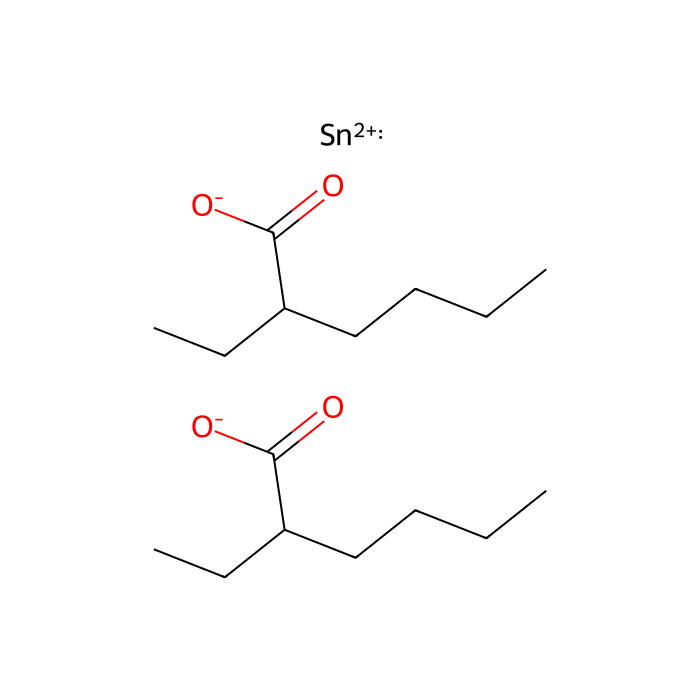
Tin 2-ethylhexanoate - ≥95% , CAS No.301-10-0

CAS: 301-10-0 Cat. No.: T100108 Summenformel: C16H30O4Sn Molekulargewicht: 405.12 EG-Nummer: 206-108-6 PubChem CID: 9318
Zu bestellen verfügbar
GRADE & PURITY ≥95%
Synonyms
SCHEMBL161914 | Stannous 2-ethylhexanoate | UNII-519A78R12Y | T-9 | Tin bis(2-ethylhexanoate) | 2-Ethylhexanoic acid tin(II) salt | EINECS 206-108-6 | Tin di(2-ethylhexanoate) | T3149 | Tin dioctoate | NSC 75857 | Tin ethylhexanoate | 2-Ethylhexanoic acid
Storage
Room temperature,Argon charged,Desiccated
Shipped In
FedEx DG Service
★
Size
Deutschland (EU)
USA*
Price
Qty
25g
T100108-25g
—
Auf Lager ≥10
8,59€
100g
T100108-100g
4 Auf Lager
6 Auf Lager
22,47€
500g
T100108-500g
1 Auf Lager
3 Auf Lager
72,80€
Enter a quantity for the sizes you want to add.
🧪
Why this grade

≥95% for sensitive chromatographic and analytical workflows requiring minimal baseline interference.

🌡

Storage & shipping

Room temperature,Argon charged,Desiccated Ships FedEx DG Service Check lot-specific COA for exact specifications.

📋

Quality documents

SDS, COA, datasheet, and spec sheet available for download. Lot-specific COA accessible via lot number lookup.

📚

Literature proof

Cited in 408 peer-reviewed publications across chromatography, organic synthesis, and cross-coupling reactions.

Übersicht

Product Description:

An intermediate. Polymerization catalyst for urethane foams, lubricant, addition agent, stabiliser for transformer oils

A catalyst for polylactide polymerization.


Product Application:

Tin(II) 2-ethylhexanoate is commonly used as a catalyst for the ring-opening polymerization of cyclic diesters such as L-lactide and glycolide to form high-molecular-weight polymers

Tin(II) 2-ethylhexanoate is used as a polymerization initiator in polylactic acid production. It acts as an intermediate as well as a catalyst for urethane foams, a lubricant, addition agent and a stabilizer for transformer oils.

Specifications

Synonyme
SCHEMBL161914 | Stannous 2-ethylhexanoate | UNII-519A78R12Y | T-9 | Tin bis(2-ethylhexanoate) | 2-Ethylhexanoic acid tin(II) salt | EINECS 206-108-6 | Tin di(2-ethylhexanoate) | T3149 | Tin dioctoate | NSC 75857 | Tin ethylhexanoate | 2-Ethylhexanoic acid
Spezifikationen & Reinheit
≥95%
Storage
Room temperature,Argon charged,Desiccated
Verschickt in
FedEx DG Service
Reinheit
≥95%
Namen und Kennungen
Pubchem Sid
Pubchem Sid Url
https://pubchem.ncbi.nlm.nih.gov/substance/488180967
Kanonisches Lächeln
CCCCC(CC)C(=O)[O-].CCCCC(CC)C(=O)[O-].[Sn+2]
IUPAC Name
2-ethylhexanoate;tin(2+)
InChIKey
KSBAEPSJVUENNK-UHFFFAOYSA-L
INCHI
1S/2C8H16O2.Sn/c2*1-3-5-6-7(4-2)8(9)10;/h2*7H,3-6H2,1-2H3,(H,9,10);/q;;+2/p-2
Isomere SMILES
CCCCC(CC)C(=O)[O-].CCCCC(CC)C(=O)[O-].[Sn+2]
WGK Deutschland
1
RTECS
MO7870000
PubChem CID
9318
Molekulargewicht
405.12
Reaxy-Rn
14203375

Documentation

📋 Safety Data Sheet (SDS)

Comprehensive hazard, handling, storage, and regulatory compliance document.

Download SDS →

✅ Certificate of Analysis (COA)

Lot-specific quality data. Enter your lot number to retrieve the exact COA.

Look up COA →

📊 Datasheet

Quick-reference summary of product specifications and applications.

View datasheet →

🔬 Specification Sheet

Full quality attributes and acceptance criteria for this grade.

View spec sheet →

Advanced Data

Taxonomic Classification

Taxonomy Tree

KingdomOrganic compounds
SuperclassLipids and lipid-like molecules
KlasseFatty Acyls
SubclassFatty acids and conjugates
Intermediate Tree Nodes Not available
Direct ParentMedium-chain fatty acids
Alternative Parents Branched fatty acids  Carboxylic acid salts  Monocarboxylic acids and derivatives  Carboxylic acids  Organic salts  Organic oxides  Hydrocarbon derivatives  Carbonyl compounds  
Molecular FrameworkNot available
Substituents Medium-chain fatty acid - Branched fatty acid - Carboxylic acid salt - Monocarboxylic acid or derivatives - Carboxylic acid - Carboxylic acid derivative - Organic oxygen compound - Organic oxide - Hydrocarbon derivative - Organic salt - Organooxygen compound - Carbonyl group - Aliphatic acyclic compound
BeschreibungThis compound belongs to the class of organic compounds known as medium-chain fatty acids. These are fatty acids with an aliphatic tail that contains between 4 and 12 carbon atoms.
External Descriptors Not available
3D-Struktur
Interaktives chemisches Strukturmodell


Zertifikate (CoA, COO, BSE/TSE und Analyse-Diagramm)
C of A & Other Certificates(BSE/TSE, COO):
Analytical Chart:

Find and download the COA for your product by matching the lot number on the packaging.

49 results found

Lot NumberCertificate TypeDatumArtikel
A2305105Certificate of AnalysisSep 22, 2026 T100108
K2217203Certificate of AnalysisSep 04, 2026 T100108
G2620471Certificate of AnalysisJul 09, 2026 T100108
G2620467Certificate of AnalysisJul 09, 2026 T100108
G2620469Certificate of AnalysisJul 09, 2026 T100108
G2629701Certificate of AnalysisJul 09, 2026 T100108
J2530595Certificate of AnalysisOct 13, 2025 T100108
J2530594Certificate of AnalysisOct 13, 2025 T100108
J2530686Certificate of AnalysisOct 13, 2025 T100108
G2601134Certificate of AnalysisOct 13, 2025 T100108
J2530687Certificate of AnalysisOct 13, 2025 T100108
L2512102Certificate of AnalysisMar 03, 2025 T100108
C2518620Certificate of AnalysisMar 03, 2025 T100108
C2518597Certificate of AnalysisMar 03, 2025 T100108
C2518596Certificate of AnalysisMar 03, 2025 T100108
C2518595Certificate of AnalysisMar 03, 2025 T100108
K2422362Certificate of AnalysisMay 18, 2023 T100108
K2418009Certificate of AnalysisMay 18, 2023 T100108
F2306677Certificate of AnalysisMay 18, 2023 T100108
H2422131Certificate of AnalysisMay 18, 2023 T100108
F2306680Certificate of AnalysisMay 18, 2023 T100108
F2306679Certificate of AnalysisMay 18, 2023 T100108
F2306678Certificate of AnalysisMay 18, 2023 T100108
J2412068Certificate of AnalysisMay 18, 2023 T100108
A2419057Certificate of AnalysisMay 18, 2023 T100108
C2506206Certificate of AnalysisMay 18, 2023 T100108
C2407297Certificate of AnalysisMay 18, 2023 T100108
B2514061Certificate of AnalysisMay 18, 2023 T100108
F2306676Certificate of AnalysisMay 18, 2023 T100108
B2318762Certificate of AnalysisFeb 02, 2023 T100108
B2318728Certificate of AnalysisFeb 02, 2023 T100108
B2318742Certificate of AnalysisFeb 02, 2023 T100108
B2318725Certificate of AnalysisFeb 02, 2023 T100108
B2318723Certificate of AnalysisFeb 02, 2023 T100108
H2520138Certificate of AnalysisFeb 02, 2023 T100108
B2318743Certificate of AnalysisFeb 02, 2023 T100108
A2630022Certificate of AnalysisFeb 02, 2023 T100108
B2302331Certificate of AnalysisJun 17, 2022 T100108
J2211184Certificate of AnalysisJun 17, 2022 T100108
K2218077Certificate of AnalysisJun 17, 2022 T100108
A2310409Certificate of AnalysisJun 17, 2022 T100108
J2211186Certificate of AnalysisJun 17, 2022 T100108
J2211185Certificate of AnalysisJun 17, 2022 T100108
J2211183Certificate of AnalysisJun 17, 2022 T100108
B2217098Certificate of AnalysisFeb 22, 2022 T100108
D2211009Certificate of AnalysisNov 22, 2021 T100108
D2211015Certificate of AnalysisNov 22, 2021 T100108
D2211019Certificate of AnalysisNov 22, 2021 T100108
D2211023Certificate of AnalysisNov 22, 2021 T100108
Chemische und physikalische Eigenschaften
LöslichkeitMiscible with water.
EmpfindlichkeitMoisture sensitive;air sensitive
Brechungsindex1.493
Flammpunkt (°F)230°F
Flammpunkt (°C)113°C
Molekulargewicht405.100 g/mol
XLogP3
Hydrogen Bond Donor Count0
Hydrogen Bond Acceptor Count4
Rotatable Bond Count8
Exact Mass406.117 Da
Monoisotopic Mass406.117 Da
Topological Polar Surface Area80.300 Ų
Heavy Atom Count21
Formal Charge0
Complexity93.900
Isotope Atom Count0
Defined Atom Stereocenter Count0
Undefined Atom Stereocenter Count2
Defined Bond Stereocenter Count0
Undefined Bond Stereocenter Count0
The total count of all stereochemical bonds0
Covalently-Bonded Unit Count3
FAQs und Artikel
Post-Transition Metals and Their Salts: A Classification Guide from Definitions to Value-Chain Applications (Including Product Lists in Tables 1–4)
Adding a Temperature-Triggered Switch to NCO: How Blocked Isocyanates Affect the Storage, Curing, and Film Performance of 1K Baking Coatings
Fluorocarbon Resin Coating Formulation Design: Resin Selection, Supporting Systems, and Key Application Control Points
1K, 2K, Waterborne, Moisture-Curing, and Blocked Systems: Classification Logic and Identification Methods for Polyurethane Coating Curing Systems
Key Control Points in Polyurethane Coating Formulation Design and Application
Silicone Resin Coating Formulation Design: From Application Conditions to Matching Resins, Pigments and Fillers, Curing, and Substrates
When Should You Choose Silicone Resin? Selection Comparison with Epoxy, Acrylic, Polyurethane, Fluororesin, and Other Coating Resins
Mechanisms and Control of Coating Yellowing: From Chromophoric Structure Formation to Source Diagnosis and Formulation Optimization
Bismuth Carboxylate Catalysts for Polyurethane Curing: Structural Features, Catalytic Mechanism, and Cure Control
Zinc–Bismuth Composite Catalysts for Polyurethane: Cure Control, Selection Methods, and Blend-Ratio Design
Structure, Degradation Behavior, and Applications of Poly(trimethylene carbonate) (PTMC) in Flexible Absorbable Materials
Differences Between Cast CPU and Thermoplastic TPU in Structure, Processing, Performance, and Applications
Citations of This Product
Lösungsrechner
Bewertungen

Kundenbewertungen

Shall we send you a message when we have discounts available?

Remind me later

Thank you! Please check your email inbox to confirm.

Oops! Notifications are disabled.