Determine the necessary mass, volume, or concentration for preparing a solution.
≥95% for sensitive chromatographic and analytical workflows requiring minimal baseline interference.
Room temperature,Argon charged,Desiccated Ships Normal Check lot-specific COA for exact specifications.
SDS, COA, datasheet, and spec sheet available for download. Lot-specific COA accessible via lot number lookup.
Cited in 0 peer-reviewed publications across chromatography, organic synthesis, and cross-coupling reactions.
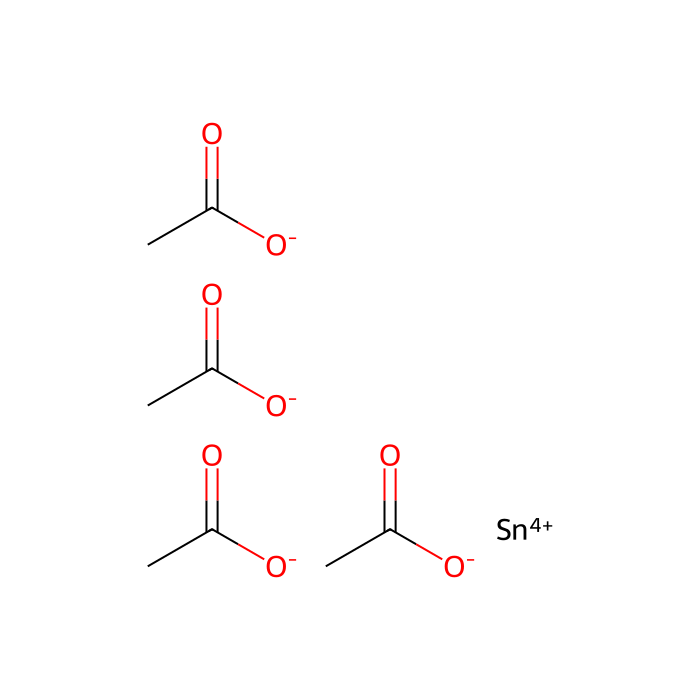
Tin(IV) acetate is used to prepare tin-based oxides (Sn-Zn-P-O), which is a negative electrodes for rechargeable lithium batteries.
Comprehensive hazard, handling, storage, and regulatory compliance document.
Download SDS →Lot-specific quality data. Enter your lot number to retrieve the exact COA.
Look up COA →Full quality attributes and acceptance criteria for this grade.
View spec sheet →Taxonomy Tree
| Kingdom | Organic compounds |
|---|---|
| Superclass | Organic acids and derivatives |
| Klasse | Carboxylic acids and derivatives |
| Subclass | Carboxylic acid derivatives |
| Intermediate Tree Nodes | Carboxylic acid salts |
| Direct Parent | Acetate salts |
| Alternative Parents | Monocarboxylic acids and derivatives Carboxylic acids Organic tin salts Organic oxides Hydrocarbon derivatives Carbonyl compounds |
| Molecular Framework | Not available |
| Substituents | Acetate salt - Monocarboxylic acid or derivatives - Carboxylic acid - Organic oxygen compound - Organic oxide - Hydrocarbon derivative - Organic tin salt - Organic salt - Organooxygen compound - Carbonyl group - Aliphatic acyclic compound |
| Beschreibung | This compound belongs to the class of organic compounds known as acetate salts. These are organic compounds containing acetic acid as its acid component. |
| External Descriptors | Not available |
Find and download the COA for your product by matching the lot number on the packaging.
| Lot Number | Certificate Type | Datum | Artikel |
|---|---|---|---|
| Certificate of Analysis | Jun 24, 2026 | T303317 | |
| Certificate of Analysis | Jun 24, 2026 | T303317 | |
| Certificate of Analysis | Mar 18, 2026 | T303317 | |
| Certificate of Analysis | Mar 18, 2026 | T303317 | |
| Certificate of Analysis | Mar 18, 2026 | T303317 | |
| Certificate of Analysis | Mar 08, 2025 | T303317 | |
| Certificate of Analysis | Jul 31, 2024 | T303317 | |
| Certificate of Analysis | Jan 11, 2024 | T303317 | |
| Certificate of Analysis | Jan 11, 2024 | T303317 | |
| Certificate of Analysis | Jan 11, 2024 | T303317 | |
| Certificate of Analysis | Jun 05, 2023 | T303317 |
| Löslichkeit | Soluble in acetone and benzene. |
|---|---|
| Empfindlichkeit | Moisture sensitive |
| Schmelzpunkt (°C) | 232-233 °C (lit.) |
| Molekulargewicht | 354.890 g/mol |
| XLogP3 | |
| Hydrogen Bond Donor Count | 0 |
| Hydrogen Bond Acceptor Count | 8 |
| Rotatable Bond Count | 0 |
| Exact Mass | 355.955 Da |
| Monoisotopic Mass | 355.955 Da |
| Topological Polar Surface Area | 161.000 Ų |
| Heavy Atom Count | 17 |
| Formal Charge | 0 |
| Complexity | 25.500 |
| Isotope Atom Count | 0 |
| Defined Atom Stereocenter Count | 0 |
| Undefined Atom Stereocenter Count | 0 |
| Defined Bond Stereocenter Count | 0 |
| Undefined Bond Stereocenter Count | 0 |
| The total count of all stereochemical bonds | 0 |
| Covalently-Bonded Unit Count | 5 |