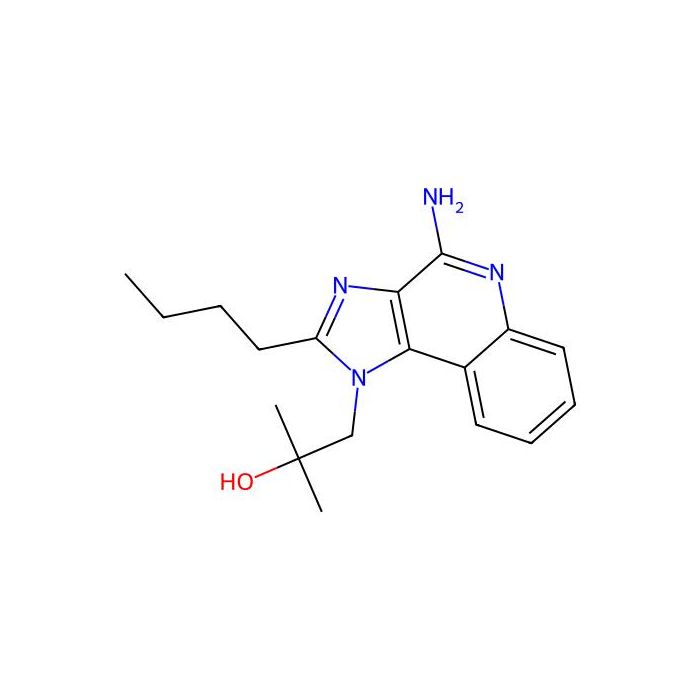
TLR7 agonist 3 (Compound 2) is a potent agonist of toll-like receptor 7 (TLR7). TLR7 has an important role in immune activation processes and represents an emerging agent discovery target for the development of immunomodulators
Form:Solid
IC50& Target:TLR7
Spezifikationen
Spezifikationen & Reinheit
≥98%
Biochemische und physiologische Mechanismen
TLR7 agonist 3 (Compound 2) is a potent agonist of toll-like receptor 7 (TLR7). TLR7 has an important role in immune activation processes and represents an emerging agent discovery target for the development of immunomodulators.
Storage
Store at -20°C
Verschickt in
Ice chest + Ice pads
Dieses Produkt erfordert Kühlkettenversand. Grundversand und andere Economy-Optionen sind nicht verfügbar.
This compound belongs to the class of organic compounds known as imidazoquinolines. These are aromatic heterocyclic compounds containing an imidazole ring fused to a quinoline ring system. In some configurations, the imidazole ring shares a nitrogen atom with the quinoline moiety.
External Descriptors
Not available
1. Djoumbou Feunang Y, Eisner R, Knox C, Chepelev L, Hastings J, Owen G, Fahy E, Steinbeck C, Subramanian S, Bolton E, Greiner R, and Wishart DS. ClassyFire: Automated Chemical Classification With A Comprehensive, Computable Taxonomy. Journal of Cheminformatics, 2016, 8:61.
Zertifikate (CoA, COO, BSE/TSE und Analyse-Diagramm)
C of A & Other Certificates(BSE/TSE, COO):
Analytical Chart:
Chemische und physikalische Eigenschaften
Löslichkeit
DMSO : 100 mg/mL (320.09 mM; Need ultrasonic)
Molekulargewicht
312.4
XLogP3
3.000
Hydrogen Bond Donor Count
2
Hydrogen Bond Acceptor Count
4
Rotatable Bond Count
5
Exact Mass
312.195 Da
Monoisotopic Mass
312.195 Da
Topological Polar Surface Area
77.000 Ų
Heavy Atom Count
23
Formal Charge
0
Complexity
402.000
Isotope Atom Count
0
Defined Atom Stereocenter Count
0
Undefined Atom Stereocenter Count
0
Defined Bond Stereocenter Count
0
Undefined Bond Stereocenter Count
0
The total count of all stereochemical bonds
0
Covalently-Bonded Unit Count
1
Lösungsrechner
Molarity Calculator
Determine the necessary mass, volume, or concentration for preparing a solution.
Dilution Calculator
Determine the dilution needed to prepare a stock solution.
Reconstitution Calculator
Bewertungen
Kundenbewertungen
Application Protocols
Only information from the product data may be reported here.
Tested/validated applications: Not specified for this item.
Recommended working concentrations, positive controls, and assay conditions: Not specified for this item.
Users should consult the primary literature and develop lab-specific protocols appropriate to their models and readouts. Always include vehicle controls and verify solubility and stability under assay conditions.
Biological Roles
Contextual overview of TLR7 agonists in research (literature; not item-specific claims).
Target/pathway:Toll-like receptor 7 (TLR7) is an endosomal pattern-recognition receptor that senses single-stranded RNA and certain small-molecule mimetics. Activation recruits MyD88, leading to IRAK/TRAF signaling and downstream NF-κB and IRF7 activation.
Cellular outcomes: Induction of type I interferon programs and proinflammatory cytokines/chemokines in plasmacytoid dendritic cells, B cells, monocytes/macrophages, and other immune cells in a context-dependent manner.
Key considerations: Species differences exist in TLR7/8 pharmacology; some agonists show differential activity in human vs murine systems. Endosomal acidification is typically required for optimal signaling; inhibitors of acidification can attenuate responses.
Research applications: Pathway mapping, innate immune stimulation controls, adjuvant mechanism studies, and evaluation of TLR7–MyD88–IRF/NF-κB crosstalk. In combination studies, TLR7 agonists are often paired with TLR3/4/9 ligands to dissect selectivity and synergy.
Important usage notes
Use vehicle controls and include TLR7-deficient cells or pathway inhibitors where possible to attribute on-target effects (literature best practice).
Potency, efficacy, and selectivity of this specific SKU are not specified in the catalog record; consult primary literature and perform in-house benchmarking.
Buffer Applications
This product is a small-molecule agonist, not a buffering agent. Therefore, buffer preparation guidance is generally not applicable.
Practical notes for assay buffers (general, non-item-specific)
Use physiologically compatible buffers (e.g., PBS, HBSS, or cell culture media) and maintain low final DMSO content to ensure cell viability.
Include serum/BSA as appropriate to reduce nonspecific adsorption and precipitation; pre-wet plastics when working at low nanomole quantities.
Item-specific buffer-related specifications: Not specified for this item; refer to CoA/Spec Sheet.
Green Alternatives
As a research small molecule (not a solvent or process reagent), “green alternatives” pertain mainly to solvent choice and waste minimization during handling and analytics.
Greener handling strategies (general)
Prefer DMSO over higher-toxicity dipolar aprotics where feasible; minimize stock concentration/volume to reduce waste.
Use microscale screening formats (96/384-well) to limit chemical consumption and solvent waste.
Choose acetonitrile–water systems with volatile buffers for LC where compatible, enabling easier solvent recovery.
Employ closed, low-dead-volume vials and caps to reduce evaporative losses and operator exposure.
Trade-offs
Higher stock concentrations reduce shipping volume and waste but may increase precipitation risk on dilution; validate solubility.
Switching from DMF/NMP to DMSO may impact solubility for certain scaffolds; small pre-tests are recommended.
Note: No greener “alternative agonist” is asserted for this specific SKU; selection of different TLR7 agonists should be guided by potency, selectivity, and assay compatibility rather than environmental metrics alone.
Pharmaceutical Uses
No pharmacopeial or excipient information is provided for this SKU. This product is supplied for research use only and is not intended for human or veterinary use.
Formulation/excipient status: Not specified for this item; refer to CoA/Spec Sheet.
Manufacturing/CMC context (general): For research prototyping, small-molecule TLR7 agonists are sometimes formulated into DMSO or cyclodextrin vehicles for in vitro studies. Such practices are investigational and remain outside clinical or GMP use.
Do not infer therapeutic suitability or clinical performance from this catalog listing.
Physical Properties
Item-specific physical constants are not provided in the catalog record.
Appearance: Not specified for this item; refer to CoA/Spec Sheet.
Melting point / Boiling point / Density / Refractive index: Not specified for this item; refer to CoA/Spec Sheet.
Solubility (item-specific): Not specified for this item; refer to CoA/Spec Sheet.
General laboratory handling properties for small-molecule TLR7 agonists (literature/class guidance; not specifications)
Often supplied as crystalline solids or powders that are sparingly soluble in water but readily soluble in DMSO and DMF; limited solubility in alcohols depends on substitution.
Aqueous work typically uses DMSO stock solutions followed by dilution into buffered media (e.g., PBS or culture media) to a final DMSO concentration ≤0.1–0.5% v/v to maintain cell compatibility (literature practice).
pKa/logP are scaffold-dependent; many analogs are weak bases with moderate lipophilicity to support endosomal access.
Practical notes (general)
Prepare a 10–50 mM DMSO stock for screening panels; verify solubility visually and by serial dilution. If precipitation occurs on aqueous dilution, add slowly with mixing or use co-solvents/surfactants compatible with the assay.
For analytical characterization, reverse-phase HPLC with acidified mobile phases (e.g., 0.1% formic acid) and LC–MS are commonly used for purity/identity confirmation.
Quality and Grades
Item-specific quality attributes are limited in the catalog entry.
Grade/Purity: Not specified for this item; refer to CoA/Spec Sheet.
Stabilizers/Antioxidants: Not specified for this item; refer to CoA/Spec Sheet.
Interpretation and implications
When grade/purity are unspecified, Aladdin Scientific recommends consulting the Certificate of Analysis (CoA) for batch-specific purity (e.g., HPLC area %), water content, residual solvents, and identity confirmation (NMR, LC–MS, HRMS).
For screening applications, purity ≥95% (HPLC) is typically preferred to minimize off-target effects from impurities; if quantitative SAR is required, ≥98% is advisable (general guidance).
If UV transparency or low absorbance is required for biochemical readouts, verify chromatographic baselines and impurity profiles on the CoA.
If the compound is salt-form dependent, check the CoA for counterion identity and content; counterions can affect solubility and apparent potency.
Documentation
Request batch documents: CoA, Spec Sheet, and SDS. These documents supersede catalog narratives for specifications.
Quality control suggestions (general)
Upon receipt, perform an incoming QC check (LC–MS retention time and m/z; quick HPLC purity scan) to confirm lot consistency before large screening campaigns.
Reaction and Applications
This compound is supplied as a bioactive small molecule (TLR7 agonist) and is not typically used as a synthetic reagent or catalyst.
Synthetic reaction families (e.g., cross-coupling, Grignard) are not generally applicable to the use-phase of this SKU.
If custom analog synthesis is intended, consult primary literature on scaffold-specific heteroaryl functionalization (e.g., halogenation, N-oxidation/reduction, SNAr, and palladium-catalyzed aryl/alkyl couplings). These are general routes for related chemotypes and are not item-specific.
Employed as a tool agonist in studies of innate immune signaling via Toll-like receptor 7 in immune cell models (e.g., reporter lines, primary cells) and in biochemical pathway interrogation. See Biological Roles for mechanistic detail.
Item-specific manufacturer applications: Not provided in the catalog entry.
Reaction Conditions
Not typically applicable. This SKU is not used as a reagent or catalyst, so preparative “reaction conditions” are not relevant to end-use.
General note (for those synthesizing analogs; literature)
Cross-couplings on halogenated heteroarenes: Pd(0)/phosphine catalysts in toluene/1,4-dioxane or DMF at 60–110°C; bases such as K2CO3/Cs2CO3.
Nucleophilic substitutions on activated positions: polar aprotic solvents (DMSO/DMF), 20–80°C.
Always tailor conditions to the specific scaffold and functional-group tolerance.
Item-specific reaction or processing conditions: Not specified for this item; refer to CoA/Spec Sheet.
Safety and Handling
Safety information specific to this SKU is not fully provided; consult the SDS for authoritative guidance.
GHS Classification / Signal Word / H-Statements / Pictograms: Not specified for this item; refer to SDS.
General hazard profile (class-based): Small-molecule TLR7 agonists can be biologically active and may cause irritation or adverse effects upon skin, eye, or respiratory exposure. Avoid inhalation of dusts and contact with skin/eyes. Treat as a potentially harmful laboratory chemical.
Handling and PPE
Work in a fume hood; avoid aerosol/dust generation. Wear lab coat, nitrile gloves, and splash goggles. Change gloves regularly and after contamination.
Use dedicated tools to prevent cross-contamination of screening libraries.
First aid (general)
Skin/eye contact: Rinse with water for ≥15 minutes; remove contaminated clothing. Seek medical attention if irritation persists.
Inhalation: Move to fresh air; seek medical attention if symptoms occur.
Ingestion: Rinse mouth; do not induce vomiting; obtain medical advice.
Storage and incompatibilities
Storage (item-specific): Store at −20°C (per product data). Keep container tightly closed, desiccated, and protected from light.
Avoid strong oxidizers and acids/bases that may degrade heteroaromatic amines (general).
Waste
Dispose as organic hazardous waste per institutional and local regulations.
Note: This material is supplied for research use only. No medical, diagnostic, or therapeutic applications are intended or implied.
Solvent Selection
This product is a small-molecule agonist rather than a process solvent. Solvent selection here refers to dissolving the analyte for assays and analytics.
General guidance (literature/class-based)
Primary stock solvent: DMSO is the standard due to broad solvency and assay compatibility.
Alternatives: DMF, NMP for challenging scaffolds; ethanol or methanol for less polar analogs. For aqueous work, dilute the organic stock into buffer/media with vigorous mixing.
Aqueous compatibility: Limit final DMSO to ≤0.1–0.5% v/v in cell assays to reduce solvent effects (typical practice).
Small comparison (general)
DMSO: Excellent solvency; miscible with water; low volatility; may affect some readouts at >0.5%.
DMF/NMP: High solvency; more hygroscopic; consider cytotoxicity; harder to remove.
EtOH/MeOH: Easier to evaporate; lower solvency for some heteroaromatics; flammable.
Analytical solvents
LC–MS: Water/acetonitrile or water/methanol with 0.1% formic acid or ammonium formate buffers are commonly used.
Item-specific solubility or solvent preferences: Not specified for this item; refer to CoA/Spec Sheet.
Storage and Reconstitution
Storage and logistics (item-specific)
Storage Conditions: Store at −20°C (per product data). Keep tightly closed, dry, and protected from light.
Shipping: Shipped on cold packs (ice chest + ice pads) to maintain stability.
Reconstitution (general guidance; not a specification)
For most small-molecule screening compounds, prepare a concentrated DMSO stock (e.g., 10–50 mM). Vortex and, if needed, gently warm to ambient to assist dissolution. Avoid prolonged heating.
If sterile solutions are required, pass through a 0.22 µm PTFE or PVDF syringe filter into sterile vials. Verify material compatibility.
Aliquot stocks to single-use volumes to minimize freeze–thaw cycles. Store aliquots at −20°C in amber vials.
Upon dilution into aqueous buffers/media, add the DMSO stock slowly with mixing to prevent precipitation. Use promptly after dilution.
Stability notes
Item-specific stability, hygroscopicity, and light sensitivity are not specified; handle conservatively by limiting exposure to air and moisture and by protecting from light. Check solution stability by LC–MS or HPLC if solutions are stored for extended periods.
Research use only: Not for human or veterinary use.
Structure and Identity
Concise identity summary based on the available catalog data and general class knowledge.
Product Name: TLR7 agonist 3 (research chemical)
CAS: 1229024-78-5
PubChem CID: 21470208
InChIKey: 103169 (as provided; note: typical InChIKeys are 27 characters; verify on CoA/SDS)
SMILES: Not specified for this item; refer to CoA/Spec Sheet.
Molecular Formula: Not specified for this item; refer to CoA/Spec Sheet.
Molecular Weight: Not specified for this item; refer to CoA/Spec Sheet.
Structural features
Item-specific functional groups, heterocycles, and stereochemistry: Not specified for this item; refer to CoA/Spec Sheet.
General class note (literature): Small-molecule TLR7 agonists frequently feature heteroaromatic systems (e.g., imidazo[4,5-c]quinolines, purine/guanosine mimetics, or bicyclic aza-arenes) designed to engage endosomal TLR7 via hydrogen bonding and π–π/heteroatom interactions. Substituent patterns modulate species selectivity (TLR7 vs TLR8) and potency.
2D structural description (general for the class; not item-specific)
Typical motifs include a fused bicyclic aromatic or heteroaromatic core bearing exocyclic amines or alkyl/aryl substituents that tune basicity and lipophilicity for endosomal uptake. Exact substitution and stereochemistry for this SKU are not provided in the product data.
Synthetic Utility
As sold, this compound is intended as a bioactive tool molecule, not a synthetic building block. Synthetic utility is limited unless one is derivatizing the scaffold for SAR.
General synthetic considerations for related chemotypes (literature; not item-specific)
Fused or bicyclic aza-aromatic cores can be accessed by annulation strategies, followed by electrophilic halogenation to create handles for Pd-catalyzed cross-coupling (Suzuki, Buchwald–Hartwig, Negishi) to diversify aryl/alkyl substituents.
N-oxidation/reduction and SNAr on activated heteroaryl positions provide entry to amine/alkoxy variants that tune TLR7 bias and solubility.
Late-stage diversification with sulfonylation, acylation, or urea formation can modulate basicity and PK-relevant properties.
If custom analogs or linkers are desired (e.g., for probes), confirm the location of metabolic soft spots and maintain features needed for endosomal engagement, then apply chemoselective transformations accordingly.
Target Specificity
Only information from the product data may be reported here.
Target-related data: Not specified for this item; refer to CoA/Spec Sheet.
Note: The product name suggests TLR7 agonism, but no validated target selectivity, species reactivity, or potency data are provided in the catalog entry.
Häufig gestellte Fragen
What is the purity of this product?
This product is supplied at ≥98% purity (chemical assay). Lot-specific values are stated on the Certificate of Analysis.
How should this product be stored?
Store at ?20 °C. Freezer storage is required to maintain the specified shelf life.
How is this product shipped?
This product ships in an insulated container with ice pads. Unpack on arrival and transfer it to the storage condition stated above.
What are the CAS number, molecular formula and molecular weight?
The CAS Number is 1229024-78-5, the molecular formula is C18H24N4O, and the molecular weight is 312.41 g/mol. InChIKey GITVQUOQRHRGQQ-UHFFFAOYSA-N.
What documentation is provided?
Available product documentation, including Certificates of Analysis (COA), Safety Data Sheets (SDS), and specification sheets, is shown in the product document area. Document availability and access follow the current site policy.
Wir verwenden Cookies, um die ordnungsgemäße Funktion der Website sicherzustellen und, soweit zulässig, Ihr Nutzererlebnis zu verbessern. Sie können Ihre Einstellungen jederzeit unter „Einstellungen“ verwalten. Weitere Informationen finden Sie in unserer Cookie-Richtlinie.
Dürfen wir Sie über Rabattaktionen informieren?
Später erinnern
Vielen Dank! Bitte überprüfen Sie Ihren E-Mail-Posteingang, um zu bestätigen.
Products are supplied to verified businesses, institutions, and qualified professionals for research and development use only. Not for use in humans, animals, diagnosis, or therapy.