QUALITÄT & REINHEITCarrier Free?Carrier-free — supplied without added carrier protein/stabilizer. Use when carriers (e.g. BSA) would interfere with conjugation or sensitive assays.ExactAb™?ExactAb™ — Aladdin's antibody line emphasizing precision and validated quality. Use for reliable, specificity-validated antibody applications.Validated?Validated grade — performance confirmed in defined applications before release. Use when you want documented assurance the reagent works as stated.High Performance?High-performance grade with optimized purity and performance characteristics. Use for sensitive analyses where ordinary grades fall short.See COA
Carrier Free, ExactAb™, Validated, High Performance, See COA Carrier Free,ExactAb™,High Performance,Validated für empfindliche chromatographische und analytische Workflows, die minimale Basislinieninterferenzen erfordern.
🌡
Lagerung & Versand
Store at -20°C,Avoid repeated freezing and thawing Versand Ice chest + Ice pads. Genaue Spezifikationen finden Sie im chargenspezifischen COA.
📋
Qualitätsdokumente
SDS, COA, Datenblatt und Spezifikationsblatt stehen zum Download bereit. Chargenspezifische COA über Chargennummernsuche abrufbar.
📚
Literaturbeleg
In 0 peer-reviewten Publikationen zu Chromatographie, organischer Synthese und Kreuzkupplungsreaktionen zitiert.
Übersicht
Rabbit anti Human TLR8 Antibody, Polyclonal, could be used for WB, IHC, ICC, IF and so on. Application: WB: 0.01-2µg/mL IHC: 5-20µg/mL ICC/IF: 5-20µg/mL Protein Function Key component of innate and adaptive immunity. TLRs (Toll-like receptors) control host immune response against pathogens through recognition of molecular patterns specific of microorganisms. Acts via MYD88 and TRAF6, leading to NF-kappa-B activation, cytokine secretion and the inflammatory response.
Spezifikationen
Product Name
TLR8 Antibody - Primärer Antikörper, specific to TLR8, Rabbit IgG
Carrier Free, ExactAb™, Validated, High Performance, See COA
Wirtsspezies
Kaninchen
Spezifität
TLR8
Immunogen
Recombinant TLR8 expressed in E.coli (AA 844-1039)
Positive Kontrolle
WB: HeLa, Hep G2, NIH/3T3 and C6 cell lysates. IHC: Human spleen, colon tissues. ICC/IF: HeLa cells.
Konjugation
Unconjugated
Note
Carrier Free, ExactAb™, High Performance, Validated
Isotyp
Rabbit IgG
SDS-PAGE
150 kDa
Verfahren zur Reinigung
Antigen affinity purified + Protein A purified
Konzentration
See COA
Product Line
Biologische Produkte
Lagerung und Versand
Form
Liquid
Storage
Store at -20°C,Avoid repeated freezing and thawing
Verschickt in
Ice chest + Ice pads
Stabilität und Lagerung
Store at 4℃ short term (1-2 weeks). Store at -20℃ long term (24 months). Upon receipt, it is recommended to aliquot. Avoid freeze/thaw cycle.
Bilder
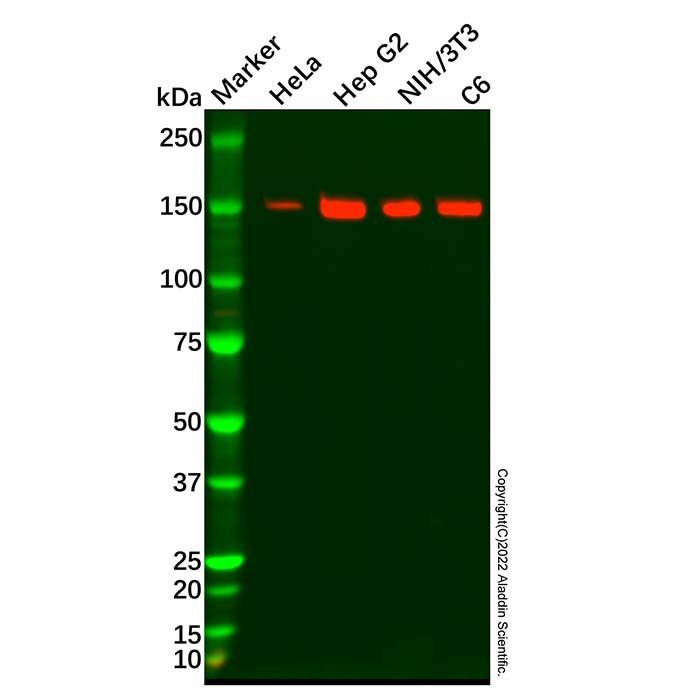
TLR8 Antibody (Ab131537) - Western Blot All lanes: TLR8 Antibody (Ab131537) at 1/1000 dilution Samples: Lysates at 20 µg per lane Secondary: Goat Anti-Rabbit IgG H&L (HRP) (Ab170144) at 1/20000 dilution
Predicted band size: 121 kDa Observed band size: 150 kDa Exposure time: 60.0 s
TLR8 Antibody (Ab131537) - IF/ICC FITC staining on IF Sample: Human HeLa cell Primary Ab: 20 μg/mL TLR8 Antibody (Ab131537) Second Ab: 2 μg/mL FITC-Linked Caprine Anti-Rabbit IgG Polyclonal Antibody.
TLR8 Antibody (Ab131537) - IHC DAB staining on IHC Samples: Human Spleen Tissue Primary Ab: 20 μg/mL TLR8 Antibody (Ab131537) Second Ab: 2 µg/mL HRP-Linked Caprine Anti-Rabbit IgG Polyclonal Antibody.
TLR8 Antibody (Ab131537) - IHC DAB staining on IHC Samples: Human Colon Tissue Primary Ab: 20 μg/mL TLR8 Antibody (Ab131537) Second Ab: 2 µg/mL HRP-Linked Caprine Anti-Rabbit IgG Polyclonal Antibody.
Anwendung
Anwendung
Dilution info
IHC
5-20 µg/mL
WB
0.01-2 µg/mL
IF/ICC
5-20 µg/mL
Dokumentation
📋 Sicherheitsdatenblatt (SDS)
Umfassendes Dokument zu Gefahren, Handhabung, Lagerung und Einhaltung regulatorischer Vorschriften.
Determine the necessary mass, volume, or concentration for preparing a solution.
Dilution Calculator
Determine the dilution needed to prepare a stock solution.
Reconstitution Calculator
Bewertungen
Kundenbewertungen
Application Protocols
Item-specific facts (from Product Data)
Tested applications, recommended dilutions, positive controls, antigen retrieval, fixation/permeabilization conditions: Not specified for this item; refer to CoA/Spec Sheet.
General workflow suggestions (informational; adapt to your system)
Western blot: Use RIPA or mild lysis buffers; enrich membrane fractions if probing TLR8. Validate transfer efficiency for high-MW and membrane proteins.
Immunofluorescence/IHC: Optimize fixation (PFA 4% or methanol), permeabilization (0.1–0.5% saponin/Triton), and antigen retrieval as required. Include isotype and no-primary controls.
Flow cytometry: For intracellular epitopes, apply fixation/permeabilization kits compatible with endosomal proteins; titrate antibody to minimize background.
ELISA/IP: Employ high-quality blocking buffers; for IP of endosomal proteins, gentle lysis and endosomal enrichment may improve yield.
Always follow the CoA/SDS for item-specific instructions once available.
Biological Roles
General background on TLR8 (literature; not product-specific)
Function: Toll-like receptor 8 (TLR8) is a pattern-recognition receptor localized predominantly to endosomes, recognizing single-stranded RNA and certain small-molecule agonists. Activation triggers MyD88-dependent signaling, leading to NF-κB and MAPK pathway activation and induction of pro-inflammatory cytokines.
Structure: Type I transmembrane protein with an extracellular leucine-rich repeat (LRR) domain, a transmembrane helix, and an intracellular TIR signaling domain. Forms homodimers upon ligand binding.
Species notes: Human TLR8 is functionally responsive to several ligands; murine TLR8 exhibits distinct responsiveness and is less active to some human agonists, which impacts cross-species experimental design.
Cellular context: Expressed in myeloid lineages (e.g., monocytes, dendritic cells) and certain epithelial cells. Endosomal acidification is important for ligand processing and receptor activation.
Research implications: Antibodies to TLR8 are used to map expression, monitor receptor trafficking, and assess pathway engagement via co-localization or immunoblot of signaling intermediates.
Buffer Applications
Applicability
This product is an antibody reagent; classical small-molecule buffer recipes do not apply directly. However, buffer choice critically affects antibody stability and assay performance.
General guidance (informational)
Working buffers: PBS or TBS at pH 7.2–7.5, with 0.05% Tween-20 for wash steps in ELISA/WB to reduce nonspecific binding.
Blocking buffers: 1–5% BSA, casein, or fish gelatin in PBS/TBS are commonly used; select carrier-free blocking agents when bioconjugation or MS compatibility is required.
Antigen retrieval: For IHC of TLR8, heat-induced epitope retrieval in citrate (pH 6) or Tris-EDTA (pH 9) buffers may be evaluated empirically depending on fixation and tissue.
Permeabilization: For intracellular TLR8 epitopes, 0.1–0.5% saponin or Triton X-100 is commonly used; optimize to preserve endosomal structures.
Green Alternatives
Sustainability considerations for antibody workflows (informational)
Buffer systems: Favor PBS/TBS prepared from powder concentrates to reduce packaging and transport footprint. Avoid sodium azide when feasible and safe alternatives exist for preservation.
Waste minimization: Use reusable, low-shedding labware where compatible; adopt micro-volume protocols to reduce consumables and reagent waste.
Safer chemicals: Prefer non-toxic blocking agents (e.g., casein, fish gelatin) over solvent-based blocking; avoid harsh solvents or fixatives when gentler options suffice.
Energy use: Store working aliquots at 4°C for short term when stability allows to minimize ultra-cold storage demand; keep long-term stocks at the recommended -20°C per item-specific guidance.
Bioconjugation: Employ aqueous, solvent-free labeling kits and site-specific enzymatic methods that reduce excess reagent and purification burden.
Trade-offs
Preservative-free, carrier-free formulations are ideal for conjugation and purity but may reduce open-vial stability, potentially increasing aliquoting frequency and consumable usage. Balance stability with waste by planning experiment scale and aliquot size carefully.
Pharmaceutical Uses
Applicability
This listing is for research use only. No clinical or therapeutic use is implied or supported.
Informational notes on antibodies in pharmaceutical contexts (not product-specific)
Antibodies are used in development workflows as analytical reagents for characterization of biologics (e.g., ELISA for impurity or biomarker quantitation) and in process monitoring (in-process controls, release testing).
Formulation learnings: Carrier-free antibodies offer flexibility for custom formulation or conjugation in preclinical assay development; however, any use in humans requires GMP-grade materials and regulatory compliance, which are not applicable to this research reagent.
Physical Properties
Item-specific facts (from Product Data)
Appearance: Not specified for this item; refer to CoA/Spec Sheet.
Concentration, formulation, excipients: Not specified for this item; refer to CoA/Spec Sheet.
pH, osmolality, refractive index: Not specified for this item; refer to CoA/Spec Sheet.
General/literature values for antibodies (informational, not item specifications)
Typical molecular mass: ~150 kDa for a full-length IgG; ~25–50 kDa for fragments (Fab/F(ab’)2).
Isoelectric point (pI): Often ~6–9 depending on isotype and sequence.
Solubility: High aqueous solubility in isotonic buffers (e.g., PBS, TBS) at neutral pH; sensitive to extremes of pH and high ionic detergents.
Stability considerations: Freeze–thaw cycling can induce aggregation; stabilizers (BSA, glycerol, sugars) may be used in general practice, though this item is listed as Carrier Free (see Quality & Grades).
Quality and Grades
Item-specific facts (from Product Data)
Grade/Purity: Carrier Free, ExactAb™, Validated, High Performance.
What these designations generally imply (informational)
Carrier Free: Formulated without protein carriers such as BSA or gelatin, and typically without glycerol or preservatives. Advantages include accurate mass loading, clean bioconjugation, and reduced background in cell-based or functional assays. Verify exact excipient profile on the CoA/Spec Sheet.
ExactAb™: Denotes a sequence-defined, recombinant or highly characterized antibody platform designed for lot-to-lot consistency and performance reproducibility. Consult product documentation for expression system and sequence details.
Validated: Indicates the antibody has undergone performance checks. Specific validation applications, species, and data are not provided here; refer to the CoA/validation report for details.
High Performance: Marketing designation highlighting strong signal-to-noise and specificity under recommended conditions. Concrete performance metrics (e.g., KD, LOD) are not specified for this item.
Quality considerations for carrier-free antibodies
Ideal for custom conjugation (enzymes, fluorophores, biotin) where carriers/preservatives interfere with labeling chemistry.
Reduced matrix effects for MS-based analytics and quantitative assays.
Requires careful aseptic handling since preservatives may be absent.
Reaction and Applications
Scope for antibody reagents (informational)
Typical research uses for an anti-TLR8 antibody include immunoblotting, immunofluorescence, immunohistochemistry, ELISA, immunoprecipitation, flow cytometry, and target capture. Specific tested applications for this item are not provided here.
Bioconjugation chemistry (general)
Amine-directed labeling: NHS ester fluorophores/biotin react with lysine ε-amines at pH 8.0–8.5. Maintain carrier-free, amine-free buffer. Quench with Tris or ethanolamine after labeling.
Thiol-directed labeling: Maleimide reagents couple to cysteine thiols at pH 6.5–7.5. Generate thiols by mild reduction of hinge disulfides if fragment labeling is desired.
Enzymatic conjugation: Sortase A (LPXTG tags) or glycan remodeling for site-specific Fc glycan labeling (literature methods).
Assay integration (general)
Pairing with ligands: TLR8 studies often require endosomal agonists (e.g., ssRNA mimetics) and acidified conditions; antibody detection typically occurs post-fixation/permeabilization for intracellular domains.
Controls: Include isotype controls, no-primary controls, and antigen competition when possible. For TLR8, species-specific expression and endosomal localization necessitate optimized fixation and retrieval steps.
Reaction Conditions
General literature conditions for antibody modifications (informational; not item specifications)
NHS-ester labeling of lysines: 10–20 molar equivalents of dye/biotin; 30–60 min at room temperature in 50–100 mM sodium bicarbonate, pH 8.3. Quench with 20–50 mM Tris or ethanolamine. Purify by desalting or SEC.
Maleimide-thiol conjugation: Reduce selectively with TCEP (0.5–2 mM) at pH 7.0–7.5 for 30–60 min; react with 3–10 eq maleimide tag for 1 h at room temperature. Include 1–5 mM EDTA to protect thiols; avoid amines that can compete.
Click chemistry: Azide-alkyne cycloaddition via SPAAC at neutral pH in PBS for 1–2 h; CuAAC is generally avoided with proteins unless carefully controlled due to copper toxicity.
Immobilization: Couple to NHS-activated sepharose in 0.1 M sodium bicarbonate, pH 8.3; block remaining sites with ethanolamine. Typical loading 2–10 mg antibody per mL resin.
Assay conditions (general)
WB/IHC/IF/FC: Optimize antibody dilution empirically; include antigen retrieval and permeabilization steps appropriate for TLR8 localization. Use appropriate secondary antibodies if the primary is unlabeled.
Storage during reactions: Keep on ice when not reacting; avoid repeated freeze–thaw to maintain activity.
Safety and Handling
Item-specific facts (from Product Data)
GHS classification, pictograms, signal word, H-statements: Not specified for this item; refer to SDS.
Storage: Store at -20°C. Avoid repeated freezing and thawing.
Shipping: Ice chest + ice pads.
General safety guidance for antibody reagents (informational)
PPE: Laboratory coat, nitrile gloves, and safety glasses recommended. Work in a clean area to prevent contamination.
Handling: Keep protein solutions cold. Mix gently; avoid vigorous vortexing to minimize aggregation/foam.
Incompatibilities: Avoid strong acids/bases, oxidants, and organic solvents that denature proteins. Avoid proteases and microbial contamination.
Preservatives: If sodium azide or thimerosal were present (not specified here), prevent contact with acids and avoid copper plumbing. This item is described as Carrier Free; verify preservative status on the CoA.
First aid (general): If skin/eye contact occurs, rinse with water. If inhaled as aerosol or ingested, seek medical attention. Always consult the SDS for authoritative, product-specific guidance.
Solvent Selection
Applicability
As a protein reagent, this product is used in aqueous buffers rather than organic solvents.
General guidance (literature/informational)
Preferred buffers: PBS or TBS, pH 7.2–7.5, isotonic ionic strength. For low-endotoxin workflows, use certified sterile, nuclease/protease-free buffers.
Additives: For working solutions, small amounts of non-ionic detergents (e.g., 0.01% Tween-20) can reduce nonspecific binding in immunoassays; not recommended for storage if carrier-free purity is required for conjugation.
Avoid: Strong denaturants (urea, guanidine) and high organic content; these can disrupt structure and antigen binding.
Filtration: 0.22 µm sterile filtration can clarify solutions prior to cell-based assays; use low-protein-binding membranes (PES, PVDF).
When to choose alternatives
For conjugation, use carrier-free antibody in neutral buffer without amines when labeling with NHS esters; switch to amine-free buffers (e.g., 50 mM sodium bicarbonate, pH ~8.3) immediately before labeling.
For thiol-specific labeling, buffer exchange into degassed, EDTA-containing PBS to protect free thiols.
Storage and Reconstitution
Item-specific facts (from Product Data)
Storage: Store at -20°C. Avoid repeated freezing and thawing.
Shipping: Ice chest + ice pads.
Reconstitution buffer/volume and appearance: Not specified for this item; refer to CoA/Spec Sheet.
General guidance (informational)
Aliquoting: Upon first thaw or reconstitution, aliquot into single-use volumes to prevent freeze–thaw cycles. Use low-protein-binding tubes.
Reconstitution: If lyophilized, reconstitute with sterile, neutral pH buffer (e.g., PBS) to the desired concentration; gently invert to dissolve. For conjugation, exchange into carrier-free, amine-free buffer as appropriate.
Short-term storage: 2–8°C for days to a week may be acceptable if preservative is present; for carrier-free, preservative-free materials, keep frozen when not in active use.
Long-term storage: Maintain at -20°C per item-specific guidance. For very long-term storage, -80°C is commonly used in literature for antibodies; verify compatibility on the CoA.
Thawing: Thaw on ice; mix gently. Do not refreeze the same aliquot. Monitor for turbidity or precipitation as signs of aggregation.
Documentation: Consult the CoA for exact buffer composition, concentration, and any stabilizers or preservatives present.
Structure and Identity
Item-specific facts (from Product Data)
Product name: TLR8 Antibody (SKU: Ab131537)
Category: Antibody reagent for research use
Molecular formula: Not specified for this item; refer to CoA/Spec Sheet.
Molecular weight: Not specified for this item; refer to CoA/Spec Sheet.
CAS, CID, InChIKey, SMILES: Not specified for this item; refer to CoA/Spec Sheet.
Antibody class/host/clone/isotype: Not specified for this item; refer to CoA/Spec Sheet.
General/literature description
Structural class: Immunoglobulin protein (antibody). Typical IgG architecture comprises two heavy and two light chains linked by disulfides, forming two antigen-binding Fab domains and one Fc domain.
Binding target: Toll-like receptor 8 (TLR8), a pattern-recognition receptor of the TLR family.
2D conceptual description: Polypeptide chains with variable regions (VH/VL) that define specificity for an epitope on TLR8; constant regions (CH/CL) determine isotype and effector properties.
Common epitopes: Antibodies to TLR8 may recognize extracellular leucine-rich repeat domains or intracellular TIR domain; exact epitope for this item is not specified.
Synthetic Utility
Applicability
For antibodies, “synthetic utility” translates to their role as affinity reagents and scaffolds for conjugate synthesis.
General guidance (informational)
Affinity capture: Anti-TLR8 antibodies can be immobilized on solid supports (NHS-activated agarose, protein A/G resins) to enrich TLR8 or associated complexes from lysates in immunoprecipitation or pull-down workflows.
Conjugate construction: Serve as scaffolds for generating ADC-like research tools, fluorophore conjugates for imaging, enzyme conjugates for ELISA, or biotinylated versions for streptavidin-based detection.
Site-specific strategies: Engineered cysteines, glycan remodeling (EndoS2/galactosyltransferase), or enzymatic tags (sortase, transglutaminase) enable controlled drug-to-antibody ratios and homogeneous labeling—valuable for quantitative assays.
Retrosynthetic perspective: The antibody provides high-affinity recognition of TLR8; ancillary functional groups introduced via conjugation enable modular assembly of complex detection or delivery systems.
Target Specificity
Item-specific facts (from Product Data)
Antigen/Target: Not specified for this item; refer to CoA/Spec Sheet. (Product name indicates TLR8, but definitive target details must be confirmed in documentation.)
Clone, host species, isotype, epitope: Not specified for this item; refer to CoA/Spec Sheet.
Species reactivity (human/mouse/rat/etc.): Not specified for this item; refer to CoA/Spec Sheet.
Notes
Consult the product CoA/validation data for confirmed epitope mapping, cross-reactivity, and species reactivity, especially important for TLR8 due to known interspecies differences.
Häufig gestellte Fragen
What does ExactAb? mean?
ExactAb? indicates the product has been validated for use in rigorous antibody validation workflows. Validation may include positive/negative control samples, signal-to-noise testing, and protocol-specific QC. Lot-specific test data is published on the Certificate of Analysis where available.
What does Carrier Free mean?
Carrier Free indicates that the material has been processed and tested for specialty industrial processing. Specifications focus on the impurities that affect performance in that application — for example, metal content for electronics, particle size for batteries, refractive index for optics, or moisture content for moisture-sensitive processes.
How should this product be stored?
Store at ?20 °C. Avoid repeated freeze–thaw cycles. Aliquot into single-use volumes before freezing.
How is this product shipped?
This product ships in an insulated container with ice pads. Unpack on arrival and transfer it to the storage condition stated above.
What documentation is provided?
Available product documentation, including Certificates of Analysis (COA), Safety Data Sheets (SDS), and specification sheets, is shown in the product document area. Document availability and access follow the current site policy.
Which species reactivity has this antibody been validated against?
Validated reactivity is listed on the PDP and on each lot's datasheet. We validate against the most commonly tested species for the target (TLR8 Antibody); cross-reactivity in untested species may exist but is not guaranteed. Contact technical support for specific species inquiries.
Benötigen Sie Hilfe bei der Auswahl der Qualität?
Unser Leitfaden zur Qualitätsauswahl behandelt Reinheit, Stabilisatorstatus und Anwendungseignung für alle Varianten in unserem Katalog.
Wir verwenden Cookies, um die ordnungsgemäße Funktion der Website sicherzustellen und, soweit zulässig, Ihr Nutzererlebnis zu verbessern. Sie können Ihre Einstellungen jederzeit unter „Einstellungen“ verwalten. Weitere Informationen finden Sie in unserer Cookie-Richtlinie.
Dürfen wir Sie über Rabattaktionen informieren?
Später erinnern
Vielen Dank! Bitte überprüfen Sie Ihren E-Mail-Posteingang, um zu bestätigen.
Products are supplied to verified businesses, institutions, and qualified professionals for research and development use only. Not for use in humans, animals, diagnosis, or therapy.

 ZJ24F0404505