≥98% for sensitive chromatographic and analytical workflows requiring minimal baseline interference.
🌡
Storage & shipping
Store at -20°C Ships Ice chest + Ice pads Check lot-specific COA for exact specifications.
📋
Quality documents
SDS, COA, datasheet, and spec sheet available for download. Lot-specific COA accessible via lot number lookup.
📚
Literature proof
Cited in 0 peer-reviewed publications across chromatography, organic synthesis, and cross-coupling reactions.
Übersicht
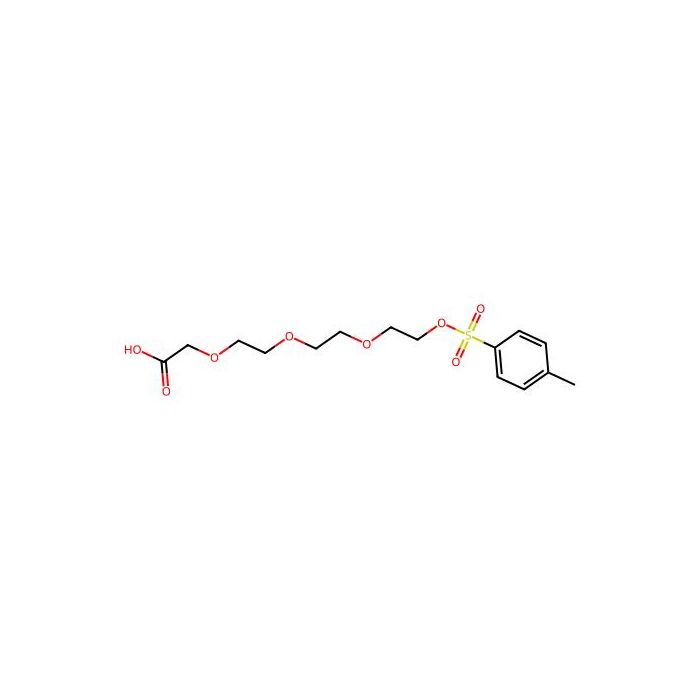
Tos-PEG4-CH2CO2H is a PEG derivative containing a tosyl group and a terminal carboxylic acid. The hydrophilic PEG spacer increases solubility in aqueous media. The tosyl group is a very good leaving group for nucleophilic substitution reactions. The terminal carboxylic acid can be reacted with primary amine groups in the presence of activators (e.g. EDC, or DCC) to form a stable amide bond.
Specifications
Spezifikationen & Reinheit
≥98%
Storage
Store at -20°C
Verschickt in
Ice chest + Ice pads
Dieses Produkt erfordert Kühlkettenversand. Grundversand und andere Economy-Optionen sind nicht verfügbar.
Reinheit
≥98%
Namen und Kennungen
Molekulargewicht
362.4
Documentation
📋 Safety Data Sheet (SDS)
Comprehensive hazard, handling, storage, and regulatory compliance document.
Zertifikate (CoA, COO, BSE/TSE und Analyse-Diagramm)
C of A & Other Certificates(BSE/TSE, COO):
Analytical Chart:
Chemische und physikalische Eigenschaften
Löslichkeit
Solubility in DCM
Lösungsrechner
Molarity Calculator
Determine the necessary mass, volume, or concentration for preparing a solution.
Dilution Calculator
Determine the dilution needed to prepare a stock solution.
Reconstitution Calculator
Bewertungen
Kundenbewertungen
Application Protocols
No tested bioassay protocols are provided for this item. As a synthetic linker, usage protocols depend on the chosen chemistry. General examples (literature, non-validated for this item):
SN2 functionalization (example workflow):
Dry glassware and solvent (DMF). 2) Dissolve Tos-PEG4-CH2CO2H (limiting) at 0.05–0.2 M. 3) Add nucleophile (2–3 eq) and base (K2CO3, 2 eq). 4) Stir 25–60°C until LC–MS indicates completion. 5) Quench with water, extract, and purify by silica or reverse-phase.
EDC/NHS amide coupling (aqueous-compatible):
Dissolve linker (or its amine-bearing derivative) in MES buffer (50 mM, pH 5.5) with 10% DMF. 2) Add EDC·HCl (1.2–1.5 eq) and NHS (1.2–1.5 eq); react 15–30 min at 25°C. 3) Transfer to solution of amine partner in phosphate buffer (pH 7.4). 4) React 1–2 h; quench with ethanolamine. 5) Desalt by dialysis or spin columns.
These are illustrative only. Optimize stoichiometry, solvent, temperature, and time for your specific substrates and scale. For authoritative instructions, refer to primary literature and your laboratory SOPs.
Biological Roles
This product is a synthetic PEG-based linker and does not have intrinsic biological activity. No biological function, metabolism, or signaling role is assigned to Tos-PEG4-CH2CO2H in living systems.
Contextual notes (general, research-oriented):
PEG spacers are widely used in bioconjugation research to modulate hydrophilicity, reduce nonspecific interactions, and improve spatial separation between a payload and a surface or biomolecule. A PEG4 length provides modest flexibility and distance without excessive chain mobility.
The carboxylic acid terminus can be coupled to primary amines on peptides, proteins, or amine-functionalized surfaces via EDC/NHS chemistry under aqueous-compatible conditions. The tosylate terminus can be transformed into azide/amine/thiol handles prior to conjugation steps.
Any use in biological assays should consider the potential for hydrolysis of the tosylate and the introduction of residual organic solvents (DMF/DMSO). Thorough purification and solvent exchange into suitable buffers are recommended.
Research use only: per product data, this material is not intended for diagnostic or therapeutic applications and should not be used in vivo without appropriate validation and regulatory approvals.
Buffer Applications
This compound is not a buffering agent and does not constitute a defined buffer system. However, for coupling the terminal carboxylic acid to amines on biomolecules, buffers are relevant to the activation chemistry (general guidance):
EDC/NHS coupling buffers (literature typical):
MES (50 mM, pH 5.0–6.0): favors formation of O-acylisourea and NHS esters while minimizing amine protonation for subsequent coupling at pH 7–8.
Phosphate (50–100 mM, pH 7.2–7.6): for the amide-formation step once the NHS ester is pre-formed; avoid primary amine-containing buffers (e.g., Tris) during activation.
HEPES or PBS without primary amines can be used in the coupling stage.
Cosolvents: Add 5–20% DMF or DMSO to aid solubility of the linker or its activated ester; keep organic content as low as practical to preserve biomolecule stability.
Not applicable items:
pKa-based buffer capacity, electrophoresis running buffers, and culture media optimization are not typically relevant to this non-ionic linker aside from the coupling workflows described above.
Green Alternatives
Sustainable choices focus on solvent and coupling reagent selection, as the linker itself is fixed.
Replace DMF/NMP with Cyrene, propylene carbonate, or 2-MeTHF when compatible with reactivity and workup.
For SN2 reactions on tosylates, acetonitrile and 2-MeTHF can sometimes substitute for DMF; evaluate rate impacts.
For amide couplings, ethyl acetate or 2-MeTHF as diluents with catalytic DMF can reduce solvent hazard.
Coupling reagents and additives:
Consider carbodiimide EDC in water/ethanol mixtures for amide formation to reduce chlorinated solvents; pair with NHS or sulfo-NHS to enhance aqueous compatibility.
Enzymatic coupling is generally not applicable here; however, use of DMTMM (in MeOH/water) can be a milder, less hazardous alternative to HATU/HOAt (which pose safety concerns).
Comparison snapshot (general trends):
DMF vs 2-MeTHF: DMF offers superior solvation for salts and fast SN2/couplings but is reproductive toxin; 2-MeTHF is biorenewable, lower toxicity, but poorer for polar salts and may slow reactions.
NMP vs propylene carbonate: NMP high-performing but SVHC; propylene carbonate safer, high bp, viscous—may complicate workup.
Operational green tips:
Run reactions at higher concentration to reduce solvent volume.
Recycle acetonitrile/ethyl acetate by fractional distillation when feasible.
Select base and quench strategies that minimize inorganic waste (e.g., organic bases like DIPEA, followed by aqueous acid washes).
Pharmaceutical Uses
No pharmacopeial status or excipient designation is provided for this item. This product is offered for research use only and is not intended for clinical or GMP manufacturing without further qualification.
Context for formulation/manufacturing scientists (general information, not product-specific claims):
PEG-based linkers like PEG4 spacers are frequently evaluated in discovery settings to modulate solubility and linker length in conjugates (e.g., small-molecule–polymer or surface conjugates). The terminal carboxylic acid allows formation of amide/ester linkages to drug-like amines/alcohols during preformulation studies.
For any movement toward regulated use, requirements would include well-defined oligomer distribution, residual solvent/impurity controls (e.g., sulfonate residues), elemental impurities, and validated analytical methods (HPLC/LC–MS, NMR). None of these controls are specified for this catalog item; consult CoA or qualify in-house.
Stability studies should examine hydrolytic stability of the tosylate and the effect of moisture/temperature on PEG chain integrity. Solid-state storage under inert atmosphere and desiccation would typically be preferred during process development.
Physical Properties
Item-specific specifications are not provided in the product data. For authoritative values, consult the CoA/Spec Sheet. The following notes reflect general/literature expectations for PEG4-based tosylate–acid linkers and are not item specifications.
Physical state/appearance: Not specified for this item; refer to CoA/Spec Sheet. (Similar PEG linkers are typically white to off-white solids, literature.)
Melting point: Not specified for this item; refer to CoA/Spec Sheet.
Boiling point: Not applicable; decomposes before boiling at atmospheric pressure (general for PEGylated sulfonates, literature).
Density: Not specified for this item; refer to CoA/Spec Sheet.
Solubility (literature, general):
High in polar aprotic solvents (DMF, DMSO, NMP, acetonitrile).
Moderate in alcohols (MeOH, EtOH, i-PrOH).
Limited to moderate in water due to terminal tosylate; carboxylate salt formation (pH > 7) increases aqueous solubility.
Poor in nonpolar hydrocarbons (hexanes, toluene) despite the tosyl ring.
pKa (carboxylic acid, literature typical): ~4–5 for aliphatic –CH2–CO2H adjacent to PEG chains.
LogP/logD: Expected low to moderate lipophilicity due to PEG; ionization reduces logD at physiological pH (literature trend).
Refractive index: Not specified for this item; refer to CoA/Spec Sheet.
Hygroscopicity: PEG chains are hygroscopic; minimize moisture exposure (general guidance).
Quality and Grades
Grade/Purity: Not specified for this item; refer to CoA/Spec Sheet.
Interpretive guidance for this product class (general):
PEG linkers used in synthetic and bioconjugation workflows benefit from high purity to minimize side reactions (e.g., partial hydrolysis of tosylate, PEG oligomer distribution, residual solvents). If an HPLC or bioconjugation grade is offered on the CoA, it typically indicates:
Low levels of hydrolyzed PEG alcohol and ditosyl byproducts.
Narrow oligomer distribution around PEG4 repeat units.
Low water and residual solvent content; low UV-absorbing impurities where applicable.
Stabilizers: None specified for this item. Tosylate functionality generally does not require stabilizers when stored dry and cold. If stabilizers or inhibitors are listed on the CoA, consider their impact on downstream reactions and include purification (e.g., azeotropic drying, short silica plug) if necessary.
Identity confirmation: CoA may include 1H/13C NMR (PEG methylenes ~3.4–3.8 ppm; Ts aromatic signals ~7.3–7.8 ppm; Ar–CH3 ~2.4 ppm), IR (S=O ~1170–1360 cm−1; C=O ~1710–1730 cm−1), and MS (appropriate [M+H]+/[M−H]−). Verify against your method requirements.
Lot-to-lot control: For sensitive conjugations, verify acid equivalent weight and residual tosylate integrity by a small-scale test coupling or titration prior to scale-up.
Reaction and Applications
Use this heterobifunctional linker to bridge nucleophiles to a carboxyl-derivatizable terminus through a PEG4 spacer. Typical research applications include small-molecule, material, and bioconjugation syntheses (no clinical use implied).
Key transformations (literature, general):
SN2 displacement of the tosylate:
Azidation: NaN3 or TMSN3 → N3–PEG4–CH2CO2H, enabling subsequent Staudinger or CuAAC chemistry after reduction or alkyne introduction.
Thioether formation: RS− (from thiols + base) in DMF to install sulfide linkages; useful for anchoring to Au surfaces or preparing thio-functional spacers.
Alkylation of amines/alcohols: Primary amines or alkoxides (generated in situ) to form secondary amines or ethers, respectively. Employ non-nucleophilic bases (e.g., K2CO3, DIPEA) and anhydrous media.
Carboxyl-end functionalization:
Carbodiimide coupling (EDC/NHS, DIC/DMAP, HATU) to give amides with amines on surfaces, polymers, or biomolecules.
Conversion to acid chloride (e.g., oxalyl chloride) followed by acylation where water-free conditions are acceptable.
Orthogonal sequences: First install the nucleophile via tosyl displacement; then couple the acid to the partner (or vice versa) depending on stability of the installed group.
Practical tips:
Control moisture to suppress hydrolysis to the corresponding PEG alcohol.
Use slight excess of nucleophile for clean SN2; monitor by LC–MS (look for loss of Ts signature ions) and 1H NMR (disappearance of Ts aromatic/Me signals).
For bioconjugation, minimize DMSO/DMF content (<10–20%) in aqueous steps and quench residual activators (e.g., with ethanolamine).
Reaction Conditions
Typical conditions reported in the literature for analogous PEG4 tosylate–acid linkers (guidance only; optimize per system):
Azidation (SN2):
Reagents: NaN3 (3–5 eq).
Solvent: Anhydrous DMF or DMSO.
Temperature/time: 50–80°C, 4–18 h.
Workup: Aqueous quench, extract with EtOAc, wash to remove salts; purify by silica (DCM/MeOH) or reverse-phase.
Solvent: DMF, DCM/DMF (1:1), or aqueous MES buffer (pH 5.5) with 10–20% DMF.
Temperature/time: 0–25°C, 0.5–4 h for activation; 1–16 h for coupling at pH 7.2–7.6.
Acid chloride formation:
Reagents: Oxalyl chloride (3 eq), catalytic DMF.
Solvent: DCM.
Temperature/time: 0–25°C, 0.5–2 h under dry conditions.
Expected outcomes: Clean SN2 with inversion at the reacting carbon (where chiral), high conversions when dry and with slight nucleophile excess. PEGylated products may require gradient elution and benefit from volatile buffers (e.g., 0.1% formic acid) for LC–MS tracking.
Safety and Handling
Hazard classifications specific to this item are not provided in the product data. Always consult the SDS for definitive safety information.
GHS classification: Not specified for this item; refer to SDS.
Signal word / H-statements / Pictograms: Not specified for this item; refer to SDS.
General handling guidance (professional practice):
Potential hazards: Aryl sulfonate esters (tosylates) are electrophilic and may cause irritation to skin, eyes, and respiratory tract; avoid contact and inhalation (general chemistry knowledge).
PPE: Lab coat, safety glasses, and suitable gloves (e.g., nitrile). Work in a fume hood to avoid dust or solvent vapors.
Incompatibilities: Strong bases/nucleophiles (may induce displacement at the tosylate), strong oxidizers (may affect the tosyl moiety), and strong acids/bases that can hydrolyze ester linkages or degrade PEG at elevated temperature (general guidance).
Moisture sensitivity: PEG linkers can absorb moisture; keep containers tightly closed under dry inert gas when possible.
First aid (overview; defer to SDS):
Skin/eye contact: Rinse with water for ≥15 min; remove contaminated clothing; seek medical attention if irritation persists.
Inhalation: Move to fresh air; seek medical attention if symptoms occur.
Ingestion: Rinse mouth; do not induce vomiting; seek medical advice.
Spill/leak: Collect solids by gentle sweeping; for solutions, absorb with inert material. Avoid generating dust/aerosols.
Waste: Dispose of according to local regulations for organic laboratory chemicals.
Solvent Selection
This linker is amphiphilic: a hydrophilic PEG4 chain with a hydrophobic tosyl aryl group and a terminal carboxylic acid. Solvent choice dictates reactivity and handling.
General miscibility/solubility (literature, typical):
Polar aprotic: DMSO, DMF, NMP, and acetonitrile usually dissolve at high concentrations—preferred for SN2 displacements on the tosylate and for carbodiimide couplings.
Alcohols: MeOH/EtOH can dissolve the linker but may compete in SN2 or interfere with activation; avoid as reaction solvents for tosyl displacement.
Aqueous media: Limited solubility at low pH; solubility increases upon neutralization to the carboxylate (add NaHCO3/TEA). Mixed solvents (DMF/water) can be used for EDC/NHS couplings to amines on biomolecules (research context).
Nonpolar: Toluene, MTBE, hexanes—poor; use only for extractions or precipitations.
Selection tips:
For nucleophilic substitutions at the tosylate: Anhydrous DMF or acetonitrile maximize SN2 rates and minimize hydrolysis; add 4 Å molecular sieves if moisture is a concern.
For amide couplings via the acid: DMF, DCM/DMF (1:1), or DMSO with EDC/HOBt/HOAt or HATU; DIPEA/TEA as base. For aqueous-compatible conjugations, use MES or phosphate buffers with DMF cosolvent.
Purification: High polarity favors reverse-phase methods; normal-phase silica can be used with polar eluents (DCM/MeOH or EtOAc/MeOH) but watch for tailing due to PEG.
Quick comparison (general):
DMF vs DMSO: DMF easier to remove; DMSO higher solvating power. Choose DMF for SN2, DMSO for poorly soluble nucleophiles.
Storage and Reconstitution
Storage conditions: Store at −20°C (per product data). Keep container tightly closed under inert atmosphere or dry air. Protect from moisture and prolonged exposure to light and heat.
Shipping: Shipped in an ice chest with ice pads (per product data) to limit thermal excursions.
Stability: Not specified for this item; refer to CoA/Spec Sheet. General note: aryl tosylates can slowly hydrolyze in the presence of moisture; PEG matrices are hygroscopic. Maintain desiccation to maximize shelf life.
Reconstitution/solubility guidance (general):
Readily dissolves in dry DMF, DMSO, or acetonitrile. For aqueous work, dissolve in a minimal volume of DMF/DMSO, then dilute into buffer; adjust pH to 7–8 if forming the carboxylate salt is acceptable.
Filter 0.2 µm if using in sensitive conjugations to remove particulates.
Aliquoting: For multi-use vials, prepare single-use aliquots in dry solvent, store at −20°C, and avoid repeated freeze–thaw or ambient exposure.
Materials compatibility: Use compatible caps/liners (PTFE-lined) to minimize solvent permeation and adsorption by PEG chains.
Research use note: For research use only (per product data).
Contains a para-toluenesulfonyl (tosyl, Ts) ester at one terminus: a p-methylphenyl–SO2–O– group functioning as a good leaving group.
Central spacer is a tetraethylene glycol chain (PEG4): –(CH2–CH2–O)4– providing ~1.6–2.0 nm flexible, hydrophilic spacing (literature, typical for PEG4).
Opposite terminus bears a terminal acetic acid unit: –CH2–CO2H, offering a carboxylic acid handle for carbodiimide-mediated coupling or conversion to activated esters/acid chlorides.
Functional group inventory: aryl sulfonate ester (electrophile/leaving group), ether repeats (PEG), primary methylene, and carboxylic acid (nucleophile/electrophile after activation).
No stereocenters; expected to be an achiral, flexible amphiphilic molecule.
Category: Materials Science (per catalog path). Research use only.
Synthetic Utility
Functional handles and their synthetic value (general chemistry knowledge):
Tosylate terminus (Ts–O–): Excellent leaving group for SN2 with soft/hard nucleophiles (azide, halide, thiolate, cyanide, amines, alkoxides), enabling rapid diversification to a wide array of terminal functionalities while preserving the PEG4 spacing.
Carboxylic acid terminus (–CH2–CO2H): Versatile for amide formation (EDC/HATU/DIC), esterification (Fischer/Steglich), or conversion to more reactive derivatives (acid chloride/anhydride, NHS ester). Orthogonality to tosylate allows stepwise assembly.
Retrosynthetic perspective:
Target structures requiring a hydrophilic spacer between a nucleophile-derived moiety and an amide-linked partner are conveniently accessed by first displacing the tosylate to introduce the desired headgroup, then coupling the acid to a complementary amine (or reversing the order when chemoselectivity dictates).
Applications:
Surface and polymer modification: Introduce carboxyl-linked groups to amine-bearing substrates or vice versa; PEG reduces nonspecific adsorption.
Click-ready intermediates: Azidation of the tosylate gives an azido-PEG4-acid; subsequent CuAAC with alkynes furnishes triazole-linked conjugates with a terminal acid for further coupling.
Bioconjugation: Prepare thiol-, amine-, or maleimide-bearing PEG4 acids from the tosylate, then couple to biomolecules via amide bond formation.
Practical considerations:
Minimize base strength during SN2 to avoid elimination or PEG cleavage; K2CO3 or Cs2CO3 are often sufficient. Control temperature to balance rate against side reactions.
Target Specificity
Not applicable. This product is a small-molecule linker, not a biological affinity reagent or antibody. No antigen, epitope, clone, isotype, or species reactivity applies.
Wir verwenden Cookies, um die ordnungsgemäße Funktion der Website sicherzustellen und, soweit zulässig, Ihr Nutzererlebnis zu verbessern. Sie können Ihre Einstellungen jederzeit unter „Einstellungen“ verwalten. Weitere Informationen finden Sie in unserer Cookie-Richtlinie.
Shall we send you a message when we have discounts available?
Remind me later
Thank you! Please check your email inbox to confirm.
Products are supplied to verified businesses, institutions, and qualified professionals for research and development use only. Not for use in humans, animals, diagnosis, or therapy.