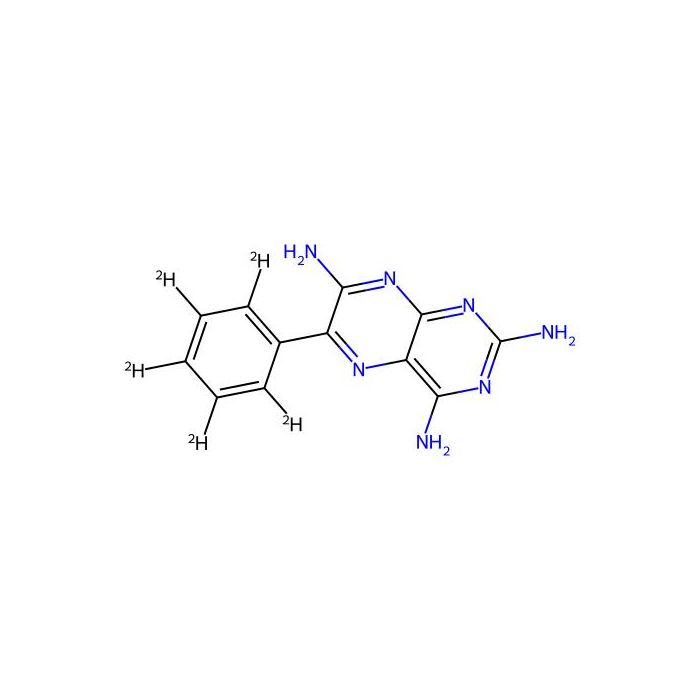
≥99% for sensitive chromatographic and analytical workflows requiring minimal baseline interference.
🌡
Storage & shipping
Store at -20°C Ships Ice chest + Ice pads Check lot-specific COA for exact specifications.
📋
Quality documents
SDS, COA, datasheet, and spec sheet available for download. Lot-specific COA accessible via lot number lookup.
📚
Literature proof
Cited in 0 peer-reviewed publications across chromatography, organic synthesis, and cross-coupling reactions.
Übersicht
Triamterene-d 5 is deuterium labeled Triamterene, which can block epithelial Na+ channel (ENaC) in a voltage-dependent manner, which used as a mild diuretic.
Form:Solid
Specifications
Spezifikationen & Reinheit
≥99%
Biochemische und physiologische Mechanismen
Triamterene-d 5 is deuterium labeled Triamterene, which can block epithelial Na+ channel (ENaC) in a voltage-dependent manner, which used as a mild diuretic.
Storage
Store at -20°C
Verschickt in
Ice chest + Ice pads
Dieses Produkt erfordert Kühlkettenversand. Grundversand und andere Economy-Optionen sind nicht verfügbar.
Zertifikate (CoA, COO, BSE/TSE und Analyse-Diagramm)
C of A & Other Certificates(BSE/TSE, COO):
Analytical Chart:
Lösungsrechner
Molarity Calculator
Determine the necessary mass, volume, or concentration for preparing a solution.
Dilution Calculator
Determine the dilution needed to prepare a stock solution.
Reconstitution Calculator
Bewertungen
Kundenbewertungen
Application Protocols
Not applicable for immunoassay formats (WB, IHC, IF, FC) as this is a small-molecule standard.
Analytical protocol outline (general, LC–MS/MS)
Prepare a primary stock in methanol or DMSO (e.g., 1 mg/mL). Serially dilute with methanol:water (1:1) containing 0.1% formic acid to prepare calibration working solutions.
Spike a fixed amount of Triamterene-d5 into all calibration standards, QCs, and samples prior to extraction.
Extract by protein precipitation (3 volumes ACN), vortex 1 min, centrifuge (≥12,000 × g, 10 min), transfer supernatant, dilute with water, and inject 1–10 µL.
Quantify using MRM with the internal standard response ratio (analyte/IS). Validate linearity, accuracy, precision, recovery, matrix effect, and stability per your laboratory SOPs.
Note: The above is general guidance; adapt to your method and regulatory framework. Item-specific tested applications are not provided for this product.
Biological Roles
Item-specific biological data: Not specified for this item; refer to primary literature if needed.
Context (general, non-clinical)
Triamterene is a well-known small molecule; the deuterated analog (Triamterene-d5) is used as a tracer/internal standard in bioanalytical chemistry. The deuterium label is biologically silent—no change in target binding or mechanism is intended or relied upon for research uses.
Use in biochemistry workflows (analytical)
Quantification of triamterene in plasma, urine, or tissue homogenates by isotope-dilution LC–MS/MS.
Assessment of extraction recovery, matrix effects, and stability in ADME sample processing. Spiking Triamterene-d5 before sample workup enables accurate correction for losses and ion suppression/enhancement.
Metabolic considerations (general)
Deuterium is located on non-exchangeable aromatic positions in typical d5 analogs, minimizing back-exchange in biological matrices. Consequently, the internal standard tracks the analyte through extraction, chromatographic separation, and ionization.
Notes
No biological activity claims are made for this product. For research use only, consistent with the product’s Research Use Note.
Buffer Applications
This compound is not a buffering agent and is not typically used to prepare pH buffer systems.
Practical analytical note
For LC–MS/MS assays, common mobile phase buffers/acids are volatile additives such as formic acid (0.1% v/v) or ammonium formate/acetate (2–20 mM) to enhance ionization and chromatographic performance of triamterene-class analytes. Select additive strength to balance sensitivity and peak shape.
Preparation tip
Dissolve Triamterene-d5 in an organic cosolvent (e.g., methanol or DMSO) before dilution into buffered aqueous mobile phases to avoid precipitation.
Green Alternatives
Context
As an isotopically labeled analytical standard, the main “green” considerations involve solvent choice, scale minimization, and waste handling rather than replacing the compound itself.
Greener solvent strategies (general)
Prefer methanol over acetonitrile when chromatographic performance allows; MeOH is generally considered a greener protic solvent with lower life-cycle impact.
Use water-rich mobile phases where solubility and retention permit; optimize gradient to minimize organic consumption.
For sample prep, consider aqueous protein precipitation (MeOH:water) or micro-SPE formats to reduce solvent volumes.
Process and waste minimization
Work at the lowest effective concentrations and volumes for calibration curves (e.g., microliter aliquots for ng/mL standards).
Adopt 96-well microplate workflows and evaporate under nitrogen at ambient or mild temperatures to reduce energy use.
Materials selection
Utilize recyclable polypropylene vials and low-dead-volume inserts to cut plastic waste; avoid PTFE where not essential.
Trade-offs
Methanol can increase ion suppression in some matrices relative to acetonitrile; perform matrix-effect assessments. Water-rich phases may reduce solubility; balance greenness with method robustness and quantitative performance.
Pharmaceutical Uses
This product is supplied for research use only. No therapeutic or clinical use is claimed or implied.
Typical roles in pharmaceutical R&D and QC (general)
Stable-isotope internal standard for method development and validation in bioanalysis (nonclinical and clinical sample testing conducted by qualified laboratories), dissolution testing, and stability studies of dosage forms containing triamterene.
System-suitability and performance tracking in LC–MS/MS assays: response factor monitoring, retention time locking, and recovery correction across batches and instruments.
Reference material in impurity profiling, forced-degradation studies, and extractables/leachables assessments where coelution and ionization parity are advantageous.
Documentation
For regulated environments, maintain full chain-of-custody and characterization package (CoA including isotopic enrichment, purity, and identity by MS/NMR). Establish storage and handling SOPs for isotope-labeled standards to ensure data integrity.
Compendial status
No pharmacopeial monograph is expected for the d5 analog. Use against internally qualified acceptance criteria. The unlabeled API may have compendial references; the isotope standard serves as an auxiliary analytical material.
Physical Properties
Item-specific specifications: Not specified for this item; refer to CoA/Spec Sheet.
Literature/general properties for the non-deuterated parent (Triamterene) — deuteration minimally alters these bulk properties but increases exact mass:
Appearance: yellow to orange crystalline solid (literature, parent compound).
Melting point: high, reported >300 °C with decomposition (literature, parent compound). Exact value varies by source; handle as a thermally robust, decomposing solid.
Solubility: practically insoluble in water; soluble in polar aprotic organics such as DMSO and DMF; sparingly to moderately soluble in methanol and ethanol with heat/sonication (literature trends, parent compound). For LC–MS use, stocks are commonly prepared in MeOH or DMSO.
Acid–base: weakly basic/anilino nitrogens; multiple ring nitrogens reduce overall basicity (literature, parent compound). Apparent pKa values depend on site; expect limited ionization at neutral pH.
LogP/logD: moderate lipophilicity reported for parent scaffold (literature, parent compound); deuteration has negligible effect on partitioning within experimental error.
UV–vis: conjugated heteroaromatic chromophore with UV absorbance in near-UV range (literature, parent compound); useful for HPLC–UV tracking, but LC–MS/MS is preferred for quantitative work.
Note: Treat all numerical values as literature guidance for the non-deuterated parent. For this specific lot’s definitive specifications, consult the CoA/Spec Sheet.
Quality and Grades
Item-specific grade/purity: Not specified for this item; refer to CoA/Spec Sheet.
Isotopic labeling considerations (general for “-d5” analytes)
Isotopic enrichment and labeling pattern: For quantitative LC–MS/MS, a high deuterium incorporation and a defined labeling site (often phenyl-d5 for aromatic drugs) are desirable to ensure coelution and similar ionization as the analyte. Actual enrichment level and labeling map are item-specific: Not specified for this item; refer to CoA/Spec Sheet.
Residual protium content and potential H/D exchange: Deuteriums on non-exchangeable aromatic carbons are stable under typical analytical conditions; ensure mobile phases lack strong acids/bases that could promote exchange at any labile sites (if present).
Analytical suitability
Stable-isotope internal standards are typically supplied at high chemical purity with low levels of isobaric interferences to support MRM quantitation. For this item, detailed impurity/assay data are Not specified; refer to CoA.
Documentation and release testing
Request CoA for: chemical purity (%), isotopic enrichment (%D), residual solvents, identification (NMR/MS), and chromatographic profile (LC–MS/HPLC). If performing regulated bioanalysis, ensure qualification against acceptance criteria (matrix-matched recovery, relative response factor, and stability).
Reaction and Applications
Primary application (analytical chemistry)
Triamterene-d5 is principally used as a stable-isotope internal standard for quantitative determination of triamterene in biological fluids, environmental samples, and dosage forms by LC–MS/MS. The d5 label closely tracks chromatographic behavior and ionization efficiency, enabling accurate isotope-dilution assays.
LC–MS/MS method notes (general)
Ionization: positive-mode ESI typically affords strong [M+H]+ signals for triamterene-class compounds.
Transitions: choose MRM transitions shifted by +5 Da relative to the analyte. Optimize collision energies empirically to avoid overlap with natural isotopic envelope.
Sample prep: protein precipitation (MeOH or ACN), SPE on mixed-mode cation-exchange cartridges, or dilute-and-shoot for clean matrices. Spike internal standard prior to extraction to correct recovery.
Other laboratory uses
Metabolic stability and permeability assays as a tracer molecule; matrix effect evaluation and instrument performance checks.
Synthetic chemistry context (secondary)
As a polyaminated heteroaromatic, the scaffold can undergo acylation/alkylation of exocyclic amines under mild base and coupling conditions; however, the d5 material is rarely used for synthetic transformations due to its analytical value.
Practical guidance
Prepare single-use aliquots to preserve isotopic integrity. Confirm absence of in-source H/D exchange under your LC–MS conditions by monitoring mass shifts across pH/mobile phase variants.
Reaction Conditions
Not typically used as a synthetic reagent. This section provides general analytical-method conditions relevant to the compound’s most common use (LC–MS/MS internal standard):
LC–MS/MS (general literature practice)
Mobile phases: A = water + 0.1% formic acid (or 2–10 mM ammonium formate, pH ~3–4); B = acetonitrile or methanol.
Gradient: start 10–30% B, ramp to 70–95% B over 2–6 min depending on column and desired retention; re-equilibrate adequately.
Column: C18 or phenyl-hexyl, 2.1 × 50–100 mm, 1.7–3 µm. Column temp 30–50 °C.
Flow rate: 0.2–0.5 mL/min (UHPLC 2.1-mm ID).
Detection: ESI(+), monitor MRM transitions offset by +5 Da from triamterene. Optimize declustering potential and collision energy empirically.
Sample preparation (general)
Spike Triamterene-d5 before extraction. Perform protein precipitation with 3–4 volumes of cold ACN or MeOH; vortex, centrifuge, and collect supernatant. Optionally, SPE (mixed-mode cation exchange) to improve cleanliness.
Working solution stability: assess at room temperature (bench-top), autosampler (4–10 °C), and freeze–thaw over at least 3 cycles.
Note: Numerical instrument parameters and transitions should be optimized in your lab; values above are general guidance, not item-specific specifications.
Safety and Handling
GHS/Classification (item-specific): Not specified for this item; refer to SDS for authoritative hazard information.
General handling guidance (good laboratory practice)
Avoid inhalation of dust and contact with skin/eyes. Use in a fume hood or ventilated enclosure when weighing powders.
Personal protective equipment: lab coat, safety glasses, and appropriate chemical-resistant gloves (e.g., nitrile). Avoid generating aerosols; use antistatic tools for microgram/milligram handling.
Hygiene: wash hands after handling; do not eat or drink in the lab.
Storage incompatibilities and precautions (general)
Store tightly sealed, protected from moisture. Aromatic amines/heteroaromatics can exhibit light sensitivity; store in amber containers or protect from strong light as a precaution.
Separate from strong oxidizers and strong acids. Avoid prolonged elevated temperatures.
First-aid overview (general, not a substitute for SDS)
Inhalation: move to fresh air; seek medical advice if symptoms persist.
Skin/eye contact: rinse with plenty of water for at least 15 minutes; remove contaminated clothing; seek medical attention if irritation persists.
Ingestion: rinse mouth; do not induce vomiting; seek medical advice.
Deuterated materials
Isotopic substitution does not materially change acute hazards relative to the unlabeled analog. Treat as you would the parent compound, following the SDS.
Solvent Selection
Polarity/behavior (general, based on parent scaffold)
Aromatic, heteroatom-rich base with very low water solubility. Best handled in polar aprotic organics.
Recommended solvents for stock solutions (analytical use)
DMSO: excellent solvating power; prepare concentrated stocks (e.g., 1–10 mg/mL) and dilute into sample diluent.
Methanol or acetonitrile: suitable for LC–MS/MS working solutions; may require sonication or gentle warming to fully dissolve.
DMF: strong solvent for difficult dissolutions; follow with dilution into LC-compatible media.
Miscibility and sample-compatibility notes
For biological matrices, final organic content is typically kept ≤30–50% to prevent precipitation during spiking. Use methanol:water or acetonitrile:water with 0.1% formic acid for positive-ion ESI methods (general LC–MS practice).
When to choose alternatives
If adsorption losses are observed at low ng/mL, add small amounts of organic modifier or BSA-free carrier, or use silanized glass/PP vials. If matrix effects are severe, consider matrix-matched calibration with the same internal standard.
Practical tips
Filter working solutions (0.2 µm PTFE) if particulates form. Avoid aqueous-only vehicles due to poor solubility of the parent scaffold. Verify solution clarity before quantitative use.
Storage and Reconstitution
Item-specific storage and shipping
Storage Conditions: Store at -20°C (item-specific).
Shipped In: Ice chest + Ice pads (item-specific), to maintain low temperature during transit.
General handling and reconstitution
Allow the sealed container to equilibrate to room temperature before opening to minimize moisture condensation.
Reconstitution solvents: methanol, acetonitrile, or DMSO are recommended for stock solutions. Water alone is not recommended due to low solubility of the parent scaffold.
Suggested stock concentrations (general): 1–10 mg/mL. Filter if particulates remain (0.2 µm PTFE) and verify clarity.
Aliquoting: prepare single-use aliquots in amber vials to avoid repeated freeze–thaw and potential light exposure.
Stability guidance (general)
Store solid at -20°C in a desiccated, light-protected environment. For solutions, refrigerate (2–8 °C) for short-term autosampler use and freeze (-20 °C) for longer-term storage; confirm stability under your conditions.
Avoid repeated freeze–thaw cycles; discard aliquots that show precipitation or degradation by LC–MS.
Documentation
Label all aliquots with concentration, solvent, and preparation date. For this specific item’s shelf life and solution stability, Not specified; refer to CoA/Spec Sheet.
Research Use Note: For research use only (item-specific).
Structure and Identity
Item-specific identifiers
CAS: 1189922-23-3 (item-specific)
SKU: T651384 (item-specific)
Molecular formula: Not specified for this item; refer to CoA/Spec Sheet.
Molecular weight: Not specified for this item; refer to CoA/Spec Sheet.
SMILES: Not specified for this item; refer to CoA/Spec Sheet.
InChIKey: Not specified for this item; refer to CoA/Spec Sheet.
Compound type and scaffold (general/literature)
Triamterene is a pteridine-derived, polyaminated heteroaromatic bearing a substituted anilide/phenyl moiety. The “-d5” denotes a deuterium-labeled analog (typically ring-deuterated on the phenyl substituent) used as a stable-isotope internal standard.
Core functional groups (parent scaffold): diaminopteridine ring system (multiple ring nitrogens, two exocyclic amines) conjugated to a para-substituted phenyl bearing additional amino substitution. The framework is highly heteroatom-rich and weakly basic due to ring nitrogens and anilino amines.
Stereochemistry (general)
No stereogenic centers; planar, conjugated, polyaza aromatic system with an appended phenyl ring.
2D structural description (general)
A bicyclic pteridine nucleus (fused 1,3,5-triazine–pyrazine-like arrangement) substituted with exocyclic –NH2 groups and connected via a C–C bond to a para-aminophenyl ring. The deuterated analog replaces five protium atoms (commonly on the phenyl ring) with deuterium, preserving electronic structure while increasing exact mass by ~5 Da (literature).
Synthetic Utility
General reactivity (based on parent scaffold)
Polyaminated, electron-deficient heteroaromatic (pteridine-like) framework with exocyclic anilino amines. Potential transformations include selective N-acylation/alkylation, diazotization of anilines under strongly acidic conditions (controlled), and electrophilic substitution on the phenyl ring (less activated due to anilino substitution and conjugation).
Metal-catalyzed cross-couplings are not typical for this fully formed scaffold; functionalization usually targets the amine groups if derivatization is required.
Relevance to the d5 analog
Because Triamterene-d5 is primarily an analytical standard, it is rarely subjected to synthetic modification. Any chemical derivatization risks scrambling or diluting isotopic labeling and is generally avoided.
Retrosynthetic perspective (general)
Construction of the parent scaffold involves condensation routes to the pteridine core followed by introduction of the anilino moiety. For labeled analogs, the deuterium is commonly introduced via use of a pre-deuterated aryl precursor (e.g., phenyl-d5) to ensure non-exchangeable labeling.
Practical note
If chemical modification is necessary (e.g., to create calibration surrogates), validate isotopic integrity post-reaction by high-resolution MS and 2H NMR.
Target Specificity
Not applicable. This product is a small-molecule chemical standard, not an antibody or affinity reagent. No antigen, clone, isotype, or species reactivity data apply.
Wir verwenden Cookies, um die ordnungsgemäße Funktion der Website sicherzustellen und, soweit zulässig, Ihr Nutzererlebnis zu verbessern. Sie können Ihre Einstellungen jederzeit unter „Einstellungen“ verwalten. Weitere Informationen finden Sie in unserer Cookie-Richtlinie.
Shall we send you a message when we have discounts available?
Remind me later
Thank you! Please check your email inbox to confirm.
Products are supplied to verified businesses, institutions, and qualified professionals for research and development use only. Not for use in humans, animals, diagnosis, or therapy.