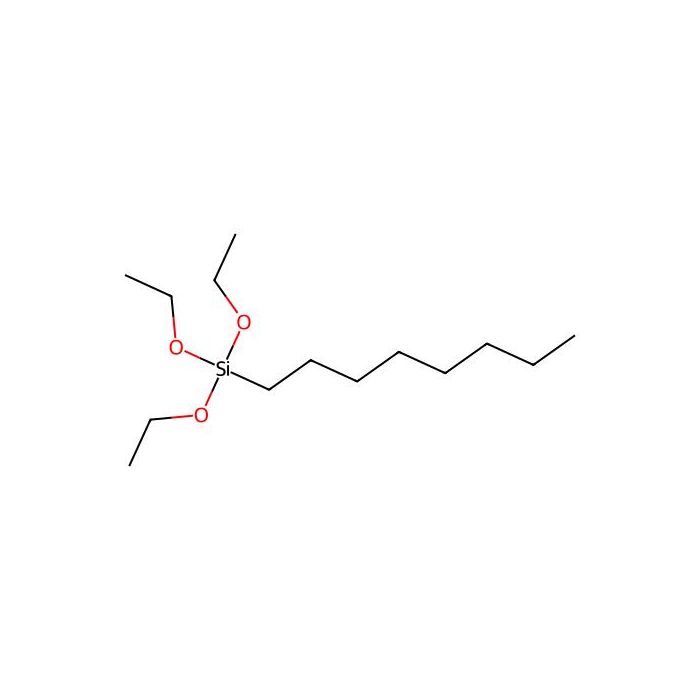
Triethoxyoctylsilane - Moligand™, 10 mM in DMSO , CAS No.2943-75-1

CAS: 2943-75-1 Cat. No.: T1499257 Summenformel: C14H32O3Si Molekulargewicht: 276.49 Beilstein Registry Number: 2325287 EG-Nummer: 220-941-2 PubChem CID: 76262
Zu bestellen verfügbar
QUALITÄT & REINHEIT Moligand™ ? Moligand™ — Aladdin's line of ligands and bioactive small molecules. Use for receptor, pathway, and binding studies needing defined small-molecule tools. 10 mM in DMSO
Storage
Desiccated,Store at -80°C
Shipped In
Dry ice packs + Cold packs
★
Größe
Deutschland (EU)
USA*
Preis
Menge
1ml
T1499257-1ml
Auf Bestellung · 8–12 Wochen
25,08€
Enter a quantity for the sizes you want to add.

Übersicht

Triethoxyoctylsilane is a compound used in plastic applications and can be utilized to produce waterproof coatings with hydrophobic properties .

Spezifikationen

Spezifikationen & Reinheit
Moligand™, 10 mM in DMSO
Storage
Desiccated,Store at -80°C
Verschickt in
Dry ice packs + Cold packs
Dieses Produkt erfordert Kühlkettenversand. Grundversand und andere Economy-Optionen sind nicht verfügbar.
Note
Moligand™
Namen und Kennungen
Isomere SMILES
CCCCCCCC[Si](OCC)(OCC)OCC
WGK Deutschland
1
RTECS
VV6695500
PubChem CID
76262
Molekulargewicht
276.49
Beilstein
2325287
Reaxys
2325287

Erweiterte Daten

Zertifikate (CoA, COO, BSE/TSE und Analyse-Diagramm)
C of A & Other Certificates(BSE/TSE, COO):
Analytical Chart:
Chemische und physikalische Eigenschaften
Brechungsindex1.417
Flammpunkt (°F)212 °F
Flammpunkt (°C)100 °C
Siedepunkt (°C)98°C
Sicherheit und Gefahren (GHS)
Piktogramm(e)
Signal
Warning
Gefahrenhinweise

H315:Causes skin irritation

H319:Causes serious eye irritation

H335:May cause respiratory irritation

Sicherheitshinweise

P261:Avoid breathing dust/fume/gas/mist/vapors/spray.

P305+P351+P338:IF IN EYES: Rinse cautiously with water for several minutes. Remove contact lenses if present and easy to do - continue rinsing.

P280:Wear protective gloves/protective clothing/eye protection/face protection.

P302+P352:IF ON SKIN: wash with plenty of water.

P321:Specific treatment (see ... on this label).

P405:Store locked up.

P501:Dispose of contents/container to an approved waste disposal plant.

P264:Wash hands [and …] thoroughly after handling.

P271:Use only outdoors or in a well-ventilated area.

P304+P340:IF INHALED: Remove person to fresh air and keep comfortable for breathing.

P403+P233:Store in a well-ventilated place. Keep container tightly closed.

P362+P364:Take off contaminated clothing and wash it before reuse.

P264+P265:Wash hands [and …] thoroughly after handling. Do not touch eyes.

P337+P317:If eye irritation persists: Get medical help.

P332+P317:If skin irritation occurs: Get medical help.

P319:Get medical help if you feel unwell.

WGK Deutschland
1
RTECS
VV6695500
Reaxys
2325287
FAQs und Artikel
A Hygrothermal Interface Guide for Silane Coupling Agents: From Failure Mechanisms to Evidence-Chain Troubleshooting and Selection (with Product Tables A–C)
Why Material Properties Are Limited by Interfaces: Mechanism of Action and Selection Guide for Silane Coupling Agents (Tables 1–4)
Silane Precursors in Sol-Gel Film Formation: Precursor Selection and Its Influence on Film-Formation Outcomes
Application Scenarios and Selection Considerations for Silane Impregnation Agents in the Protection of Concrete and Absorptive Masonry
Alkylsilanes: Structural Features, Surface Reactions, Applications, and Product Selection
Preparation Methods and Precautions for Silane Coupling Agent Primer Solutions
Which Fillers and Substrates Are Suitable for Silane Coupling Agents: Surface Hydroxyls, Interfacial Bonding, and Experimental Verification
How Matting Agents in Coatings Build Low-Gloss Coating Surfaces: Mechanisms, Formulation Trade-Offs, and Product Selection
Structure–Property Relationship of Silicone Resins: Mechanisms of Heat Resistance, Weatherability, Hydrophobicity, and Coating Performance Analysis
Color-Development Mechanisms, Formulation Forms, and Selection/Application Logic of Colorants in Personal Care Products
Mechanism of Action of Porous Silica in Oil-Control Loose Powder: Pore Structure, Capillary Imbibition, and Surface Modification
UVA Absorption Mechanism of Avobenzone: Keto–Enol Tautomerism, Photochemical Instability, and Formulation Photostabilization Strategies
Citations of This Product
Lösungsrechner
Bewertungen

Kundenbewertungen

Häufig gestellte Fragen

What are the CAS number, molecular formula and molecular weight?
The CAS Number is 2943-75-1, the molecular formula is C14H32O3Si, and the molecular weight is 276.49 g/mol.
What is Moligand??
Moligand? is one of Aladdin Scientific's premium product lines, formulated for high-purity applications across multiple workflows. Compared to standard grades in the same workflow, Moligand? products typically offer tighter specifications, more rigorous QC, and stronger lot-to-lot consistency.
How should this product be stored?
Store at ?80 °C, desiccated. Keep the container tightly closed with desiccant — the material is moisture-sensitive.
How is this product shipped?
This product ships frozen with dry ice and cold packs. Unpack on arrival and transfer it to the storage condition stated above; handle dry ice with insulated gloves in a ventilated area.
What documentation is provided?
Available product documentation, including Certificates of Analysis (COA), Safety Data Sheets (SDS), and specification sheets, is shown in the product document area. Document availability and access follow the current site policy.

Dürfen wir Sie über Rabattaktionen informieren?

Später erinnern

Vielen Dank! Bitte überprüfen Sie Ihren E-Mail-Posteingang, um zu bestätigen.

Hoppla! Benachrichtigungen sind deaktiviert.