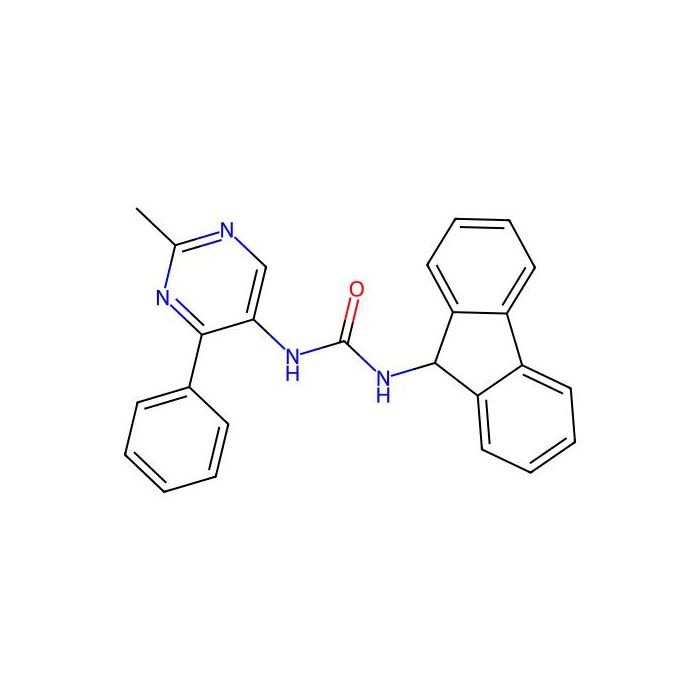
TrkA-IN-1 is a potent and selective Tropomyosin-related kinase A (TrkA) inhibitor with an IC 50 of 99 nM in a cell-based assay. TrkA-IN-1 has analgesic activity
TrkA-IN-1 is a potent and selective Tropomyosin-related kinase A (TrkA) inhibitor with an IC 50 of 99 nM in a cell-based assay. TrkA-IN-1 has analgesic activity.
Storage
Store at -20°C
Verschickt in
Ice chest + Ice pads
Dieses Produkt erfordert Kühlkettenversand. Grundversand und andere Economy-Optionen sind nicht verfügbar.
This compound belongs to the class of organic compounds known as fluorenes. These are compounds containing a fluorene moiety, which consists of two benzene rings connected through either a cyclopentane, cyclopentene, or cyclopenta-1,3-diene.
External Descriptors
Not available
1. Djoumbou Feunang Y, Eisner R, Knox C, Chepelev L, Hastings J, Owen G, Fahy E, Steinbeck C, Subramanian S, Bolton E, Greiner R, and Wishart DS. ClassyFire: Automated Chemical Classification With A Comprehensive, Computable Taxonomy. Journal of Cheminformatics, 2016, 8:61.
Zertifikate (CoA, COO, BSE/TSE und Analyse-Diagramm)
C of A & Other Certificates(BSE/TSE, COO):
Analytical Chart:
Chemische und physikalische Eigenschaften
Löslichkeit
DMSO : 8.33 mg/mL (21.23 mM; Need ultrasonic)
Molekulargewicht
392.500 g/mol
XLogP3
4.200
Hydrogen Bond Donor Count
2
Hydrogen Bond Acceptor Count
3
Rotatable Bond Count
3
Exact Mass
392.164 Da
Monoisotopic Mass
392.164 Da
Topological Polar Surface Area
66.900 Ų
Heavy Atom Count
30
Formal Charge
0
Complexity
570.000
Isotope Atom Count
0
Defined Atom Stereocenter Count
0
Undefined Atom Stereocenter Count
0
Defined Bond Stereocenter Count
0
Undefined Bond Stereocenter Count
0
The total count of all stereochemical bonds
0
Covalently-Bonded Unit Count
1
Lösungsrechner
Molarity Calculator
Determine the necessary mass, volume, or concentration for preparing a solution.
Dilution Calculator
Determine the dilution needed to prepare a stock solution.
Reconstitution Calculator
Bewertungen
Kundenbewertungen
Application Protocols
No tested applications or validated protocols are provided in the product data for this SKU.
General research-use guidance (not item-specific; adapt to your system):
Prepare a concentrated DMSO stock solution under dry conditions; vortex and sonicate if needed to fully dissolve. Record exact concentration.
For biochemical assays, pre‑incubate the inhibitor with enzyme in assay buffer before initiating with ATP/substrate; include vehicle controls and, if possible, a known comparator.
For cellular assays, dilute the DMSO stock into pre‑warmed media to the desired concentration, ensuring final DMSO within tolerated limits. Include time‑course and dose‑response to map potency and kinetics.
Please consult the CoA/Spec Sheet and SDS for any item-specific instructions when available.
Biological Roles
Context and mechanism (general literature; not item-specific claims):
TrkA (NTRK1) is a receptor tyrosine kinase and the high‑affinity receptor for nerve growth factor (NGF). Upon NGF binding, TrkA dimerizes and autophosphorylates, recruiting adaptor proteins that activate downstream pathways including MAPK/ERK, PI3K/AKT, and PLCγ.
Small‑molecule TrkA inhibitors bind the ATP site of the kinase domain, suppressing catalytic activity and downstream signaling. Such compounds are widely used as chemical probes to dissect NGF/TrkA biology, neurite outgrowth signaling, pain pathway modulation, and feedback regulation within the neurotrophin network.
Use cases in research (general):
Enzyme assays: Determination of IC50/Ki against recombinant TrkA kinase domain; kinetic mechanism studies (competitive vs time‑dependent binding).
Cellular studies: Assessment of NGF‑induced TrkA phosphorylation and ERK activation in TrkA‑expressing lines; target engagement readouts (CETSA, NanoBRET).
Selectivity profiling: Cross‑screening against related neurotrophin receptors (TrkB/TrkC) and kinome‑wide panels to understand off‑target liabilities.
Notes for experimental design:
Include NGF stimulation controls and parallel assays with TrkB/TrkC to contextualize specificity.
Maintain low DMSO in final assay media and verify compound stability under assay conditions (light, temperature, protein binding).
Buffer Applications
This item is a small‑molecule kinase inhibitor, not a buffering agent. Therefore, classic buffer system guidance (pKa, buffer capacity, recipes) is not applicable.
Practical notes for assay buffers (general, not item‑specific):
Prepare inhibitor stocks in DMSO and dilute into phosphate- or HEPES‑buffered saline with compatible additives (e.g., 0.01–0.1% Tween‑20) to limit nonspecific adsorption and precipitation.
Control the final DMSO percentage (typically ≤0.1–0.5% v/v) and include vehicle controls in all experiments.
Filter buffers (0.22 μm) and pre‑equilibrate to assay temperature to maintain reproducibility.
Green Alternatives
This product is a bioactive tool compound used at micro- to milligram scales in biochemical and cellular assays; “green alternatives” are less about replacing the compound itself and more about optimizing solvents and workflows.
General recommendations (not item-specific):
Prefer DMSO over DMF/NMP for stock preparation due to lower toxicity and better biodegradability profiles at laboratory scale.
Minimize DMSO carryover by preparing high-concentration stocks (as solubility allows) to keep final assay DMSO ≤0.1–0.5% v/v.
Use aqueous buffers with appropriate surfactants (e.g., low levels of nonionic detergents) instead of organic cosolvents when compatible with the assay.
Implement microscale assays (low-volume plates, acoustic dispensing) to reduce solvent consumption and compound waste.
Trade-offs:
While greener solvents like ethanol or isopropanol are preferred from an EHS standpoint, they may not solubilize hydrophobic kinase inhibitors as effectively as DMSO, potentially causing precipitation and assay variability.
Waste minimization:
Consolidate and properly segregate organic solvent waste. Use amber microvials and septa caps to extend solution life and reduce repeated preparations.
Pharmaceutical Uses
No clinical or therapeutic uses are claimed for this catalog item. It is supplied strictly for research use only.
Relevant nonclinical/formulation contexts (general; not item-specific):
Reference standard for analytical method development (LC–MS, UPLC) and system suitability in kinase inhibitor panels.
Spiking controls for bioanalytical recovery studies in complex matrices (e.g., plasma, cell lysates) when permitted by institutional policy.
Formulation screening in preclinical research to evaluate solvent/cosolvent systems, stability, and adsorption to plastics for hydrophobic small molecules.
Regulatory note:
No pharmacopeial monograph is associated with this item based on the provided data. Any GMP or clinical manufacturing use would require additional qualification that is outside the scope of this research‑use product.
Physical Properties
Only item-specific details provided by the catalog are reported below. Numerical specifications not listed here are not established for this item.
Appearance (catalog): Not specified for this item; refer to CoA/Spec Sheet.
Molecular weight (catalog): Not specified for this item; refer to CoA/Spec Sheet.
Molecular formula (catalog): Not specified for this item; refer to CoA/Spec Sheet.
Melting point: Not specified for this item; refer to CoA/Spec Sheet.
Boiling point: Not applicable/rarely reported for solid kinase inhibitors; not specified for this item.
Density: Not specified for this item.
LogP/logD, pKa, refractive index: Not specified for this item.
Aqueous/organic solubility: Not specified for this item; refer to CoA/Spec Sheet. General literature practice for kinase tool compounds is dissolution in anhydrous DMSO to prepare concentrated stocks.
General considerations (literature/good practice, not item-specific):
Many Trk inhibitors are moderately lipophilic and sparingly soluble in water at neutral pH; DMSO is typically used for primary stocks (e.g., 10–50 mM), followed by dilution into assay buffers with final DMSO ≤0.1–0.5% v/v to maintain enzyme/cell compatibility.
Hygroscopicity is variable across scaffolds; minimize atmospheric exposure until solubility is established.
Quality and Grades
Grade/Purity (catalog): Not specified for this item; refer to CoA/Spec Sheet.
Interpretation and guidance:
When purity is not specified in the catalog entry, the definitive values (chromatographic purity, residual solvents, water content, and elemental analysis if applicable) are reported on the item’s Certificate of Analysis (CoA) for the specific lot. Request the CoA prior to critical assays.
For bioactive screening compounds, high chromatographic purity (often ≥95% by HPLC/UPLC) and well-characterized identity (NMR, HRMS) are typically expected, but the exact acceptance criteria for this SKU are not specified.
If a stabilizer or counter-ion were present (e.g., TFA salt), it would be disclosed on the CoA/specification. None are listed here for this item.
Practical QC tips:
Verify identity by LC–MS against the provided reference mass and expected retention window (from CoA).
Check purity by orthogonal methods when possible (e.g., HPLC with PDA and MS, or qNMR) before deploying in SAR or screening campaigns.
Establish a lot-specific extinction coefficient if relying on UV quantitation, as aromatic kinase inhibitors often exhibit strong absorbance in the 250–320 nm region (general guidance, not item-specific).
Reaction and Applications
This SKU is a finished bioactive small molecule intended as a tool compound, not a synthetic reagent. As such, traditional synthetic “reaction applications” (e.g., serving as a coupling partner, catalyst, or reagent) are not typically applicable.
Relevant applications instead focus on biochemical and cellular assay contexts (see Biological Roles and Application Protocols):
Use as a reference inhibitor in enzyme kinetics assays for TrkA (NTRK1) catalytic activity (general practice, not item-specific).
Include in selectivity panels across kinases to benchmark assay performance and instrument suitability.
Employ in target engagement assays (e.g., CETSA, NanoBRET target engagement) as a positive control for TrkA pathway modulation.
If chemical modification is desired (e.g., to prepare a probe or conjugate), consult the primary literature for the exact scaffold of TrkA-IN-1 to identify vector positions tolerant to substitution. Such derivatization is outside the intended use of this catalog item and may require custom synthesis.
Reaction Conditions
Not applicable in the classical synthetic sense, as this product is a ready‑to‑use bioactive small molecule rather than a reagent. No catalytic or stoichiometric reaction conditions are associated with its use in chemistry.
Assay-related conditions (general guidance, literature-based; not item-specific):
Enzyme assays: 20–50 mM HEPES or Tris buffer, pH 7.4–7.5; 1–10 mM MgCl2; 0.01–0.05% Tween‑20; ATP near Km; incubations at 25–30°C; inhibitor preincubation 10–30 min may be used to reach equilibrium.
Cell assays: Serum‑reduced media for stimulation experiments; NGF stimulation (time and dose per cell line literature); maintain final DMSO ≤0.1–0.5% v/v.
Stability checks: Monitor by LC–MS after incubation under assay conditions to confirm compound integrity.
These are general literature norms for kinase inhibitors and should be adapted to the user’s specific protocols and controls.
Safety and Handling
Safety overview for research use only compounds of this class. Always consult the SDS for authoritative information.
GHS classification (catalog): Not specified for this item; refer to SDS.
Signal word / H-statements / pictograms: Not specified for this item; refer to SDS.
Recommended PPE: Lab coat, safety glasses, and suitable chemical-resistant gloves (e.g., nitrile). Handle powders in a fume hood to avoid inhalation of dust/aerosols.
Storage conditions (catalog): Store at −20°C. Keep container tightly closed and protected from light and moisture. Avoid repeated freeze–thaw of solutions.
Shipping conditions (catalog): Shipped in ice chest with ice pads to maintain a low-temperature chain.
General hazards for bioactive small molecules: May be harmful if swallowed, inhaled, or absorbed through skin; may cause irritation. Avoid exposure until specific hazard data are known.
Incompatibilities: Strong oxidizers and strong acids/bases may degrade organic small molecules; avoid prolonged exposure to air, heat, and light.
First aid (general guidance): If inhaled—move to fresh air; skin contact—wash with soap/water; eye contact—rinse cautiously with water for several minutes; ingestion—rinse mouth and seek medical advice. Provide SDS to healthcare providers.
Waste disposal: Collect in labeled organic waste according to institutional and local regulations.
Solvent Selection
This product is a hydrophobic small-molecule kinase inhibitor; solvent choice is critical for preparing concentrated stocks and for assay compatibility.
Item-specific solubility is not provided; guidance below is general/literature-based and not a specification for this SKU.
Primary stock solvent (typical): Anhydrous DMSO is the default for kinase tool compounds due to broad solvating power and assay compatibility at low carryover.
Secondary solvents (if needed): DMF or NMP for difficult cases (use sparingly due to cytotoxicity in cell assays); ethanol or isopropanol may help co-solubilization when combined with DMSO.
Aqueous buffers: Direct dissolution into water/neutral buffers is often poor. Prepare DMSO stock then dilute into assay buffer with vigorous mixing; maintain final DMSO ≤0.1–0.5% v/v as tolerated by the biological system.
Polarity context: Kinase inhibitors frequently have moderate-to-high lipophilicity; nonpolar or mid-polar aprotic media (DMSO > DMF ≫ MeOH/H2O) are commonly effective.
Comparison (general):
DMSO: maximal solubilizing ability; biologically tolerated at low %.
Ethanol: volatile, miscible with water; lower solvency for many heteroaromatics vs DMSO.
DMF/NMP: strong solvents but less favored in live-cell contexts.
Practical tips:
Warm gently (≤37°C) and sonicate to aid dissolution. Filter stocks (0.22 μm PTFE) if particulates persist. Record exact solvent and concentration on vial.
Storage and Reconstitution
Storage conditions (catalog): Store at −20°C. Keep tightly closed, dry, and protected from light. Avoid prolonged exposure to ambient conditions.
Shipping conditions (catalog): Shipped in ice chest with ice pads to maintain a cold chain.
Reconstitution/solubility: Not specified for this item; refer to CoA/Spec Sheet.
Aliquoting: Not specified for this item; general best practice is to minimize freeze–thaw by preparing single‑use aliquots, but this is not specified for this SKU.
Shelf life/retest date: Not specified for this item; refer to product label or CoA.
Notes:
For any prepared solutions, document solvent, concentration, and preparation date. Verify stability by LC–MS or HPLC as needed for critical experiments.
This product is supplied for research use only.
Structure and Identity
Brief overview: TrkA-IN-1 (CAS 1680179-43-4) is a small-molecule research inhibitor named for activity against the TrkA (NTRK1) tyrosine kinase. Item-specific structural identifiers are incomplete in the provided data; consult the CoA/SDS for definitive identifiers.
Product name: TrkA-IN-1
CAS: 1680179-43-4
PubChem CID (provided): 117967296
InChIKey (as provided): 279891 (full InChIKey not specified for this item; refer to CoA/Spec Sheet.)
SMILES: Not specified for this item; refer to CoA/Spec Sheet.
Molecular formula: Not specified for this item; refer to CoA/Spec Sheet.
Molecular weight: Not specified for this item; refer to CoA/Spec Sheet.
Structural features (general context, literature):
Trk kinase inhibitors are commonly heteroaromatic scaffolds bearing H-bond donor/acceptor motifs that engage the ATP-binding hinge and a hydrophobic core that occupies the adenine pocket.
Many members of this chemotype are neutral to weakly basic and designed for kinase selectivity through gatekeeper and DFG-pocket interactions.
2D structure description (general):
Typical kinase inhibitors comprise one or more fused/aromatic rings with heteroatoms (e.g., N, O, sometimes halogens) and side chains that project into solvent-exposed regions. The exact ring systems and substituent topology for TrkA-IN-1 are not specified in the product data.
Synthetic Utility
This SKU is a finished bioactive compound and is not typically used as a building block or reagent in synthetic chemistry.
General retrosynthetic considerations (literature context for kinase inhibitors; not item-specific):
Many kinase inhibitor scaffolds are assembled via heteroaryl–heteroaryl couplings (e.g., Suzuki–Miyaura, Buchwald–Hartwig) to connect hinge-binding motifs with hydrophobic cores.
Late‑stage diversification often employs amide couplings, nucleophilic aromatic substitutions (SNAr) on activated heteroarenes, and selective halogenations to modulate potency and solubility.
Salt formation and polymorph control can be relevant for solid‑state properties, though no salt form is specified for this item.
If derivatization or probe synthesis is planned, consult primary literature on TrkA-IN-1 to identify positions tolerant to modification and to avoid disrupting hinge interactions critical for potency.
Target Specificity
Item-specific target details have not been provided beyond the product name.
Declared/Implied target (from product name): TrkA (NTRK1) receptor tyrosine kinase. No potency, selectivity, or off-target data are specified for this SKU.
Assay validations, species reactivity, or binding constants: Not specified for this item; refer to CoA/Spec Sheet or primary literature on TrkA-IN-1 if available.
Users should verify target engagement under their specific assay conditions (e.g., enzymatic IC50, cellular phospho‑TrkA readouts) before relying on this compound as a reference standard.
Häufig gestellte Fragen
What is the purity of this product?
This product is supplied at ≥98% purity (chemical assay). Lot-specific values are stated on the Certificate of Analysis.
How should this product be stored?
Store at ?20 °C. Freezer storage is required to maintain the specified shelf life.
How is this product shipped?
This product ships in an insulated container with ice pads. Unpack on arrival and transfer it to the storage condition stated above.
What are the CAS number, molecular formula and molecular weight?
The CAS Number is 1680179-43-4, the molecular formula is C25H20N4O, and the molecular weight is 392.45 g/mol. InChIKey PKOROKYRNIDSPX-UHFFFAOYSA-N.
What documentation is provided?
Available product documentation, including Certificates of Analysis (COA), Safety Data Sheets (SDS), and specification sheets, is shown in the product document area. Document availability and access follow the current site policy.
Wir verwenden Cookies, um die ordnungsgemäße Funktion der Website sicherzustellen und, soweit zulässig, Ihr Nutzererlebnis zu verbessern. Sie können Ihre Einstellungen jederzeit unter „Einstellungen“ verwalten. Weitere Informationen finden Sie in unserer Cookie-Richtlinie.
Dürfen wir Sie über Rabattaktionen informieren?
Später erinnern
Vielen Dank! Bitte überprüfen Sie Ihren E-Mail-Posteingang, um zu bestätigen.
Products are supplied to verified businesses, institutions, and qualified professionals for research and development use only. Not for use in humans, animals, diagnosis, or therapy.