QUALITÄT & REINHEITMoligand™?Moligand™ — Aladdin's line of ligands and bioactive small molecules. Use for receptor, pathway, and binding studies needing defined small-molecule tools.10 mM in DMSO
Moligand™, 10 mM in DMSO Moligand™ für empfindliche chromatographische und analytische Workflows, die minimale Basislinieninterferenzen erfordern.
🌡
Lagerung & Versand
Store at -80°C Versand Dry ice packs + Cold packs. Genaue Spezifikationen finden Sie im chargenspezifischen COA.
📋
Qualitätsdokumente
SDS, COA, Datenblatt und Spezifikationsblatt stehen zum Download bereit. Chargenspezifische COA über Chargennummernsuche abrufbar.
📚
Literaturbeleg
In 0 peer-reviewten Publikationen zu Chromatographie, organischer Synthese und Kreuzkupplungsreaktionen zitiert.
Übersicht
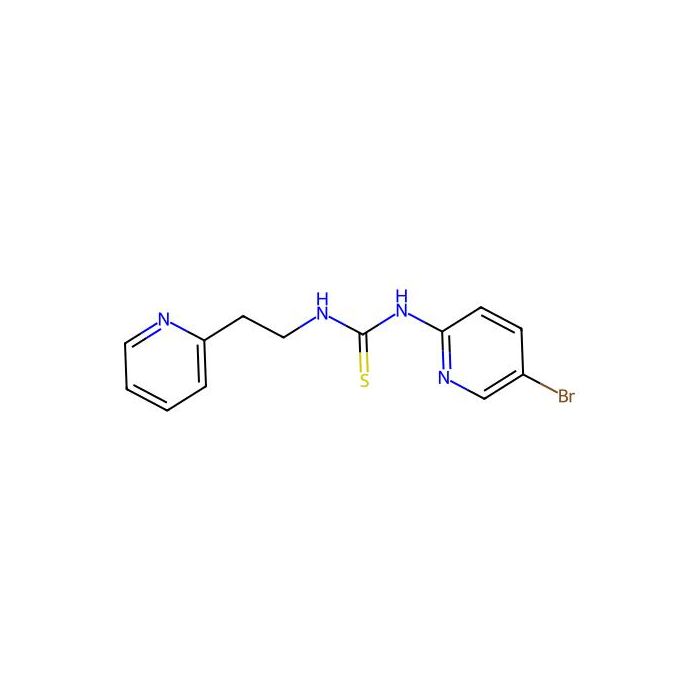
Trovirdine inhibits HIV-1 RT with an IC50 of 7 nM when employing heteropolymeric primer/template (oligo-DNA/ribosomal RNA)and dGTP as substrate.IC50 value: 7 nMTarget: HIV-1 Trovirdine is currently in phase I clinical trials for potential use in thetreatment of AIDS.
Spezifikationen
Spezifikationen & Reinheit
Moligand™, 10 mM in DMSO
Storage
Store at -80°C
Verschickt in
Dry ice packs + Cold packs
Dieses Produkt erfordert Kühlkettenversand. Grundversand und andere Economy-Optionen sind nicht verfügbar.
Note
Moligand™
Namen und Kennungen
Isomere SMILES
C1=CC=NC(=C1)CCNC(=S)NC2=NC=C(C=C2)Br
PubChem CID
3000870
Molekulargewicht
337.24
Dokumentation
📋 Sicherheitsdatenblatt (SDS)
Umfassendes Dokument zu Gefahren, Handhabung, Lagerung und Einhaltung regulatorischer Vorschriften.
Zertifikate (CoA, COO, BSE/TSE und Analyse-Diagramm)
C of A & Other Certificates(BSE/TSE, COO):
Analytical Chart:
Lösungsrechner
Molarity Calculator
Determine the necessary mass, volume, or concentration for preparing a solution.
Dilution Calculator
Determine the dilution needed to prepare a stock solution.
Reconstitution Calculator
Bewertungen
Kundenbewertungen
Application Protocols
No item-specific, validated application protocols are provided in the Product Data.
General guidance for small-molecule screening
Stock solution: Prepare at 10–50 mM in anhydrous DMSO. Aliquot and store at -80°C. Thaw once, keep on ice during use, and avoid repeated freeze–thaw.
Biochemical assays: Titrate across a broad concentration range (e.g., 0.1 nM–100 µM depending on expected potency). Include vehicle controls (DMSO-only) and orthogonal assay formats to detect interference.
Cell-based assays: Maintain final DMSO ≤0.5% v/v when possible. Confirm compound tolerance in your cell line. Monitor precipitation or turbidity after dosing.
Data quality: Use triplicate wells, include positive/negative controls, and assess Hill slope and maximum effect to flag potential aggregation.
Documentation
Record lot number and storage history. Attach CoA and SDS to your ELN entry for traceability.
Note: Any example concentrations are general, literature-style guidance for small molecules and are not specifications for this item.
Biological Roles
Context for research use (literature-based, non-clinical)
Trovirdine has been described in the literature as a small-molecule modulator of HIV-1 reverse transcriptase through a non-nucleoside binding site. As such, it is used in research to probe enzyme allostery, conformational dynamics, and resistance-associated mutations.
Common research readouts
Enzymology: IC50/Ki determination against recombinant reverse transcriptase, steady-state kinetics, and mechanism-of-inhibition studies.
Structural biology: Co-crystallization or modeling in the NNRTI pocket to evaluate binding modes and resistance mutations (e.g., K103N, Y181C) in a research context.
Virology research: Biochemical and cell-based assay development for understanding replication pathways and inhibitor susceptibility profiles. This product is for research use only and not for diagnostic or therapeutic use.
Caveats
Actual activity and selectivity can be assay-format dependent. Validate with appropriate positive/negative controls and orthogonal assays.
Avoid extrapolation to clinical performance; no medical or clinical claims are made for this research-grade material.
Buffer Applications
This compound is not a buffering agent and is not typically used to control pH. Accordingly, standard buffer formulation guidance (pH ranges, recipes) is not applicable.
Practical note for assays
When preparing aqueous working solutions, use established biological buffers (e.g., PBS, HEPES) and keep organic cosolvent levels (e.g., DMSO) within assay-tolerated limits. Item-specific pKa and buffer compatibility are not provided; determine empirically if pH-sensitive behavior is suspected.
Green Alternatives
Greener considerations focus on handling and solvent use during preparation and assays, as the compound itself is fixed.
Prefer low-toxicity, low-VOC solvents for cleaning and sample prep where feasible. For stock solutions, DMSO remains standard; however, keep final DMSO concentrations at the minimum needed for solubility (often 0.1–0.5% v/v in assays).
If ethanol can adequately solubilize at working concentrations, it may offer easier biodegradation and lower persistence than amide solvents like DMF.
Comparison (general)
DMSO: High solvency, miscible with water; relatively benign but can facilitate dermal transport—use PPE.
Ethanol: Renewable feedstock options; higher volatility and flammability.
Water-based vehicles: Ideal if compound solubility allows; consider cyclodextrins or mild surfactants for greener solubilization, balancing assay compatibility.
Operational green tips
Minimize solvent volumes via concentrated stocks and precise dispensing (acoustic/low-dead-volume systems).
Consolidate waste streams and use microplate-based formats to reduce consumables.
Note: No change to the identity of the active chemical is implied; these are process-level greener choices. Item-specific solubility is not specified; confirm feasibility experimentally.
Pharmaceutical Uses
This material is supplied strictly for research use only. It is not produced to pharmacopoeial standards and is not intended for human or veterinary use, clinical diagnostics, or as an active pharmaceutical ingredient.
Context (literature, for research background only)
Trovirdine has been studied historically as a non-nucleoside reverse transcriptase inhibitor scaffold. Any development status described in the literature does not constitute a specification or a use claim for this product.
Formulation research considerations
For preclinical research workflows (in vitro), DMSO stock solutions are commonly used; for in vivo formulation research, consult institutional guidelines and material safety data, and generate compound-specific solubility, stability, and vehicle compatibility profiles. No formulation specifications are provided for this item.
Regulatory note
No USP/EP/JP monograph or GMP status is claimed. For regulated applications, source GMP-grade materials and appropriate regulatory documentation.
Physical Properties
Item-specific physical property specifications are not included in the Product Data for this Moligand listing.
Appearance: Not specified for this item; refer to CoA/Spec Sheet.
Molecular weight: Not specified for this item; refer to CoA/Spec Sheet.
Molecular formula: Not specified for this item; refer to CoA/Spec Sheet.
Melting point: Not specified for this item; refer to CoA/Spec Sheet.
Boiling point: Not specified for this item; refer to CoA/Spec Sheet.
Density: Not specified for this item; refer to CoA/Spec Sheet.
LogP/logD: Not specified for this item; refer to CoA/Spec Sheet.
pKa: Not specified for this item; refer to CoA/Spec Sheet.
Solubility: Not specified for this item; refer to CoA/Spec Sheet.
Refractive index: Not applicable to solids; if a solution is provided, refer to CoA/Spec Sheet.
For small-molecule screening compounds, initial dissolution in anhydrous DMSO to prepare 10–50 mM stocks is common practice. If aqueous work is required, serial dilution of the DMSO stock into buffered media with gentle mixing and potential use of co-solvents (e.g., 0.1–1% DMSO final) is typical.
If the compound is hydrophobic, sonication and gradual cosolvent addition can aid dissolution. Always verify concentration and clarity before use.
Note: All numerical specifications should be taken from the CoA/SDS for the specific lot. Literature values, if consulted, are not specifications for this catalog item.
Quality and Grades
Grade: Moligand (from Product Data).
What Moligand signifies (general description)
Moligand refers to a small-molecule/ligand screening format intended for research discovery, HTS, and chemical biology. Materials are typically supplied to enable rapid assay deployment and medicinal chemistry triage.
Item-specific quality details
Purity, identity test methods (e.g., LC–MS, 1H NMR), counter-ion content, residual solvent, and water/peroxide/metal content: Not specified for this item; refer to CoA/Spec Sheet.
Implications for use
For biochemical or cell-based screening, ensure lot-specific purity and identity meet your internal QC thresholds by reviewing the CoA and acquiring orthogonal QC data if needed (e.g., re-check LC–MS, qNMR).
UV background and fluorescence: Not specified for this item. If using optical assays, run vehicle controls and spectral scans to exclude interference.
Documentation and traceability
Request and retain the CoA and SDS for your records. If regulatory submission or GLP/GMP context is anticipated, note that this research-grade material is for research use only and not manufactured to pharmacopoeial or GMP standards.
Reaction and Applications
This product is offered as a bioactive small molecule for research screening rather than as a synthetic reagent. Consequently, it is not typically used as a reactant or solvent in preparative organic synthesis.
Research applications (general, literature-based)
Chemical biology: Probe candidate for studying reverse transcriptase function and non-nucleoside binding-site interactions in biochemical assays and structural biology (e.g., enzyme inhibition kinetics, thermal shift assays).
Screening: Member of small-molecule libraries for high-throughput screening (HTS), dose–response profiling, and SAR hypothesis generation.
Analytical reference: Can serve as a reference standard in LC–MS method development for bioanalytical or ADME research workflows.
Not typically applicable
Named reactions, catalytic roles, or stoichiometric transformations are not relevant for this catalog item. For synthetic method development, consider dedicated reagents in our building-block or catalyst portfolios.
Best practices
Validate activity in your assay format with fresh DMSO stocks and appropriate controls (vehicle, negative/positive controls).
Check for compound aggregation or assay interference (detergent controls, orthogonal readouts).
Reaction Conditions
Not typically applicable. Trovirdine is supplied as a research screening compound, not a reagent for carrying out named reactions or catalysis.
General handling in experimental workflows
Stock preparation: Dissolve in anhydrous DMSO to desired concentration (e.g., 10–50 mM), vortex/sonicate as needed. Filter through 0.22 µm (PTFE) if particulate persists.
Assay incubation: Typical biochemical or cell-based assays use 0.1–1% DMSO final; optimize exposure time and temperature per your protocol. Light and temperature sensitivity, if any, should be determined empirically; no item-specific data are provided.
Note: For synthetic transformations involving this scaffold (e.g., analog synthesis), consult primary literature for reaction conditions. Such literature conditions are not specifications for this catalog item.
Safety and Handling
Safety information specific to this item is not provided in the Product Data. Always consult the SDS for authoritative guidance.
GHS classification: Not specified for this item; refer to SDS.
Signal word / H-statements / pictograms: Not specified for this item; refer to SDS.
General lab safety (good practice)
PPE: laboratory coat, safety glasses, and appropriate chemically resistant gloves (e.g., nitrile). Handle powders in a fume hood to avoid inhalation of dust/aerosols.
Avoid ingestion and skin/eye contact. Wash thoroughly after handling. Prevent environmental release—dispose of waste via approved chemical waste streams.
Incompatibilities: Without item-specific data, avoid strong oxidizers and strong acids/bases until compatibility is confirmed. Keep away from ignition sources when using organic solvents.
First aid (overview): If inhaled—move to fresh air; if on skin—wash with soap and water; if in eyes—rinse cautiously with water for several minutes; if ingested—rinse mouth. Seek medical attention and provide the SDS.
Storage and shipping
Storage: Store at -80°C (from Product Data). Protect from moisture and light. Keep container tightly closed.
Shipping: Shipped on dry ice packs + cold packs (from Product Data) to maintain material integrity.
Note: Some screening compounds may have limited stability in solution; prepare fresh aliquots and minimize freeze–thaw cycles.
Solvent Selection
Because item-specific solubility data are not provided, solvent choice should follow general best practices for small-molecule screening compounds.
Primary stock solvent: Anhydrous DMSO is typically preferred for library members due to broad solvating power and assay compatibility at 0.1–1% v/v.
Secondary co-solvents: DMF or ethanol can be used to pre-wet difficult solids before DMSO; for aqueous working solutions, buffer with 0.1–1% DMSO is common. Surfactants (e.g., 0.01% Tween-20) may enhance apparent solubility in some biochemical assays.
Aqueous buffers: If aqueous solubility permits, use neutral pH phosphate or HEPES buffers. Adjust pH only if the compound’s ionization behavior is known and compatible with your assay; item-specific pKa is not provided.
Comparison (general)
DMSO: Highest success rate for hydrophobic libraries; cell-compatible at low percentages.
Ethanol: Volatile and often acceptable up to ~0.5–1% v/v in cells; less potent solvent than DMSO.
DMF: Strong solvent; consider cytotoxicity and hygroscopicity.
Practical tips
Prepare concentrated DMSO stocks (e.g., 10–50 mM), filter if needed (PTFE, 0.22 µm), aliquot, and store at -80°C to limit freeze–thaw.
Verify clarity after dilution; if precipitation occurs, lower concentration or increase DMSO carryover within assay tolerance.
Note: For precise solubility limits and pH stability, consult the CoA or generate in-house solubility/stability profiles.
Storage and Reconstitution
Storage
Temperature: Store at -80°C (from Product Data).
Container: Keep tightly closed in the original container. Protect from light and moisture.
Solvent: Item-specific solubility is not provided; DMSO is generally recommended for initial stock preparation of small molecules. Verify clarity and stability after dissolution.
Concentration: Choose based on assay needs (e.g., 10–50 mM typical for screening stocks). Filter through 0.22 µm PTFE if particulates are observed.
Aliquoting: Prepare single-use aliquots to avoid repeated freeze–thaw cycles. Store aliquots at -80°C.
Stability
Solid-state and solution stability data are not specified for this item; refer to CoA/Spec Sheet. As a precaution, minimize time at ambient temperature, and avoid prolonged exposure to air and light.
Disposal
Dispose of unused material and solutions in accordance with institutional chemical waste procedures and local regulations.
Research use only
This product is intended exclusively for research use and is not for human or veterinary use, diagnostics, or therapeutic applications.
Structure and Identity
Trovirdine is supplied as a Moligand small-molecule library member for research screening.
CAS: 149488-17-5 (from Product Data)
PubChem CID: 3000870 (from Product Data)
Molecular formula: Not specified for this item; refer to CoA/Spec Sheet.
Molecular weight: Not specified for this item; refer to CoA/Spec Sheet.
SMILES: Not specified for this item; refer to CoA/Spec Sheet.
InChIKey: Not specified for this item; refer to CoA/Spec Sheet.
Structural notes
Item-specific structural descriptors (ring systems/functional groups, stereochemistry) are not provided in the Product Data. Refer to the attached CoA/Spec Sheet or authoritative databases (cross-reference using CAS 149488-17-5 or CID 3000870) for the exact 2D structure and identifiers.
General context (literature)
Trovirdine is described in the literature as a small-molecule heteroaromatic compound developed as a non-nucleoside modulator of reverse transcriptase. For precise structural features, consult primary literature or curated databases. This information is provided for context only and is not a specification for this catalog item.
Synthetic Utility
This product is offered as a defined bioactive small molecule rather than as a synthetic building block. As such, it is not typically used to form new bonds or serve as a reagent/catalyst in synthesis.
Research utility in synthesis-adjacent contexts
Analytical standard: Can aid in developing and validating LC–MS methods (retention time, fragmentation) in medicinal chemistry workflows.
SAR benchmarking: Serves as a reference chemotype when designing or comparing analogs targeting reverse transcriptase in a research setting.
If synthetic modification is intended
Obtain the exact structure and functional group map from the CoA/Spec Sheet or literature (via CAS 149488-17-5 or CID 3000870) to plan protection/deprotection and diversification strategies.
Generate your own stability map (acid/base/oxidative) before late-stage functionalization; item-specific stability parameters are not provided.
Target Specificity
Item-specific target, binding constants, and selectivity panels are not provided in the Product Data.
General research context (literature)
Trovirdine has been reported as a non-nucleoside modulator of HIV-1 reverse transcriptase, binding to an allosteric pocket distinct from the nucleoside substrate site. Actual affinity, selectivity versus related polymerases, and resistance profiles must be established under your assay conditions.
For this catalog item
Verified target, assay validations, and potency data: Not specified for this item; refer to CoA/Spec Sheet and generate in-house QC and bioactivity data as required.
Häufig gestellte Fragen
What is Moligand??
Moligand? is one of Aladdin Scientific's premium product lines, formulated for high-purity applications across multiple workflows. Compared to standard grades in the same workflow, Moligand? products typically offer tighter specifications, more rigorous QC, and stronger lot-to-lot consistency.
How should this product be stored?
Store at ?80 °C. Ultra-low temperature storage is required to maintain the specified shelf life.
How is this product shipped?
This product ships frozen with dry ice and cold packs. Unpack on arrival and transfer it to the storage condition stated above; handle dry ice with insulated gloves in a ventilated area.
What are the CAS number, molecular formula and molecular weight?
The CAS Number is 149488-17-5, the molecular formula is C13H13BrN4S, and the molecular weight is 337.24 g/mol.
What documentation is provided?
Available product documentation, including Certificates of Analysis (COA), Safety Data Sheets (SDS), and specification sheets, is shown in the product document area. Document availability and access follow the current site policy.
Benötigen Sie Hilfe bei der Auswahl der Qualität?
Unser Leitfaden zur Qualitätsauswahl behandelt Reinheit, Stabilisatorstatus und Anwendungseignung für alle Varianten in unserem Katalog.
Wir verwenden Cookies, um die ordnungsgemäße Funktion der Website sicherzustellen und, soweit zulässig, Ihr Nutzererlebnis zu verbessern. Sie können Ihre Einstellungen jederzeit unter „Einstellungen“ verwalten. Weitere Informationen finden Sie in unserer Cookie-Richtlinie.
Dürfen wir Sie über Rabattaktionen informieren?
Später erinnern
Vielen Dank! Bitte überprüfen Sie Ihren E-Mail-Posteingang, um zu bestätigen.
Products are supplied to verified businesses, institutions, and qualified professionals for research and development use only. Not for use in humans, animals, diagnosis, or therapy.