GRADE & PURITYMoligand™?Moligand™ — Aladdin's line of ligands and bioactive small molecules. Use for receptor, pathway, and binding studies needing defined small-molecule tools.10 mM in DMSO
Zertifikate (CoA, COO, BSE/TSE und Analyse-Diagramm)
C of A & Other Certificates(BSE/TSE, COO):
Analytical Chart:
Lösungsrechner
Molarity Calculator
Determine the necessary mass, volume, or concentration for preparing a solution.
Dilution Calculator
Determine the dilution needed to prepare a stock solution.
Reconstitution Calculator
Bewertungen
Kundenbewertungen
Application Protocols
Validated application types, recommended concentrations, and assay-specific protocols are not supplied for this item.
General starting points (non-item-specific)
Stock preparation: Dissolve in anhydrous DMSO to prepare a concentrated stock (e.g., 10–50 mM). Aliquot and store as directed to avoid repeated freeze–thaw.
Biochemical assays: Typical working concentrations span low nanomolar to micromolar; perform a dilution series (e.g., 10-point, 1:3 or 1:2) to map potency and solubility limits.
Cell-based assays: Keep final DMSO ≤0.1–0.5% v/v unless your system tolerates higher. Include vehicle controls and time-matched treatments.
Stability checks: Verify short-term stability in the specific assay buffer/media over the experiment duration (e.g., 4–24 h) using LC–MS or HPLC.
Item-specific parameters
Tested applications and dilutions: Not specified for this item; refer to CoA/Spec Sheet.
For detailed SOPs, request the technical dossier or consult primary literature associated with this CAS.
Biological Roles
This catalog item is provided as a research-only small molecule. Specific molecular targets, binding modes, and cellular phenotypes for this item are not specified in this listing and should be confirmed from the CoA/Spec Sheet or primary literature associated with CAS 1801756-06-8.
General considerations for small-molecule research tools
Such compounds are commonly used to interrogate signaling pathways, validate targets in chemical biology, and support structure–activity relationship (SAR) studies.
Off-target assessment may involve broad kinase or proteome panels, counterscreens for pan-assay interference (PAINS), and orthogonal assays to rule out aggregation or redox artifacts.
Practical advice
Establish a reference stock in DMSO and validate concentration by UV–Vis or quantitative NMR when feasible.
Run titration series across multiple assay formats to triangulate potency and rule out system-specific artifacts.
Include solvent controls and, where available, benchmark comparators from the same target class for internal calibration.
Note
For any claimed biological role or pathway mapping, rely on peer-reviewed sources or the product’s technical dossier; this listing does not assert therapeutic utility.
Buffer Applications
This product is not a buffering agent and is not intended to establish or maintain pH in solution.
In practice, the compound may be diluted from an organic stock (e.g., DMSO) into a pre-selected biological buffer (e.g., PBS, HEPES, or assay-specific media) for testing.
Choose buffers with sufficient ionic strength and protein content (e.g., BSA, serum) when needed to limit nonspecific adsorption and precipitation during low-percent DMSO additions.
For buffer recipes and pH ranges, consult standard buffer references; no item-specific buffer parameters apply to this compound.
Green Alternatives
Sustainability in handling small-molecule research agents centers on solvent choices and process minimization rather than substitution of the active compound itself.
Greener handling strategies (general)
High-concentration stocks: Prepare the highest practical DMSO stock to minimize total solvent volume used across experiments.
Aqueous-first dilutions: Dilute into buffered aqueous media as early as performance allows to reduce organic solvent burden.
Solvent alternatives: Where feasible, replace DMF with DMSO or water-miscible bio-based solvents for cleaning steps. For glassware cleaning, employ aqueous detergents before resorting to organic rinses.
Waste minimization: Plan experiments to use microplate formats and low-dead-volume reservoirs to reduce waste.
Illustrative comparison (general; not item-specific)
DMSO vs DMF: DMSO offers lower volatility and favorable worker exposure profile; DMF is a reproductive toxin and should be minimized when alternatives exist.
Ethanol vs isopropanol for intermediate solubilization: Both are relatively benign; select based on assay tolerance and evaporation rate.
Caveats
Maintain compound integrity: do not compromise the molecule’s stability by switching to a solvent system that induces precipitation or degradation.
Always validate green substitutions empirically in your assay system.
Pharmaceutical Uses
For research use only. No clinical or therapeutic claims are made for this product.
Research and development contexts (general)
Reference standard/control: Can serve as a reference compound in medicinal chemistry and discovery biology workflows (e.g., assay benchmarking, profiling cascades), subject to confirmation of identity and purity from the CoA/Spec Sheet.
Formulation research: Preclinical formulation experiments may explore solubilization strategies (co-solvents, cyclodextrins, micelles, lipid-based systems) to improve delivery in in vitro/in vivo models. Any such work must remain within non-clinical research contexts.
Analytical method development: Useful for establishing LC–MS/MS methods, recovery from matrices, and stability-indicating methods, once structural data and ionization behavior are confirmed.
Regulatory note
This item is not produced to GMP standards and is not intended for human or veterinary use. If you require pharmacopeial or GMP-grade materials, contact us to discuss sourcing options.
Physical Properties
Physical constants and handling-relevant parameters for this specific catalog item are not provided. Use the CoA/Spec Sheet for experiment-critical planning.
Item-specific values
Appearance: Not specified for this item; refer to CoA/Spec Sheet.
Molecular weight: Not specified for this item; refer to CoA/Spec Sheet.
Melting point / Boiling point: Not specified for this item; refer to CoA/Spec Sheet.
Density / Refractive index: Not specified for this item; refer to CoA/Spec Sheet.
Solubility: Not specified for this item; refer to CoA/Spec Sheet.
LogP / pKa: Not specified for this item; refer to CoA/Spec Sheet.
General laboratory guidance (non-item-specific)
Small-molecule research agents of this class are commonly supplied as solids or concentrated solutions. For stock preparation, labs often employ high-boiling, polar aprotic solvents (e.g., DMSO) to achieve millimolar concentrations, followed by dilution into aqueous assay buffers just prior to use to minimize compound precipitation and adsorption.
If lyophilized, allow vial to equilibrate to ambient temperature in a desiccated environment before opening to prevent moisture condensation.
Important
Do not treat any literature constant as a product specification. Where a precise numerical value is required for QC or method validation, obtain the verified specification for the lot you receive.
Quality and Grades
This item is supplied as Moligand™ grade, intended for research use in chemical biology, screening, and ligand-discovery workflows.
What Moligand™ typically implies (general information)
Use intent: Designed for small-molecule and compound library applications, including target engagement studies, phenotypic screening, and SAR exploration.
Analytical control: Emphasis on identity confirmation and high chemical purity suitable for discovery assays; documentation typically includes mass/identity verification and impurity control appropriate for screening. Exact specifications (e.g., HPLC area %, residual solvents, water content) are lot-dependent.
Item-specific statements
Purity/assay: Not specified for this item; refer to CoA/Spec Sheet.
Stabilizers/additives: Not specified for this item; refer to CoA/Spec Sheet.
Practical implications
For sensitive biophysical assays (SPR, ITC, DSF) or cell-based workflows, verify lot-specific purity and counterion/solvent profile to minimize assay artifacts (e.g., aggregate formation, fluorescence interference).
If performing trace-analytics or photometric assays, request UV–Vis background/LC-UV profiles to ensure low baseline absorbance in your detection window.
Documentation
For regulated workflows or reproducibility packages, request the latest CoA/Spec Sheet and any available analytical chromatograms for your lot.
Reaction and Applications
This product is a bioactive small molecule supplied for research use and is not typically employed as a chemical reagent or catalyst in synthetic transformations.
As a result, conventional organic reaction roles (e.g., nucleophile, electrophile, ligand, catalyst) are not generally applicable to this item in routine bench chemistry.
In research programs, compounds of this type are primarily used in biochemical, cell-based, or biophysical assays to interrogate pathways and target engagement, rather than to participate in bond-forming reactions.
If you intend to derivatize or immobilize the molecule
Obtain the full structural information (SMILES/InChI) and functional group map from the CoA/Spec Sheet to assess modification points.
Conduct a small-scale compatibility screen to evaluate stability against hydrolysis, oxidation, strong acids/bases, and common coupling reagents prior to any conjugation workflow.
For laboratories seeking a synthetic intermediate instead
Please contact us with the desired functionality or scaffold requirements; alternative catalog building blocks may be more suitable for synthetic chemistry.
Reaction Conditions
Conventional synthetic reaction conditions are not typically applicable to this product because it is supplied as a finished bioactive compound rather than a reagent.
If you plan to modify the molecule, conduct a limited stress-screen to map stability against common conditions (acidic/basic media, oxidants/reductants, elevated temperatures, light exposure), using analytical follow-up (LC–MS, HPLC) to monitor integrity.
When preparing solutions for biological assays, maintain gentle conditions: neutral pH buffers, low light if the compound shows UV/visible chromophores, and minimal agitation/air exposure to reduce oxidative degradation.
Data needs
Obtain the structure and any known stability data from the CoA/Spec Sheet or literature before attempting reactions or advanced formulation work.
Safety and Handling
Safety information for this catalog item is partially unspecified. Always review the official SDS for authoritative guidance and local compliance.
Item-specific safety data
GHS classification: Not specified for this item; refer to SDS.
Signal word / Pictograms / H-statements: Not specified for this item; refer to SDS.
General laboratory precautions (good practice)
PPE: Lab coat, nitrile gloves, and splash-resistant safety glasses as a baseline. Upgrade to chemically resistant gloves and eye/face protection if handling concentrated solutions or powders that may become airborne.
Engineering controls: Work in a chemical fume hood when weighing solids or preparing stock solutions to avoid inhalation of dusts/aerosols.
Hygiene: Avoid ingestion/inhalation and skin contact. Wash thoroughly after handling. Do not eat, drink, or smoke in work areas.
Incompatibilities: Avoid strong oxidizers and strong acids/bases until compatibility is established from the SDS or small-scale testing.
First aid (overview): In case of contact, rinse affected area with copious water for ≥15 minutes and remove contaminated clothing. If inhaled, move to fresh air. If ingested, do not induce vomiting; seek medical attention. Provide SDS to responders.
Waste disposal: Dispose according to institutional chemical waste protocols; do not discharge to drains.
Transportation and cold-chain
Shipped on dry ice packs + cold packs to maintain low temperature. Upon arrival, promptly transfer to the specified storage (see Storage & Reconstitution).
Solvent Selection
Guidance for preparing working stocks and assay solutions for a hydrophobic small-molecule research agent.
General characteristics (class-level, not item-specific)
Many kinase-focused tool compounds are moderately to highly hydrophobic with limited aqueous solubility. Stock solutions are commonly prepared in DMSO at 10–50 mM, then diluted into aqueous buffer just before use.
Recommended approach
Primary solvent: DMSO (anhydrous) for high-concentration stocks. Filter-sterilize if needed (0.22 µm PTFE) and aliquot to minimize freeze–thaw.
Co-solvent dilution: For aqueous assays, dilute the DMSO stock into buffer while vortexing; keep final DMSO ≤0.1–0.5% v/v for sensitive cellular systems (optimize per assay).
Alternative solvents (as appropriate): DMF or ethanol can be used for intermediate stocks when compatible with downstream assays. Avoid strong protic acids/bases without compatibility data.
Surfactant assistance: For stubborn precipitation on dilution, 0.01–0.05% non-ionic surfactant (e.g., Tween 80 or Pluronic F-68) may help; verify biological inertness.
Comparison snapshot (typical, literature)
DMSO: maximal solubilization, broad biological compatibility at ≤0.1–0.5%.
Ethanol: acceptable for some assays; volatility and cytotoxicity at ≥0.5–1% can be limiting.
Aqueous buffer only: often insufficient without co-solvent.
Note
Do not treat these as specifications; confirm solubility and compatibility empirically for your system.
Storage and Reconstitution
Follow cold-chain best practices to preserve integrity across experiments.
Item-specific storage
Storage conditions: Store at -80°C (per product data).
Shipping: Dispatched on dry ice packs + cold packs to maintain low temperature during transit.
Reconstitution guidance (general)
Equilibrate the sealed vial to room temperature in a desiccator before opening to avoid moisture condensation.
Prepare a concentrated DMSO stock under dry, inert conditions if feasible. Vortex to ensure complete dissolution; brief sonication may help. Avoid elevated temperatures unless stability is confirmed.
Aliquot into low-bind microtubes to minimize adsorption and freeze–thaw cycles; purge headspace with inert gas if oxidation is a concern.
For aqueous use, dilute the DMSO stock into buffer immediately before the assay. Monitor for precipitation; if observed, increase dilution rate, adjust temperature slightly, or add an approved non-ionic surfactant at low percentage.
Stability notes
Protect from light if the compound shows chromophoric behavior (verify via CoA or a quick UV scan).
Avoid repeated freeze–thaw; store aliquots tightly capped at -80°C. For short-term working stocks at 4°C or -20°C, establish stability by analytical testing.
Always defer to the lot-specific CoA/Spec Sheet for definitive storage and reconstitution instructions.
Structure and Identity
Overview of structural identity and registry information for this item as supplied in our catalog.
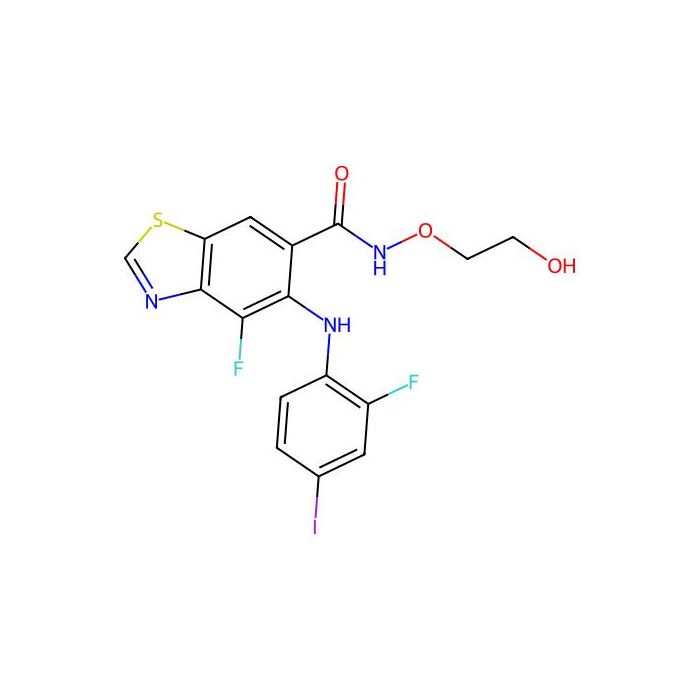
Product name: Tunlametinib (SKU: T1496206)
CAS: 1801756-06-8
PubChem CID (literature): 71621329
InChIKey: Not specified for this item; refer to CoA/Spec Sheet.
SMILES: Not specified for this item; refer to CoA/Spec Sheet.
Molecular formula: Not specified for this item; refer to CoA/Spec Sheet.
Molecular weight: Not specified for this item; refer to CoA/Spec Sheet.
Tunlametinib is a small-molecule research compound. Detailed atom-by-atom connectivity, stereochemistry, and functional group annotations are not provided in this listing. For precise 2D/3D structure, please consult the CoA/Spec Sheet or primary literature associated with CAS 1801756-06-8.
Notes
This listing emphasizes catalog identity and traceability. Where structure strings (SMILES/InChI) and exact composition are required for cheminformatics, please request the latest specification package.
Synthetic Utility
This product is supplied as a finished small-molecule research agent and is not positioned as a synthetic building block.
Without item-specific structural details (SMILES/functional groups), proposing derivatization or fragment-based synthetic routes would be speculative. If your use case involves conjugation, prodrug design, or immobilization, please request detailed structural documentation (CoA/Spec Sheet) and consider procuring suitable analogs or intermediates.
For method development or analog synthesis, cheminformatics searches using the provided CAS (1801756-06-8) and literature sources can help identify compatible reaction manifolds and stability constraints.
Recommendation
If you need a precursor scaffold or functional-handle variant, our team can help identify alternative catalog items that better serve as synthetic feedstocks.
Target Specificity
Target, selectivity profile, and binding parameters are not provided in this product listing.
Item-specific details such as primary target, off-targets, Kd/IC50 values, and selectivity ratios are not specified for this item; refer to CoA/Spec Sheet.
For program planning, consult peer-reviewed literature associated with CAS 1801756-06-8 and confirm applicability to your experimental system.
Note: In keeping with catalog policy, we do not assert biological targets or clinical claims without explicit supporting data in the product documentation.
Need help choosing the grade?
Our grade selection guide covers purity, stabilizer status, and application suitability for all variants in our catalog.
Wir verwenden Cookies, um die ordnungsgemäße Funktion der Website sicherzustellen und, soweit zulässig, Ihr Nutzererlebnis zu verbessern. Sie können Ihre Einstellungen jederzeit unter „Einstellungen“ verwalten. Weitere Informationen finden Sie in unserer Cookie-Richtlinie.
Shall we send you a message when we have discounts available?
Remind me later
Thank you! Please check your email inbox to confirm.
Products are supplied to verified businesses, institutions, and qualified professionals for research and development use only. Not for use in humans, animals, diagnosis, or therapy.