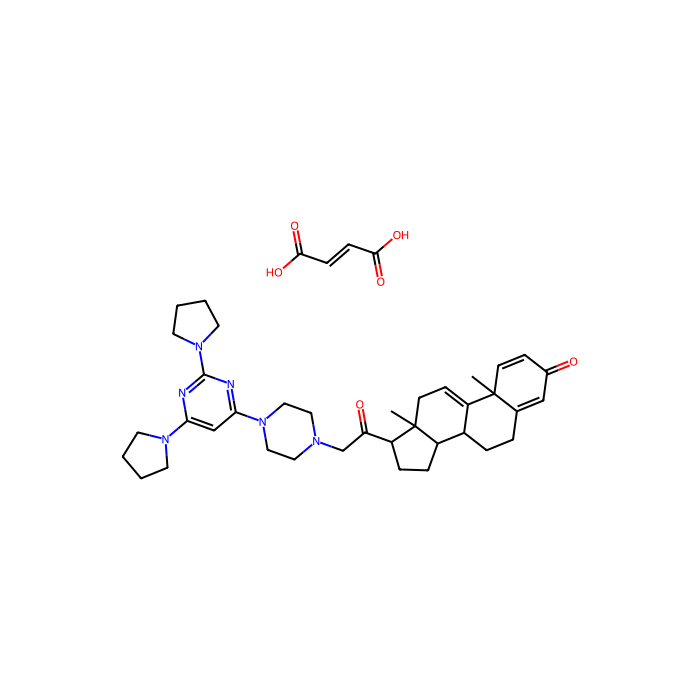
U-74389G - ≥98% , CAS No.153190-29-5

CAS: 153190-29-5 Cat. No.: U275892 Summenformel: C37H50N6O2.C4H4O4 Molekulargewicht: 726.9 PubChem CID: 9896684
Zu bestellen verfügbar
QUALITÄT & REINHEIT ≥98%
Storage
Store at -20°C,Desiccated
Shipped In
Ice chest + Ice pads
★
Größe
Deutschland (EU)
USA*
Preis
Menge
100mg
U275892-100mg
Auf Bestellung · 8–12 Wochen
225,53€
Enter a quantity for the sizes you want to add.

Übersicht

Store at -20°C. Store under desiccating conditions. The product can be stored for up to 12 months.

Spezifikationen

Spezifikationen & Reinheit
≥98%
Biochemische und physiologische Mechanismen
Antioxidant. Protects against lipid peroxidation by inhibiting the activity of the inducible nitric oxide synthase. Blood brain barrier permeable. Active both in vivo and in vitro .
Storage
Store at -20°C,Desiccated
Verschickt in
Ice chest + Ice pads
Dieses Produkt erfordert Kühlkettenversand. Grundversand und andere Economy-Optionen sind nicht verfügbar.
Hinweis
Wherever possible, you should prepare and use solutions on the same day. However, if you need to make up stock solutions in advance, we recommend that you store the solution as aliquots in tightly sealed vials at -20°C. Generally, these will be useable for up to one month. Before use, and prior to opening the vial we recommend that you allow your product to equilibrate to room temperature for at least 1 hour. Need more advice on solubility, usage and handling? Please visit our frequently asked questions (FAQ) page for more details.
Reinheit
≥98%
Namen und Kennungen
SMILES
CC12CC=C3C(C1CCC2C(=O)CN4CCN(CC4)C5=NC(=NC(=C5)N6CCCC6)N7CCCC7)CCC8=CC(=O)C=CC83C.C(=CC(=O)O)C(=O)O
IUPAC Name
(Z)-but-2-enedioic acid;(8S,10S,13S,14S,17S)-17-[2-[4-(2,6-dipyrrolidin-1-ylpyrimidin-4-yl)piperazin-1-yl]acetyl]-10,13-dimethyl-6,7,8,12,14,15,16,17-octahydrocyclopenta[a]phenanthren-3-one
InChIKey
ABCSSKWSUJMJCP-WQDFMEOSSA-N
InChI
1S/C37H50N6O2.C4H4O4/c1-36-13-11-27(44)23-26(36)7-8-28-29-9-10-31(37(29,2)14-12-30(28)36)32(45)25-40-19-21-42(22-20-40)34-24-33(41-15-3-4-16-41)38-35(39-34)43-17-5-6-18-43;5-3(6)1-2-4(7)8/h11-13,23-24,28-29,31H,3-10,14-22,25H2,1-2H3;1-2H,(H,5,6)(H,7,8)/b;2-1-/t28-,29-,31+,36-,37-;/m0./s1
Isomere SMILES
C[C@]12CC=C3[C@H]([C@@H]1CC[C@@H]2C(=O)CN4CCN(CC4)C5=NC(=NC(=C5)N6CCCC6)N7CCCC7)CCC8=CC(=O)C=C[C@@]83C.C(=C\C(=O)O)\C(=O)O
PubChem CID
9896684
Molekulargewicht
726.9

Erweiterte Daten

Taxonomic Classification

Taxonomy Tree

KingdomOrganic compounds
SuperclassLipids and lipid-like molecules
KlasseSteroids and steroid derivatives
SubclassPregnane steroids
Intermediate Tree Nodes Not available
Direct ParentGluco/mineralocorticoids, progestogins and derivatives
Alternative Parents 20-oxosteroids  3-oxo delta-1,4-steroids  Delta-1,4-steroids  N-arylpiperazines  Dialkylarylamines  Aminopyrimidines and derivatives  N-alkylpiperazines  Unsaturated fatty acids  Imidolactams  Dicarboxylic acids and derivatives  Pyrrolidines  Alpha-amino ketones  Heteroaromatic compounds  Trialkylamines  Cyclic ketones  Carboxylic acids  Azacyclic compounds  Organic oxides  Hydrocarbon derivatives  
Molecular FrameworkNot available
Substituents Progestogin-skeleton - 20-oxosteroid - 3-oxo-delta-1,4-steroid - 3-oxosteroid - Oxosteroid - Delta-1,4-steroid - N-arylpiperazine - Dialkylarylamine - Aminopyrimidine - N-alkylpiperazine - 1,4-diazinane - Dicarboxylic acid or derivatives - Fatty acyl - Piperazine - Pyrimidine - Unsaturated fatty acid - Fatty acid - Imidolactam - Alpha-aminoketone - Heteroaromatic compound - Pyrrolidine - Cyclic ketone - Tertiary aliphatic amine - Ketone - Tertiary amine - Carboxylic acid derivative - Azacycle - Organoheterocyclic compound - Carboxylic acid - Organic oxide - Hydrocarbon derivative - Organic nitrogen compound - Organic oxygen compound - Organonitrogen compound - Carbonyl group - Organooxygen compound - Amine - Aromatic heteropolycyclic compound
BeschreibungThis compound belongs to the class of organic compounds known as gluco/mineralocorticoids, progestogins and derivatives. These are steroids with a structure based on a hydroxylated prostane moiety.
External Descriptors Not available
3D-Struktur
Interaktives chemisches Strukturmodell


Zugehörige Ziele (menschlich)
VDR Tclin Vitamin D receptor (26531 Activities)
Activity TypeRelationActivity valueUnitsAction TypeJournalPubMed IddoiAssay Aladdin ID
TRPV1 Tclin Vanilloid receptor (8273 Activities)
Activity TypeRelationActivity valueUnitsAction TypeJournalPubMed IddoiAssay Aladdin ID
ALDH1A1 Tchem Aldehyde dehydrogenase 1A1 (77053 Activities)
Activity TypeRelationActivity valueUnitsAction TypeJournalPubMed IddoiAssay Aladdin ID
PIN1 Tchem Peptidyl-prolyl cis-trans isomerase NIMA-interacting 1 (36611 Activities)
Activity TypeRelationActivity valueUnitsAction TypeJournalPubMed IddoiAssay Aladdin ID
HEK293 (82097 Activities)
Activity TypeRelationActivity valueUnitsAction TypeJournalPubMed IddoiAssay Aladdin ID
HepG2 (196354 Activities)
Activity TypeRelationActivity valueUnitsAction TypeJournalPubMed IddoiAssay Aladdin ID
POLI Tchem DNA polymerase iota (116820 Activities)
Activity TypeRelationActivity valueUnitsAction TypeJournalPubMed IddoiAssay Aladdin ID
POLH Tchem DNA polymerase eta (21678 Activities)
Activity TypeRelationActivity valueUnitsAction TypeJournalPubMed IddoiAssay Aladdin ID
KDM4A Tchem Lysine-specific demethylase 4A (52245 Activities)
Activity TypeRelationActivity valueUnitsAction TypeJournalPubMed IddoiAssay Aladdin ID
EHMT2 Tchem Histone-lysine N-methyltransferase, H3 lysine-9 specific 3 (93046 Activities)
Activity TypeRelationActivity valueUnitsAction TypeJournalPubMed IddoiAssay Aladdin ID
TDP1 Tchem Tyrosyl-DNA phosphodiesterase 1 (345557 Activities)
Activity TypeRelationActivity valueUnitsAction TypeJournalPubMed IddoiAssay Aladdin ID
KDM4E Tchem Lysine-specific demethylase 4D-like (40243 Activities)
Activity TypeRelationActivity valueUnitsAction TypeJournalPubMed IddoiAssay Aladdin ID
LMNA Tbio Prelamin-A/C (36751 Activities)
Activity TypeRelationActivity valueUnitsAction TypeJournalPubMed IddoiAssay Aladdin ID
RECQL Tbio ATP-dependent DNA helicase Q1 (5575 Activities)
Activity TypeRelationActivity valueUnitsAction TypeJournalPubMed IddoiAssay Aladdin ID
BLM Tchem Bloom syndrome protein (4248 Activities)
Activity TypeRelationActivity valueUnitsAction TypeJournalPubMed IddoiAssay Aladdin ID
GMNN Tbio Geminin (128009 Activities)
Activity TypeRelationActivity valueUnitsAction TypeJournalPubMed IddoiAssay Aladdin ID
PMP22 Tbio Peripheral myelin protein 22 (699 Activities)
Activity TypeRelationActivity valueUnitsAction TypeJournalPubMed IddoiAssay Aladdin ID
KMT2A Tchem Histone-lysine N-methyltransferase MLL (17327 Activities)
Activity TypeRelationActivity valueUnitsAction TypeJournalPubMed IddoiAssay Aladdin ID
MPHOSPH8 Tbio M-phase phosphoprotein 8 (656 Activities)
Activity TypeRelationActivity valueUnitsAction TypeJournalPubMed IddoiAssay Aladdin ID
USP1 Tchem Ubiquitin carboxyl-terminal hydrolase 1 (22556 Activities)
Activity TypeRelationActivity valueUnitsAction TypeJournalPubMed IddoiAssay Aladdin ID
RGS4 Tchem Regulator of G-protein signaling 4 (13867 Activities)
Activity TypeRelationActivity valueUnitsAction TypeJournalPubMed IddoiAssay Aladdin ID
IDH1 Tclin Isocitrate dehydrogenase [NADP] cytoplasmic (40980 Activities)
Activity TypeRelationActivity valueUnitsAction TypeJournalPubMed IddoiAssay Aladdin ID
APOBEC3F Tbio DNA dC->dU-editing enzyme APOBEC-3F (14861 Activities)
Activity TypeRelationActivity valueUnitsAction TypeJournalPubMed IddoiAssay Aladdin ID
MEN1 Tchem Menin/Histone-lysine N-methyltransferase MLL (48157 Activities)
Activity TypeRelationActivity valueUnitsAction TypeJournalPubMed IddoiAssay Aladdin ID
TARDBP Tchem TAR DNA-binding protein 43 (40113 Activities)
Activity TypeRelationActivity valueUnitsAction TypeJournalPubMed IddoiAssay Aladdin ID
RAN Tchem GTP-binding nuclear protein Ran/Importin subunit beta-1/Snurportin-1 (21853 Activities)
Activity TypeRelationActivity valueUnitsAction TypeJournalPubMed IddoiAssay Aladdin ID
Zugehörige Ziele (nicht menschlich)
Cruzipain (33337 Activities)
Activity TypeRelationActivity valueUnitsAction TypeJournalPubMed IddoiAssay Aladdin ID
Plasmodium falciparum (966862 Activities)
Activity TypeRelationActivity valueUnitsAction TypeJournalPubMed IddoiAssay Aladdin ID
Npsr1 Neuropeptide S receptor (260 Activities)
Activity TypeRelationActivity valueUnitsAction TypeJournalPubMed IddoiAssay Aladdin ID
Txnrd1 Thioredoxin reductase 1, cytoplasmic (45279 Activities)
Activity TypeRelationActivity valueUnitsAction TypeJournalPubMed IddoiAssay Aladdin ID
Mapt Microtubule-associated protein tau (6 Activities)
Activity TypeRelationActivity valueUnitsAction TypeJournalPubMed IddoiAssay Aladdin ID
FTL Ferritin light chain (43324 Activities)
Activity TypeRelationActivity valueUnitsAction TypeJournalPubMed IddoiAssay Aladdin ID
nfo Endonuclease 4 (425 Activities)
Activity TypeRelationActivity valueUnitsAction TypeJournalPubMed IddoiAssay Aladdin ID
NS1 Nonstructural protein 1 (33327 Activities)
Activity TypeRelationActivity valueUnitsAction TypeJournalPubMed IddoiAssay Aladdin ID
Wirkungsmechanismen
Zertifikate (CoA, COO, BSE/TSE und Analyse-Diagramm)
C of A & Other Certificates(BSE/TSE, COO):
Analytical Chart:
Chemische und physikalische Eigenschaften
LöslichkeitSoluble in DMSO to 25 mM and in ethanol to 25 mM
Molekulargewicht726.900 g/mol
XLogP3
Hydrogen Bond Donor Count2
Hydrogen Bond Acceptor Count12
Rotatable Bond Count8
Exact Mass726.41 Da
Monoisotopic Mass726.41 Da
Topological Polar Surface Area147.000 Ų
Heavy Atom Count53
Formal Charge0
Complexity1380.000
Isotope Atom Count0
Defined Atom Stereocenter Count5
Undefined Atom Stereocenter Count0
Defined Bond Stereocenter Count1
Undefined Bond Stereocenter Count0
The total count of all stereochemical bonds1
Covalently-Bonded Unit Count2
Lösungsrechner
Bewertungen

Kundenbewertungen

Application Protocols

No item-specific, validated protocols are provided in this listing. The following are general research-use guidelines for small, lipophilic antioxidants in cell-based or biochemical assays. Always optimize for your system.

General cell-based assay setup (example framework):

  • Stock: Prepare 10–50 mM in DMSO; store at −20 °C in aliquots to minimize freeze–thaw.
  • Working solutions: Dilute into prewarmed culture media to achieve desired final concentration with ≤0.1–0.5% DMSO. Include vehicle controls at matching solvent content.
  • Exposure: Typical exploratory ranges are low micromolar to tens of micromolar; confirm cytotoxicity and solubility.
  • Readouts: Assess oxidative stress markers (e.g., lipid peroxidation assays) alongside orthogonal controls to verify mechanism-related effects.

Biochemical assays:

  • Use appropriate detergent-free buffers unless validated otherwise; maintain constant ionic strength and pH. Verify compound stability across the assay timeframe by parallel analytical samples.

These are illustrative, literature-style guidelines and are not item-specific performance claims.

Biological Roles

Literature context (non-clinical, mechanistic):

  • U-74389G is described as a member of the “lazaroid”/21-aminosteroid antioxidants, developed to inhibit lipid peroxidation in biological membranes. Such compounds typically function as radical-trapping agents that intercept peroxyl radicals within the lipid bilayer, thereby modulating propagation of oxidative damage.
  • Membrane localization: The steroidal core confers strong lipid affinity, facilitating partitioning into bilayers where lipid peroxidation occurs. The amino substituent can influence protonation state and microenvironment interactions at physiological pH.
  • Use in model systems: Employed as a probe in cell culture and biochemical assays to study oxidative stress, membrane stability, and downstream signaling events (e.g., effects on peroxide-derived electrophiles), always with appropriate controls to distinguish antioxidant from nonspecific amphiphile effects.

Notes and caveats:

  • Activity is sensitive to formulation, local pH, and membrane composition; validating effective intracellular or membrane concentrations is critical.
  • Avoid over-interpretation: off-target interactions (e.g., membrane fluidity changes) can confound readouts; orthogonal assays are recommended.

All uses are for research only. No medical or clinical claims are made or implied.

Buffer Applications

This product is not a buffering agent and does not define a characteristic pH range. Accordingly, there are no standard buffer recipes applicable to U-74389G.

Practical guidance for use in buffered systems (research context):

  • Prepare concentrated stocks in a miscible organic solvent (commonly DMSO). Add to pre-equilibrated buffer with vigorous mixing to avoid precipitation; typical final organic content ≤0.5% v/v, but optimize per assay tolerance.
  • If the compound is supplied or prepared as a free base, partial protonation (e.g., dilute HCl in buffer) may improve aqueous compatibility; confirm that pH adjustments do not disrupt your biological system.
  • Use surfactant-free buffers unless a defined, low concentration of biocompatible surfactant (e.g., 0.01–0.05% polysorbate) is validated to aid dispersion; verify that the surfactant does not alter assay endpoints.

For pH control, choose conventional buffers (HEPES, PBS, MOPS, Tris) based on your experimental pH; U-74389G does not substitute for these.

Green Alternatives

As a specialized research small molecule, U-74389G itself is not a process solvent or commodity reagent; therefore, green-chemistry substitution typically focuses on the choice of vehicles and assay media rather than replacing the molecule.

Greener handling choices (general guidance):

  • Prefer water-rich media with minimal organic cosolvent where feasible; keep DMSO ≤0.1–0.5% v/v in bioassays.
  • When preparing stocks, consider ethanol over DMF/DMAC if solubility permits, due to lower toxicity and improved environmental profile.
  • Use glass syringes/vials to minimize plastic waste and adsorption losses, thereby reducing repeat preparations.

Alternative antioxidant tool compounds (literature; context-dependent tradeoffs):

  • Trolox (water-soluble vitamin E analog): More hydrophilic; easier aqueous formulation but different membrane partitioning and mechanism.
  • TEMPOL (nitroxide radical): Catalytic redox mediator; distinct reactivity and potential off-target effects; typically more water soluble.
  • BHT/BHA: Phenolic antioxidants; simpler handling but less selective and with different biological profiles.

Tradeoffs:

  • U-74389G-class aminosteroids are designed for membrane-localized radical trapping; hydrophilic alternatives may not model the same biophysical context. Choice should align with the experimental objective and safety profile.
Pharmaceutical Uses

This product is supplied strictly for research use only. No therapeutic, diagnostic, or clinical claims are made.

Formulation-oriented notes (general, non-clinical research):

  • As a lipophilic aminosteroid, U-74389G-class compounds are often formulated for in vitro studies in DMSO or ethanol stocks, with subsequent dilution into aqueous media.
  • If salt forms are available (e.g., hydrochloride or mesylate in related aminosteroids), they may exhibit improved aqueous compatibility; confirm the exact form and counterion on the CoA for this item before calculating concentrations.
  • For preformulation studies, evaluate: solubility vs pH (Henderson–Hasselbalch behavior of the amine), cosolvent tolerance of the intended system, adsorption to plastics, and light/moisture sensitivity.

Regulatory compendia:

  • No pharmacopeial monograph is indicated for this item. Any references to pharmacopoeias or GMP suitability must be verified on the CoA/Spec Sheet; none are stated in this listing.

All uses are limited to laboratory research and method development.

Physical Properties

Item-specific physicochemical data are not provided in this catalog entry. Do not treat literature values as specifications; verify with CoA/Spec Sheet for release criteria.

  • Appearance: Not specified for this item; refer to CoA/Spec Sheet.
  • Molecular weight: Not specified for this item; refer to CoA/Spec Sheet.
  • Molecular formula: Not specified for this item; refer to CoA/Spec Sheet.
  • Melting point: Not specified for this item; refer to CoA/Spec Sheet.
  • Boiling point: Not applicable/rarely reported for steroidal solids (decompose); item-specific value not provided.
  • Density: Not specified for this item; refer to CoA/Spec Sheet.
  • Refractive index: Not applicable for solids; not specified.
  • pKa/logP: Not specified for this item; refer to CoA/Spec Sheet.
  • Solubility: Not specified for this item; refer to CoA/Spec Sheet.

General guidance (literature/experience with 21-aminosteroids):

  • Often hydrophobic solids that dissolve in polar aprotic organic solvents (e.g., DMSO) and alcohols; limited aqueous solubility unless protonated as a salt.
  • For assay stock preparation, researchers commonly prepare concentrated DMSO stocks (e.g., 10–50 mM) and dilute into buffered media; verify actual solubility for this specific item before use.
Quality and Grades
  • Grade/Purity: Not specified for this item; refer to CoA/Spec Sheet.

Interpretation and implications:

  • When purity is specified on the CoA (e.g., HPLC or NMR assay), it indicates the mass fraction of the main component and the analytical method used. For small-molecule research chemicals like U-74389G, HPLC area% is commonly used to control organic impurities and degradation products.
  • If supplied as a particular salt form (common for amines), the CoA should indicate the counterion and assay on anhydrous basis; this affects molecular weight calculations for dosing.
  • Stabilizers: None are indicated in this listing. If stabilizers or counterions are present, they will be listed on the CoA. Absence of a stabilizer callout should not be interpreted as a guarantee of “stabilizer-free” without the CoA.
  • Lot-specific analytical data: Expect to see chromatographic purity, identity confirmation (e.g., MS/NMR), water content (Karl Fischer), and residual solvents per internal methods. Where a specific limit/value is not provided here, refer to the CoA/Spec Sheet.
Reaction and Applications

This compound is not commonly employed as a general-purpose synthetic reagent or catalyst. Its primary value is as a research small molecule from the “lazaroid”/21-aminosteroid family.

Research applications (literature, non-clinical):

  • Tool compound in oxidative stress biology: used to probe pathways of lipid peroxidation and membrane-associated radical chemistry in biochemical and cell-based settings.
  • Membrane biophysics: representative of amphiphilic steroids that localize to lipid bilayers; can inform on structure–activity relationships for radical-trapping antioxidants.

Practical notes:

  • Prepare concentrated, well-characterized stock solutions (e.g., in DMSO) and verify stability by analytical HPLC before critical experiments.
  • Perform adsorption/precipitation checks: lipophilic steroids may adsorb to plastics; use low-binding labware or glass vials.
  • Include rigorous vehicle controls and dose–response profiling since apparent activity can be sensitive to solvent and dispersion state.

Not typically used in:

  • Cross-coupling, Grignard, or standard functional group transformations. For synthetic chemistry applications, refer instead to the Synthetic Utility section for class-level reactivity considerations if derivatization is desired.
Reaction Conditions

This compound is not typically employed as a reagent or catalyst with standard “reaction conditions.” However, for analytical handling and formulation during research use, the following general conditions are helpful:

  • Stock solutions: Dissolve in anhydrous DMSO at room temperature with gentle warming (≤40 °C) if needed. Verify solubility visually and by analytical HPLC.
  • Dilution: Add stock to aqueous buffer with rapid mixing; avoid local supersaturation. Sonication or brief vortexing can improve dispersion.
  • Stability checks: Assess bench stability by time-course HPLC (e.g., 0, 2, 6, 24 h at room temperature and 4 °C). Protect from light if degradation is observed in related aminosteroids.
  • Material compatibility: Prefer glass vials and PTFE-lined closures; minimize contact with polystyrene/polypropylene when working at low micromolar concentrations to reduce adsorption losses.

If conducting chemical derivatization (general):

  • Amine acylation: mild base (DIPEA) in DMF/DCM, 0–25 °C.
  • Salt formation: gaseous HCl or methanesulfonic acid in isopropanol/ether to precipitate salts; dry thoroughly under vacuum.

All conditions should be validated experimentally for this specific item.

Safety and Handling

Always consult the product SDS for authoritative safety information. The following is general guidance for small-molecule, lipophilic amines and steroids.

Item-specific hazard data:

  • Signal word: Not specified; refer to SDS.
  • H-statements: Not specified; refer to SDS.
  • GHS classification and pictograms: Not specified; refer to SDS.

General precautions (good laboratory practice):

  • PPE: lab coat, safety glasses, and suitable chemical-resistant gloves (e.g., nitrile). Handle in a fume hood to avoid dust/vapor exposure.
  • Avoid inhalation of dust and skin/eye contact; wash thoroughly after handling.
  • Incompatibilities: Strong oxidizers; strong acids/bases may affect amine functionality; protect from moisture if supplied anhydrous.
  • First aid (general): Eye/skin contact—rinse with water for 15 minutes, remove contaminated clothing; inhalation—move to fresh air; ingestion—rinse mouth. Seek medical attention; provide SDS to responders.
  • Environmental: Prevent release to drains; collect spills with inert absorbent. Dispose of waste as hazardous organic chemical per institutional and local regulations.

Special notes for aminosteroids (literature):

  • Some members can be photosensitive or hygroscopic; minimize light and moisture exposure. Use amber vials where practical.
Solvent Selection

This product is a hydrophobic small molecule (aminosteroid class, literature). Item-specific solubility is not listed; verify experimentally and consult the CoA.

Preferred stock-solution vehicles (general guidance):

  • DMSO: common primary solvent for lipophilic research compounds; enables high-concentration stocks. Filter-sterilize if using in cell-based assays.
  • Ethanol or isopropanol: acceptable for some bioassays; ensure final solvent percentage is compatible with the system.
  • Dilution into aqueous buffers: often requires cosolvent or acidification to protonate the amine; consider buffer with 0.1–1% DMSO or 5–10% ethanol, or prepare hydrochloride salt if applicable.

Selection considerations:

  • Aim for final organic solvent ≤0.1–0.5% v/v in sensitive cells; perform vehicle controls.
  • Avoid nonpolar hydrocarbons for bioassays; they may not mix uniformly and can extract plasticizers from labware.
  • For preparative workup or purification, polar aprotic solvents (acetonitrile, DMF) can increase solubility; confirm compatibility with your method.

Comparison (general):

  • DMSO vs ethanol: DMSO typically affords higher solubility and stability; ethanol may be preferable when DMSO interferes with enzyme or receptor assays.
Storage and Reconstitution

Item-specific storage and shipping:

  • Storage conditions: Store at −20 °C, desiccated. (item-specific)
  • Shipping: Ice chest + ice pads. (item-specific)

Handling recommendations:

  • Upon receipt, allow the sealed container to equilibrate to room temperature before opening to minimize moisture condensation. Reseal promptly under dry atmosphere with desiccant present.
  • For long-term storage, keep tightly closed in the original container or aliquoted into amber vials to limit light exposure. Protect from moisture.

Reconstitution (general guidance):

  • Solvents: DMSO is commonly suitable for lipophilic aminosteroids; ethanol may also be used if compatible. Actual solubility for this item is not specified—verify empirically.
  • Stock concentration: Choose a concentration that remains below the solubility limit at storage temperature (e.g., 10–50 mM as a starting point for feasibility), then filter through 0.22 µm if sterility is required.
  • Freeze–thaw: Minimize cycles by preparing single-use aliquots. Avoid repeated warming; thaw on ice and return unused portions to −20 °C promptly.

Always consult the CoA/Spec Sheet and SDS for any additional, lot-specific instructions.

Structure and Identity

Item-specific structural identifiers are limited in the current listing. Where a specific value is missing below, consult the CoA/Spec Sheet or SDS.

  • CAS: 153190-29-5 (item-specific)
  • PubChem CID: 9896684 (item-specific)
  • InChIKey: Not specified for this item; refer to CoA/Spec Sheet. (catalog shows an incomplete value)
  • SMILES: Not specified for this item; refer to CoA/Spec Sheet.
  • Molecular formula: Not specified for this item; refer to CoA/Spec Sheet.
  • Molecular weight: Not specified for this item; refer to CoA/Spec Sheet.

General structural notes (literature):

  • U-74389G is reported in the literature as a “lazaroid”/21-aminosteroid class antioxidant. Compounds in this class typically feature a tetracyclic steroidal core with modified A/B rings and a C21 amino substituent designed to inhibit lipid peroxidation in membranes.
  • Expected functional groups (class-level, not item-specific): tertiary amino side chain (C21), multiple ring junction stereocenters characteristic of steroids, and lipophilic substituents enhancing membrane association.

2D description (class-level):

  • Four fused rings (cyclohexane–cyclohexane–cyclohexane–cyclopentane) forming the steroid nucleus; a side chain at C17/C20–C21 terminating in an amino functionality; additional ring substituents tailored for radical-scavenging activity.
Synthetic Utility

While U-74389G is primarily used as a research tool compound, chemists may be interested in derivatization or analog synthesis. The notes below are general to the 21-aminosteroid class and should not be taken as item-specific specifications.

Functional group considerations (class-level):

  • Tertiary/secondary amine at C21: amenable to salt formation, acylation, sulfonylation, quaternization, or reductive amination to tune polarity and binding.
  • Steroid nucleus: multiple stereogenic centers and typical reactive handles (e.g., allylic positions, hydroxyls if present in the scaffold variant) can be leveraged for selective oxidation/reduction or protection–deprotection strategies.
  • Lipophilic aryl/alkyl substituents (if present) can be diversified via cross-coupling in precursor routes.

Retrosynthetic commentary (literature):

  • Many aminosteroids derive from modified androstane frameworks, installing the C17–C21 side chain through Wittig/aldol sequences, followed by amination and late-stage functionalization.

Analytical characterization:

  • Due to lipophilicity, reversed-phase HPLC with gradient elution (water–acetonitrile + 0.1% formic acid) is typical; LC–MS (ESI+ for amine) gives robust detection. NMR in CDCl3 or DMSO-d6 commonly affords well-resolved spectra.
Target Specificity

Not applicable. This product is a small-molecule research chemical, not a biological macromolecule or antibody with defined antigen/epitope specificity. Any observed biological effects should be interpreted as small-molecule, mechanism-driven responses rather than target-binding specificity in the immunochemical sense.

Häufig gestellte Fragen

What is the purity of this product?
This product is supplied at ≥98% purity (chemical assay). Lot-specific values are stated on the Certificate of Analysis.
How should this product be stored?
Store at ?20 °C, desiccated. Keep the container tightly closed with desiccant — the material is moisture-sensitive.
How is this product shipped?
This product ships in an insulated container with ice pads. Unpack on arrival and transfer it to the storage condition stated above.
What are the CAS number, molecular formula and molecular weight?
The CAS Number is 153190-29-5, the molecular formula is C37H50N6O2.C4H4O4, and the molecular weight is 726.9 g/mol. InChIKey ABCSSKWSUJMJCP-WQDFMEOSSA-N.
What documentation is provided?
Available product documentation, including Certificates of Analysis (COA), Safety Data Sheets (SDS), and specification sheets, is shown in the product document area. Document availability and access follow the current site policy.

Dürfen wir Sie über Rabattaktionen informieren?

Später erinnern

Vielen Dank! Bitte überprüfen Sie Ihren E-Mail-Posteingang, um zu bestätigen.

Hoppla! Benachrichtigungen sind deaktiviert.