GRADE & PURITYCarrier Free?Carrier-free — supplied without added carrier protein/stabilizer. Use when carriers (e.g. BSA) would interfere with conjugation or sensitive assays.ExactAb™?ExactAb™ — Aladdin's antibody line emphasizing precision and validated quality. Use for reliable, specificity-validated antibody applications.Validated?Validated grade — performance confirmed in defined applications before release. Use when you want documented assurance the reagent works as stated.High Performance?High-performance grade with optimized purity and performance characteristics. Use for sensitive analyses where ordinary grades fall short.See COA
Carrier Free, ExactAb™, Validated, High Performance, See COA Carrier Free,ExactAb™,High Performance,Validated for sensitive chromatographic and analytical workflows requiring minimal baseline interference.
🌡
Storage & shipping
Store at -20°C,Avoid repeated freezing and thawing Ships Ice chest + Ice pads Check lot-specific COA for exact specifications.
📋
Quality documents
SDS, COA, datasheet, and spec sheet available for download. Lot-specific COA accessible via lot number lookup.
📚
Literature proof
Cited in 0 peer-reviewed publications across chromatography, organic synthesis, and cross-coupling reactions.
Übersicht
Rabbit anti Human UBE2C Antibody, Polyclonal, could be used for WB, ICC, IF and so on. Application · WB: 0.01-2μg/mL · ICC/IF: 5-20μg/mL Protein Function Accepts ubiquitin from the E1 complex and catalyzes its covalent attachment to other proteins. In vitro catalyzes 'Lys-11'- and 'Lys-48'-linked polyubiquitination. Acts as an essential factor of the anaphase promoting complex/cyclosome (APC/C), a cell cycle-regulated ubiquitin ligase that controls progression through mitosis. Acts by initiating 'Lys-11'-linked polyubiquitin chains on APC/C substrates, leading to the degradation of APC/C substrates by the proteasome and promoting mitotic exit.
Specifications
Product Name
UBE2C Antibody - Primärer Antikörper, specific to UBE2C, Rabbit IgG
Carrier Free, ExactAb™, Validated, High Performance, See COA
Wirtsspezies
Kaninchen
Spezifität
UBE2C
Immunogen
Recombinant UBE2C expressed in E.coli (AA 2-179).
Positive Kontrolle
WB: HeLa, A431, MCF7 and RAW 264.7 cell lysates. ICC/IF: HeLa cells.
Konjugation
Unconjugated
Note
Carrier Free, ExactAb™, High Performance, Validated
Isotyp
Rabbit IgG
SDS-PAGE
150 kDa
Verfahren zur Reinigung
Antigen affinity purified + Protein A purified
Konzentration
See COA
Product Line
Biologische Produkte
Lagerung und Versand
Form
Liquid
Storage
Store at -20°C,Avoid repeated freezing and thawing
Verschickt in
Ice chest + Ice pads
Stabilität und Lagerung
Store at 4°C short term (1-2 weeks). Store at -20°C long term (24months). Upon receipt, it is recommended to aliquot. Avoid freeze/thaw cycle.
Bilder
UBE2C Antibody (Ab133227) - Western Blot All lanes: UBE2C Antibody (Ab133227) at 1/2000 dilution Samples: Lysates at 20 µg per lane Secondary: Goat Anti-Rabbit IgG H&L (HRP) (Ab170144) at 1/10000 dilution
Predicted band size: 20 kDa Observed band size: 17, 19 kDa Exposure time: 5.0 s
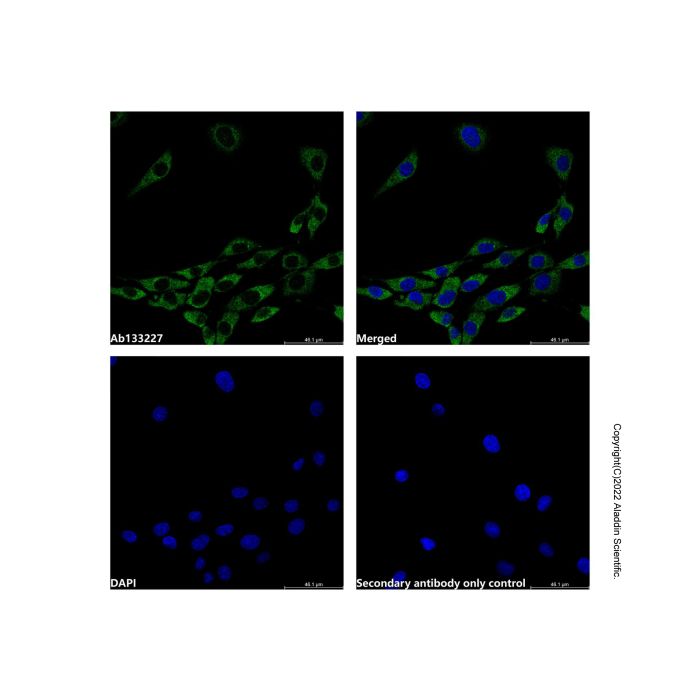
UBE2C Antibody (Ab133227) - IF/ICC FITC staining on IF Samples: Human HeLa Cells Primary Ab: 20 µg/mL UBE2C Antibody (Ab133227).
UBE2C Antibody (Ab133227) - IF/ICC
IF analysis of UBE2C Antibody (Ab133227) in HeLa cells. The cells were fixed with 4% PFA for 10 minutes, permeabilized with 0.3% Triton X-100 (I743383) for 10 minutes and then blocked with 5% BSA for 1 hour at room temperature. Cells were stained with UBE2C Antibody (Ab133227) at 1/200 dilution in blocking buffer overnight at 4°C, and then incubated with Goat Anti-Rabbit IgG H&L (AF488) (Ab181954) at a dilution of 1/1000 for 1 hour at room temperature in the dark (green). Cells were counterstained with DAPI (blue).
Anwendung
Anwendung
Dilution info
WB
0.01-2 µg/mL
IF/ICC
5-20 µg/mL
Documentation
📋 Safety Data Sheet (SDS)
Comprehensive hazard, handling, storage, and regulatory compliance document.
Determine the necessary mass, volume, or concentration for preparing a solution.
Dilution Calculator
Determine the dilution needed to prepare a stock solution.
Reconstitution Calculator
Bewertungen
Kundenbewertungen
Application Protocols
Item-specific validated applications, species reactivity, recommended dilutions, and positive control samples: Not specified for this item; refer to CoA/Spec Sheet.
General protocol guidance (literature/general)
Western blot (WB): Begin with 1:500–1:2000 primary dilution; incubate 1–2 h RT or overnight 4°C. Use appropriate secondary antibodies and chemiluminescent or fluorescent detection.
Immunofluorescence (IF/ICC): Start at 1:100–1:500; fix with paraformaldehyde or methanol per epitope sensitivity; block with serum/BSA; include detergent permeabilization as needed.
Immunohistochemistry (IHC-P): Antigen retrieval (citrate pH 6.0 or Tris-EDTA pH 9.0) may be required; start at 1:100–1:400.
Immunoprecipitation (IP): Titrate 1–5 µg antibody per mg lysate protein; use protein A/G beads matched to isotype.
ELISA: Coating 0.5–2 µg/mL capture; detect with properly validated secondary conjugates.
These ranges are starting points only. Empirically determine optimal conditions in your system.
Biological Roles
Target background (general literature; not a claim of product performance)
UBE2C (Ubiquitin-conjugating enzyme E2 C) is an E2 enzyme within the ubiquitin–proteasome pathway. It cooperates with E3 ligases, notably the anaphase-promoting complex/cyclosome (APC/C), to transfer activated ubiquitin to substrates.
Functional context: Plays a role in cell-cycle progression, particularly in metaphase–anaphase transitions where timely ubiquitination of regulatory proteins is essential for mitotic exit.
Regulation: Expression and activity are tightly controlled across the cell cycle; post-translational modifications and interactions with APC/C co-activators modulate substrate selectivity.
Research utility (general)
Antibodies to UBE2C are commonly used to study ubiquitination dynamics, proteostasis, and checkpoints in dividing cells, and for monitoring expression across synchronized cell populations by WB, IF, or IHC when validated.
Orthogonal validation can include siRNA/CRISPR knockdown of UBE2C, proteomics to assess ubiquitination signatures, and co-immunoprecipitation to probe interactions with ubiquitination machinery.
Note: The above describes the biology of the target protein. It does not specify or guarantee the applications or performance of this particular item; see Application Protocols for item-specific guidance (not specified here).
Buffer Applications
Not directly applicable as a buffering reagent. For antibody-based assays, select buffers that preserve antigen–antibody interactions and reduce background:
General guidance (literature/general)
WB/IHC/IF: PBS or TBS (pH 7.2–7.6) with 0.05–0.1% Tween-20 for washing. Blocking with 3–5% BSA or non-fat dry milk (optimize to reduce nonspecific binding).
IP: Use lysis buffers compatible with native protein complexes (e.g., mild NP-40 or digitonin-based buffers) and avoid harsh detergents if preserving interactions.
ELISA: Coating in carbonate–bicarbonate buffer (pH ~9.6), blocking with protein-based blockers; detect in PBS/TBS with surfactant.
Item-specific buffer composition for Ab133227 is not specified; refer to CoA/Spec Sheet.
Green Alternatives
Sustainability considerations for antibody reagents (general)
Cold-chain optimization: Consolidate orders and use reusable cold packs where permitted. Promptly transfer to -20°C to minimize cold-chain waste.
Buffer choices: Use phosphate- or Tris-based buffers prepared from high-purity salts; avoid unnecessary organic cosolvents and azides if incompatible with downstream biology (balance with preservative needs).
Packaging and plastics: Employ low-protein-binding but recyclable plastics where available; minimize single-use components by careful aliquoting.
Conjugation chemistries: Select aqueous, solvent-free coupling methods (e.g., NHS-ester reactions in buffered saline) to reduce VOCs.
Tradeoffs (general)
Preservative-free/carrier-free formats reduce additives but may shorten bench stability; users may need to add stabilizers after aliquoting, balancing green goals with data quality.
Lyophilized formats can reduce shipping mass and ice-pack use but require careful reconstitution. Format for this item is not specified.
Pharmaceutical Uses
Not applicable. This research-grade antibody is not intended for clinical diagnostics, therapeutic use, or manufacturing of medicinal products. No pharmacopeial status is provided. For research use only (per Product Data).
Physical Properties
Item-specific facts (from Product Data)
Appearance: Not specified for this item; refer to CoA/Spec Sheet.
Concentration, buffer composition, preservatives, stabilizers: Not specified for this item; refer to CoA/Spec Sheet.
Molecular Weight: Not specified for this item; refer to CoA/Spec Sheet.
General properties for antibody reagents (literature/general)
Typical IgG molecular weight: ~150 kDa (literature), though recombinant fragments can range from ~25–100 kDa depending on format.
Physical form: Commonly supplied as liquid in buffered saline with protein stabilizers, or lyophilized; specifics for this item are not provided.
Solubility: Antibodies are soluble in aqueous buffers near physiological pH; avoid extreme pH, high shear, or denaturants to preserve activity.
Stability: Sensitive to repeated freeze–thaw; stability improves with aliquoting and storage at recommended temperatures (see Storage & Reconstitution).
Quality and Grades
Item-specific facts (from Product Data)
Grade/Purity: Carrier Free, ExactAb™, Validated, High Performance.
Interpretation and implications (general, with item-specific mapping)
Carrier Free (item-specific): Supplied without added carrier proteins. Practical implications: improved conjugation performance (e.g., fluorophores, HRP) and reduced background in sensitive assays. Note: Exact buffer/preservatives for this item are not specified; refer to CoA/Spec Sheet.
Validated, High Performance (item-specific): Indicates the product has undergone internal validation. The exact tested applications, species reactivity, and validation datasets are not specified for this item; consult datasheet when available.
ExactAb™ (item-specific brand designation): Denotes Aladdin Scientific’s high-precision antibody line focused on reproducibility and lot-to-lot consistency. Specific format (recombinant vs hybridoma), clonality, and isotype are not specified; refer to CoA/Spec Sheet.
Quality considerations (general)
Lot-to-lot consistency: Critical for quantitative work (WB densitometry, IHC scoring). Maintain records of lot numbers and revalidate key controls when switching lots.
Carrier-free handling: Use low-protein-binding plastics; consider adding your own stabilizer (e.g., inert protein or trehalose) only if compatible with downstream applications.
Documentation: For regulated environments, archive CoA and SDS; verify absence/presence of preservatives if performing live-cell applications or sensitive enzymatic assays.
Reaction and Applications
Not a small-molecule reagent; traditional synthetic reactions (e.g., cross-couplings, acid–base, polymerizations) do not apply.
General laboratory applications for antibodies (literature/general)
Immunodetection: Commonly used in Western blot (WB), immunofluorescence (IF/ICC), immunohistochemistry (IHC), immunoprecipitation (IP), ELISA, and flow cytometry when validated. For this specific item, tested applications are not specified; refer to CoA/Spec Sheet.
Conjugation: Carrier-free format is advantageous for user-performed conjugation to enzymes, fluorophores, or beads. Optimize conjugation chemistry (e.g., NHS-ester to lysines, maleimide to reduced cysteines) and perform buffer exchange to remove amines/thiols that interfere.
Quantitative workflows: Use standard curves, internal controls, and replicate measurements to ensure linearity and reproducibility. Validate specificity via knockdown/knockout or orthogonal antibodies when feasible.
Reaction Conditions
Not applicable to chemical reactions. For immunoassay workflows (general literature guidance):
Incubations: Typical primary antibody incubations range from 1–2 h at room temperature to overnight at 4°C, depending on assay and antibody affinity.
Buffers: Use PBS or TBS with appropriate blocking agents and mild detergents; calcium/magnesium can influence certain epitopes.
Temperatures: Keep on ice or 2–8°C when handling to minimize degradation; avoid prolonged bench exposure.
Concentrations: Titrate to determine optimal working dilutions; start with standard ranges for your assay type. Tested dilutions for this item are not specified.
These are general guidelines only; specific, validated conditions for Ab133227 are not provided in the Product Data.
Safety and Handling
Item-specific facts (from Product Data)
Storage conditions: Store at -20°C; avoid repeated freezing and thawing. Shipped in ice chest with ice pads.
GHS classification, signal word, H-statements, pictograms: Not specified for this item; refer to SDS.
General safety guidance for antibody reagents (literature/general)
Hazard profile: Most purified antibodies in neutral aqueous buffers are generally considered low hazard; however, consult the SDS for authoritative classification and emergency measures.
PPE: Laboratory coat, safety glasses, and appropriate gloves. Avoid ingestion, inhalation of aerosols, and contact with skin/eyes.
Handling: Work on ice or at 2–8°C while in use to minimize activity loss. Use low-retention tips/tubes to reduce adsorption. Avoid vortexing; mix gently.
Incompatibilities: Avoid strong oxidizers, proteases, extreme pH, and organic solvents that can denature proteins.
First aid (general): If skin/eye contact occurs, rinse with water for several minutes; if inhaled, move to fresh air; if ingested, rinse mouth and seek medical advice. Follow institutional biosafety procedures.
Waste: Dispose according to local regulations for proteinaceous laboratory waste; decontaminate spills with appropriate detergents and standard lab disinfectants.
Always defer to the product’s SDS and institutional EHS policies for definitive guidance.
Solvent Selection
Not typically applicable. This product is an aqueous antibody reagent rather than a solvent. For practical use, focus on choosing compatible assay buffers (e.g., PBS, TBS) and blocking solutions appropriate to your application. See Application Protocols and Storage & Reconstitution for handling guidance.
Storage and Reconstitution
Item-specific facts (from Product Data)
Storage: Store at -20°C. Avoid repeated freezing and thawing.
Shipping: Ice chest with ice pads.
Appearance, formulation, concentration, and whether liquid or lyophilized: Not specified for this item; refer to CoA/Spec Sheet.
General best practices for antibody handling (literature/general)
Upon receipt: Inspect packaging temperature and integrity. Record lot number and date.
Aliquoting: If supplied liquid, aliquot into low-protein-binding tubes to single-use volumes to avoid freeze–thaw cycles. Keep on ice during aliquoting; mix gently (do not vortex).
Freeze–thaw avoidance: Repeated cycles can reduce binding activity; store working aliquots at -20°C (or -80°C for long-term) per your lab’s practice and compatibility with formulation.
Thawing: Thaw on ice; mix gently by inversion. Centrifuge briefly to collect contents.
Reconstitution: If lyophilized (not specified here), reconstitute with the recommended buffer/volume on the CoA. Typical choices are sterile water or PBS to yield a convenient stock concentration; allow to gently dissolve 10–15 minutes on ice.
Short-term storage during use: Keep at 2–8°C for hours to a few days depending on preservatives/stabilizers (not specified for this item). Discard if turbidity or precipitation develops.
Documentation: Consult the SDS and CoA for exact buffer composition, presence/absence of preservatives, and any stabilizers to ensure compatibility with your application.
Research Use Note
For research use only.
Structure and Identity
Item-specific facts (from Product Data)
Product name: UBE2C Antibody (SKU: Ab133227)
Category: Antibody (research use only)
CAS, CID, InChIKey, SMILES: Not specified for this item; refer to CoA/Spec Sheet.
Molecular formula / molecular weight: Not specified for this item; refer to CoA/Spec Sheet.
General information for antibodies (literature/general)
Structural class: Protein-based immunoglobulin reagent; exact isotype, clonality (mono/polyclonal), and host species are not specified for this item.
Typical architecture: Two heavy and two light chains for IgG-class antibodies with variable regions recognizing the target epitope; recombinant formats may vary (Fab, scFv, etc.). Format for this item is not specified.
2D/functional description (general)
Depicted generically as Y-shaped immunoglobulin with antigen-binding fragments (Fab) conferring specificity to the target antigen (here, named UBE2C by product title).
Synthetic Utility
Not applicable. As a protein antibody reagent, this product is not used as a synthetic building block or reagent in classical organic or inorganic synthesis. For practical laboratory use, see Application Protocols and Storage & Reconstitution.
Target Specificity
Item-specific facts (from Product Data)
Target name (per product title): UBE2C (Ubiquitin-conjugating enzyme E2 C).
Additional details such as clone ID, host species, isotype, epitope, species reactivity, and cross-reactivity: Not specified for this item; refer to CoA/Spec Sheet.
Notes
The stated target name derives from the product title and does not imply validated species/application without supporting data on the datasheet.
Häufig gestellte Fragen
What does ExactAb? mean?
ExactAb? indicates the product has been validated for use in rigorous antibody validation workflows. Validation may include positive/negative control samples, signal-to-noise testing, and protocol-specific QC. Lot-specific test data is published on the Certificate of Analysis where available.
What does Carrier Free mean?
Carrier Free indicates that the material has been processed and tested for specialty industrial processing. Specifications focus on the impurities that affect performance in that application — for example, metal content for electronics, particle size for batteries, refractive index for optics, or moisture content for moisture-sensitive processes.
How should this product be stored?
Store at ?20 °C. Avoid repeated freeze–thaw cycles. Aliquot into single-use volumes before freezing.
How is this product shipped?
This product ships in an insulated container with ice pads. Unpack on arrival and transfer it to the storage condition stated above.
What documentation is provided?
Available product documentation, including Certificates of Analysis (COA), Safety Data Sheets (SDS), and specification sheets, is shown in the product document area. Document availability and access follow the current site policy.
Which species reactivity has this antibody been validated against?
Validated reactivity is listed on the PDP and on each lot's datasheet. We validate against the most commonly tested species for the target (UBE2C Antibody); cross-reactivity in untested species may exist but is not guaranteed. Contact technical support for specific species inquiries.
Need help choosing the grade?
Our grade selection guide covers purity, stabilizer status, and application suitability for all variants in our catalog.
Wir verwenden Cookies, um die ordnungsgemäße Funktion der Website sicherzustellen und, soweit zulässig, Ihr Nutzererlebnis zu verbessern. Sie können Ihre Einstellungen jederzeit unter „Einstellungen“ verwalten. Weitere Informationen finden Sie in unserer Cookie-Richtlinie.
Dürfen wir Sie über Rabattaktionen informieren?
Später erinnern
Vielen Dank! Bitte überprüfen Sie Ihren E-Mail-Posteingang, um zu bestätigen.
Products are supplied to verified businesses, institutions, and qualified professionals for research and development use only. Not for use in humans, animals, diagnosis, or therapy.

 ZJ24F0404094