GRADE & PURITYCarrier Free?Carrier-free — supplied without added carrier protein/stabilizer. Use when carriers (e.g. BSA) would interfere with conjugation or sensitive assays.ExactAb™?ExactAb™ — Aladdin's antibody line emphasizing precision and validated quality. Use for reliable, specificity-validated antibody applications.Validated?Validated grade — performance confirmed in defined applications before release. Use when you want documented assurance the reagent works as stated.0.5 mg/mL
A KLH conjugated synthetic peptide from the N-terminal region of human Dsk2 (AA 20-50).
Positive Kontrolle
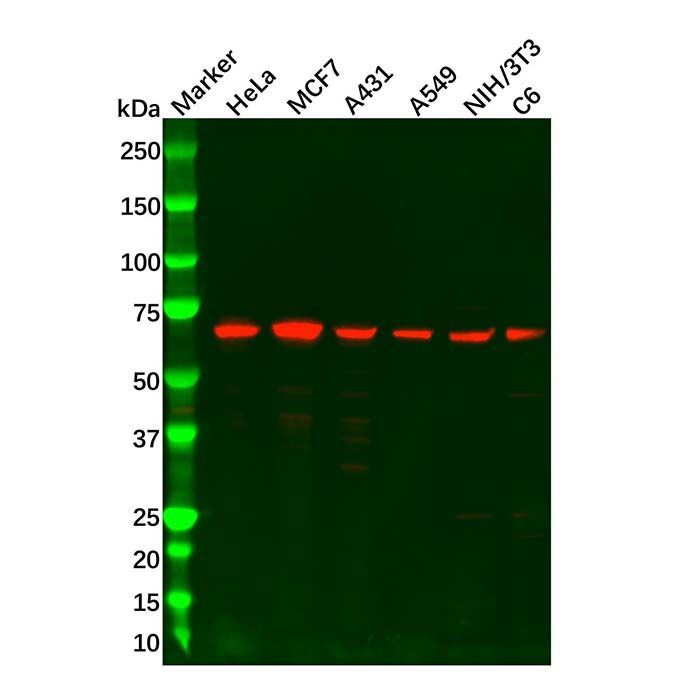
WB: HeLa, MCF7, A431, A549, NIH/3T3 and C6 cell lysates. IHC: Human cancer and lung carcinoma tissues. IF/ICC: HeLa cells.
Konjugation
Unconjugated
Note
Carrier Free, ExactAb™, Validated
Isotyp
Rabbit IgG
SDS-PAGE
150 kDa
Verfahren zur Reinigung
Saturated ammonium sulfate precipitation
Konzentration
0.5 mg/mL
Product Line
Biologische Produkte
Lagerung und Versand
Form
Liquid
Storage
Store at -20°C,Avoid repeated freezing and thawing
Verschickt in
Ice chest + Ice pads
Stabilität und Lagerung
Store at 4°C short term (1-2 weeks). Store at -20°C long term (24months). Upon receipt, it is recommended to aliquot. Avoid freeze/thaw cycle.
Bilder
UBQLN2 Antibody (Ab133349) - Western Blot All lanes: UBQLN2 Antibody (Ab133349) at 1/1000 dilution Samples: Lysates at 20 µg per lane Secondary: Goat Anti-Rabbit IgG H&L (HRP) (Ab170144) at 1/20000 dilution
Predicted band size: 66 kDa Observed band size: 66 kDa Exposure time: 7.8 s
UBQLN2 Antibody (Ab133349) - IF/ICC
IF analysis of UBQLN2 Antibody (Ab133349) in HeLa cells. The cells were fixed with 4% PFA for 10 minutes, permeabilized with 0.3% Triton X-100 (I743383) for 10 minutes and then blocked with 5% BSA for 1 hour at room temperature. Cells were stained with UBQLN2 Antibody (Ab133349) at 1/500 dilution in blocking buffer overnight at 4°C, and then incubated with Goat Anti-Rabbit IgG H&L (AF488) (Ab181954) at a dilution of 1/1000 for 1 hour at room temperature in the dark (green). Cells were counterstained with DAPI (blue).
Anwendung
Anwendung
Dilution info
IHC
1/100-1/500
WB
1/1000
Documentation
📋 Safety Data Sheet (SDS)
Comprehensive hazard, handling, storage, and regulatory compliance document.
Determine the necessary mass, volume, or concentration for preparing a solution.
Dilution Calculator
Determine the dilution needed to prepare a stock solution.
Reconstitution Calculator
Bewertungen
Kundenbewertungen
Application Protocols
Item-specific tested applications, recommended dilutions, and positive control materials are not provided here; refer to the CoA/Spec Sheet for validated protocols if available.
General workflow guidance (to be optimized empirically)
Western blot (WB)
Prepare lysates with protease inhibitors; denature/reduce as appropriate.
Transfer to PVDF/nitrocellulose; block with 5% BSA or milk in TBST.
Incubate with primary anti-UBQLN2 antibody at an empirically determined dilution; wash and detect with species-appropriate secondary.
Fix (paraformaldehyde or methanol) and permeabilize (e.g., Triton X-100) as compatible with epitope preservation.
Block, incubate with primary, then fluorophore-conjugated secondary; mount with anti-fade.
Immunohistochemistry (IHC)
Perform antigen retrieval as needed (citrate or EDTA buffers); block endogenous peroxidase for HRP detection.
Apply primary, then HRP- or AP-conjugated secondary; develop and counterstain.
Immunoprecipitation (IP)
Pre-clear lysate, incubate with antibody, capture with Protein A/G resin, wash, and elute.
Include appropriate controls (isotype control, no-primary, known positive lysate) and titrate antibody to minimize background.
Biological Roles
UBQLN2 (ubiquilin-2) is a ubiquitin-like/ubiquitin-associated (UBL/UBA) domain protein implicated in protein quality control. The UBQLN2 Antibody targets epitopes on this protein to enable research detection and characterization.
UBQLN2 functional context (literature)
Acts as a shuttle factor linking polyubiquitinated substrates to the 26S proteasome via its UBA (ubiquitin-associated) domain while engaging chaperones through other regions.
Intersects with autophagy pathways and protein aggregate handling; participates in ER-associated degradation (ERAD) and stress responses.
Contains a proline-rich region and PXX repeats unique among ubiquilins, which can modulate protein–protein interactions.
Research significance (general)
Monitoring UBQLN2 levels, localization, and post-translational modifications helps elucidate proteostasis mechanisms across neuronal and non-neuronal systems.
The antibody can support studies of turnover of misfolded proteins, ubiquitination dynamics, and crosstalk between proteasomal degradation and autophagic pathways.
Note: Functional descriptions are provided for biological context and do not constitute validated performance claims for this specific item.
Buffer Applications
This product is an antibody, not a buffering agent. However, proper buffer selection is essential for its use.
Typical working buffers (general guidance)
Storage/reconstitution: PBS (10–50 mM phosphate, 150 mM NaCl, pH 7.2–7.4) or Tris-buffered saline (20–50 mM Tris, 150 mM NaCl, pH 7.4–8.0), sterile-filtered.
Assay buffers: May include 0.05–0.1% nonionic detergent (e.g., Tween-20) to reduce nonspecific binding; blocking agents (e.g., 1–5% BSA or nonfat dry milk) for immunoassays, as compatible.
For bioconjugation: Avoid primary amine buffers (e.g., Tris) when using NHS-ester chemistry; use phosphate or bicarbonate instead.
pH and ionic strength
Maintain near-neutral pH to preserve antibody structure; extreme pH can denature IgG.
Adequate ionic strength (150 mM NaCl) stabilizes proteins and reduces nonspecific interactions.
Item-specific formulation details are not provided; refer to the CoA/Spec Sheet for exact buffer recommendations if supplied with the product.
Green Alternatives
While “green alternatives” are typically discussed for organic solvents and reagents, environmental stewardship also applies to biologics:
Cold-chain considerations
Item is shipped with ice pads in an insulated container to minimize energy usage compared to dry ice where feasible; maintain the cold chain upon receipt.
Formulation choices (general)
Carrier-free supply allows end-users to formulate only what is necessary, reducing waste of stabilizing proteins and buffers.
Use recyclable cold packs and insulation where local regulations permit, and consolidate orders to reduce shipping frequency and packaging.
Laboratory practices
Aliquot to reduce waste from freeze–thaw–induced degradation.
Use reusable ice buckets and energy-efficient freezers; maintain freezers at optimal setpoints (−20°C as specified for this item) and defrost regularly for efficiency.
These considerations reduce environmental impact without altering the item-specific performance characteristics.
Pharmaceutical Uses
This antibody is supplied for research use only and is not intended for human or veterinary use, diagnostic, or therapeutic applications.
Relevant non-clinical uses (general)
May serve as a qualified analytical reagent in bioprocess or QC laboratories for research assays such as identity testing, impurity profiling, or mechanism-of-action studies involving UBQLN2 in cell/tissue models.
Carrier-free format is suitable for custom conjugation to reporter enzymes, fluorophores, or solid supports used in research-grade analytical platforms.
No pharmacopeial status, excipient role, or clinical formulation details are provided for this item.
Physical Properties
Item-specific physicochemical parameters are not provided for this antibody preparation.
Item-specific
Appearance: Not specified for this item; refer to CoA/Spec Sheet.
Concentration/formulation: Not specified for this item; refer to CoA/Spec Sheet.
Molecular weight: Not specified for this item; refer to CoA/Spec Sheet.
General/literature values for IgG-class antibodies (for context, not product specifications)
Typical molecular mass: ~150 kDa for intact IgG; fragments (Fab/F(ab')2) are smaller.
Isoelectric point (pI): commonly ~6–9, varying with sequence and glycosylation.
Solubility: Highly soluble in aqueous buffers (e.g., PBS, Tris); stability enhanced with protein carriers (e.g., BSA) and sugars (e.g., trehalose) when compatible with the application.
Stability: Sensitive to repeated freeze–thaw; adsorption losses occur in low-protein buffers and on untreated plastics.
Refractive and spectral properties (general)
Proteins typically have A280 extinction dependent on sequence; exact A280 coefficient is sequence-specific and not provided for this item.
Note: Treat all general values as literature guidance only; consult the CoA/Spec Sheet for item-specific details.
Quality and Grades
Item-specific quality designations
Grade/Purity: Carrier Free, ExactAb™, Validated.
What this means in practice
Carrier Free: Supplied without protein carriers (e.g., BSA, gelatin). Advantages include compatibility with conjugation chemistries, mass spectrometry, and sensitive assays where carrier proteins interfere. Users may add a stabilizer post-reconstitution if compatible with their application.
ExactAb™: Denotes a high-consistency antibody preparation and/or recombinant/engineered production workflow designed to reduce lot-to-lot variability and deliver precise performance characteristics. Specific manufacturing details are not provided for this item; refer to CoA/Spec Sheet.
Validated: Indicates in-house or vendor verification for intended research applications. Exact tested applications, species reactivity, and performance metrics are not specified here; consult the CoA/Spec Sheet or validation data when available.
Additional quality considerations (general)
Purity assessment typically via SDS-PAGE/HPLC; endotoxin and bioburden controls may be reported for cell-based use. Not specified for this item.
Low aggregate content is desirable to preserve binding and reduce nonspecific background; aggregation profile not specified for this item.
For precise specifications (concentration, buffer composition, residuals, endotoxin), refer to the item’s CoA/Spec Sheet.
Reaction and Applications
Classical organic or organometallic reaction applications are not applicable to this antibody reagent.
Relevant laboratory applications (contextual, not item-validated)
Antibodies are used for immunoassays and detection (e.g., WB, IHC, IF, ELISA), immunoprecipitation, and affinity enrichment. However, specific validated applications for this item are not provided here; consult the CoA/Spec Sheet.
Conjugation chemistry (general guidance for carrier-free antibodies)
Site-selective strategies include enzymatic Fc glycan remodeling or protein A–directed approaches to preserve antigen binding.
No synthetic “reaction conditions” are defined for this product beyond standard bioconjugation practices, which should be optimized empirically.
Reaction Conditions
Classical reaction condition tables (solvent, temperature, catalyst) do not apply to this antibody. For bioconjugation and assay preparation, consider the following general conditions (not product specifications):
Bioconjugation (general)
NHS–ester labeling: pH 7.5–8.5 in amine-free buffers (e.g., phosphate, bicarbonate), 4–25°C, minutes to hours; quench with Tris or ethanolamine post-reaction.
Maleimide–thiol coupling: pH 6.5–7.5 after selective reduction of hinge disulfides or introduction of thiols; avoid competing thiols in buffer.
Click chemistry (azide–alkyne): Performed after installing bio-orthogonal handles; copper-free methods favored for live-cell compatibility.
Assay setup (general)
Incubation temperatures: 4°C for overnight bindings or 20–25°C for shorter incubations.
Wash buffers: PBS/TBS with 0.05–0.1% Tween-20 to reduce background.
Specific validated applications and optimal conditions for this item are not provided; consult CoA/Spec Sheet and optimize empirically.
Safety and Handling
GHS classification and hazard statements
Signal word, pictograms, and H-statements: Not specified for this item; consult the SDS for authoritative safety information.
General laboratory safety for protein biologics
Use standard PPE: lab coat, gloves, and eye protection.
Handle using aseptic technique to avoid microbial contamination of the antibody solution.
Avoid creating aerosols; work in a biosafety cabinet if sterility is required for downstream cell-based assays.
Storage and stability
Storage conditions (item-specific): Store at −20°C. Avoid repeated freezing and thawing.
Shipping (item-specific): Shipped in an ice chest with ice pads to maintain a cold chain.
Incompatibilities and precautions
Avoid repeated freeze–thaw cycles; aliquot upon first use.
Avoid strong oxidizers and extremes of pH that can denature proteins.
Use low-binding plastics or pre-blocked vessels to reduce adsorption losses.
First-aid overview (general)
Skin/eye contact: Rinse with water; seek medical evaluation if irritation persists.
Ingestion/inhalation: Not intended for ingestion or inhalation; seek medical attention if exposure occurs.
Always defer to the product SDS for definitive hazard, toxicology, and disposal guidance.
Solvent Selection
This product is a protein antibody and is not used as an organic solvent. Its appropriate medium is aqueous buffer.
Practical guidance
Reconstitution and storage are typically in sterile, neutral pH buffers such as PBS or Tris-buffered saline. Exact formulation is not specified for this item; refer to CoA/Spec Sheet.
Avoid organic solvents (e.g., acetonitrile, methanol, DMSO) for long-term storage of intact antibodies, as they can denature proteins, unless specifically formulating for specialized conjugations where brief exposure is controlled.
Maintain isotonicity and include stabilizers only if compatible with downstream assays (carrier-free stock allows user-defined formulation).
Comparison (general)
PBS vs Tris buffers: PBS offers better ionic strength for many immunoassays; Tris can interact with certain crosslinkers—choose based on downstream chemistry.
Additives: 0.05–0.1% Tween-20 may reduce nonspecific binding in assay buffers; sugars (trehalose) and amino acids (arginine) can enhance stability during freezing (general guidance; not product specification).
Storage and Reconstitution
Item-specific conditions
Storage: Store at −20°C.
Handling: Avoid repeated freezing and thawing.
Shipping: Ice chest with ice pads to maintain cold chain.
Reconstitution guidance (general; not product specification)
If supplied lyophilized: Reconstitute with sterile, neutral pH buffer (e.g., PBS) to a convenient stock concentration. Allow to dissolve gently at room temperature, then mix by slow inversion (avoid vigorous vortexing/foaming).
If supplied in solution: Upon first use, dispense into low-binding microtubes to create single-use aliquots.
Carrier-free considerations: To enhance stability after reconstitution, users may add compatible stabilizers (e.g., 0.1–1% BSA, 10–50% glycerol, or 0.2–0.5 M trehalose) if such additives do not interfere with downstream applications.
Additional best practices
Store working aliquots at 4°C for short-term use (days to 1–2 weeks) when sterility is ensured; for longer-term storage, keep at −20°C or below as specified.
Avoid freeze–thaw cycles by aliquoting; thaw on ice.
Use sterile, low-protein-binding plastics and pre-chilled pipette tips to minimize adsorption losses.
Refer to the CoA/Spec Sheet for any item-specific buffer composition, concentration, and reconstitution volume if provided.
Structure and Identity
UBQLN2 Antibody (SKU: Ab133349) is an affinity reagent directed against the UBQLN2 protein (ubiquilin-2), supplied as Carrier Free, ExactAb™, Validated.
Item-specific identifiers
Product name: UBQLN2 Antibody
Category: Antibody (research use only)
CAS: Not applicable for antibodies
Molecular formula: Not specified for this item; refer to CoA/Spec Sheet.
Molecular weight: Not specified for this item; refer to CoA/Spec Sheet.
SMILES/InChI/InChIKey: Not applicable to biologics/antibodies.
Structural features (general antibody architecture; literature)
Immunoglobulin G–type structure typically comprises two heavy and two light chains forming a Y-shaped heterotetramer with variable regions for antigen binding and constant Fc domain for effector functions.
Antigen-binding sites (paratopes) in the variable domains recognize epitopes on UBQLN2.
Post-translational features may include disulfide bonds and glycosylation on the Fc region (depending on host/expression system; not specified for this item).
2D description in words (general)
Two Fab arms (VH–VL pairs) connected via a flexible hinge to an Fc stem (CH2–CH3 domains). Antigen recognition occurs at complementarity-determining regions (CDRs) within the Fab.
Synthetic Utility
Synthetic organic utility is not applicable to this antibody. However, as a biomolecular tool, it can be integrated into workflows that support chemical biology:
Chemical biology interfaces (general)
Antibody–drug/label conjugation through amine, thiol, glycan, or click-chemistry handles enables detection, capture, or imaging of UBQLN2 in complex matrices.
Immobilization on chromatographic media (e.g., NHS-activated agarose) can create affinity columns for UBQLN2 enrichment in research settings.
These practices require optimization for each conjugation chemistry; no item-specific conjugation data are provided.
Epitope: Not specified for this item; refer to CoA/Spec Sheet.
Clone/host/isotype: Not specified for this item; refer to CoA/Spec Sheet.
Species reactivity: Not specified for this item; refer to CoA/Spec Sheet.
Cross-reactivity: Not specified for this item; refer to CoA/Spec Sheet.
Notes
The product name indicates specificity for UBQLN2; however, detailed mapping (linear vs conformational epitope), post-translational modification sensitivity, and species coverage must be confirmed from the certificate of analysis or validation data.
For critical experiments, include appropriate positive and negative controls and perform titration to verify specificity under your assay conditions.
Häufig gestellte Fragen
What does ExactAb? mean?
ExactAb? indicates the product has been validated for use in rigorous antibody validation workflows. Validation may include positive/negative control samples, signal-to-noise testing, and protocol-specific QC. Lot-specific test data is published on the Certificate of Analysis where available.
What does Carrier Free mean?
Carrier Free indicates that the material has been processed and tested for specialty industrial processing. Specifications focus on the impurities that affect performance in that application — for example, metal content for electronics, particle size for batteries, refractive index for optics, or moisture content for moisture-sensitive processes.
How should this product be stored?
Store at ?20 °C. Avoid repeated freeze–thaw cycles. Aliquot into single-use volumes before freezing.
How is this product shipped?
This product ships in an insulated container with ice pads. Unpack on arrival and transfer it to the storage condition stated above.
What documentation is provided?
Available product documentation, including Certificates of Analysis (COA), Safety Data Sheets (SDS), and specification sheets, is shown in the product document area. Document availability and access follow the current site policy.
Which species reactivity has this antibody been validated against?
Validated reactivity is listed on the PDP and on each lot's datasheet. We validate against the most commonly tested species for the target (UBQLN2 Antibody); cross-reactivity in untested species may exist but is not guaranteed. Contact technical support for specific species inquiries.
Need help choosing the grade?
Our grade selection guide covers purity, stabilizer status, and application suitability for all variants in our catalog.
Wir verwenden Cookies, um die ordnungsgemäße Funktion der Website sicherzustellen und, soweit zulässig, Ihr Nutzererlebnis zu verbessern. Sie können Ihre Einstellungen jederzeit unter „Einstellungen“ verwalten. Weitere Informationen finden Sie in unserer Cookie-Richtlinie.
Dürfen wir Sie über Rabattaktionen informieren?
Später erinnern
Vielen Dank! Bitte überprüfen Sie Ihren E-Mail-Posteingang, um zu bestätigen.
Products are supplied to verified businesses, institutions, and qualified professionals for research and development use only. Not for use in humans, animals, diagnosis, or therapy.

 ZJ24F0303484