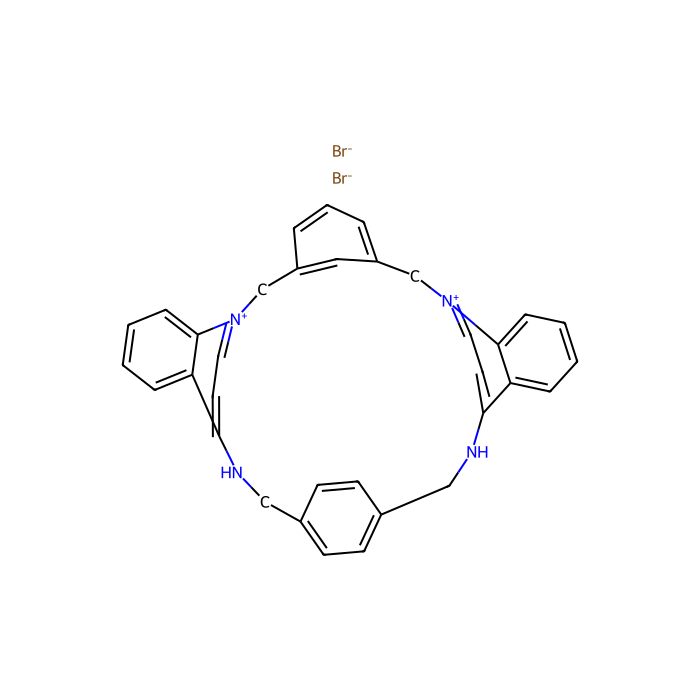
Highly potent, non-peptidic blocker of the apamin-sensitive Ca2+-activated K+channel (KCa2.1) (IC50= 3 nM in rat sympathetic neurons). Blocks hKCa2.1 and rKCa2.2 channels expressed in HEK 293 cells with IC50values of 762 and 364 pM respectively.
Storage
Protected from light,Store at -20°C,Desiccated
Verschickt in
Ice chest + Ice pads
Dieses Produkt erfordert Kühlkettenversand. Grundversand und andere Economy-Optionen sind nicht verfügbar.
This compound belongs to the class of organic compounds known as 4-aminoquinolines. These are organic compounds containing an amino group attached to the 4-position of a quinoline ring system.
External Descriptors
Not available
1. Djoumbou Feunang Y, Eisner R, Knox C, Chepelev L, Hastings J, Owen G, Fahy E, Steinbeck C, Subramanian S, Bolton E, Greiner R, and Wishart DS. ClassyFire: Automated Chemical Classification With A Comprehensive, Computable Taxonomy. Journal of Cheminformatics, 2016, 8:61.
Zertifikate (CoA, COO, BSE/TSE und Analyse-Diagramm)
C of A & Other Certificates(BSE/TSE, COO):
Analytical Chart:
Chemische und physikalische Eigenschaften
Löslichkeit
Solvent:DMSO, Max Conc. mg/mL: 7.21, Max Conc. mM: 10
Empfindlichkeit
Light sensitive
Molekulargewicht
654.4
XLogP3
Hydrogen Bond Donor Count
2
Hydrogen Bond Acceptor Count
4
Rotatable Bond Count
0
Exact Mass
654.082 Da
Monoisotopic Mass
652.084 Da
Topological Polar Surface Area
31.800 Ų
Heavy Atom Count
40
Formal Charge
0
Complexity
689.000
Isotope Atom Count
0
Defined Atom Stereocenter Count
0
Undefined Atom Stereocenter Count
0
Defined Bond Stereocenter Count
0
Undefined Bond Stereocenter Count
0
The total count of all stereochemical bonds
0
Covalently-Bonded Unit Count
3
Lösungsrechner
Molarity Calculator
Determine the necessary mass, volume, or concentration for preparing a solution.
Dilution Calculator
Determine the dilution needed to prepare a stock solution.
Reconstitution Calculator
Bewertungen
Kundenbewertungen
Application Protocols
No vendor-tested application protocols are provided for this item. The following general guidance is offered for small-molecule tool compounds (not item-specific and not a substitute for method validation):
Stock preparation: Weigh quickly to minimize moisture uptake. Prepare a concentrated DMSO stock (e.g., 10 mM), vortex/sonicate to dissolve, and aliquot into amber vials. Record the exact mass and molecular weight from the CoA to ensure correct molarity.
Working solutions: Dilute into assay buffer or media with mixing to reach the desired final concentration. Maintain consistent vehicle controls matching the final DMSO content.
Electrophysiology: Use freshly prepared, filtered buffers; verify compound addition does not alter osmolarity or pH significantly. Employ serial dilutions for concentration–response curves.
Storage of stocks: Store aliquots at −20°C, protected from light and moisture. Avoid repeated freeze–thaw cycles.
Always develop and validate protocols under your laboratory’s QA practices and consult the SDS for safe handling.
UCL 1684 is described in the literature as a potent small-molecule blocker of small-conductance Ca2+-activated K+ channels (SK/KCa2), a family involved in afterhyperpolarization and excitability control in excitable cells. It has been used as a research tool to probe SK channel function, kinetics, and pharmacology in cellular and tissue models.
As a cationic heteroaromatic compound (literature), it may display interactions with membrane or protein sites characteristic of quaternary/quinolinium-like scaffolds; detailed binding determinants and selectivity versus other K+ channel families should be consulted in peer-reviewed sources for the exact form studied.
In biochemical and electrophysiological studies, such tool compounds support target validation, structure–activity relationship work, and benchmarking of newer analogs. Note that potency and selectivity can depend on the exact salt/form, temperature, and ionic conditions used in the assay.
Important: The present catalog entry does not specify target, potency, or selectivity for this particular lot; please consult primary literature for UCL 1684 generally and rely on your own characterization for your experimental system.
Buffer Applications
This product is not a classical buffering agent. However, practical buffer considerations apply when preparing assay solutions of small-molecule tool compounds:
Vehicle/buffer selection: Use physiologically relevant buffers (e.g., HEPES- or phosphate-buffered saline) with low background fluorescence/absorbance if optical readouts are required.
pH and ionic strength: Confirm that the working pH supports solubility of the supplied salt form. Small changes in pH can significantly influence solubility and apparent potency for cationic compounds.
Protein additives: Low levels of serum albumin or carrier proteins can reduce nonspecific adsorption to plastics but may also alter free concentration; keep conditions consistent and include vehicle controls.
Filtration: If sterile working solutions are needed, 0.22 µm filtration is typical; check for adsorption losses by monitoring UV or assay response before and after filtration.
Because no buffer recipes or pKa values are specified for this item, optimize buffer composition empirically for your assay format and document conditions alongside compound lot information.
Green Alternatives
For bioassay stock preparation, solvent selection and handling can influence environmental footprint. While this item is not a process solvent or bulk reagent, consider the following greener practices:
Prefer water or buffered aqueous systems when solubility permits; otherwise, minimize DMSO volumes and consolidate stock solutions across projects to reduce waste.
Use amber vials to honor light protection and reduce degradation, thereby limiting re-preparation cycles and solvent usage.
Illustrative comparison (general, not item-specific):
DMSO: High solvating power; good assay compatibility at low percentages; biodegradable but can carry analytes into wastewater—collect for appropriate disposal.
Ethanol: More benign solvent; may have lower solubility for cationic aromatic salts; can affect membrane integrity in cell assays at similar v/v as DMSO.
Water/buffer: Greenest option; contingent on salt form and pH; verify stability and precipitation risk.
Operational tips:
Prepare concentrated master stocks to minimize freeze–thaw cycles and aliquot to reduce waste.
Use microscale dissolution and pre-screen solubility before scaling up to reduce solvent consumption.
Pharmaceutical Uses
Regulatory/compendial status: Not specified for this item; no pharmacopeial monograph indicated.
Role in formulations: This product is offered strictly for research use only. It is not supplied as an excipient or API for human or veterinary use. No clinical or therapeutic claims are made.
Development context (general): Compounds like UCL 1684 are commonly used as reference standards or tool molecules in discovery biology and target validation. Any use in formulation research should be limited to in vitro or preclinical method development under appropriate institutional review, and with full characterization of salt form, purity, and stability.
Manufacturing considerations: If used in preclinical research, track lot-to-lot quality via CoA data (identity, purity) and establish handling SOPs (light protection, desiccation, cold storage) to maintain consistency across studies.
Physical Properties
Item-specific specifications:
Appearance: Not specified for this item; refer to CoA/Spec Sheet.
Molecular weight: Not specified for this item; refer to CoA/Spec Sheet.
Molecular formula: Not specified for this item; refer to CoA/Spec Sheet.
Melting point: Not specified for this item; refer to CoA/Spec Sheet.
Boiling point: Not applicable/unknown for salts or thermally labile solids; not specified for this item; refer to CoA/Spec Sheet.
Density: Not specified for this item; refer to CoA/Spec Sheet.
Refractive index: Not applicable for solids; not specified for this item; refer to CoA/Spec Sheet.
Solubility: Not specified for this item; refer to CoA/Spec Sheet.
Many bioactive screening compounds are provided as solids that are soluble in polar aprotic solvents (e.g., DMSO) and variably soluble in water depending on salt form and counterion. UCL 1684 is frequently handled as a salt that can show good solubility in DMSO and aqueous buffers; actual solubility depends on the exact form supplied.
pKa/logP: Values are form-dependent and vary across sources; consult literature for the specific salt/base reported. For critical applications, measure solubility and pH stability in your working buffer.
Quality and Grades
Grade/Purity (item-specific): Not specified for this item; refer to CoA/Spec Sheet.
What this means for use: In the absence of a stated analytical grade, users should consult the CoA for assay purity, residual solvent content, and any stabilizers or counterions. For screening or mechanistic studies, lot-specific purity and identity confirmation (e.g., HPLC/LC-MS) are recommended.
UV/Chromatography considerations: If planning quantitative bioassays or photometric detection, check the CoA for UV-Vis profile and potential interfering absorbance. For LC/MS applications, confirm that the salt form and counterion are compatible with your method.
Stabilizers: None are specified for this listing. If stabilizers or particular salt forms are present, they will be stated on the CoA; account for them when preparing stock concentrations (mass-to-mole conversions).
Research use only: As noted, this product is for research use only and not for diagnostic, therapeutic, or clinical applications.
Reaction and Applications
This catalog item is positioned as a small-molecule library compound rather than a synthetic reagent. Consequently, it is not typically used as a solvent, coupling partner, or stoichiometric reagent in preparative organic synthesis.
Research applications (general/literature context, not item-specific claims):
UCL 1684 is widely used as a reference tool compound in ion-channel pharmacology, particularly in studies of small-conductance Ca2+-activated K+ (SK/KCa2) channels, for target validation, selectivity profiling, and mechanistic assays.
Typical laboratory uses include preparation of DMSO stocks for cell-based or electrophysiological assays, concentration–response analyses, and comparative studies versus other K+ channel modulators.
If you require a building block or reagent grade material for synthesis, please refer to our dedicated reagents catalog. For this item, emphasize careful solution preparation, vehicle controls, and documentation of the specific salt form and purity (from the CoA) for reproducibility.
Reaction Conditions
Not typically applicable. UCL 1684 is offered as a bioactive tool compound rather than a reagent used in chemical transformations. No standard preparative reaction conditions are associated with this item.
General laboratory handling for solution preparation (not reaction conditions):
Dissolution: Start with anhydrous DMSO to prepare concentrated stocks (e.g., 5–20 mM), with brief sonication if needed.
Dilution: Add DMSO stocks into buffered aqueous media slowly under vortexing to mitigate precipitation; keep final DMSO within assay-tolerated limits.
Stability checks: Because this item requires light protection and desiccation at −20°C, verify stability of working solutions over the course of your experiment (e.g., by LC/MS or functional assay response).
Safety and Handling
Item-specific hazard data:
GHS classification: Not specified for this item; refer to SDS.
Signal word: Not specified for this item; refer to SDS.
H-statements/Pictograms: Not specified for this item; refer to SDS.
General precautions (good laboratory practice; not a substitute for SDS):
Handle in a chemical fume hood and avoid inhalation of dust or aerosols. Use standard PPE: lab coat, safety glasses, and suitable gloves (e.g., nitrile). Minimize skin and eye contact.
Storage incompatibilities: Avoid strong oxidizers and strong acids/bases unless stability is known. Many cationic aromatic salts can be light sensitive; this item is specified to be protected from light.
First aid overview: In case of skin/eye contact, rinse with water for at least 15 minutes; remove contaminated clothing. If inhaled, move to fresh air. If ingested, rinse mouth and seek medical attention. Always follow your institution’s emergency procedures and consult the SDS for authoritative instructions.
Special risks: Bioactive small molecules may have potent physiological activity in vitro; handle with care, avoid aerosolization, and clean spills promptly. Given the specified need for desiccation and light protection, minimize exposure to humidity and ambient light during handling and storage.
Solvent Selection
Polarity/handling class: UCL 1684 is typically handled as a bioactive small-molecule solid. In practice, DMSO is the default solvent for preparing concentrated stock solutions for screening; water or aqueous buffers may be suitable depending on the exact salt form (verify solubility with the supplied lot).
Recommended approach (general):
Prepare a small test dissolution in anhydrous DMSO (e.g., 5–20 mM). Sonication and brief warming (≤40°C) can aid dissolution. Filter sterilize if required for cell-based assays.
For aqueous use, dilute DMSO stocks slowly into buffer with vortexing to avoid precipitation. Typical final DMSO in bioassays is 0.1–0.5% v/v (confirm tolerance of your system).
Alternative solvents: Methanol or ethanol may dissolve some salt forms but can complicate biological assays. When possible, prefer DMSO or water/buffer.
Compatibility:
Cell-based assays: Use serum- or protein-containing media to minimize nonspecific binding; maintain consistent vehicle controls.
Electrophysiology: Use high-purity solvent and thoroughly degassed buffers; avoid quaternary ammonium detergents or additives that may confound ion-channel readouts.
Practical tip: Record the exact mass fraction of active base vs. salt (from CoA) to ensure accurate molar dosing across experiments.
Storage and Reconstitution
Item-specific instructions from Product Data:
Storage: Store at −20°C, desiccated, and protected from light.
Shipping: Ice chest + ice pads.
Reconstitution (general guidance; verify with your lot’s CoA):
Solvent: DMSO is commonly used to prepare concentrated stocks of bioactive small molecules. If aqueous dissolution is desired, test a small aliquot first to confirm solubility of the specific salt form.
Concentration: Typical screening stocks are 5–20 mM in DMSO. Calculate exact molarity using the molecular weight provided on your CoA (this listing does not specify MW).
Technique: Allow vial to equilibrate to room temperature in the dark before opening to avoid moisture condensation. Weigh rapidly, add anhydrous solvent, and mix until fully dissolved. Filter sterilize if needed.
Aliquoting: Dispense single-use aliquots in amber tubes to minimize light exposure and freeze–thaw cycles.
Stability: Monitor for precipitation or color change upon storage or dilution. For long-term storage, maintain at −20°C in a desiccator or sealed with desiccant. Discard solutions that show degradation signs or after your lab’s validated stability window.
Note: All parameters not explicitly stated above are not specified for this item; refer to the CoA/SDS for definitive guidance.
Structure and Identity
Product name: UCL 1684 (SKU: U286881)
CAS: 199934-16-2
PubChem CID: 9852584
InChIKey (item-specific): Not specified for this item; refer to CoA/Spec Sheet. (The value provided in Product Data is not a standard InChIKey string.)
SMILES (item-specific): Not specified for this item; refer to CoA/Spec Sheet.
Molecular formula (item-specific): Not specified for this item; refer to CoA/Spec Sheet.
Molecular weight (item-specific): Not specified for this item; refer to CoA/Spec Sheet.
Structural features (general/literature context):
UCL 1684 is widely reported in the literature as a small-molecule blocker of small-conductance Ca2+-activated K+ (SK/KCa2) channels and is often described as a cationic, bis-heteroaromatic scaffold (literature). Exact salt form and counterion can vary by supplier; consult the CoA for this item.
2D description (literature): commonly depicted as a multi-ring, cationic heteroaromatic framework. Because this listing does not provide a definitive structure string, rely on supplier documentation for the precise form supplied in this catalog item.
Synthetic Utility
This item is not typically employed as a synthetic building block or reagent. It is primarily used as a bioactive small molecule for screening and mechanism studies.
General notes for chemists considering derivatization (literature context, not item-specific):
Reported scaffolds associated with UCL 1684 in the literature are cationic, heteroaromatic systems. Diversification often targets heteroaromatic substitution patterns or linker modifications to modulate potency and selectivity.
If derivatization is intended, be aware that quaternary or permanently cationic centers can complicate isolation and purification. Ion-pairing chromatography or counterion exchange may be needed. NMR in DMSO-d6 or D2O is common for salts; HRMS characterization should account for the charged species.
For conventional synthetic tasks (cross-coupling, nucleophilic substitutions, etc.), please refer to dedicated reagents within our catalog.
Target Specificity
Item-specific target data are not provided for this catalog entry.
Target, epitope, clone/isotype, and species reactivity fields are not applicable to this small-molecule product and are not specified in the Product Data.
For literature context regarding UCL 1684 and reported biological targets, consult peer-reviewed sources; do not infer specificity for this exact item without confirming via your own assays and the item’s CoA.
Häufig gestellte Fragen
What is the purity of this product, and how is it determined?
This product is supplied at ≥97% purity, determined by HPLC. Lot-specific values are stated on the Certificate of Analysis.
How should this product be stored?
Store at ?20 °C, protected from light, desiccated. Keep the container tightly closed with desiccant — the material is moisture-sensitive.
How is this product shipped?
This product ships in an insulated container with ice pads. Unpack on arrival and transfer it to the storage condition stated above.
What are the CAS number, molecular formula and molecular weight?
The CAS Number is 199934-16-2, the molecular formula is C??H??Br?N?, and the molecular weight is 654.44 g/mol. InChIKey KPNMQIKQVCWNTP-UHFFFAOYSA-N.
What documentation is provided?
Available product documentation, including Certificates of Analysis (COA), Safety Data Sheets (SDS), and specification sheets, is shown in the product document area. Document availability and access follow the current site policy.
Wir verwenden Cookies, um die ordnungsgemäße Funktion der Website sicherzustellen und, soweit zulässig, Ihr Nutzererlebnis zu verbessern. Sie können Ihre Einstellungen jederzeit unter „Einstellungen“ verwalten. Weitere Informationen finden Sie in unserer Cookie-Richtlinie.
Dürfen wir Sie über Rabattaktionen informieren?
Später erinnern
Vielen Dank! Bitte überprüfen Sie Ihren E-Mail-Posteingang, um zu bestätigen.
Products are supplied to verified businesses, institutions, and qualified professionals for research and development use only. Not for use in humans, animals, diagnosis, or therapy.