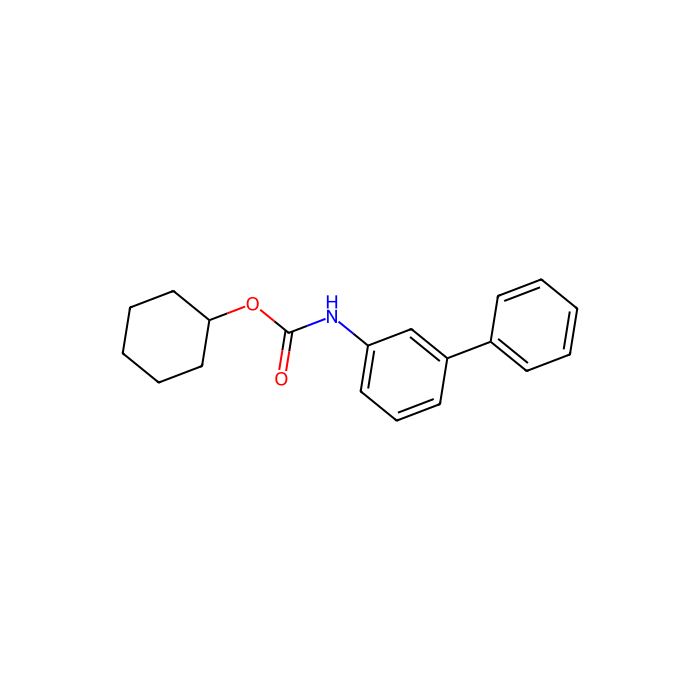
URB602 ist ein selektiver Monoacylglycerinlipase (MGL)-Inhibitor, der die MGL im Rattenhirn mit einer IC50 von 28±4 μM über einen nichtkompetitiven Mechanismus hemmt.
Wenn möglich, sollten Sie die Lösungen noch am selben Tag zubereiten und verwenden. Wenn Sie jedoch Stammlösungen im Voraus herstellen müssen, empfehlen wir Ihnen, die Lösung als Aliquote in dicht verschlossenen Fläschchen bei -20 °C zu lagern. Diese sind in der Regel bis zu einem Monat haltbar. Vor der Verwendung und vor dem Öffnen des Fläschchens empfehlen wir, das Produkt mindestens 1 Stunde lang auf Raumtemperatur kommen zu lassen. Benötigen Sie weitere Ratschläge zur Löslichkeit, Verwendung und Handhabung? Besuchen Sie unsere Seite mit den häufig gestellten Fragen (FAQ) für weitere Informationen.
This compound belongs to the class of organic compounds known as biphenyls and derivatives. These are organic compounds containing to benzene rings linked together by a C-C bond.
External Descriptors
Not available
1. Djoumbou Feunang Y, Eisner R, Knox C, Chepelev L, Hastings J, Owen G, Fahy E, Steinbeck C, Subramanian S, Bolton E, Greiner R, and Wishart DS. ClassyFire: Automated Chemical Classification With A Comprehensive, Computable Taxonomy. Journal of Cheminformatics, 2016, 8:61.
Determine the necessary mass, volume, or concentration for preparing a solution.
Dilution Calculator
Determine the dilution needed to prepare a stock solution.
Reconstitution Calculator
Bewertungen
Kundenbewertungen
Application Protocols
Application details must come from product data. For this SKU, no tested applications or protocols are provided.
Tested applications (WB, IHC, IF, FC, enzymatic assays): Not specified for this item; refer to CoA/Spec Sheet.
Recommended dilutions and controls: Not specified for this item; refer to CoA/Spec Sheet.
General guidance (non-specific): Prepare concentrated DMSO stocks, include vehicle controls, and validate dose–response behavior with appropriate positive/negative controls in your assay platform.
Biological Roles
Contextual background (general literature, not product-specific claims):
URB602 is widely cited as a small-molecule probe in endocannabinoid biology. It has been used to investigate hydrolytic enzymes involved in the turnover of 2‑arachidonoylglycerol (2‑AG) and related monoacylglycerols, thereby modulating lipid signaling pathways.
By altering lipid hydrolysis in biochemical or cell-based systems, researchers study downstream effects on receptor tone, intracellular signaling cascades, and lipid mediator profiles measured by targeted LC–MS/MS.
Typical applications include enzyme inhibition studies, target-validation experiments using lysates or purified proteins, and temporal profiling of lipid pools in response to perturbation.
Important caveats:
Selectivity and potency can vary with assay format, species, and enzyme source. Literature reports should be carefully matched to experimental conditions, and orthogonal assays (e.g., activity-based protein profiling, ABPP) are recommended to confirm on-target engagement.
Avoid extrapolating mechanistic findings to therapeutic outcomes; this compound is supplied strictly for research use only, as indicated in the Product Data.
Buffer Applications
Not typically applicable. URB602 is not used as a buffering agent. Instead, it is dosed into preselected assay buffers.
Practical notes:
Choose assay buffers compatible with hydrophobic small molecules (e.g., inclusion of ≤0.1–1% DMSO) and with the enzymatic system under study.
Maintain neutral pH to reduce potential carbamate hydrolysis during longer incubations. Validate compound stability in the chosen buffer matrix prior to extended experiments.
Green Alternatives
Not typically applicable. URB602 is a bioactive tool compound used at micromolar concentrations in biochemical or cellular experiments, not a bulk solvent or a process reagent where greener replacements are generally evaluated.
Sustainability notes (general):
Minimize solvent use by preparing concentrated DMSO stocks and aliquoting to reduce waste from repeated thaw/discard cycles.
Choose lower-toxicity solvents for dilutions where compatible with assay biology (e.g., ethanol over chlorinated solvents), and dispose of organic waste according to institutional green chemistry guidelines.
If process-scale synthesis of URB602 is undertaken in-house, consider greener solvent swaps and catalytic steps during route design; such process guidance is outside the scope of this catalog listing.
Pharmaceutical Uses
No excipient or pharmacopeial uses are specified for this item. This product is provided for research use only and is not intended for human or veterinary use, diagnostic procedures, or clinical applications.
Context (general):
In drug discovery laboratories, compounds like URB602 may be used as reference ligands or tool inhibitors in target validation, assay development, and mechanistic studies. Any formulation-like handling is strictly for in vitro or preclinical research workflows.
If formulating for in vivo research, investigators typically use cosolvent systems (e.g., DMSO/PEG/saline) validated for their model; such procedures must be developed and risk-assessed by the end user and are not specified for this catalog item.
Physical Properties
Item-specific physicochemical specifications are not provided in the Product Data for this SKU.
Appearance: Not specified for this item; refer to CoA/Spec Sheet.
Molecular weight: Not specified for this item; refer to CoA/Spec Sheet.
Molecular formula: Not specified for this item; refer to CoA/Spec Sheet.
Melting point, boiling point, density, refractive index, logP, pKa: Not specified for this item; refer to CoA/Spec Sheet.
General handling considerations for this compound type (literature/good practice):
Solubility: Small lipophilic aryl carbamates like URB602 are typically soluble in polar aprotic organic solvents (e.g., DMSO, DMF, acetonitrile) and moderately soluble in alcohols; they generally show poor water solubility. Prepare concentrated DMSO stock solutions and dilute into assay buffer with vigorous mixing to minimize precipitation.
Light and moisture: Neutral carbamates are usually stable to ambient light and moisture but can slowly hydrolyze under strong acidic/basic conditions; avoid prolonged exposure to extremes of pH during storage or assay preparation.
For quantitative values applicable to this lot (e.g., solubility limits, melting range), consult the CoA/Spec Sheet and SDS. Do not treat literature values as product specifications.
Quality and Grades
Grade/Purity (item-specific): Not specified for this item; refer to CoA/Spec Sheet.
Interpretive guidance (general):
Research-grade small molecules are typically supplied at high chemical purity suitable for in vitro assays, method development, and mechanistic studies. If UV transparency or LC–MS background is critical (e.g., bioanalytical quantitation), verify chromatographic purity, residual solvent profile, and non-volatile residue on the CoA.
Stabilizers: None indicated in the Product Data. If stabilizers or counter-ions are present, they will be listed on the CoA; these can influence solubility and biological assay background.
Batch verification: For potency-sensitive applications, confirm identity by orthogonal methods (e.g., HPLC-UV/ELSD, LC–MS, 1H NMR) and verify water content if hygroscopicity is suspected. Document any in-house qualification alongside the vendor CoA.
What is specific to this item:
The vendor specifies cold-chain shipping and −20°C storage, signaling emphasis on preserving integrity. Users should minimize freeze–thaw cycles and maintain desiccation as appropriate. For exact impurity limits, residual solvents, and assay-related specs, consult the lot-specific CoA.
Reaction and Applications
This product is a bioactive research compound rather than a general-purpose synthetic reagent. As such, it is typically applied in biochemical and cell-based experiments rather than in chemical synthesis.
Use contexts (general, literature):
Employed as a probe molecule in enzymology and lipid signaling studies within the endocannabinoid system. Researchers use it to modulate endogenous lipid hydrolase activity in cell lysates or intact cells and to observe consequent changes in lipid mediators by LC–MS-based lipidomics.
Utilized in target-engagement studies (e.g., activity assays, substrate turnover measurements) and in validating assay platforms for lipid-metabolizing enzymes.
Practical notes:
Prepare fresh working solutions immediately prior to assays to minimize any potential hydrolysis or adsorption losses. Filter through 0.2 µm PTFE if particulate is observed.
For biochemical assays, pre-incubation with the target enzyme is often performed to establish steady-state inhibition; optimize pre-incubation time and temperature empirically.
No named organic reactions or coupling protocols are typically associated with URB602 as a reagent. For synthesis-related content, see “Synthetic Utility,” which for this compound class is limited.
Reaction Conditions
This compound is not generally used as a reagent in chemical reactions. However, for its use in biochemical assays, the following generalized guidance (literature-based) may be helpful:
Stock solutions: Prepare in anhydrous DMSO (typical 10–50 mM). Store as single-use aliquots at −20°C to minimize freeze–thaw.
Assay incubation: Pre-incubate enzyme preparations with compound for 10–30 minutes at room temperature or 37°C prior to initiating reactions, adjusting time based on the kinetic mechanism observed in your system.
Working concentrations: Common screening ranges are 0.01–100 µM, titrated to define concentration–response curves. Optimize according to the sensitivity of your assay and expected potency from literature.
Detection: Quantify effects on lipid substrates/products using LC–MS/MS, fluorogenic/Colorimetric substrates, or activity-based probes, ensuring solvent controls are matched.
All values above are general literature guidance and are not specifications for this item. Users should pilot conditions to confirm stability, lack of aggregation, and absence of assay interference (e.g., inner-filter effects or detergent sensitivity).
Safety and Handling
GHS classification, signal word, hazard statements, and pictograms: Not specified for this item; refer to the SDS for authoritative safety information.
Storage conditions (from Product Data): Store at −20°C. Shipments are provided in an ice chest with ice pads to maintain a low temperature in transit.
General laboratory safety guidance for hydrophobic bioactive small molecules (supplementary, not product-specific):
PPE: Wear lab coat, safety glasses, and appropriate chemical-resistant gloves (e.g., nitrile). Handle powders and solutions in a fume hood to avoid inhalation or aerosol exposure.
Incompatibilities: Avoid strong acids/bases for extended periods (risk of carbamate hydrolysis). Keep away from oxidizing agents until compatibility is assessed.
Hygiene: Avoid skin contact and ingestion; wash thoroughly after handling. Decontaminate benchtops with suitable organic solvent followed by detergent and water, disposing of waste according to institutional protocols.
First aid (overview; defer to SDS): If on skin, wash with soap and water. If in eyes, rinse cautiously with water for several minutes and seek medical attention. If inhaled, move to fresh air. If ingested, rinse mouth and seek medical advice; do not induce vomiting unless directed by medical personnel.
Always consult the SDS supplied with the product for complete hazard, exposure limit, and spill/accident response procedures.
Solvent Selection
URB602 is a bioactive small molecule, not a laboratory solvent. Solvent selection considerations focus on preparing analytical or biological assay solutions rather than using the compound as a reaction medium.
Practical guidance (general, literature-based):
Primary stock preparation: DMSO is commonly used to prepare concentrated stocks (e.g., 10–50 mM) due to excellent solubilizing power for lipophilic aryl carbamates. DMF or ethanol can be alternatives when DMSO is undesirable for the assay readout.
Aqueous dilution: Add DMSO stocks slowly into vigorously stirred buffer or culture medium to minimize precipitation; keep final DMSO typically ≤0.1–1% v/v depending on biological system tolerance.
Co-solvent strategies: If precipitation occurs, include a small percentage of co-solvent (e.g., 0.1–0.5% non-ionic surfactant or 0.5–2% ethanol) consistent with assay constraints.
Adsorption: Hydrophobic compounds may adsorb to plastics; use low-binding tubes/plates or glassware for accurate dosing at low concentrations.
Because item-specific solubility limits are not provided, always verify clarity and stability of working solutions empirically and document solvent composition in your records.
Storage and Reconstitution
Storage (from Product Data): Store at −20°C. Shipments are provided in an ice chest with ice pads to maintain temperature during transit.
Reconstitution: Not specified for this item; refer to CoA/Spec Sheet.
Good practice for bioactive small molecules (general):
Upon receipt, allow the sealed container to equilibrate to room temperature in a desiccator before opening to avoid condensation. If supplied as a solid, subdivide into single-use aliquots under dry conditions.
For solution stocks, dissolve in anhydrous DMSO to a convenient concentration (e.g., 10–50 mM), vortex to ensure complete dissolution, then aliquot into inert, low-binding vials. Store aliquots at −20°C or below, protected from repeated freeze–thaw.
Thaw aliquots at room temperature, mix thoroughly, and visually inspect for precipitation or cloudiness upon dilution into aqueous media. Discard aliquots that show signs of degradation or contamination.
Research Use Note: For research use only.
Structure and Identity
URB602 is a bioactive small-molecule tool compound commonly used in chemical biology studies. For this specific catalog item, structural identifiers provided are incomplete.
Item-specific identifiers (from Product Data):
CAS: 565460-15-3
InChIKey: 121941 (Note: this appears truncated; consult CoA/SDS for the full identifier.)
SMILES: Not specified for this item; refer to CoA/Spec Sheet.
Molecular formula: Not specified for this item; refer to CoA/Spec Sheet.
Molecular weight: Not specified for this item; refer to CoA/Spec Sheet.
Structural description (general literature context):
URB602 is reported in the literature as a hydrophobic aryl carbamate-type small molecule used as a biochemical probe in endocannabinoid research. It lacks ionizable groups in physiological pH ranges and is typically handled as a neutral organic compound.
Functional group features (general, literature):
Contains an aryl moiety and a carbamate ester linkage; overall nonpolar character with limited aqueous solubility expected.
Please verify exact structure and identifiers for this SKU via the accompanying Certificate of Analysis (CoA) or Specification Sheet before use in regulated workflows.
Synthetic Utility
URB602 is sold as a finished bioactive tool compound, not as a synthetic building block. It is not commonly used as a substrate, coupling partner, or catalyst in preparative organic synthesis.
General chemical perspective (literature):
Aryl carbamates can, in principle, undergo hydrolysis or transcarbamoylation under forcing conditions, but such transformations are not typical use cases for this compound in research labs.
If analog development is pursued, synthetic routes often involve coupling of an aryl phenol/amine with a chloroformate or carbamoylating agent, followed by purification to high chemical purity suitable for biological testing. These routes are outside the scope of the present catalog entry.
Target Specificity
Only product-data-sourced specificity is permitted in this section.
Target, mechanism, species reactivity, and related details: Not specified for this item; refer to CoA/Spec Sheet and primary literature.
Note: While URB602 is discussed in the literature as a tool compound in endocannabinoid enzymology, Aladdin provides no item-specific target claims for this SKU. Users should consult peer-reviewed sources to align their experimental design and verify target engagement with orthogonal methods.
Häufig gestellte Fragen
What is the purity of this product, and how is it determined?
This product is supplied at ≥98% purity, determined by HPLC. Lot-specific values are stated on the Certificate of Analysis.
How should this product be stored?
Store at ?20 °C. Freezer storage is required to maintain the specified shelf life.
How is this product shipped?
This product ships in an insulated container with ice pads. Unpack on arrival and transfer it to the storage condition stated above.
What are the CAS number, molecular formula and molecular weight?
The CAS Number is 565460-15-3, the molecular formula is C19H21NO2, and the molecular weight is 295.38 g/mol. InChIKey HHVUFQYJOSFTEH-UHFFFAOYSA-N.
What documentation is provided?
Available product documentation, including Certificates of Analysis (COA), Safety Data Sheets (SDS), and specification sheets, is shown in the product document area. Document availability and access follow the current site policy.
Wir verwenden Cookies, um die ordnungsgemäße Funktion der Website sicherzustellen und, soweit zulässig, Ihr Nutzererlebnis zu verbessern. Sie können Ihre Einstellungen jederzeit unter „Einstellungen“ verwalten. Weitere Informationen finden Sie in unserer Cookie-Richtlinie.
Dürfen wir Sie über Rabattaktionen informieren?
Später erinnern
Vielen Dank! Bitte überprüfen Sie Ihren E-Mail-Posteingang, um zu bestätigen.
Products are supplied to verified businesses, institutions, and qualified professionals for research and development use only. Not for use in humans, animals, diagnosis, or therapy.
 D2103001
