Determine the necessary mass, volume, or concentration for preparing a solution.
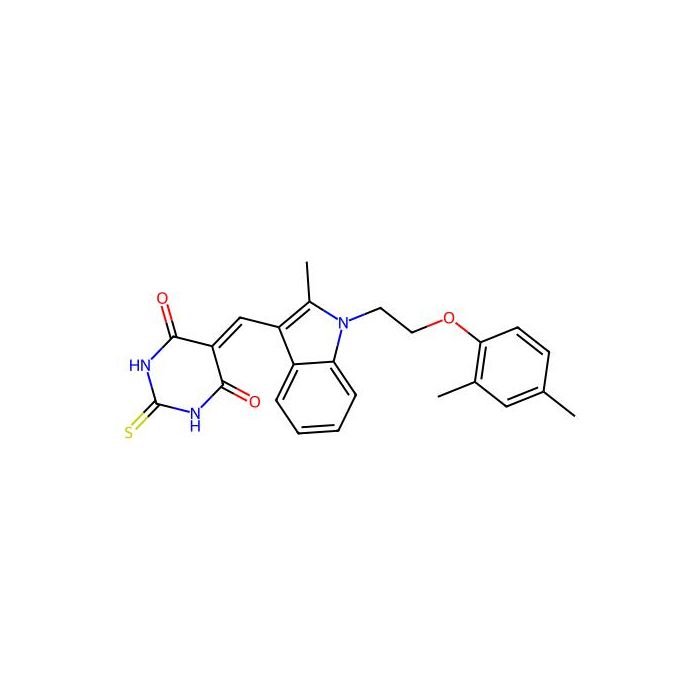
ZLDI-8 - 10mM in DMSO , CAS No.667880-38-8
Zu bestellen verfügbar
QUALITÄT & REINHEIT 10mM in DMSO
Storage
Store at -80°C
Shipped In
Dry ice packs + Cold packs

ZLDI-8 is a Notch activating/cleaving enzyme ADAM-17 inhibitor and inhibits the cleavage of Notch protein. ZLDI-8 decreases the expression of pro-survival/anti-apoptosis and epithelial-mesenchymal transition (EMT) related proteins. ZLDI-8 is also a competitive and irreversible tyrosine phosphatase (Lyp) inhibitor with an IC 50 of 31.6 μM and a K i of 26.22 μM. ZLDI-8 inhibits the growth of MHCC97-H cells with an IC 50 of 5.32 μM
In Vitro
ZLDI-8 (0.03-30 μM; 6-72 hours; MHCC97-H cells) treatment reduces cell viability in a time- and dose-dependent manner. ZLDI-8 (1-10 μM; 6-72 hours; MHCC97-H cells) significantly decreases the level of NICD and the accumulation of NICD in the nucleus. ZLDI-8 could also reduce the expression of pro-survival/anti-apoptosis regulators, Survivin and cIAP1/2. And also increases the expression of epithelial marker E-Cadherin and reduced mesenchymal markers N-Cadherin and Vimentin. ZLDI-8 enhances chemotherapy effects on tumor cell proliferation blockage, induction of apoptosis and cell-cycle arrest by inhibiting Notch pathway and blocking chemical resistance. MCE has not independently confirmed the accuracy of these methods. They are for reference only. Cell Viability AssayCell Line: MHCC97-H cells Concentration: 0.03 μM, 0.1 μM, 0.3 μM, 1 μM, 3 μM, 10 μM, 30 μM Incubation Time: 6 hours, 12 hours, 24 hours, 48 hours, 72 hours Result: Emerged cytotoxic effect on MHCC97-H cells in a time- and dose-dependent manner. Western Blot AnalysisCell Line: MHCC97-H cells Concentration: 1 μM, 3 μM, 10 μM Incubation Time: 6 hours, 12 hours, 24 hours, 48 hours, 72 hours Result: Significantly decreased the level of NICD and the accumulation of NICD in the nucleus. Also reduced the expression of pro-survival/anti-apoptosis regulators, Survivin and cIAP1/2
In Vivo
ZLDI-8 (0.2-2 mg/kg; intraperitoneal injection; every two days; for 20 days; nude mice) treatment enhances the effect of Sorafenib on inhibiting tumor growth in nude HCC-bearing mice model . MCE has not independently confirmed the accuracy of these methods. They are for reference only. Animal Model: Nude mice with MHCC-97H cells Dosage: 2 mg/kg, 1 mg/kg, 500 μg/kg, or 200 μg/kg Administration: Intraperitoneal injection; every two days; for 20 days Result: Inhibited tumor growth in nude HCC-bearing mice model.
IC50& Target:ADAM-17, IC50: 31.6 μM (Tyrosine phosphatase), Ki: 26.22 μM (Tyrosine phosphatase)
No tested application protocols are provided in this listing.
General protocol framework for screening compounds:
No definitive biological function, target, or pathway information is provided for this product entry. Any target specificity or mode-of-action claims must be derived from peer-reviewed literature associated with the exact structure corresponding to CAS 667880-38-8.
General considerations for research-use small molecules:
Important: This product is supplied strictly for research use only. It is not intended for use in humans, animals, diagnostics, or therapeutic applications.
This item is a small-molecule screening compound and is not a buffering reagent. No buffer system or pKa data are provided.
Practical assay-related notes (general):
Item-specific buffer recipes, buffering ranges, or compatibility data: Not specified for this item; refer to CoA/Spec Sheet.
As a screening compound, ZLDI-8 is typically handled in micro- to milligram quantities; the main greenness levers involve solvent choice and waste minimization rather than replacement of the compound itself.
Greener handling strategies (general):
Illustrative comparison (general solvent considerations):
Operational tips:
Note: No item-specific environmental metrics or life-cycle data are available for this compound.
No pharmacopeial status, excipient role, or formulation use is provided for this product. ZLDI-8 is supplied strictly as a research-use compound.
General notes (non-clinical, non-therapeutic):
Item-specific regulatory/compendial information: Not specified for this item; refer to CoA/Spec Sheet.
Item-specific physical constants are not provided in this listing.
General guidance for small-molecule screening compounds (literature/practice):
This listing does not include an explicit grade or purity specification.
Interpretation and guidance:
Documentation:
This catalog entry is positioned as a small-molecule screening compound, not a synthetic reagent. There are no item-specific reaction use-cases provided.
Practical applications relevant to screening compounds (general guidance):
If you intend to use ZLDI-8 in chemical synthesis:
Always consult the primary literature or the CoA for any structure-dependent application claims.
Not applicable. ZLDI-8 is not supplied as a reagent with defined reaction roles, and no item-specific synthetic or transformation conditions are provided in this listing.
General notes relevant to handling in experimental workflows:
Hazard data are not provided for this specific item. Handle as a potentially hazardous laboratory chemical and defer to the SDS for authoritative guidance.
General laboratory precautions (best practice):
This product is a small-molecule screening solid; dissolution strategy is central to usage. No item-specific solubility data are provided.
General dissolution guidance (practice/literature):
Selection considerations:
Mini comparison (general):
Follow the item-specific storage instructions and shipping conditions below.
General best practices for small-molecule screening solids and DMSO stocks:
Item-specific stabilizers, excipients, or formulation details: Not specified for this item; refer to CoA/Spec Sheet.
Research Use Note: For research use only.
Brief overview: ZLDI-8 is listed as a research-use small molecule in our screening compound collection. The structural identifiers for this specific catalog entry are incomplete in the present record.
Structural description (general):
Notes for identity verification (general best practices):
This product is offered as a discrete small molecule for screening and is not positioned as a general synthetic reagent or building block in this listing.
General guidance if derivatization is contemplated (structure-dependent, not item-specific):
Item-specific functional groups and reactivity: Not specified for this item; refer to CoA/Spec Sheet and primary literature tied to CAS 667880-38-8.
Target, pathway, or biochemical specificity is not provided for this catalog entry.
Guidance (general):