GRADE & PURITYCarrier Free?Carrier-free — supplied without added carrier protein/stabilizer. Use when carriers (e.g. BSA) would interfere with conjugation or sensitive assays.ExactAb™?ExactAb™ — Aladdin's antibody line emphasizing precision and validated quality. Use for reliable, specificity-validated antibody applications.Validated?Validated grade — performance confirmed in defined applications before release. Use when you want documented assurance the reagent works as stated.See COA
Rabbit anti Human GSDMB Antibody, Polyclonal, could be used for WB and so on.
Specifications
Product Name
GSDMB Antibody - Primary antibody, specific to GSDMB, Rabbit IgG
Synonyms
GSDMB-1|GSDML|123 antibody|156 antibody|Gasdermin B antibody|Gasdermin like protein antibody|Gasdermin-B antibody|Gasdermin-like protein antibody|GSDMB antibody|GSDML antibody|PP4052 antibody|PRO2521 antibody|Gasdermin-like protein
Specifications & Purity
Carrier Free, ExactAb™, Validated, See COA
Biochemical and Physiological Mechanisms
The N-terminal moiety promotes pyroptosis. May be acting by homooligomerizing within the membrane and forming pores (PubMed:27281216). The physiological relevance of this observation is unknown.
Host species
Rabbit
Specificity
GSDMB
Immunogen
Recombinant GSDMB expressed in E.coli (AA 208-237).
Positive Control
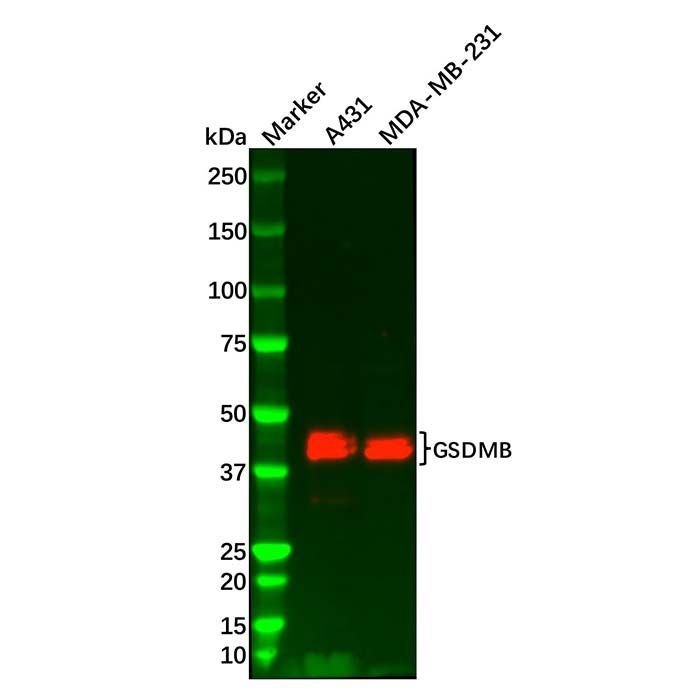
WB: A431 and MDA-MB-231 cell lysates.
Conjugation
Unconjugated
Grade
Carrier Free, ExactAb™, Validated
Isotype
Rabbit IgG
SDS-PAGE
150 kDa
Purification Method
Protein A purified + Peptide affinity purified
Concentration
See COA
Product Line
Biological Products
Storage and Shipping
Form
Liquid
Storage
Store at -20°C,Avoid repeated freezing and thawing
Shipped In
Ice chest + Ice pads
Stability And Storage
Store at 4℃ short term (1-2 weeks). Store at -20℃ long term (24 months). Upon receipt, it is recommended to aliquot. Avoid freeze/thaw cycle.
Images
GSDMB Antibody (Ab106583) - Western Blot All lanes: GSDMB Antibody (Ab106583) at 1/1000 dilution Samples: Lysates at 20 µg per lane Secondary: Goat Anti-Rabbit IgG H&L (HRP) (Ab170144) at 1/10000 dilution
Predicted band size: 47 kDa Observed band size: 41, 43, 45 kDa Exposure time: 10.6 s
Determine the necessary mass, volume, or concentration for preparing a solution.
Dilution Calculator
Determine the dilution needed to prepare a stock solution.
Reconstitution Calculator
Reviews
Customer Reviews
Application Protocols
Manufacturer-tested applications, recommended dilutions, incubation times, and positive control materials are not specified for this item; refer to CoA/Spec Sheet.
General guidance for establishing protocols with Carrier Free antibodies (non-item-specific):
Start with a titration series to determine optimal working concentration for your assay matrix (e.g., 0.05–2 µg/mL for plate-based capture; 0.1–1 µg per IP; ranges are illustrative only).
Include appropriate controls (isotype, secondary-only, and antigen-blocking where feasible).
Validate specificity using knockdown/knockout or overexpression systems when possible.
Because no application data are provided here, users must perform application-specific optimization.
Biological Roles
Target context (literature/general for GSDMB):
GSDMB (Gasdermin B) is a member of the gasdermin family implicated in pyroptotic cell death. Upon proteolytic activation that liberates the N‑terminal domain, GSDMB can form membrane pores leading to lytic cell death and inflammatory signaling.
Activation/processing: Certain granzymes (e.g., GzmA) and context-dependent proteases have been reported to cleave gasdermins; precise activating protease(s) for GSDMB can be cell-type and context dependent in the literature. The full-length protein is autoinhibited by its C‑terminal domain.
Biological pathways: Innate immune responses, epithelial barrier biology, and inflammation. Genetic variation and expression patterns of GSDMB have been associated with immune and epithelial phenotypes in population studies (literature background; not a product claim).
Subcellular behavior: Activated N‑terminal fragments target membranes, particularly those enriched in acidic phospholipids, to form pores; full-length protein is cytosolic prior to activation (literature/general).
Use of an antibody to GSDMB (general rationale):
Enables detection of endogenous or overexpressed GSDMB, assessment of cleavage/activation status (when epitope allows), subcellular localization studies, and immunocapture for interactome or proteoform analysis.
Item-specific biological data (species reactivity, epitope, isotype, WB banding): Not specified for this item; consult CoA/Spec Sheet.
Buffer Applications
Antibody reagents are not themselves buffering agents; however, buffer choice is critical for maintaining stability and activity.
Working buffers (general guidance):
Storage/assay: PBS or HEPES-buffered saline at pH ~7.2–7.5 is commonly used. For Carrier Free material, users may supplement with low concentrations of stabilizers after aliquoting if compatible with downstream assays.
Conjugation: Use amine-free buffers (avoid Tris) for NHS ester labeling; maintain low ionic strength where high coupling efficiency is required.
Immunocapture: Couple in PBS; wash with gentle nonionic detergents (e.g., 0.05% Tween-20) if compatible with the application.
Avoid: Extreme pH (<5 or >9) and high salt/chaotropes unless specifically required, as these can reduce binding or induce aggregation.
Item-specific buffer composition and pH are not provided for this SKU; refer to CoA/Spec Sheet for exact formulation, if applicable.
Green Alternatives
Environmental considerations for antibody workflows center on buffer choice, preservative use, and minimizing hazardous reagents rather than choosing among organic solvents.
Prefer aqueous buffers at neutral pH and avoid nonessential azide/mercurials. Where microbial control is needed, consider sterile technique and single-use aliquots to avoid chemical preservatives.
Replace methanol-containing fixation or transfer buffers (where applicable) with alcohol-free or lower-toxicity alternatives when compatible with the assay.
Minimize single-use plastics by planning aliquots and using refillable reservoirs; employ recyclable secondary packaging.
For conjugations, choose water-soluble, high-atom-economy linkers and avoid excess organic cosolvent.
Comparison (general):
Sodium azide vs sterile, aliquoted carrier-free stocks: Azide provides microbial control but is toxic and incompatible with HRP; sterile, small aliquots reduce preservative need (trade-off: shelf-life vs safety and downstream compatibility).
Organic dye NHS-esters in DMF/DMSO vs water-dispersible labels: Water-compatible labels reduce VOCs and simplify workup, but may offer a narrower selection of spectral properties.
Item-specific environmental certifications or green attributes are not specified for this SKU.
Pharmaceutical Uses
This product is a research-use-only antibody reagent and is not intended for human or veterinary diagnostic or therapeutic use.
Formulation/excipient status: No pharmacopeial status or excipient role is provided for this item.
Potential roles in pharmaceutical R&D (general): Target quantitation in biological matrices, mechanism-of-action studies, biomarker characterization, and QC of expression systems. For regulated applications, use qualified/validated reagents and document lot traceability.
Item-specific regulatory status, residuals, and viral safety validations are not specified; refer to CoA/Spec Sheet. No clinical or therapeutic claims are made.
Physical Properties
Physical state/appearance: Not specified for this item; refer to CoA/Spec Sheet.
Molecular weight (item-specific): Not specified for this item; refer to CoA/Spec Sheet.
Buffer/excipients (item-specific): Not specified for this item; refer to CoA/Spec Sheet. Grade indicates Carrier Free (see Quality & Grades).
pH of formulation (item-specific): Not specified for this item; refer to CoA/Spec Sheet.
Literature/general properties for antibodies (not item-specific):
Isoelectric point (pI): commonly ~6–9 depending on sequence and isotype.
Extinction coefficient (ε280): varies by sequence; a common approximation for IgG is A280 of 1.4 ≈ 1 mg/mL (use item-specific CoA for accurate factor).
Solubility: Highly soluble in isotonic aqueous buffers (e.g., PBS); sensitive to denaturation at extremes of pH, high temperature, organic solvents, and strong surfactants.
Stability considerations: Freeze–thaw cycling can cause aggregation; stabilizers (e.g., carrier proteins) are often used, but this product is Carrier Free by grade designation (no carrier proteins added by design; see Quality & Grades).
Quality & Grades
Item-specific grade declarations:
Carrier Free, ExactAb™, Validated (as listed for this SKU).
What these mean (general definitions; not a substitute for the item CoA):
Carrier Free: Formulated without carrier proteins (e.g., BSA), glycerol, or other stabilizing additives that can interfere with conjugation, functional assays, or mass spectrometry. Practical implication: you may add your own stabilizers post-aliquoting to suit the application.
ExactAb™: Denotes sequence-defined, recombinantly produced or highly standardized antibodies designed to deliver lot-to-lot consistency and reproducible performance. Practical implication: reduced variability across purchases and compatibility with quantitative assays. (Brand/term explanation; consult datasheet for production method specifics.)
Validated: Indicates the antibody has undergone internal verification of identity and/or functional binding. The exact panel of tested applications, host reactivity, and validation methods are not specified for this item; refer to CoA/Spec Sheet.
Release documentation and testing:
Purity, concentration, endotoxin/bioburden, binding specificity, and residual host cell protein/DNA (if recombinant) are commonly reported for quality-controlled antibodies; item-specific acceptance criteria are not specified here.
When to choose Carrier Free/ExactAb™:
Preferred for custom conjugations (enzymes, fluorophores, oligos), surface immobilization, SPR/BLI, and functional assays where excipients could interfere.
Useful when reproducibility and traceability of sequence are priorities.
Reaction & Applications
As an antibody reagent, this product is used in immunoassay and affinity-based detection or capture workflows rather than chemical synthesis.
Potential use domains (general, not item-validated): antigen detection/quantitation in lysates or fractions, immunocapture/enrichment prior to MS, target engagement studies, proximity assays, or biosensor measurements (SPR/BLI). Specific tested applications for this item are not specified; consult CoA/Spec Sheet.
Conjugation chemistry (general): Carrier Free format is suitable for custom labeling with NHS esters (amines on lysines), maleimide reagents (reduced hinge cysteines), click handles (azide/alkyne via enzymatic or chemical methods), and site-specific Fc glycoconjugation (oxidation-based or enzymatic remodeling). Optimize stoichiometry and maintain gentle conditions (4–25°C, neutral pH) to preserve affinity.
Immobilization (general): Passive adsorption to polystyrene (ELISA plates) or covalent coupling to activated resins (NHS-activated agarose) for immunoprecipitation; confirm orientation and capacity empirically.
Controls: Include isotype and no-primary controls; for quantitative work, establish standard curves using purified antigen.
Note: The manufacturer’s tested/validated applications for this specific SKU are not listed in the Product Data; therefore, users should perform application-specific optimization and validation.
Reaction Conditions
Classical organic reaction conditions are not applicable to an antibody reagent. For bioconjugation and assay setup, the following general (literature) conditions may be useful. These are guidance only and are not item-specific recommendations:
NHS-ester labeling of lysines: pH 7.4–8.3 in amine-free buffer (e.g., PBS or bicarbonate), 4–25°C, molar ratio label:antibody 3–10:1, 30–120 min; quench with Tris or ethanolamine; remove excess label by desalting.
Maleimide-thiol labeling: Reduce hinge disulfides mildly (e.g., TCEP 0.5–5 mM, pH ~7) or use engineered cysteines; react with maleimide label at pH 6.5–7.0, 4–25°C, protect from light; remove excess reagent.
Biotinylation (sulfo-NHS): Similar to NHS-ester labeling; verify degree of labeling by HABA/Avidin or MS.
Immobilization to NHS-activated resin: Couple in PBS (pH ~7.2–7.5) for 1–2 h at RT; block remaining actives with ethanolamine; wash extensively.
Expected outcomes (general): Maintain functional binding while achieving desired label density; excessive modification can reduce affinity.
Item-specific optimal conditions, concentrations, and tested applications are not provided; consult CoA/Spec Sheet and perform small-scale pilots.
Safety & Handling
GHS classification, signal word, hazard statements, and pictograms: Not specified for this item; refer to the product SDS for authoritative safety information.
General laboratory precaution (proteins/antibodies):
Wear appropriate PPE: lab coat, gloves, and safety glasses.
Avoid aerosol generation and ingestion; handle solutions in a biosafety cabinet if sterility is required for your workflow.
Prevent microbial contamination; use sterile tips/tubes and keep containers closed.
Incompatibilities (general): Prolonged exposure to strong acids/bases, oxidants, chaotropes, or organic solvents can denature antibodies. Avoid metal-catalyzed oxidation; minimize exposure to light and elevated temperatures.
First-aid overview (general): In case of contact with eyes/skin, rinse with water. If inhaled as aerosol, move to fresh air. If swallowed, rinse mouth with water. Seek medical attention if irritation persists. Follow institutional guidelines.
Spill/cleanup: Absorb liquid with inert material, wash spill area with water/detergent. Dispose according to local regulations and institutional biosafety policies.
Waste: Treat as laboratory biological/chemical waste per institutional SOPs.
Shipping: Shipped in ice chest with ice pads (item-specific). Inspect for temperature excursions upon receipt.
For research use only (item-specific).
Solvent Selection
This product is an antibody reagent and is typically supplied in, or reconstituted into, aqueous biological buffers. Organic solvent selection is generally not applicable.
Recommended medium (general): Isotonic, neutral pH buffers (e.g., PBS, HEPES, or Tris) compatible with downstream assays. For Carrier Free material, users may add stabilizers (e.g., low levels of trehalose, sugars, amino acids) as appropriate after aliquoting.
Avoid: High percentages of organic solvents (acetonitrile, methanol, DMSO) and extreme pH, which can denature proteins.
If conjugating: Use amine-free buffers (e.g., PBS without Tris) for NHS-ester chemistry; for maleimide-thiol conjugations, maintain pH ~6.5–7.0 and avoid competing thiols (general guidance).
For solvent selection in chemical synthesis, refer instead to the Green Alternatives and Reaction & Applications sections of small-molecule products; this section is not typically applicable to antibodies.
Storage & Reconstitution
Item-specific storage and shipping:
Storage conditions: Store at -20°C. Avoid repeated freezing and thawing.
Shipping: Shipped in an ice chest with ice pads.
General storage guidance for antibodies (not item-specific; follow datasheet if provided):
Upon receipt, promptly store at the recommended temperature. If the product is supplied lyophilized, allow the vial to equilibrate to room temperature in a desiccator before opening to minimize moisture uptake.
Reconstitution (if lyophilized; not specified for this SKU): Reconstitute with sterile, neutral pH buffer (e.g., PBS) to a convenient stock concentration. For Carrier Free antibodies, consider preparing single-use aliquots and, if compatible with your application, adding user-selected stabilizers (e.g., 0.1–1% trehalose or 0.05–0.1% inert protein) after aliquoting to minimize adsorption; ensure any additive does not interfere with downstream assays.
Aliquoting: Prepare small, single-use aliquots to avoid freeze–thaw cycles. Use low-bind tubes and keep on ice during handling.
Short-term storage: 2–8°C for hours to a few days may be acceptable for in-use aliquots; monitor for microbial growth and avoid contamination.
Long-term storage: -20°C (as specified) or below; protect from repeated freeze–thaw.
Concentration, exact buffer composition, and stabilizers for this SKU are not specified; consult the CoA/Spec Sheet for product-specific instructions.
Structure & Identity
GSDMB Antibody is a protein-based affinity reagent directed against the target designated in the product name.
Item-specific small-molecule identifiers (SMILES, InChIKey, CAS, CID, empirical formula, exact molecular weight): Not applicable to antibodies and not specified for this item; refer to CoA/Spec Sheet.
Molecular class: Protein immunoglobulin (antibody) reagent (general information; not item-specific).
Structural features (literature/general):
Typical IgG architecture with two identical heavy chains and two identical light chains forming two antigen-binding fragments (Fabs) and one Fc domain.
Variable regions (VH/VL) provide specificity toward the GSDMB epitope; constant regions define isotype and effector functions (isotype not specified for this item).
Disulfide bonds stabilize intra- and inter-chain structure; glycosylation of Fc is common in many antibodies (degree/pattern not specified for this item).
Target name as provided: GSDMB.
Host/clonality/clone ID/isotype/epitope: Not specified for this item; refer to CoA/Spec Sheet.
2D structural description (general for IgG): A Y‑shaped quaternary structure where each arm (Fab) comprises a heavy-chain variable and light-chain variable domain forming the paratope; the stem is the Fc region composed of heavy-chain constant domains. Exact sequence and paratope details for this product are not specified.
Synthetic Utility
Not applicable. This SKU is an antibody reagent intended for biochemical detection, capture, or quantitation of the GSDMB target. It is not a synthetic building block or a reagent for chemical bond-forming reactions.
For users engaging in bioconjugation, see Reaction & Applications for general labeling strategies compatible with Carrier Free antibodies.
Target Specificity
Target name (from product title): GSDMB.
Target full name, epitope, clone ID, host species, isotype, species reactivity, and cross-reactivity: Not specified for this item; refer to CoA/Spec Sheet.
Note: Without item-specific epitope/host/isotype information, users should verify compatibility with their sample species and application through preliminary testing or by consulting the datasheet.
Frequently Asked Questions
What does ExactAb? mean?
ExactAb? indicates the product has been validated for use in rigorous antibody validation workflows. Validation may include positive/negative control samples, signal-to-noise testing, and protocol-specific QC. Lot-specific test data is published on the Certificate of Analysis where available.
What does Carrier Free mean?
Carrier Free indicates that the material has been processed and tested for specialty industrial processing. Specifications focus on the impurities that affect performance in that application — for example, metal content for electronics, particle size for batteries, refractive index for optics, or moisture content for moisture-sensitive processes.
How should this product be stored?
Store at ?20 °C. Avoid repeated freeze–thaw cycles. Aliquot into single-use volumes before freezing.
How is this product shipped?
This product ships in an insulated container with ice pads. Unpack on arrival and transfer it to the storage condition stated above.
What documentation is provided?
Available product documentation, including Certificates of Analysis (COA), Safety Data Sheets (SDS), and specification sheets, is shown in the product document area. Document availability and access follow the current site policy.
Which species reactivity has this antibody been validated against?
Validated reactivity is listed on the PDP and on each lot's datasheet. We validate against the most commonly tested species for the target (GSDMB Antibody); cross-reactivity in untested species may exist but is not guaranteed. Contact technical support for specific species inquiries.
Need help choosing the grade?
Our grade selection guide covers purity, stabilizer status, and application suitability for all variants in our catalog.
We use cookies to ensure the website functions properly and, where permitted, to improve your experience. You can manage your preferences at any time in Settings. Learn more in our Cookie Policy.
Shall we send you a message when we have discounts available?
Remind me later
Thank you! Please check your email inbox to confirm.
Products are supplied to verified businesses, institutions, and qualified professionals for research and development use only. Not for use in humans, animals, diagnosis, or therapy.

 ZJ24F0303300