Used in the detection and assay of peptides, amino acids, amines, and amino sugars yielding highly fluorescent ternary compounds with aldehydes and primary amines. Reaction with sarcosine or proline gives azomethine ylides.
Application:
It can be used for the detection of peptides, amino acids, amino acids and amino sugars, and can produce strong fluorescent ternary compounds with aldehydes and primary amines. Reacts with sarcosine or proline to form methylimine Ylide.
Ninhydrin (ninhydrin hydrate) can be used as a reagent for the determination of amino acids and peptides by photometry and colorimetry. It can also be used to prepare ninhydrin reagents by mixing ninhydrin with hydroninhydrin (reduced form of ninhydrin) in dimethyl sulfoxide. This reagent can be used for the manual ninhydrin method to quantify amino acids.
It can be used to detect free amino groups in amino acids, peptides and proteins.
Specifications
Specifications & Purity
10mM in DMSO
Biochemical and Physiological Mechanisms
Ninhydrin reacts with primary and secondary amines producing a blue or purple reaction product (diketohydrindylidene-diketohydrindamine). Ninhydrin is commonly used for the development of fingermarks on porous surfaces and is often used in comparison with
Storage
Protected from light,Argon charged,Desiccated,Store at -80°C
Shipped In
Dry ice packs + Cold packs
This product requires cold chain shipping. Ground and other economy services are not available.
After chromatography, spray plate uniformly in a fume hood.
Heat at 110 °C for 5–10 min until violet spots develop. Document immediately.
Amino Acid Colorimetric Assay (Batch)
Reagent: 0.25% w/v ninhydrin in ethanol with 0.2 M citrate buffer (pH 5.5) at a 1:1 ratio.
Mix sample (containing primary amines) 1:1 with reagent.
Incubate at 95 °C for 15 min; cool to RT.
Read A560–570 nm vs reagent blank. Quantify using glycine calibration curve.
Latent Fingerprint Development on Paper (Laboratory Research Setting)
Working solution: 0.6% w/v ninhydrin in ethanol (or acetone). Optional: small % acetic acid to enhance contrast.
Apply by spraying or dipping; allow solvent to evaporate.
Develop at 60–80 °C for 10–20 min in a humidity chamber (~60–80% RH). Protect from light and overdevelopment.
General tips
Use freshly prepared solutions; store aliquots cold and light-protected when necessary.
Include positive controls (e.g., known amino acid dots on TLC) and blanks.
Avoid strong base and reducing agents that suppress color formation.
Dispose of solvent waste per institutional guidelines.
Biological Roles
Applicability
Ninhydrin is not a biological molecule and has no endogenous role. This section addresses its interaction with biomolecules in analytical contexts.
Literature overview (general; not item-specific specifications)
Reactivity toward biomolecules: Selectively reacts with primary amines, including N-termini of peptides, ε-amino groups of lysine (less efficient in structured proteins), and free amino acids, producing chromophores (Ruhemann’s purple) useful for detection and quantitation.
Analytical biochemistry: Historically central in amino acid analysis, both in batch colorimetry and in flow/post-column derivatization after ion-exchange or reversed-phase separation. Sensitivity is in the low nmol range for colorimetric detection with appropriate pathlength and blanks.
Fingerprint chemistry: Latent fingerprints on porous substrates contain amino acid residues; ninhydrin visualizes these deposits, enabling forensic imaging (outside the scope of clinical/diagnostic use).
Selectivity considerations: Primary aliphatic amines react strongly; secondary amines yield weaker yellow adducts; tertiary amines do not form chromophores. Interferents include strong reducing agents and excessive basicity.
Notes
This product is for research use only. It is not intended for diagnostic procedures in humans or animals.
For quantitative biological assays, use standardized amino acid solutions for calibration and control matrix pH/ionic strength to ensure reproducibility.
Buffer Applications
Not typically applicable.
Ninhydrin is not a buffering agent and is not used to maintain pH. It is occasionally used within buffered systems for colorimetric assays (e.g., citrate or acetate buffers around mildly acidic pH) to control reaction conditions.
For buffer selection in assays, refer instead to the Reaction Conditions and Application Protocols sections, which outline buffer composition and pH ranges used with ninhydrin derivatization.
Green Alternatives
Context
The sustainability profile of a ninhydrin workflow is dominated by the choice of solvent and the need for heating. The reagent itself is effective at very low loadings, minimizing mass intensity.
Greener options (literature; general)
Solvent substitution: Replace acetone or acetonitrile where possible with ethanol or isopropanol (renewable feedstocks, lower toxicity). Aqueous–ethanol blends can maintain reactivity while reducing VOC impact.
Alternative reagents: For amine detection, consider fluorescamine (non-aqueous, requires fluorescence detection) or o‑phthalaldehyde (OPA) with thiols in aqueous media (strong signal, but also hazardous—evaluate tradeoffs). For fingerprints, 1,2‑indanedione–Zn(II) systems can outperform ninhydrin on paper and may operate at lower reagent consumption; they still require organic carriers.
Comparison (typical, literature; qualitative)
Ninhydrin in acetone: Fast drying, strong color; high VOC/flammability.
Ninhydrin in ethanol: Slightly slower, safer solvent; similar performance for TLC and many stains.
OPA/thiol in buffer: Highly sensitive fluorescent detection; requires fluorimetry and thiol handling.
Fluorescamine: No background fluorescence pre-reaction; strictly anhydrous conditions required; waste still organic-rich.
Practical tips
Use minimal effective reagent concentration (e.g., 0.1–0.5% w/v) and fine mist sprayers to reduce solvent usage.
Recover solvent vapors with hoods equipped with capture/filtration; prefer ethanol where compatible.
Consider lower-temperature/longer-time development to save energy when feasible.
Pharmaceutical Uses
Not an excipient or API in formulations.
Ninhydrin is used in pharmaceutical quality control laboratories as an analytical/derivatization reagent to detect free amino groups in raw materials, intermediates, and surfaces (e.g., swab tests), but it is not itself formulated into drug products.
Regulatory/compendial: No specific pharmacopeial monograph is typically assigned for ninhydrin as a reagent in major compendia; laboratories follow internal/validated methods for ninhydrin-based assays.
Practical considerations: For GMP environments, source material with documented CoA, establish solution preparation SOPs (solvent, concentration, filtration), define acceptance criteria (blank response, color yield with standards), and capture stability/expiry for working solutions under light-protected, low-temperature storage.
Waste handling: Treat spent ninhydrin solutions and stained materials as chemical waste; segregate organic solvent waste per facility policy.
Physical Properties
Item-specific (from Product Data)
Appearance: Not specified for this item; refer to CoA/Spec Sheet.
Literature/Computed (general reference values; not item-specific specifications)
Phase at RT: solid
Melting point: ~248–250 °C (decomposes; literature)
Boiling point: not applicable (decomposes before boiling; literature)
Density: ~1.7–1.8 g/cm³ at 20 °C (literature, approximate)
Solubility: sparingly soluble in cold water; more soluble in hot water; readily soluble in polar organics such as acetone, ethanol, methanol, acetonitrile, and DMF (literature). Frequently used as 0.1–2% w/v solutions in acetone or ethanol for staining.
pKa: behaves as a highly activated 1,3-dicarbonyl/gem-diol; reported acidity consistent with activated methine and enolization in protic media (qualitative, literature). Exact pKa values vary with tautomer/medium.
LogP: low; compound is polar and hydrogen-bonding (qualitative, literature).
UV/Vis: parent reagent absorbs in near-UV; reacts with primary amines to form Ruhemann’s purple, λmax ~560–575 nm (literature; product chromophore, not the reagent itself).
Notes
Thermal decomposition and susceptibility to photodegradation are well documented; prepare solutions fresh and protect from light to preserve activity.
Quality & Grades
Item-specific (from Product Data)
Grade/purity: Not specified for this item; refer to CoA/Spec Sheet.
General guidance (for professional use)
Ninhydrin used in analytical applications (amino acid analysis, TLC staining, latent fingerprint visualization) often benefits from high chemical purity and low inorganic residue, as trace basic/amine impurities can reduce color yield or introduce background.
If designated as analytical/reagent grade: Typically suitable for qualitative tests and TLC visualization; assess background staining and blank response.
If designated as HPLC grade (when available): Emphasizes low UV background and low nonvolatile residue; commonly paired with rigorous solution preparation and filtration for post-/pre-column derivatization workflows.
Stabilizers: Ninhydrin is generally sold neat without stabilizers; protection from light and moisture is crucial. This item is provided argon charged and desiccated at −80 °C per Product Data to maximize shelf life.
Verification recommendations
Confirm assay/purity by HPLC or quantitative NMR when using for colorimetric quantitation.
Run a performance check (e.g., standardized glycine solution) to benchmark chromogenic response lot-to-lot.
Consult the product CoA/Spec Sheet for item-specific impurity profiles and any stabilizer or residual solvent content.
Reaction & Applications
Item-specific (from Product Data)
Manufacturer note: Not provided. Research use only.
Literature applications (general; not item-specific specifications)
Amino acid/amine detection: Classic chromogenic reagent that reacts with primary amines to form Ruhemann’s purple (λmax ~560–575 nm). Secondary amines typically yield yellow products with weaker absorbance.
Mechanistic outline: Initial Schiff base formation with the carbonyl system, followed by oxidative decarboxylation (for α-amino acids), iminium intermediates, and condensation to the chromophore via hydrindantin pathways.
TLC visualization: 0.2–0.5% w/v ninhydrin in acetone or ethanol; spray and heat (80–120 °C) to develop violet spots for primary amines, amino acids, peptides.
Latent fingerprint development: 0.5–1% w/v in polar solvent (often acetone or ethanol) for porous substrates; reacts with amino acid residues in fingerprint deposits to yield purple impressions on paper and cardboard.
Quantitative amino acid analysis: Colorimetric assays in buffered media (often citrate or acetate buffer), with heat to accelerate color development; used historically in flow-injection and post-column HPLC derivatization setups.
Solid-phase peptide synthesis monitoring: Basis of the Kaiser test (with supplemental reagents) to detect free amines on resin.
Other uses: Derivatization of amine-containing polymers and surfaces for visualization; educational qualitative tests for amino groups.
Practical considerations
Light, moisture, and base degrade activity; prepare fresh, protect from light.
Include blanks and standards to correct for background and matrix effects.
Reaction Conditions
General conditions (literature; guidance only—not item-specific specifications)
TLC stain: 0.2–0.5% w/v ninhydrin in acetone or ethanol. Spray evenly; dry briefly; heat plate at 100–120 °C for 5–10 min until violet spots appear for primary amines.
Fingerprint development (porous substrates): 0.5–1% w/v in acetone or ethanol. Apply by dipping or spraying; air-dry; develop at 20–25 °C for several hours or accelerate at 50–80 °C for 10–30 min in a humidity-controlled chamber. Protect from strong light.
Amino acid colorimetry (batch): Prepare ninhydrin reagent in ethanol or aqueous buffer (e.g., 0.2 M citrate, pH ~5–6) optionally with co-solvent (EtOH/DMF). Heat reaction mixture at 80–100 °C for 10–30 min; cool; measure absorbance of Ruhemann’s purple at ~560–575 nm against reagent blank. Calibrate with known amino acid standards (e.g., glycine).
Post-column HPLC derivatization: Ion-exchange separation followed by mixing with heated ninhydrin reagent (often 120 °C reaction coil) and photometric detection in visible range. Flow rates, reactor volumes, and reagent composition are method-specific.
Practical controls
Use freshly prepared solutions or validated stored aliquots (light-protected, cold).
Maintain mildly acidic conditions for robust chromophore formation; avoid strong base and strong reducing agents.
Include blanks and matrix spikes to assess background and recovery.
Expected performance
Detection sensitivity typically in low nmol range for primary amines under optimized conditions; secondary amines yield weaker responses (literature).
Safety & Handling
Item-specific (from Product Data)
Storage: Protect from light; keep under argon; desiccated; store at −80 °C. Shipments on dry ice + cold packs.
GHS/Classification
GHS classification, signal word, pictograms, and H-statements: Not specified for this item; refer to SDS for authoritative classification.
General safety guidance (literature/standard practice; not item-specific specifications)
Hazards: Irritant; may cause eye/skin/respiratory irritation. Dust may be harmful if inhaled. Can undergo slow photodegradation; avoid exposure to strong bases or strong oxidants/reductants during storage.
PPE: Lab coat, safety glasses or goggles, appropriate gloves (e.g., nitrile). Use in a fume hood to avoid inhalation of dust/aerosols.
Handling: Avoid moisture and light. Prepare staining/analytical solutions freshly or store aliquots protected from light at low temperature.
Incompatibilities: Strong bases (can accelerate degradation), strong oxidizing agents/reducing agents (may induce side reactions), moisture and light (decomposition/ activity loss).
First aid (overview): If inhaled—fresh air; seek medical attention if symptoms occur. Skin—wash with soap and water. Eyes—rinse cautiously with water for several minutes; remove contact lenses if easy to do. Ingestion—rinse mouth; seek medical advice.
Spill/cleanup: Avoid dust; collect with inert absorbent; ventilate area; dispose according to local regulations.
Fire: Use standard extinguishing media (CO2, dry chemical); thermal decomposition may produce irritating fumes. Refer to SDS for details.
Solvent Selection
Applicability
Ninhydrin is a solid reagent; solvent selection pertains to preparing working solutions for staining or derivatization.
Literature guidance (general; not item-specific specifications)
Preferred solvents: Acetone and ethanol are widely used for TLC stains and fingerprint development (0.1–2% w/v). Acetonitrile and methanol are also common, especially in HPLC derivatization. DMF or aqueous buffer mixtures are used for specific analytical protocols.
Aqueous systems: Sparing solubility at RT; heat improves dissolution. For amino acid assays, buffered aqueous–organic mixtures (e.g., citrate buffer with ethanol or DMF co-solvent) help control pH and improve kinetics.
Polarity and miscibility: Choose polar protic (EtOH, MeOH) or polar aprotic (acetone, ACN) solvents that wet silica/alumina evenly (for TLC) and evaporate cleanly.
When to choose what:
Acetone: Fast evaporation, excellent wetting for TLC/fingerprint work; highly flammable and volatile.
Ethanol: Safer profile, suitable for lab environments with flammability constraints; slightly slower evaporation.
Acetonitrile: HPLC compatibility; good stability; higher toxicity considerations.
Aqueous buffer blends: For controlled pH in quantitative amino acid colorimetry.
Practical tips
Filter solutions (0.2–0.45 µm PTFE) to remove particulates.
Prepare fresh or store aliquots light-protected at low temperature to minimize degradation.
Avoid strong basic media, which can lead to background and reduced chromogenic yield.
Storage & Reconstitution
Item-specific (from Product Data)
Storage conditions: Protect from light; maintain under argon; keep desiccated; store at −80 °C.
Shipping: Dry ice packs + cold packs.
General guidance (literature; complements but does not replace item-specific instructions)
Solid handling: Equilibrate sealed container to room temperature before opening to prevent moisture condensation. Minimize exposure to ambient light and humidity; promptly reseal under inert gas.
Working solutions: Common solvents include acetone, ethanol, methanol, and acetonitrile. Prepare at 0.1–2% w/v depending on application. Filter through 0.2–0.45 µm PTFE if spraying or using in flow systems.
Aliquoting: For repeated use, prepare small, light-protected aliquots (amber vials) to avoid multiple freeze–thaw and headspace oxygen. Store aliquots at low temperature (e.g., −20 °C) and protect from light. Define in-lab expiry based on performance checks (e.g., response to standard amino acid).
Reconstitution notes: Ninhydrin dissolves more readily in warm polar solvents; avoid strong bases during dissolution. For buffered assays, adjust pH (typically mildly acidic) after dissolution if needed.
Stability: Ninhydrin can degrade with light, moisture, and elevated temperature; observe any color change or decreased response as indicators to replace solution. Always prioritize the stricter item-specific storage guidance listed above.
For research use only.
Structure & Identity
Item-specific (from Product Data)
Product name: Ninhydrin (SKU: N661258)
CAS: 485-47-2; CID: 10236
Storage flags: Protected from light; Argon charged; Desiccated; Store at -80°C; shipped on dry ice + cold packs
Literature/Computed (general reference values; not item-specific specifications)
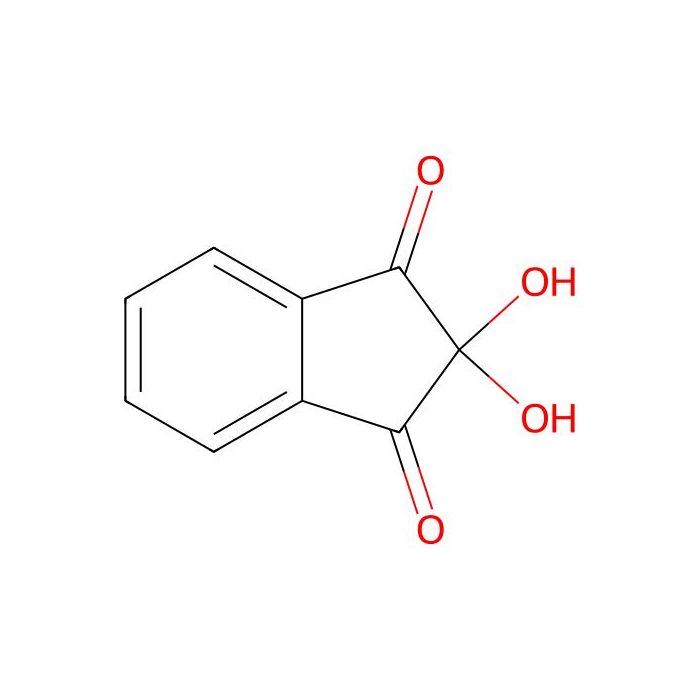
Common name/description: Ninhydrin (triketohydrindene hydrate)
Molecular formula: C9H6O4 (literature)
Molecular weight: ~178.14 g/mol (literature)
2D structural features: bicyclic indan (benzofused five-membered) core bearing two α-diketone carbonyls (1,3-dione) and a geminal diol at C-2 (2,2-dihydroxy-1,3-indanedione tautomer). Planar aromatic ring fused to a highly electron-deficient 1,3-dicarbonyl system.
SMILES/InChIKey: Not specified for this item; refer to CoA/Spec Sheet.
General notes for identification
Typical analytical IDs: strong UV absorbance in near-UV; forms Ruhemann’s purple chromophore upon reaction with primary amines (diagnostic qualitative test). Use NMR/IR and HPLC purity profiling for confirmation as needed.
Synthetic Utility
Literature perspective (general; not item-specific specifications)
Electrophilic 1,3-dicarbonyl: The triketone/gem-diol framework makes ninhydrin a potent electrophile toward nucleophilic amines, enabling rapid formation of imines/enamines that evolve to chromophores. This underpins its widespread use as a derivatization agent rather than a building block.
Oxidative deamination/decarboxylation: For α-amino acids, ninhydrin promotes decarboxylative oxidative deamination, liberating CO2 and forming aldehydes/ketones and ammonia that condense to Ruhemann’s purple—useful mechanistically and for analytical transformations.
Derivatization in separations: In TLC/HPTLC and paper chromatography, post-run staining with ninhydrin provides high-contrast visualization of amino-containing analytes. In HPLC, on-line post-column ninhydrin derivatization has been employed with ion-exchange separations for amino acid quantitation.
Surface chemistry: Aminated polymers and resins can be profiled by ninhydrin staining to estimate amine loading (e.g., resin capacity checks in SPPS, with calibration).
Limitations: Poor reactivity with tertiary amines; secondary amines yield non-purple products and lower sensitivity. Strongly basic or reducing media attenuate chromophore formation.
Complementary reagents: Use OPA/thiol, dansyl/chloroformate reagents, or fluorescamine for alternative selectivity/sensitivity or fluorescence readouts.
Target Specificity
Not applicable.
This product is a small-molecule chemical reagent, not a biological targeting reagent (e.g., antibody, probe). It exhibits chemical reactivity toward primary amines rather than specific biological epitopes.
We use cookies to ensure the website functions properly and, where permitted, to improve your experience. You can manage your preferences at any time in Settings. Learn more in our Cookie Policy.
Shall we send you a message when we have discounts available?
Remind me later
Thank you! Please check your email inbox to confirm.
Products are supplied to verified businesses, institutions, and qualified professionals for research and development use only. Not for use in humans, animals, diagnosis, or therapy.

 F2610571