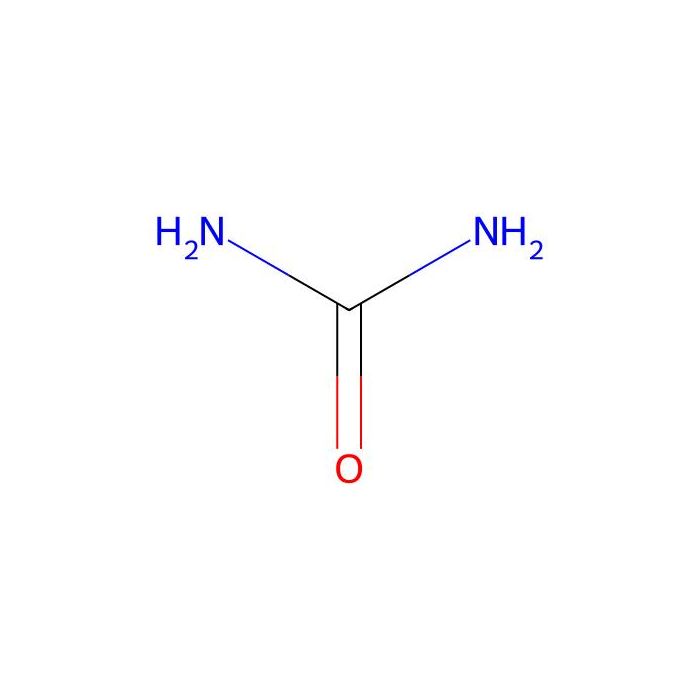
Urea - BioReagent,pH 7.5-9.5 (20 °C, 5 M in H2O) , CAS No.57-13-6

CAS: 57-13-6 Cat. No.: U755712 Formula: H2NCONH2 Molecular Weight: 60.06 Beilstein Registry Number: 635724 EC Number: 200-315-5 PubChem CID: 1176
AVAILABLE TO ORDER
GRADE & PURITY BioReagent ? BioReagent grade — tested suitable for life-science and molecular-biology use. Use for cell culture, assays, and biochemical work needing biological compatibility. pH 7.5-9.5 (20 °C, 5 M in H2O)
Synonyms
Carbamide|Carbonyldiamide
Storage
Room temperature
Shipped In
Normal
★
Size
Germany (EU)
USA*
Price
Qty
100g
U755712-100g
Made to order · 8–12 wks
€25.95
500g
U755712-500g
Made to order · 8–12 wks
€78.01
Enter a quantity for the sizes you want to add.

Overview

Used for the denaturation of proteins and as a mild solubilization agent for insoluble or denatured proteins. Useful for renaturing proteins from samples already denatured with 6 M guanidine chloride such as inclusion bodies. May be used with guanidine hydrochloride and dithiothreitrol (DTT) in the refolding of denatured proteins into their native or active form.

Specifications

Synonyms
Carbamide | Carbonyldiamide
Specifications & Purity
BioReagent,pH 7.5-9.5 (20 °C, 5 M in H2O)
Storage
Room temperature
Shipped In
Normal
Grade
BioReagent
Names and Identifiers
PH
7.5-9.5 (20 °C, 5 M in H 2 O)
Isomeric SMILES
C(=O)(N)N
WGK Germany
1
RTECS
YR6250000
PubChem CID
1176
Molecular Weight
60.06
Beilstein
635724

Advanced Data

Certificates (CoA,COO,BSE/TSE and Analysis Chart)
C of A & Other Certificates(BSE/TSE, COO):
Analytical Chart:

Find and download the COA for your product by matching the lot number on the packaging.

6 results found

Lot NumberCertificate TypeDateItem
A2628624A2628624Certificate of AnalysisJan 19, 2026 U755712
A2628625A2628625Certificate of AnalysisJan 19, 2026 U755712
A2628626A2628626Certificate of AnalysisJan 19, 2026 U755712
C2619045C2619045Certificate of AnalysisJan 19, 2026 U755712
F2625160F2625160Certificate of AnalysisJan 19, 2026 U755712
I2605006I2605006Certificate of AnalysisJan 19, 2026 U755712
Chemical and Physical Properties
SolubilityH 2 O: 5 M at 20 °C, clear, colorless
Melt Point132-135 °C (lit.)
Safety and Hazards(GHS)
WGK Germany
1
RTECS
YR6250000
Merck Index
9867
Documents & Articles
Comparing Guanidine Hydrochloride and Urea for Inclusion-Body Solubilization
Common Questions and Answers for SDS-PAGE Experiments
Common Reagents for Reducing Protein Disulfide Bonds
Why Did My Ni-Agarose Beads Turn Black or Brown?
How to Optimize Buffer Components for Ni-Agarose Beads
Obtaining soluble and biologically active recombinant proteins from inclusion bodies
Eight Common Lysis Buffers
His-Tagged Protein Purification
Biotin-Labeled Protein Purification
His-Tag Protein Purification: Common Troubleshooting Questions and Practical Solutions
Nucleic Acid and Nuclease Decontamination in Biopharmaceutical Manufacturing and Molecular Testing Workflows
How to Choose a Hydrogen Evolution (HER) Catalyst: Kinetic Barriers in Water Electrolysis, AWE/PEM/AEM Pathways, and a Materials-Family Roadmap (with a Product Map)
How to Purify Proteins by Ion-Exchange Chromatography Under Denaturing Condition
A Practical Guide to Small-Molecule Chemical Probes: Concept Clarification, Causal Validation, and Experimental Selection (with Product Navigation and Tables A–D)
Endoproteinase Lys-C: Mechanism, Applications, and Method-Control Considerations for Lysine-Specific Digestion
A Review of Ten Commonly Used Techniques for Detection, Quantification, and Interaction Analysis in Nucleic Acid Research
Protein Tags Demystified: Classification, Properties, and Suitable Experimental Applications
Key Enzymes in Amino Acid Metabolism: A Mechanistic Framework and Research Applications
Why Metal Nanocatalysts Can “Save Energy Yet Lose Performance Easily”: Durability Logic from Active Sites to Support/Interface Engineering (Including Selection Guide and Product Tables A–D)
Proteinase K: Frequently Asked Questions
Plant Omics Panorama: Workflow Frameworks and Multi-Omics Integration from Genomics to Transcriptomics, Proteomics, and Metabolomics
Whey Protein: Composition Profile, Manufacturing Routes, and Key Product-Type Essentials
Review of Chymotrypsin: Enzymological Properties, Catalytic Mechanism, and Research Applications
Glycoprotein Hormone Family: Molecular Features, Signaling Bias, and In Vivo Pharmacokinetics
Roles of the Carboxypeptidase Family in Protein C-Terminal Processing and Experimental Analysis
Methodological Studies on Glycoprotein Structural Characterization and Quality Attribute Analysis
Research Framework for Multi-Enzyme Digestion Strategies and Optimization of Proteomic Coverage
Technical Comparison and Method Selection for Hydroxyproline Determination
Decision Logic for Peptide Synthesis Routes: Applicability and Criteria for Choosing among SPPS, LPPS, and Recombinant Expression
Thiol and Disulfide Status in Biological Samples: Detection Methods and Applications
Perovskite Oxides for Energy and Environmental Catalysis: How Oxygen Vacancies, B-Site Metals, and the Metal–Oxygen Bond Network Regulate Reaction Performance
Experimental Research on Candidate Probiotics: From Strain Identification and Mechanistic Evaluation to Product Selection
Comparison of Urea Detection Methods: Reaction Mechanisms, Interference Factors, and Application Scenarios of the Urease Method and Diacetyl Monoxime Method
Solvents, Co-solvents, and Solubilization Systems in Home and Personal Care Formulations: Classification, Functions, and Selection Guide
Why Do Alcohols Differ in Function: Why Is Glycerol Mainly Moisturizing, Propylene Glycol Mainly Solubilizing, and Isopropyl Alcohol Fast-Drying? — Understanding Personal Care Formulation Functions from Structural Differences
What Is Synthetic Biology? The Industrialization Pathway from Upstream Reagent Toolchains to Biomanufacturing Applications
Structure, Properties, and Mechanisms of Powdered Fragrances and Fragrance Delivery Materials: Stability, Release Mechanisms, and Selection Logic
Understanding Ceramides from the Perspective of the Stratum Corneum Lipid Barrier: Moisturizing and Barrier-Repair Mechanisms, Ingredient Selection, and Formulation Research Considerations
How Sodium Cumenesulfonate Improves the Stability of Water-Based Cleaning Formulations: From Structure and Phase Behavior to Selection Criteria
Evaluation of Blood-Brain Barrier Permeability: Tracer Extravasation, TEER Measurement, and Interpretation of In Vitro Model Results
Analysis of Hydrolyzed Pearl as a Cosmetic Raw Material: Preparation Process, Active Components, and Skincare Formulation Applications
The Dual-Targeted Skin-Brightening Mechanism of 4-MSK: Inhibiting Melanin Production and Reducing Epidermal Pigment Retention
Moisturizing Mechanism of Polyglutamic Acid: From the γ-Glutamyl Structure to Hydration Networks and Surface Film-Forming Behavior
Probiotics, Prebiotics, and Postbiotics in Skin Care: Conceptual Distinctions, Mechanisms of Action, and Their Applications in the Care of Dry, Itchy, and Rough Skin
The Moisturizing and Low-Moisture Protective Mechanisms of Trehalose: From Its α,α-1,1 Structure and Hydration Dynamics to In Vitro Skin Barrier Research
Protective and Potential Reparative Mechanisms of Prinsepia utilis Seed Oil on the Skin Barrier: Fatty Acid Composition, Epidermal Lipid Metabolism, and Research Evidence
Structure, Stratum Corneum Distribution, and Stratum Corneum Conditioning Mechanism of Capryloyl Salicylic Acid: Barrier Effects and Safety Evaluation
The Sebum-Regulating Potential of Zinc PCA and Its Relationship with Stratum Corneum Hydration
Mechanisms by Which Fructan-Rich Ophiopogon japonicus Tuberous Root Extract Supports Skin Moisturization and Barrier Function
Multilevel Moisturizing Mechanisms of Sodium Hyaluronate and Its Derivatives: Molecular Weight Modulation, Crosslinking, Acetylation, and Major Sites of Action
What Is “Plant Collagen”? Distinguishing Ingredient Types, Structural Differences, Production Methods, and Skincare Effects
How Ectoine Regulates Skin Hydration: Zwitterionic Structure, Preferential Hydration, and Barrier-Support Mechanisms
Direct Construction of Methylsulfonyl-Containing Heterocycles: Synthesis and Applications of Prefunctionalized Three-Carbon Vinamidinium Salts
Stratum Corneum Penetration and Skin Mechanisms of Panthenol: Moisturization, Barrier Repair, and Soothing Effects
Citations of This Product
Solution Calculators
Reviews

Customer Reviews

Shall we send you a message when we have discounts available?

Remind me later

Thank you! Please check your email inbox to confirm.

Oops! Notifications are disabled.