Determine the necessary mass, volume, or concentration for preparing a solution.
| Activity Type | Relation | Activity value | Units | Action Type | Journal | PubMed Id | doi | Assay Aladdin ID |
|---|

≥98% para flujos de trabajo cromatográficos y analíticos sensibles que requieren una interferencia mínima de la línea base.
Room temperature,Argon charged Envío Normal. Consulte el COA específico del lote para conocer las especificaciones exactas.
SDS, COA, ficha técnica y hoja de especificaciones disponibles para descargar. COA específico del lote accesible mediante búsqueda por número de lote.
Citado en 2093 publicaciones revisadas por pares sobre cromatografía, síntesis orgánica y reacciones de acoplamiento cruzado.
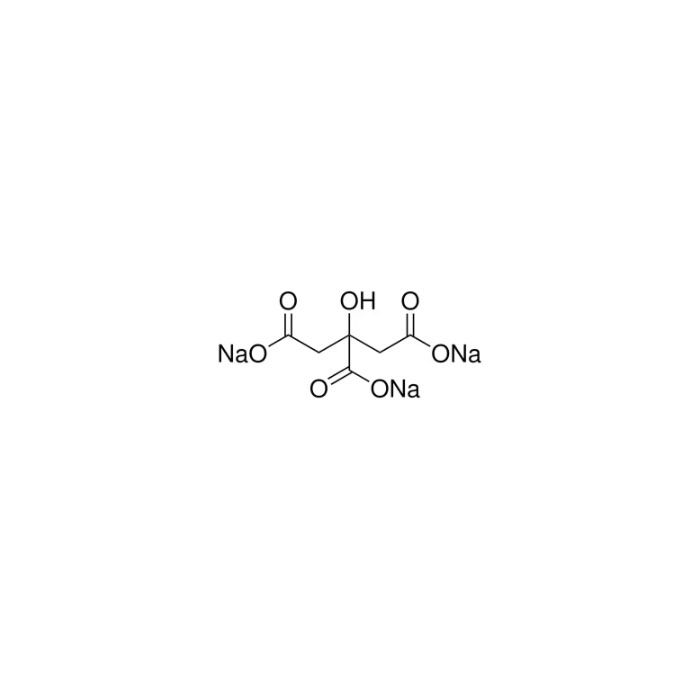
Trisodium citrate has a molecular weight of 258 Da. It has a high sodium content and a filtration coefficient.
Product Application:
Trisodium citrate has been used as a component of mobile phase buffer for HPLC analysis of dorsal striatum homogenate. As NiW codeposition electrolyte; As a component of sodium citrate buffer (SSC), it is used in the washing step of probe hybridization
Documento completo sobre peligros, manipulación, almacenamiento y cumplimiento normativo.
<<<<<<< HEAD Descargar SDS → ======= Descargar SDS → >>>>>>> release248-p3Datos de calidad específicos del lote. Introduzca su número de lote para obtener el COA exacto.
Buscar COA →Resumen de referencia rápida de las especificaciones y aplicaciones del producto.
Ver ficha técnica →Atributos de calidad completos y criterios de aceptación para esta calidad.
Ver hoja de especificaciones →Taxonomy Tree
| Kingdom | Organic compounds |
|---|---|
| Superclass | Organic acids and derivatives |
| Clase | Carboxylic acids and derivatives |
| Subclass | Tricarboxylic acids and derivatives |
| Intermediate Tree Nodes | Not available |
| Direct Parent | Tricarboxylic acids and derivatives |
| Alternative Parents | Tertiary alcohols Carboxylic acid salts Carboxylic acids Organic sodium salts Organic oxides Hydrocarbon derivatives Carbonyl compounds |
| Molecular Framework | Aliphatic acyclic compounds |
| Substituents | Tricarboxylic acid or derivatives - Tertiary alcohol - Carboxylic acid salt - Organic alkali metal salt - Carboxylic acid - Organic oxygen compound - Organic oxide - Hydrocarbon derivative - Organic sodium salt - Organic salt - Organooxygen compound - Carbonyl group - Alcohol - Aliphatic acyclic compound |
| Descripción | This compound belongs to the class of organic compounds known as tricarboxylic acids and derivatives. These are carboxylic acids containing exactly three carboxyl groups. |
| External Descriptors | organic sodium salt |
| Activity Type | Relation | Activity value | Units | Action Type | Journal | PubMed Id | doi | Assay Aladdin ID |
|---|
| Activity Type | Relation | Activity value | Units | Action Type | Journal | PubMed Id | doi | Assay Aladdin ID |
|---|
| Activity Type | Relation | Activity value | Units | Action Type | Journal | PubMed Id | doi | Assay Aladdin ID |
|---|
| Activity Type | Relation | Activity value | Units | Action Type | Journal | PubMed Id | doi | Assay Aladdin ID |
|---|
| Activity Type | Relation | Activity value | Units | Action Type | Journal | PubMed Id | doi | Assay Aladdin ID |
|---|
| Activity Type | Relation | Activity value | Units | Action Type | Journal | PubMed Id | doi | Assay Aladdin ID |
|---|
Find and download the COA for your product by matching the lot number on the packaging.
| Lot Number | Certificate Type | Fecha | Articulo |
|---|---|---|---|
 G2614337 | Certificate of Analysis | Jun 01, 2026 | S189183 |
| G2614340 | Certificate of Analysis | Jun 01, 2026 | S189183 |
| G2614411 | Certificate of Analysis | Jun 01, 2026 | S189183 |
| F2313723 | Certificate of Analysis | Mar 18, 2026 | S189183 |
| A2630459 | Certificate of Analysis | Jan 21, 2026 | S189183 |
| A2630601 | Certificate of Analysis | Jan 21, 2026 | S189183 |
| A2630629 | Certificate of Analysis | Jan 21, 2026 | S189183 |
| H2507471 | Certificate of Analysis | Aug 14, 2025 | S189183 |
| I2501658 | Certificate of Analysis | May 12, 2025 | S189183 |
| I2501412 | Certificate of Analysis | May 12, 2025 | S189183 |
| I2501657 | Certificate of Analysis | May 12, 2025 | S189183 |
| D2527269 | Certificate of Analysis | Apr 21, 2025 | S189183 |
| D2527268 | Certificate of Analysis | Apr 21, 2025 | S189183 |
| D2527267 | Certificate of Analysis | Apr 21, 2025 | S189183 |
| C2504549 | Certificate of Analysis | Jan 06, 2025 | S189183 |
| C2504619 | Certificate of Analysis | Jan 06, 2025 | S189183 |
| C2504628 | Certificate of Analysis | Jan 06, 2025 | S189183 |
| K2420613 | Certificate of Analysis | Nov 12, 2024 | S189183 |
| K2420609 | Certificate of Analysis | Nov 12, 2024 | S189183 |
| I2419267 | Certificate of Analysis | Sep 09, 2024 | S189183 |
| I2419266 | Certificate of Analysis | Sep 09, 2024 | S189183 |
| I2419265 | Certificate of Analysis | Sep 09, 2024 | S189183 |
| F2411445 | Certificate of Analysis | May 29, 2024 | S189183 |
| F2411444 | Certificate of Analysis | May 29, 2024 | S189183 |
| F2411443 | Certificate of Analysis | May 29, 2024 | S189183 |
| C2430199 | Certificate of Analysis | Mar 12, 2024 | S189183 |
| D2403530 | Certificate of Analysis | Mar 11, 2024 | S189183 |
| D2403528 | Certificate of Analysis | Mar 11, 2024 | S189183 |
| D2403531 | Certificate of Analysis | Mar 11, 2024 | S189183 |
| C2421726 | Certificate of Analysis | Mar 04, 2024 | S189183 |
| B2422163 | Certificate of Analysis | Jan 22, 2024 | S189183 |
| B2422162 | Certificate of Analysis | Jan 22, 2024 | S189183 |
| K2329052 | Certificate of Analysis | Nov 18, 2023 | S189183 |
| K2329053 | Certificate of Analysis | Nov 18, 2023 | S189183 |
| F2313727 | Certificate of Analysis | May 10, 2023 | S189183 |
| K2302074 | Certificate of Analysis | May 10, 2023 | S189183 |
| A2409061 | Certificate of Analysis | May 10, 2023 | S189183 |
| F2313737 | Certificate of Analysis | May 10, 2023 | S189183 |
| K2223724 | Certificate of Analysis | Nov 15, 2022 | S189183 |
| K2223722 | Certificate of Analysis | Nov 15, 2022 | S189183 |
| A2331459 | Certificate of Analysis | Nov 15, 2022 | S189183 |
| K2223720 | Certificate of Analysis | Nov 15, 2022 | S189183 |
| K2223718 | Certificate of Analysis | Nov 15, 2022 | S189183 |
| F2225487 | Certificate of Analysis | Jun 16, 2022 | S189183 |
| F2225484 | Certificate of Analysis | Jun 16, 2022 | S189183 |
| F2225483 | Certificate of Analysis | Jun 16, 2022 | S189183 |
| D2211021 | Certificate of Analysis | Mar 15, 2022 | S189183 |
| D2211017 | Certificate of Analysis | Mar 15, 2022 | S189183 |
| D2211008 | Certificate of Analysis | Mar 15, 2022 | S189183 |
| A2215009 | Certificate of Analysis | Dec 16, 2021 | S189183 |
| A2215012 | Certificate of Analysis | Dec 16, 2021 | S189183 |
| A2215010 | Certificate of Analysis | Dec 16, 2021 | S189183 |
| Solubilidad | Soluble in water.425 g/l at 25℃ |
|---|---|
| Sensibilidad | Hygroscopic. |
| Punto de fusión (°C) | 150 °C (decomposition) |
| Peso molecular | 258.070 g/mol |
| XLogP3 | |
| Hydrogen Bond Donor Count | 1 |
| Hydrogen Bond Acceptor Count | 7 |
| Rotatable Bond Count | 2 |
| Exact Mass | 257.973 Da |
| Monoisotopic Mass | 257.973 Da |
| Topological Polar Surface Area | 141.000 Ų |
| Heavy Atom Count | 16 |
| Formal Charge | 0 |
| Complexity | 211.000 |
| Isotope Atom Count | 0 |
| Defined Atom Stereocenter Count | 0 |
| Undefined Atom Stereocenter Count | 0 |
| Defined Bond Stereocenter Count | 0 |
| Undefined Bond Stereocenter Count | 0 |
| The total count of all stereochemical bonds | 0 |
| Covalently-Bonded Unit Count | 4 |