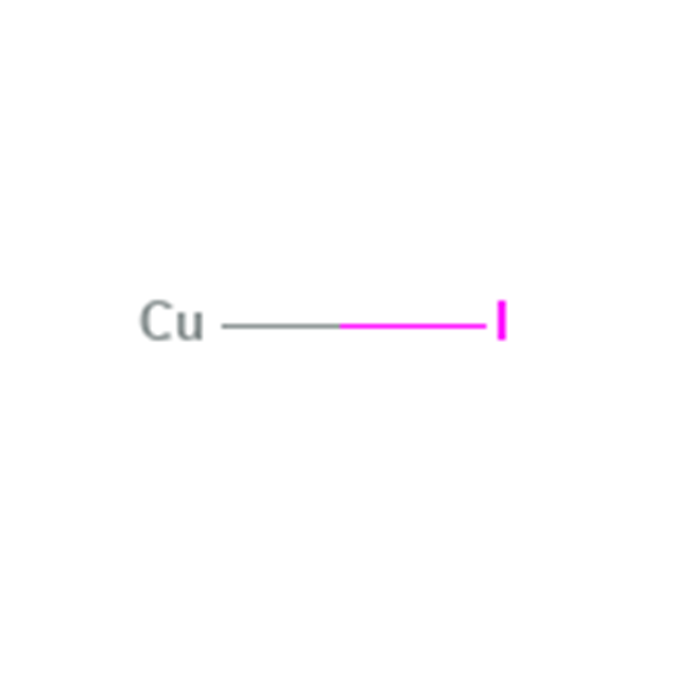
Copper(I) iodide - PrimorTrace™, ≥99.999% metals basis, used for Copper(I) iodide can be used as a catalyst for: For arylation of pyrazole and derivatives by coupling arenediazonium species under mild and ligand-free conditions. Selective cross-coupling o

CAS: 7681-65-4 Cat. No.: C433810 Formule: CuI Poids moléculaire: 190.45 Numéro CE: 231-674-6 PubChem CID: 24350
DISPONIBLE À COMMANDE
QUALITÉ & PURETÉ PrimorTrace™ ? PrimorTrace™ — Aladdin's trace-metal-analysis line with ultra-low metal background. Use for ICP/AAS trace-metal work where contamination must be minimal. ≥99.999% metals basis
Synonyms
Cuprous iodide
Storage
Protected from light,Room temperature,Desiccated
Shipped In
Normal
★
Taille
Allemagne (EU)
USA*
Prix
Qté
5g
C433810-5g
—
En stock ≥10
43,30€
25g
C433810-25g
—
2 En stock
138,75€
100g
C433810-100g
—
1 En stock
347,01€
Enter a quantity for the sizes you want to add.

Spécifications

Synonymes
Cuprous iodide
Spécifications et pureté
PrimorTrace™, ≥99.999% metals basis
Application
Copper(I) iodide can be used as a catalyst for: For arylation of pyrazole and derivatives by coupling arenediazonium species under mild and ligand-free conditions. Selective cross-coupling of dibromo alkenes and heteronucleophiles which leads to numerous
Conditions de stockage de stockage
Protected from light,Room temperature,Desiccated
Expédié en
Normal
Grade
PrimorTrace™
Pureté
≥99.999% metals basis
Noms et identifiants
Pubchem Sid
Pubchem Sid Url
https://pubchem.ncbi.nlm.nih.gov/substance/508815494
SMILES
[Cu]I;[I-].[Cu+]
InChIKey
LSXDOTMGLUJQCM-UHFFFAOYSA-M
InChI
1S/Cu.HI/h;1H/q+1;/p-1
Isomères SMILES
[Cu]I
WGK Allemagne
3
CAS alternatif
1335-23-5
PubChem CID
24350
Numéro ONU
3077
Groupe d'emballage
III
Poids moléculaire
190.45

Données avancées

Taxonomic Classification

Taxonomy Tree

KingdomInorganic compounds
SuperclassMixed metal/non-metal compounds
ClasseTransition metal salts
SubclassTransition metal iodides
Intermediate Tree Nodes Not available
Direct ParentTransition metal iodides
Alternative Parents Inorganic salts  
Molecular FrameworkNot available
Substituents Transition metal iodide - Inorganic salt
DescriptionThis compound belongs to the class of inorganic compounds known as transition metal iodides. These are inorganic compounds in which the largest halogen atom is Iodine, and the heaviest metal atom is a transition metal.
External Descriptors Not available
Certificats (CoA, COO, BSE/TSE et tableau d'analyse)
C of A & Other Certificates(BSE/TSE, COO):
Analytical Chart:

Find and download the COA for your product by matching the lot number on the packaging.

16 results found

Lot NumberCertificate TypeDateArticle
C2626369C2626369Certificate of AnalysisMar 14, 2026 C433810
C2626377C2626377Certificate of AnalysisMar 14, 2026 C433810
C2626378C2626378Certificate of AnalysisMar 14, 2026 C433810
D2327096D2327096Certificate of AnalysisFeb 05, 2026 C433810
D2327097D2327097Certificate of AnalysisFeb 05, 2026 C433810
D2327100D2327100Certificate of AnalysisFeb 05, 2026 C433810
A2517270A2517270Certificate of AnalysisDec 09, 2024 C433810
A2517283A2517283Certificate of AnalysisDec 09, 2024 C433810
A2517284A2517284Certificate of AnalysisDec 09, 2024 C433810
E2428292E2428292Certificate of AnalysisMay 11, 2024 C433810
E2428293E2428293Certificate of AnalysisMay 11, 2024 C433810
E2428294E2428294Certificate of AnalysisMay 11, 2024 C433810
D2327089D2327089Certificate of AnalysisApr 12, 2023 C433810
D2327094D2327094Certificate of AnalysisApr 12, 2023 C433810
D2327095D2327095Certificate of AnalysisApr 12, 2023 C433810
L2327008L2327008Certificate of AnalysisApr 12, 2023 C433810
Propriétés chimiques et physiques
Solubilitédilute aqueous acid: insoluble(lit.)
SensibilitéLight sensitive
Point d'ébullition (°C)1290°C
Point de fusion (°C)605°C
Poids moléculaire190.45
XLogP3
Hydrogen Bond Donor Count0
Hydrogen Bond Acceptor Count0
Rotatable Bond Count0
Exact Mass189.834 Da
Monoisotopic Mass189.834 Da
Topological Polar Surface Area0.000 Ų
Heavy Atom Count2
Formal Charge0
Complexity2.000
Isotope Atom Count0
Defined Atom Stereocenter Count0
Undefined Atom Stereocenter Count0
Defined Bond Stereocenter Count0
Undefined Bond Stereocenter Count0
The total count of all stereochemical bonds0
Covalently-Bonded Unit Count1
Sécurité et dangers (GHS)
Pictogramme(s)
GHS05,   GHS07,   GHS09
Signal
Danger
Mentions de danger

H302:Harmful if swallowed

H315:Causes skin irritation

H317:May cause an allergic skin reaction

H318:Causes serious eye damage

H410:Very toxic to aquatic life with long lasting effects

Conseils de prudence

P261:Avoid breathing dust/fume/gas/mist/vapors/spray.

P264:Wash hands [and …] thoroughly after handling.

P270:Do not eat, drink or smoke when using this product.

P272:Contaminated work clothing should not be allowed out of the workplace.

P273:Avoid release to the environment.

P280:Wear protective gloves/protective clothing/eye protection/face protection.

P310:Immediately call a POISON CENTER or doctor/physician.

P391:Collect spillage.

P302+P352:IF ON SKIN: wash with plenty of water.

P305+P351+P338:IF IN EYES: Rinse cautiously with water for several minutes. Remove contact lenses if present and easy to do - continue rinsing.

P333+P313:IF SKIN irritation or rash occurs: Get medical advice/attention.

P501:Dispose of contents/container to an approved waste disposal plant.

P301+P312+P330:IF SWALLOWED: Call a POISON CENTER/ doctor if you feel unwell. Rinse mouth.

WGK Allemagne
3
Classe
9
FAQ et articles
Diethyl azodicarboxylate (DEAD)
Di-tert-butyl peroxide (DTBP)
Strategies and Progress in the Asymmetric Catalytic Synthesis of Chiral 1,2-Bis(boronic) Esters: Route Types, Selectivity Challenges, and Sequential Site Utilization (with Product Selection Navigator and Tables 1–4)
A Practical Guide to Small-Molecule Chemical Probes: Concept Clarification, Causal Validation, and Experimental Selection (with Product Navigation and Tables A–D)
OSF/ASF Dual-Channel Toolbox: Divergent Reactions of Four-Membered Ring Sulfonyl Fluorides, Condition “Knobs,” and Selection Navigation
From Piperidine to Pyridine: The “Most Common N-Heterocycle” Shift in FDA Small-Molecule New Drugs (2013–2023) and a Selection Guide (Tables 1–4)
Perovskite PV/PeLED Precursor Guide: Selecting Metal Halide Salts, Key Conditions, and Reproducible Performance (including Product Tables 1–4 and a Selection Navigation Guide)
Transition-Metal Salts/Precursor Selection Guide: How “Different Salts of the Same Metal” Start from Different Chemical Realities—and How to Reproduce Results (including a Selection Navigator and Product Tables 1–5)
Haloheterocycles and Cross-Coupling: A Research-Oriented Selection Framework from Substrate Identification to Bond-Forming Routes (Including Product Navigation and Tables 1–5)
How to Construct Nitriles: Route Selection Across Direct Introduction, Precursor Dehydration, Oxidation/Dehydrogenation, and Cyanide-Free Processes
Experimental Selection Logic for C-C Bond Construction: Understanding Fragment Coupling, Carbonyl Chain Extension, Olefination, and Late-Stage Bond-Forming Pathways by Bond-Forming Task
Reaction Selection in Small-Molecule Synthesis: From Transformation-Type Assessment to Experimental Route Screening
Experimental Decision-Making for Cross-Coupling Reactions: Target Bond Type, Substrate Combination, and Catalytic System Selection
Structural Features, Property Modulation, and Typical Applications of Triazole Compounds
Synthetic Application Logic of Triazoles and Related Compounds: Structural Introduction, Reactive Sites, and Target Molecule Construction
Medicinal Chemistry Design of the Indazole Scaffold: Tautomerism, Molecular Recognition, Substitution-Site Design, and Synthetic Strategies
Build the Three-Membered Ring First, or Form the Carbon–Nitrogen Bond First?—Retrosynthetic Strategies, Route Selection, and Stereochemical Control in Cyclopropylamine Synthesis
Route Selection for Thiol Synthesis: C–S Bond Construction, Sulfur Source Forms, and Thiol Release
Citations of This Product
Calculateurs de solution
Avis

Avis des clients

Souhaitez-vous que nous vous envoyions un message lorsque des réductions seront disponibles?

Me rappeler plus tard

Merci ! Veuillez vérifier votre boîte de réception e-mail pour confirmer.

Oups ! Les notifications sont désactivées.