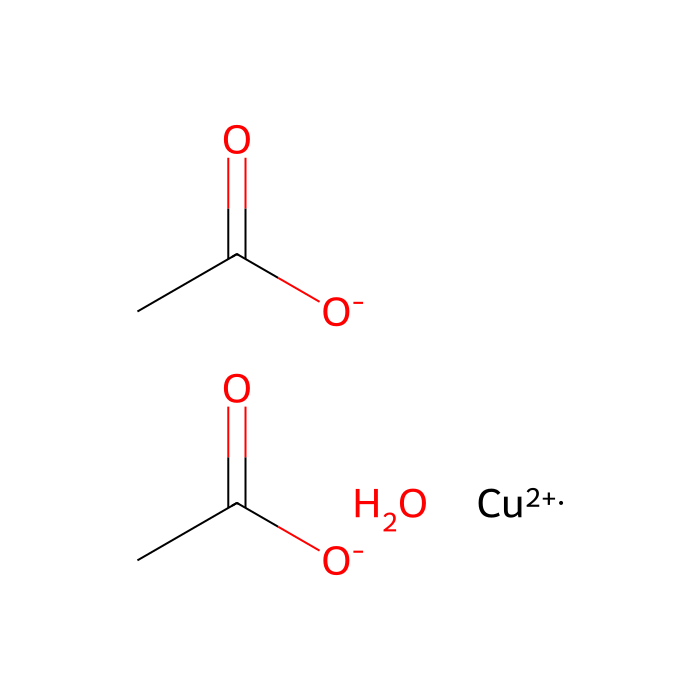
Copper(II) acetate monohydrate - ≥98% , CAS No.6046-93-1

CAS: 6046-93-1 Cat. No.: C665013 Formule: C4H6CuO4·H2O Poids moléculaire: 199.65 Beilstein Registry Number: 3730548 Numéro CE: 611-978-9
DISPONIBLE À COMMANDE
QUALITÉ & PURETÉ ≥98%
Synonyms
Cupric acetate|Copper(II) acetate monohydrate
Storage
Room temperature
Shipped In
Normal
★
Taille
Allemagne (EU)
USA*
Prix
Qté
500g
C665013-500g
1 En stock
1 En stock
25,95€
Enter a quantity for the sizes you want to add.
🧪
Pourquoi cette qualité

≥98% pour les flux de travail chromatographiques et analytiques sensibles nécessitant une interférence de ligne de base minimale.

🌡

Stockage & expédition

Room temperature Expédition Normal. Consultez le COA spécifique au lot pour les spécifications exactes.

📋

Documents qualité

SDS, COA, fiche technique et fiche de spécifications disponibles au téléchargement. COA spécifique au lot accessible via la recherche par numéro de lot.

📚

Preuve documentaire

Cité dans 428 publications à comité de lecture couvrant la chromatographie, la synthèse organique et les réactions de couplage croisé.

Spécifications

Synonymes
Cupric acetate | Copper(II) acetate monohydrate
Spécifications et pureté
≥98%
Conditions de stockage de stockage
Room temperature
Expédié en
Normal
Pureté
≥98%
Noms et identifiants
Pubchem Sid
Pubchem Sid Url
https://pubchem.ncbi.nlm.nih.gov/substance/528768915
Sourires canoniques
CC(=O)[O-].CC(=O)[O-].O.[Cu+2]
IUPAC Name
copper;diacetate;hydrate
InChIKey
NWFNSTOSIVLCJA-UHFFFAOYSA-L
INCHI
1S/2C2H4O2.Cu.H2O/c2*1-2(3)4;;/h2*1H3,(H,3,4);;1H2/q;;+2;/p-2
Isomères SMILES
CC(=O)[O-].CC(=O)[O-].O.[Cu+2]
WGK Allemagne
3
RTECS
AG3500000
Numéro ONU
3077
Groupe d'emballage
II
Poids moléculaire
199.65
Beilstein
3730548
Reaxy-Rn
3730548
Reaxys-RN_link_address
https://www.reaxys.com/reaxys/secured/hopinto.do?context=S&query=IDE.XRN=3730548&ln=

Documentation

📋 Fiche de données de sécurité (FDS)

Document complet couvrant les dangers, la manipulation, le stockage et la conformité réglementaire.

<<<<<<< HEAD Télécharger la SDS → ======= Télécharger la SDS → >>>>>>> release248-p3

✅ Certificat d'analyse (COA)

Données qualité spécifiques au lot. Saisissez votre numéro de lot pour récupérer le COA exact.

Rechercher le COA →

📊 Fiche technique

Résumé de référence rapide des spécifications et applications du produit.

Voir la fiche technique →

🔬 Fiche de spécifications

Attributs de qualité complets et critères d'acceptation pour cette qualité.

Voir la fiche de spécifications →

Données avancées

Taxonomic Classification

Taxonomy Tree

KingdomOrganic compounds
SuperclassOrganic acids and derivatives
ClasseCarboxylic acids and derivatives
SubclassCarboxylic acid derivatives
Intermediate Tree Nodes Carboxylic acid salts
Direct ParentAcetate salts
Alternative Parents Monocarboxylic acids and derivatives  Carboxylic acids  Organic oxides  Organic copper salts  Hydrocarbon derivatives  Carbonyl compounds  
Molecular FrameworkNot available
Substituents Acetate salt - Organic transition metal salt - Monocarboxylic acid or derivatives - Carboxylic acid - Organic oxygen compound - Organic oxide - Hydrocarbon derivative - Organic copper salt - Organic salt - Organooxygen compound - Carbonyl group - Aliphatic acyclic compound
DescriptionThis compound belongs to the class of organic compounds known as acetate salts. These are organic compounds containing acetic acid as its acid component.
External Descriptors Not available
Structure 3D
Modèle de structure chimique interactif


Certificats (CoA, COO, BSE/TSE et tableau d'analyse)
C of A & Other Certificates(BSE/TSE, COO):
Analytical Chart:

Find and download the COA for your product by matching the lot number on the packaging.

15 results found

Lot NumberCertificate TypeDateArticle
K2604229K2604229Certificate of AnalysisNov 05, 2026 C665013
K2604231K2604231Certificate of AnalysisNov 05, 2026 C665013
H2612048H2612048Certificate of AnalysisAug 14, 2026 C665013
C2625571C2625571Certificate of AnalysisApr 06, 2026 C665013
L2509330L2509330Certificate of AnalysisDec 20, 2025 C665013
H2511341H2511341Certificate of AnalysisAug 19, 2025 C665013
G2607107G2607107Certificate of AnalysisAug 18, 2025 C665013
H2511342H2511342Certificate of AnalysisAug 18, 2025 C665013
F2504376F2504376Certificate of AnalysisJun 09, 2025 C665013
D2521323D2521323Certificate of AnalysisApr 23, 2025 C665013
D2521359D2521359Certificate of AnalysisApr 23, 2025 C665013
G2508084G2508084Certificate of AnalysisApr 23, 2025 C665013
A2514079A2514079Certificate of AnalysisJan 17, 2025 C665013
G2412049G2412049Certificate of AnalysisJul 20, 2024 C665013
D2417197D2417197Certificate of AnalysisMay 17, 2024 C665013
Propriétés chimiques et physiques
Solubilité72g/L
Point de fusion (°C)240 °C
Poids moléculaire199.650 g/mol
XLogP3
Hydrogen Bond Donor Count1
Hydrogen Bond Acceptor Count5
Rotatable Bond Count0
Exact Mass198.967 Da
Monoisotopic Mass198.967 Da
Topological Polar Surface Area81.300 Ų
Heavy Atom Count10
Formal Charge0
Complexity25.500
Isotope Atom Count0
Defined Atom Stereocenter Count0
Undefined Atom Stereocenter Count0
Defined Bond Stereocenter Count0
Undefined Bond Stereocenter Count0
The total count of all stereochemical bonds0
Covalently-Bonded Unit Count4
FAQ et articles
Dimethoxymethylsilane, DMMS
PMHS, Polymethylhydrosiloxane
TEMPO-Catalyzed Oxidation Quick Reference (Alcohol Oxidation Focus): Three Regeneration Routes (NaOCl / Cu–O₂ / PIDA) + Selection & Troubleshooting
Transition-Metal Salts/Precursor Selection Guide: How “Different Salts of the Same Metal” Start from Different Chemical Realities—and How to Reproduce Results (including a Selection Navigator and Product Tables 1–5)
Experimental Selection Logic for C-C Bond Construction: Understanding Fragment Coupling, Carbonyl Chain Extension, Olefination, and Late-Stage Bond-Forming Pathways by Bond-Forming Task
Reaction Selection in Small-Molecule Synthesis: From Transformation-Type Assessment to Experimental Route Screening
Experimental Selection Logic for Transition-Metal-Catalyzed C–H Functionalization: When It Is Worth Pursuing and How to Assess Site Selectivity and Conditions
Copper Tripeptide GHK-Cu and Skin Repair: From Copper Coordination Chemistry to Extracellular Matrix Remodeling
Why Do Skincare Oligopeptides Have Different Effects? — Molecular Structure, Skin Delivery, and Mechanisms of Action
Citations of This Product
Calculateurs de solution
Avis

Avis des clients

Souhaitez-vous que nous vous envoyions un message lorsque des réductions seront disponibles?

Me rappeler plus tard

Merci ! Veuillez vérifier votre boîte de réception e-mail pour confirmer.

Oups ! Les notifications sont désactivées.