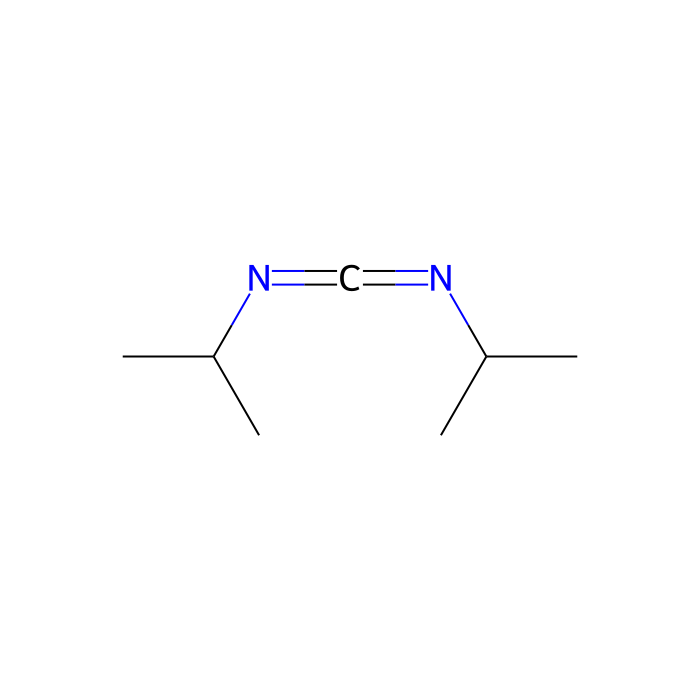
Diisopropylcarbodiimide solution - 1 M in THF , CAS No.693-13-0

CAS: 693-13-0 Cat. No.: D433332 Formule: C7H14N2 Poids moléculaire: 126.20 Beilstein Registry Number: 878281 Numéro CE: 211-743-7
DISPONIBLE À COMMANDE
QUALITÉ & PURETÉ 1 M in THF
Synonyms
EINECS 211-743-7 | diisopropyl carbodiimide | N,N'-Diisopropyl carbodimide | dipropan-2-ylmethanediimine | N-((isopropylimino)methyl-ene)propan-2-amine | N-((isopropylimino)methylene)propan-2-amine | STR04127 | UNII-OQO20I6TWH | DIC, 99% | MFCD00065689 |
Storage
Room temperature
★
Taille
Allemagne (EU)
USA*
Prix
Qté
25ml
D433332-25ml
Sur commande · 8–12 semaines

202,96€

237,67€
Enregistrer 34,71 € (14.60%)
100ml
D433332-100ml
Sur commande · 8–12 semaines

586,50€

685,43€
Enregistrer 98,92 € (14.43%)
Enter a quantity for the sizes you want to add.
🧪
Pourquoi cette qualité

1 M in THF pour les flux de travail chromatographiques et analytiques sensibles nécessitant une interférence de ligne de base minimale.

🌡

Stockage & expédition

Room temperature Expédition . Consultez le COA spécifique au lot pour les spécifications exactes.

📋

Documents qualité

SDS, COA, fiche technique et fiche de spécifications disponibles au téléchargement. COA spécifique au lot accessible via la recherche par numéro de lot.

📚

Preuve documentaire

Cité dans 77 publications à comité de lecture couvrant la chromatographie, la synthèse organique et les réactions de couplage croisé.

Vue d’ensemble

Application

DIC ( N,N ′-Diisopropylcarbodiimide) has been used in combination with 1-hydroxy-7-azabenzotriazole (HOAt) for the coupling of amino acid with N -allylglycine to form N -allylpeptide. Valuable reagent offered as a solution in tetrahydrofuran for more convenient handling. Coupling reagent for peptide syntheses.

Spécifications

Synonymes
EINECS 211-743-7 | diisopropyl carbodiimide | N,N'-Diisopropyl carbodimide | dipropan-2-ylmethanediimine | N-((isopropylimino)methyl-ene)propan-2-amine | N-((isopropylimino)methylene)propan-2-amine | STR04127 | UNII-OQO20I6TWH | DIC, 99% | MFCD00065689 |
Spécifications et pureté
1 M in THF
Conditions de stockage de stockage
Room temperature
Noms et identifiants
Sourires canoniques
CC(C)N=C=NC(C)C
InChIKey
BDNKZNFMNDZQMI-UHFFFAOYSA-N
INCHI
1S/C7H14N2/c1-6(2)8-5-9-7(3)4/h6-7H,1-4H3
Isomères SMILES
CC(C)N=C=NC(C)C
WGK Allemagne
3
RTECS
FF2175000
Numéro ONU
2929
Poids moléculaire
126.20
Beilstein
878281
Reaxy-Rn
878281
Reaxys-RN_link_address
https://www.reaxys.com/reaxys/secured/hopinto.do?context=S&query=IDE.XRN=878281&ln=

Documentation

📋 Fiche de données de sécurité (FDS)

Document complet couvrant les dangers, la manipulation, le stockage et la conformité réglementaire.

<<<<<<< HEAD Télécharger la SDS → ======= Télécharger la SDS → >>>>>>> release248-p3

✅ Certificat d'analyse (COA)

Données qualité spécifiques au lot. Saisissez votre numéro de lot pour récupérer le COA exact.

Rechercher le COA →

📊 Fiche technique

Résumé de référence rapide des spécifications et applications du produit.

Voir la fiche technique →

🔬 Fiche de spécifications

Attributs de qualité complets et critères d'acceptation pour cette qualité.

Voir la fiche de spécifications →

Données avancées

Structure 3D
Modèle de structure chimique interactif


Cibles associées (humaines)
KCNH2 Tclin HERG (29587 Activities)
Activity TypeRelationActivity valueUnitsAction TypeJournalPubMed IddoiAssay Aladdin ID
Mécanismes d'action
Certificats (CoA, COO, BSE/TSE et tableau d'analyse)
C of A & Other Certificates(BSE/TSE, COO):
Analytical Chart:
Propriétés chimiques et physiques
Indice de réfraction1.433
Point d'éclair (°F)91°F
Point d'éclair (°C)31°C
Point d'ébullition (°C)145-148°C
Poids moléculaire126.200 g/mol
XLogP32.600
Hydrogen Bond Donor Count0
Hydrogen Bond Acceptor Count2
Rotatable Bond Count2
Exact Mass126.116 Da
Monoisotopic Mass126.116 Da
Topological Polar Surface Area24.700 Ų
Heavy Atom Count9
Formal Charge0
Complexity101.000
Isotope Atom Count0
Defined Atom Stereocenter Count0
Undefined Atom Stereocenter Count0
Defined Bond Stereocenter Count0
Undefined Bond Stereocenter Count0
The total count of all stereochemical bonds0
Covalently-Bonded Unit Count1
FAQ et articles
A Complete Guide to Choosing Resins for SPPS (Solid-Phase Peptide Synthesis): Fmoc/Boc Routes, C-Terminal Acid/Amide, and a Key-Parameter Navigator
β-Acyloxy Alkenyl Amides (AAAs): A New Approach to Amide Bond and Peptide Bond Construction Worth Attention
DAST-Mediated Amidation at Room Temperature: Method Features, Practical Value, and Scope of Applicability
From High Reactivity to Comprehensive Evaluation: Using CTSOAt as an Example to Understand the Design Logic of New Coupling Reagents
From Analytical Instrument to Synthetic Platform: A New Strategy for Reconstructing Automated Flow Solid-Phase Peptide Synthesis with Standard Analytical HPLC
New Progress in the Solid-Phase Synthesis of Sterically Hindered Peptides: Background, Core Breakthroughs, and Implications for Automation Compatibility of the RMMR Strategy
TCFH–NMI Amidation in Highly Aqueous Media: Research Value, Methodological Understanding, and Experimental Insights
A New Balance in Coupling Reagents: How DMT-TU Balances Reactivity, Racemization Control, and Thermal Hazard
The Positioning of TBTU in Practice: Racemization Risk, Extended Uses, and Selection Criteria
From “High Yield” to “Configuration Retention”: Activation-Stage Risks, Route Differences, and Selection Principles for Coupling Systems
The Methodological Value of HATU in Difficult Couplings: Reactivity Advantages, Stereochemical Retention, and Condition Management
The Methodological Value of Boc-Oxyma: Low-Racemization Coupling, Route Continuity, and Extended Applications
Low Racemization in Peptide Synthesis Is Not Just About Reagent Choice: Stereochemical Risk During the Activation Stage and Practical Strategies for Experimental Control
The Methodological Value of TCFH: Advantages in Challenging Amidation and the Switching Logic of Carboxylic Acid Activation Pathways
Ynamide Coupling Reagents: From Low-Epimerization Activation Pathways to More Practically Usable N→C Inverse Peptide Synthesis
Decision Logic for Peptide Synthesis Routes: Applicability and Criteria for Choosing among SPPS, LPPS, and Recombinant Expression
Decision Logic for Selecting Coupling Reagents in Amide Bond Formation: Activation Pathways, Side Reactions, Epimerization, Workup, and Safety
DMAP Is More Than Just an Organic Base: Experimental Judgment from Nucleophilic Acyl Transfer to Esterification and Macrolactonization
Experimental Assessment of HOPO in Carbodiimide-Mediated Amide Coupling: Low-Racemization Control, Application Scenarios, and Process Considerations
Experimental Selection Logic for Pentafluorophenyl-Based Systems: Practical Judgment from Active Esters and Pre-Activated Monomers to Downstream Transformations
Experimental Judgment in Oxyma Coupling Systems: Coupling Efficiency, Racemization Control, and the HCN Risk in DIC-Based Systems
Experimental Judgment for CMPI in Carboxylic Acid Activation: Applicable Tasks, Base Matching, and Workup Burden
Experimental Judgment for TFPN in Carboxylic Acid Activation: Suitable Scenarios, Intermediate Distribution, and Nucleophile Compatibility
Selective Acylation of Less Reactive Amines in Complex Substrates: Strategies for N/O and N/N Selectivity Control This article draws on the work of Li et al. on the TCFH/catalytic Oxyma system and transient imine protection, and summarizes design strateg
How to Troubleshoot Abnormal Impurities in Peptide Synthesis? Locating Process Issues Through Amino-Related Side Reactions
Peptide Intermediates Difficult to Dissolve and Separate? Route Design and Workup Strategies for Tag-Assisted Liquid-Phase Peptide Synthesis (TAG-LPPS)
AITF-Mediated Carboxylic Acid Activation for the Synthesis of Amides, Peptides, and Esters: Activation Mechanism and Applicable Scenarios
Formation and Control of Carboxyl- and Hydroxyl-Related Impurities in Peptide Synthesis — Using Asp/Glu and Ser/Thr Residue Side Reactions as Examples
Logic for Selecting Amidation Reagents in Aqueous Media: Competing Reactions, Activated Intermediates, and Substrate Effects
Where Does the Selectivity in Piperidine C–H Functionalization Come From? — Nitrogen Effects, Chair Conformations, and Four Classes of Key Intermediates
How Cyclization Changes Peptide Behavior: Conformational Preorganization, Skin Delivery, and Integrin Binding, Using Cyclopeptide-5 as an Example
The Combination Logic of Palmitoyl Tripeptide-1 and Palmitoyl Pentapeptide-4: Skin Delivery, Matrix Signaling, and Regulation of Collagen Homeostasis
Copper Tripeptide GHK-Cu and Skin Repair: From Copper Coordination Chemistry to Extracellular Matrix Remodeling
Citations of This Product
Calculateurs de solution
Avis

Avis des clients

Foire aux questions

How should this product be stored?
Store at room temperature.
What are the CAS number, molecular formula and molecular weight?
The CAS Number is 693-13-0, the molecular formula is C7H14N2, and the molecular weight is 126.20 g/mol. InChIKey BDNKZNFMNDZQMI-UHFFFAOYSA-N.
What documentation is provided?
Available product documentation, including Certificates of Analysis (COA), Safety Data Sheets (SDS), and specification sheets, is shown in the product document area. Document availability and access follow the current site policy.

Souhaitez-vous que nous vous envoyions un message lorsque des réductions seront disponibles?

Me rappeler plus tard

Merci ! Veuillez vérifier votre boîte de réception e-mail pour confirmer.

Oups ! Les notifications sont désactivées.