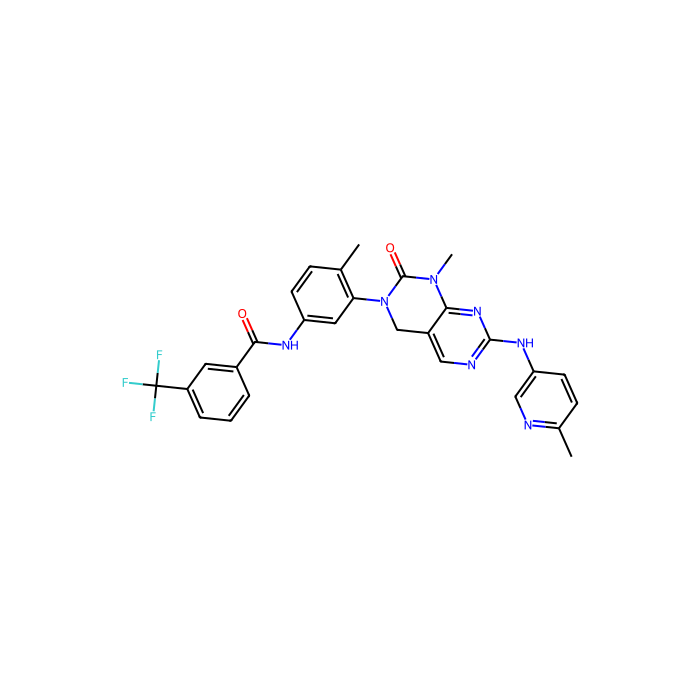
GNF-7 - ≥97% , CAS No.839706-07-9

CAS: 839706-07-9 Cat. No.: G177569 Formule: C28H24F3N7O2 Poids moléculaire: 547.542 Numéro CE: 110-403-4
DISPONIBLE À COMMANDE
QUALITÉ & PURETÉ ≥97%
Synonyms
N-(4-Methyl-3-(1-methyl-7-(6-methylpyridin-3-ylamino)-2-oxo-1,2-dihydropyrimido[4,5-d]pyrimidin-3(4H)-yl)phenyl)-3-(trifluoromethyl)benzamide|N-[3-[1,4-Dihydro-1-methyl-7-[(6-methyl-3-pyridinyl)amino]-2-oxopyrimido[4,5-d]pyrimidin-3(2H)-yl]-4-methylphenyl]-3-(trifluoromethyl)-benzamide
Storage
Store at -20°C
Shipped In
Ice chest + Ice pads
★
Taille
Allemagne (EU)
USA*
Prix
Qté
5mg
G177569-5mg
—
3 En stock
42,43€
10mg
G177569-10mg
—
3 En stock
80,61€
25mg
G177569-25mg
—
2 En stock
173,46€
100mg
G177569-100mg
—
1 En stock
498,00€
Enter a quantity for the sizes you want to add.

Vue d’ensemble

GNF-7 is a potent type-II kinase Bcr-Abl inhibitor with IC50 of <5 nM, 61 nM, 122 nM, 136 nM, and 133 nM for M351T, T315I, E255 V, G250E, and c-Abl, respectively.

Spécifications

Synonymes
N-(4-Methyl-3-(1-methyl-7-(6-methylpyridin-3-ylamino)-2-oxo-1,2-dihydropyrimido[4,5-d]pyrimidin-3(4H)-yl)phenyl)-3-(trifluoromethyl)benzamide | N-[3-[1,4-Dihydro-1-methyl-7-[(6-methyl-3-pyridinyl)amino]-2-oxopyrimido[4,5-d]pyrimidin-3(2H)-yl]-4-methylphenyl]-3-(trifluoromethyl)-benzamide
Spécifications et pureté
≥97%
Mécanismes biochimiques et physiologiques
Ras signaling inhibitor; inhibits Ack1 and germinal center kinase (GCK). Suppresses proliferation, and induces cell cycle arrest and apoptosis in leukemia cells harboring NRAS mutations. Prolongs survival in a leukemia cell xenotransplantation model in mice.
Conditions de stockage de stockage
Store at -20°C
Expédié en
Ice chest + Ice pads
Ce produit nécessite l'expédition en chaîne froide. Les services terrestres et autres services économiques ne sont pas disponibles.
Pureté
≥97%
Noms et identifiants
Pubchem Sid
Pubchem Sid Url
https://pubchem.ncbi.nlm.nih.gov/substance/504766471
SMILES
CC1=C(C=C(C=C1)NC(=O)C2=CC(=CC=C2)C(F)(F)F)N3CC4=CN=C(N=C4N(C3=O)C)NC5=CN=C(C=C5)C
IUPAC Name
N-[4-methyl-3-[1-methyl-7-[(6-methylpyridin-3-yl)amino]-2-oxo-4H-pyrimido[4,5-d]pyrimidin-3-yl]phenyl]-3-(trifluoromethyl)benzamide
InChIKey
SZNYUUZOQHNEKB-UHFFFAOYSA-N
InChI
1S/C28H24F3N7O2/c1-16-7-9-21(34-25(39)18-5-4-6-20(11-18)28(29,30)31)12-23(16)38-15-19-13-33-26(36-24(19)37(3)27(38)40)35-22-10-8-17(2)32-14-22/h4-14H,15H2,1-3H3,(H,34,39)(H,33,35,36)
Isomères SMILES
CC1=C(C=C(C=C1)NC(=O)C2=CC(=CC=C2)C(F)(F)F)N3CC4=CN=C(N=C4N(C3=O)C)NC5=CN=C(C=C5)C
Poids moléculaire
547.542
Reaxys
20769524
Reaxys-RN_link_address
https://www.reaxys.com/reaxys/secured/hopinto.do?context=S&query=IDE.XRN=20769524&ln=

Données avancées

Taxonomic Classification

Taxonomy Tree

KingdomOrganic compounds
SuperclassBenzenoids
ClasseBenzene and substituted derivatives
SubclassAnilides
Intermediate Tree Nodes Aromatic anilides
Direct ParentBenzanilides
Alternative Parents Trifluoromethylbenzenes  Benzamides  Diaminotoluenes  Benzoyl derivatives  Pyrimidones  Aminopyridines and derivatives  Aminopyrimidines and derivatives  Methylpyridines  Imidolactams  Heteroaromatic compounds  Ureas  Secondary carboxylic acid amides  Azacyclic compounds  Hydrocarbon derivatives  Alkyl fluorides  Organic oxides  Organofluorides  Amines  Carbonyl compounds  
Molecular FrameworkAromatic heteropolycyclic compounds
Substituents Benzanilide - Trifluoromethylbenzene - Benzamide - Benzoic acid or derivatives - Diaminotoluene - Benzoyl - Methylpyridine - Aminopyridine - Toluene - Pyrimidone - Aminopyrimidine - Imidolactam - Pyrimidine - Pyridine - Heteroaromatic compound - Urea - Secondary carboxylic acid amide - Carboxamide group - Azacycle - Organoheterocyclic compound - Carboxylic acid derivative - Hydrocarbon derivative - Organohalogen compound - Organofluoride - Organonitrogen compound - Carbonyl group - Alkyl fluoride - Organic oxygen compound - Organic nitrogen compound - Organooxygen compound - Organic oxide - Amine - Alkyl halide - Aromatic heteropolycyclic compound
DescriptionThis compound belongs to the class of organic compounds known as benzanilides. These are aromatic compounds containing an anilide group in which the carboxamide group is substituted with a benzene ring. They have the general structure RNC(=O)R', where R,R'= benzene.
External Descriptors Not available
Structure 3D
Modèle de structure chimique interactif


Cibles associées (humaines)
MAP4K2 Tchem Mitogen-activated protein kinase kinase kinase kinase 2 (1 Activities)
Activity TypeActivity Value -log(M)Mechanism of ActionActivity ReferencePublications (PubMed IDs)
BMX Tchem Cytoplasmic tyrosine-protein kinase BMX (1 Activities)
Activity TypeActivity Value -log(M)Mechanism of ActionActivity ReferencePublications (PubMed IDs)
TNK2 Tclin Activated CDC42 kinase 1 (1 Activities)
Activity TypeActivity Value -log(M)Mechanism of ActionActivity ReferencePublications (PubMed IDs)
ABL1 Tclin Tyrosine-protein kinase ABL1 (2 Activities)
Activity TypeActivity Value -log(M)Mechanism of ActionActivity ReferencePublications (PubMed IDs)
ABL1 Tclin Tyrosine-protein kinase ABL (18331 Activities)
Activity TypeRelationActivity valueUnitsAction TypeJournalPubMed IddoiAssay Aladdin ID
INSR Tclin Insulin receptor (5558 Activities)
Activity TypeRelationActivity valueUnitsAction TypeJournalPubMed IddoiAssay Aladdin ID
MAPK11 Tchem MAP kinase p38 beta (2785 Activities)
Activity TypeRelationActivity valueUnitsAction TypeJournalPubMed IddoiAssay Aladdin ID
LCK Tclin Tyrosine-protein kinase LCK (9212 Activities)
Activity TypeRelationActivity valueUnitsAction TypeJournalPubMed IddoiAssay Aladdin ID
MAPK14 Tchem MAP kinase p38 alpha (12866 Activities)
Activity TypeRelationActivity valueUnitsAction TypeJournalPubMed IddoiAssay Aladdin ID
MAP2K6 Tchem Dual specificity mitogen-activated protein kinase kinase 6 (1284 Activities)
Activity TypeRelationActivity valueUnitsAction TypeJournalPubMed IddoiAssay Aladdin ID
CHEK2 Tchem Serine/threonine-protein kinase Chk2 (4015 Activities)
Activity TypeRelationActivity valueUnitsAction TypeJournalPubMed IddoiAssay Aladdin ID
CHUK Tchem Inhibitor of nuclear factor kappa B kinase alpha subunit (3170 Activities)
Activity TypeRelationActivity valueUnitsAction TypeJournalPubMed IddoiAssay Aladdin ID
CSK Tchem Tyrosine-protein kinase CSK (2395 Activities)
Activity TypeRelationActivity valueUnitsAction TypeJournalPubMed IddoiAssay Aladdin ID
RAF1 Tclin Serine/threonine-protein kinase RAF (4169 Activities)
Activity TypeRelationActivity valueUnitsAction TypeJournalPubMed IddoiAssay Aladdin ID
SYK Tclin Tyrosine-protein kinase SYK (7372 Activities)
Activity TypeRelationActivity valueUnitsAction TypeJournalPubMed IddoiAssay Aladdin ID
RPS6KA1 Tchem Ribosomal protein S6 kinase alpha 1 (2796 Activities)
Activity TypeRelationActivity valueUnitsAction TypeJournalPubMed IddoiAssay Aladdin ID
CAMK4 Tbio CaM kinase IV (2116 Activities)
Activity TypeRelationActivity valueUnitsAction TypeJournalPubMed IddoiAssay Aladdin ID
MAPKAPK2 Tchem MAP kinase-activated protein kinase 2 (4814 Activities)
Activity TypeRelationActivity valueUnitsAction TypeJournalPubMed IddoiAssay Aladdin ID
ROCK2 Tclin Rho-associated protein kinase 2 (6206 Activities)
Activity TypeRelationActivity valueUnitsAction TypeJournalPubMed IddoiAssay Aladdin ID
CYP2D6 Tclin Cytochrome P450 2D6 (33882 Activities)
Activity TypeRelationActivity valueUnitsAction TypeJournalPubMed IddoiAssay Aladdin ID
MAPK9 Tchem c-Jun N-terminal kinase 2 (4655 Activities)
Activity TypeRelationActivity valueUnitsAction TypeJournalPubMed IddoiAssay Aladdin ID
MAP2K1 Tclin Dual specificity mitogen-activated protein kinase kinase 1 (4127 Activities)
Activity TypeRelationActivity valueUnitsAction TypeJournalPubMed IddoiAssay Aladdin ID
PRKCA Tchem Protein kinase C alpha (5923 Activities)
Activity TypeRelationActivity valueUnitsAction TypeJournalPubMed IddoiAssay Aladdin ID
ZAP70 Tchem Tyrosine-protein kinase ZAP-70 (2189 Activities)
Activity TypeRelationActivity valueUnitsAction TypeJournalPubMed IddoiAssay Aladdin ID
MAPK8 Tchem c-Jun N-terminal kinase 1 (5038 Activities)
Activity TypeRelationActivity valueUnitsAction TypeJournalPubMed IddoiAssay Aladdin ID
CYP1A2 Tchem Cytochrome P450 1A2 (26471 Activities)
Activity TypeRelationActivity valueUnitsAction TypeJournalPubMed IddoiAssay Aladdin ID
PDGFRA Tclin Platelet-derived growth factor receptor alpha (5682 Activities)
Activity TypeRelationActivity valueUnitsAction TypeJournalPubMed IddoiAssay Aladdin ID
PRKCQ Tchem Protein kinase C theta (3319 Activities)
Activity TypeRelationActivity valueUnitsAction TypeJournalPubMed IddoiAssay Aladdin ID
AKT1 Tchem Serine/threonine-protein kinase AKT (9192 Activities)
Activity TypeRelationActivity valueUnitsAction TypeJournalPubMed IddoiAssay Aladdin ID
FLT3 Tclin Tyrosine-protein kinase receptor FLT3 (13481 Activities)
Activity TypeRelationActivity valueUnitsAction TypeJournalPubMed IddoiAssay Aladdin ID
PDK1 Tchem Pyruvate dehydrogenase kinase isoform 1 (2021 Activities)
Activity TypeRelationActivity valueUnitsAction TypeJournalPubMed IddoiAssay Aladdin ID
SGK1 Tchem Serine/threonine-protein kinase Sgk1 (2343 Activities)
Activity TypeRelationActivity valueUnitsAction TypeJournalPubMed IddoiAssay Aladdin ID
CYP2C9 Tchem Cytochrome P450 2C9 (32119 Activities)
Activity TypeRelationActivity valueUnitsAction TypeJournalPubMed IddoiAssay Aladdin ID
RPS6KB1 Tchem Ribosomal protein S6 kinase 1 (4456 Activities)
Activity TypeRelationActivity valueUnitsAction TypeJournalPubMed IddoiAssay Aladdin ID
MAPK12 Tchem MAP kinase p38 gamma (2776 Activities)
Activity TypeRelationActivity valueUnitsAction TypeJournalPubMed IddoiAssay Aladdin ID
CYP3A4 Tclin Cytochrome P450 3A4 (53859 Activities)
Activity TypeRelationActivity valueUnitsAction TypeJournalPubMed IddoiAssay Aladdin ID
AURKA Tchem Serine/threonine-protein kinase Aurora-A (10240 Activities)
Activity TypeRelationActivity valueUnitsAction TypeJournalPubMed IddoiAssay Aladdin ID
BMX Tchem Tyrosine-protein kinase BMX (1995 Activities)
Activity TypeRelationActivity valueUnitsAction TypeJournalPubMed IddoiAssay Aladdin ID
TNK2 Tclin Tyrosine kinase non-receptor protein 2 (2836 Activities)
Activity TypeRelationActivity valueUnitsAction TypeJournalPubMed IddoiAssay Aladdin ID
COLO 205 (50209 Activities)
Activity TypeRelationActivity valueUnitsAction TypeJournalPubMed IddoiAssay Aladdin ID
HT-29 (80576 Activities)
Activity TypeRelationActivity valueUnitsAction TypeJournalPubMed IddoiAssay Aladdin ID
K562 (73714 Activities)
Activity TypeRelationActivity valueUnitsAction TypeJournalPubMed IddoiAssay Aladdin ID
U-937 (7138 Activities)
Activity TypeRelationActivity valueUnitsAction TypeJournalPubMed IddoiAssay Aladdin ID
HepG2 (196354 Activities)
Activity TypeRelationActivity valueUnitsAction TypeJournalPubMed IddoiAssay Aladdin ID
SW-620 (52400 Activities)
Activity TypeRelationActivity valueUnitsAction TypeJournalPubMed IddoiAssay Aladdin ID
FES Tclin Tyrosine-protein kinase FES (2339 Activities)
Activity TypeRelationActivity valueUnitsAction TypeJournalPubMed IddoiAssay Aladdin ID
PAK2 Tchem Serine/threonine-protein kinase PAK 2 (1925 Activities)
Activity TypeRelationActivity valueUnitsAction TypeJournalPubMed IddoiAssay Aladdin ID
AXL Tchem Tyrosine-protein kinase receptor UFO (3469 Activities)
Activity TypeRelationActivity valueUnitsAction TypeJournalPubMed IddoiAssay Aladdin ID
NTRK2 Tclin Neurotrophic tyrosine kinase receptor type 2 (3279 Activities)
Activity TypeRelationActivity valueUnitsAction TypeJournalPubMed IddoiAssay Aladdin ID
PRKD2 Tchem Serine/threonine-protein kinase D2 (2847 Activities)
Activity TypeRelationActivity valueUnitsAction TypeJournalPubMed IddoiAssay Aladdin ID
MAP4K2 Tchem Mitogen-activated protein kinase kinase kinase kinase 2 (2692 Activities)
Activity TypeRelationActivity valueUnitsAction TypeJournalPubMed IddoiAssay Aladdin ID
RIPK1 Tchem Receptor-interacting serine/threonine-protein kinase 1 (1548 Activities)
Activity TypeRelationActivity valueUnitsAction TypeJournalPubMed IddoiAssay Aladdin ID
CDK1 Tchem Cyclin-dependent kinase 1/cyclin B1 (1887 Activities)
Activity TypeRelationActivity valueUnitsAction TypeJournalPubMed IddoiAssay Aladdin ID
GSK3A Tclin Glycogen synthase kinase-3 (736 Activities)
Activity TypeRelationActivity valueUnitsAction TypeJournalPubMed IddoiAssay Aladdin ID
Cibles associées (non humaines)
Mapk1 MAP kinase ERK2 (650 Activities)
Activity TypeRelationActivity valueUnitsAction TypeJournalPubMed IddoiAssay Aladdin ID
Hdac6 Histone deacetylase 6 (222 Activities)
Activity TypeRelationActivity valueUnitsAction TypeJournalPubMed IddoiAssay Aladdin ID
Fgfr3 Fibroblast growth factor receptor 3 (21 Activities)
Activity TypeRelationActivity valueUnitsAction TypeJournalPubMed IddoiAssay Aladdin ID
Mus musculus (284745 Activities)
Activity TypeRelationActivity valueUnitsAction TypeJournalPubMed IddoiAssay Aladdin ID
BaF3 (4657 Activities)
Activity TypeRelationActivity valueUnitsAction TypeJournalPubMed IddoiAssay Aladdin ID
rep Replicase polyprotein 1ab (378 Activities)
Activity TypeRelationActivity valueUnitsAction TypeJournalPubMed IddoiAssay Aladdin ID
SARS-CoV-2 (38078 Activities)
Activity TypeRelationActivity valueUnitsAction TypeJournalPubMed IddoiAssay Aladdin ID
Mécanismes d'action
Certificats (CoA, COO, BSE/TSE et tableau d'analyse)
C of A & Other Certificates(BSE/TSE, COO):
Analytical Chart:

Find and download the COA for your product by matching the lot number on the packaging.

4 results found

Lot NumberCertificate TypeDateArticle
K2520198K2520198Certificate of AnalysisDec 03, 2025 G177569
D2028138D2028138Certificate of AnalysisNov 10, 2025 G177569
A2207383A2207383Certificate of AnalysisOct 24, 2024 G177569
A2207384A2207384Certificate of AnalysisOct 24, 2024 G177569
Propriétés chimiques et physiques
SolubilitéSolvent:DMSO, Max Conc. mg/mL: 27.38, Max Conc. mM: 50
Poids moléculaire547.5
XLogP34.300
Hydrogen Bond Donor Count2
Hydrogen Bond Acceptor Count9
Rotatable Bond Count5
Exact Mass547.194 Da
Monoisotopic Mass547.194 Da
Topological Polar Surface Area103.000 Ų
Heavy Atom Count40
Formal Charge0
Complexity908.000
Isotope Atom Count0
Defined Atom Stereocenter Count0
Undefined Atom Stereocenter Count0
Defined Bond Stereocenter Count0
Undefined Bond Stereocenter Count0
The total count of all stereochemical bonds0
Covalently-Bonded Unit Count1
Sécurité et dangers (GHS)
Pictogramme(s)
Signal
Danger
Mentions de danger

H301:Toxic if swallowed

Conseils de prudence

P264:Wash hands [and …] thoroughly after handling.

P270:Do not eat, drink or smoke when using this product.

P405:Store locked up.

P501:Dispose of contents/container to an approved waste disposal plant.

P301+P312+P330:IF SWALLOWED: Call a POISON CENTER/ doctor if you feel unwell. Rinse mouth.

Reaxys
20769524
Reaxys-RN_link_address
https://www.reaxys.com/reaxys/secured/hopinto.do?context=S&query=IDE.XRN=20769524&ln=
Calculateurs de solution
Avis

Avis des clients

Application Protocols

No tested application protocols (e.g., WB, IHC, IF, FC) are provided in the Product Data for this small-molecule compound.

General workflow suggestions (non-item-specific) for chemical biology use:

  • Prepare single-use DMSO aliquots (e.g., 10–50 mM). Avoid repeated freeze–thaw.
  • Perform an 11-point dose–response with 2–3 technical replicates; include vehicle controls and a known active comparator if available.
  • Validate compound stability in the exact assay matrix and time frame via LC-MS.
  • For cell assays: verify cytotoxicity separately (e.g., CellTiter-type viability readout) to interpret functional assay results.
  • For biochemical assays: include detergent (e.g., 0.01% Tween 20) and BSA as needed to mitigate nonspecific adsorption/aggregation, and verify no interference with detection modality.

Documentation:

  • Record lot number, purity, salt/form, stock concentration, preparation date, and storage conditions in the ELN.

Note: For target-specific protocols, consult literature corresponding to CAS 839706-07-9 or your internal SOPs.

Biological Roles

Item-specific biological/target information: Not specified for this item in the Product Data.

General context (non-item-specific) for small-molecule research probes such as GNF-7:

  • These compounds are commonly used to interrogate cell signaling pathways, enzyme functions, and regulatory networks by modulating protein activity in a concentration- and time-dependent manner.
  • Typical applications include: target validation, pathway mapping, chemical genetic approaches, and phenotypic screening in cells or lysates.
  • Data derived from such probes help establish structure–activity relationships (SAR), on-target vs off-target effects, and exposure–response relationships.

Best practices for biological use:

  • Verify identity, purity, and form (salt vs free base) before potency profiling. Small changes in form can affect permeability and solubility.
  • Establish control arms: vehicle (e.g., DMSO), inactive analogs, and orthogonal tool compounds with distinct chemotypes for triangulation.
  • Confirm reversibility/irreversibility and kinetics of action using time-course and washout experiments; incorporate counter-screens to quantify selectivity.
  • Use appropriate negative and positive controls to benchmark assay dynamic range and to detect assay artifacts (fluorescence interference, redox cycling, aggregation). Conduct aggregation controls (e.g., with detergent) when applicable.

Important note:

  • No medical or clinical claims are made. This compound is provided strictly for laboratory research use. For target specificity and potency values, consult peer-reviewed literature and the supplier’s CoA/SDS; align dosing with your internal profiling data.
Buffer Applications

Not typically applicable. GNF-7 is a bioactive small molecule, not a buffering agent. It does not serve as a pH buffer component.

Practical notes for assay buffers (general):

  • Prepare compound stocks in DMSO, then dilute into your chosen buffer (e.g., HEPES, PBS) ensuring the final DMSO fraction remains within the assay’s tolerated range.
  • Validate precipitation risk upon dilution by visual inspection and by pre-/post-incubation HPLC if data quality is critical.
  • Maintain consistent pH and ionic strength; some targets are sensitive to buffer composition and co-solvent content.
Green Alternatives

Relevance: GNF-7 is a research tool compound, not a process solvent or commodity reagent. “Green alternatives” typically pertain to solvent or reagent substitution for environmental impact reduction. As such, this section is only tangentially applicable.

General guidance for greener practice when handling small-molecule tool compounds:

  • Prefer DMSO over halogenated solvents for stock solutions when chemically compatible.
  • Minimize solvent volumes and adopt microscale assay formats (384/1536-well) to reduce chemical waste.
  • Use aqueous-compatible assay conditions where feasible, limiting final organic co-solvent content.
  • Implement closed-source dispensing (acoustic or pin tools) from sealed plates to limit evaporative VOC losses.
  • Consolidate compound plates and optimize storage to reduce freeze–thaw waste.

If method development requires organic extractions or chromatographic purification (e.g., QC):

  • Consider ethyl acetate or 2-MeTHF in place of dichloromethane when appropriate, and supercritical CO2 for certain purifications.
  • Choose LC-MS methods with water–acetonitrile or water–methanol mobile phases and minimize buffer/ion-pair concentrations to reduce waste toxicity.

Note: No greener “substitute compound” applies because GNF-7 serves a specific mechanistic probe role; alternative probes should be selected based on biological profile rather than generic green metrics.

Pharmaceutical Uses

No pharmaceutical or clinical use is claimed or implied for this product.

General information (non-item-specific):

  • Compounds like GNF-7 may be used in early discovery research to assess target engagement, ADME characteristics, and preliminary developability. Such work is strictly non-clinical.
  • If an excipient or formulated presentation were intended, it would be specified; none is provided here. This listing is for research use only.

Formulation-related lab considerations (for discovery research only):

  • When evaluating compound behavior in dose-formulation studies (preclinical method development), common vehicles include PEG400, captisol, cremophor EL, or 0.5% methylcellulose blends; however, formulation selection must be based on compound-specific solubility and stability data generated in-house.
  • Document the exact salt/form and concentration. Ensure proper filtration and sterility if in vivo research is conducted under institutional approvals. Again, this product is not supplied for clinical applications.
Physical Properties

Item-specific physical data (specifications):

  • Molecular Formula: Not specified for this item; refer to CoA/Spec Sheet.
  • Molecular Weight: Not specified for this item; refer to CoA/Spec Sheet.
  • Appearance: Not specified for this item; refer to CoA/Spec Sheet.
  • Melting point (mp): Not specified for this item; refer to CoA/Spec Sheet.
  • Boiling point (bp): Not applicable for most solid small molecules; if needed, refer to literature/CoA.
  • Density / Refractive index: Not specified for this item; refer to CoA/Spec Sheet.
  • Solubility (spec): Not specified for this item; refer to CoA/Spec Sheet.

General/literature guidance (non-item-specific):

  • GNF-series discovery compounds are typically supplied as crystalline or amorphous solids with limited aqueous solubility. They are often reconstituted in anhydrous DMSO to prepare concentrated stocks (e.g., 10–50 mM), then diluted into assay buffers or media.
  • Many heteroaromatic kinase-tool compounds display higher solubility in polar aprotic solvents (DMSO, DMF, DMA) and co-solvent mixtures (DMSO + aqueous buffer with surfactant or serum proteins).
  • Hygroscopicity and polymorphism can impact apparent mp and solubility; equilibrate samples in a desiccator prior to mp measurement and use consistent thermal ramps.

Computed/literature values for this specific CAS/CID were not asserted here to avoid mismatch; consult PubChem (CID 11478363) and the lot-specific CoA for definitive properties needed for formulation, QC, or computational modeling.

Quality and Grades

Item-specific quality information:

  • Grade/Purity: Not specified for this item; refer to CoA/Spec Sheet for assay purity, residual solvents, and impurity profile.

How to interpret typical grades (general guidance):

  • Research-grade screening compounds are commonly supplied at ≥95% purity by HPLC/LC-MS unless otherwise noted. Verify the exact acceptance criteria on the Certificate of Analysis (CoA) for the purchased lot.
  • If LC-UV purity is reported, note the detection wavelength and gradient; UV purity can overestimate purity for low-absorbing impurities. LC-MS/HRMS adds confidence by mass-filtering coelutions.
  • Residual solvent levels, water content (Karl Fischer), and salt/form state (free base vs. salt) materially affect potency measurements and dosing calculations; confirm on the CoA.

Stabilizers and formulation (item-specific):

  • No stabilizer or excipient information is provided for this item. If present (e.g., as a salt form or with an antioxidant), it will be stated on the CoA/label.

Fit-for-purpose considerations:

  • For HTS and chemical biology work, request or verify: purity method, counter-ion/salt identity, form (amorphous vs crystalline), and batch-to-batch reproducibility.
  • If conducting GLP-adjacent studies, consider additional QA documentation (impurity ID, residual metals/elemental analysis). Absent explicit claims, treat this as research-use grade.
Reaction and Applications

Applicability to chemical reactions:

  • GNF-7 is a finished small-molecule research tool and is not typically employed as a reagent or catalyst in synthetic transformations. No manufacturer-provided “reaction” applications are listed for this item.

Research applications (general, non-item-specific):

  • Widely used types of small-molecule tools like GNF-7 are applied in target validation, pathway dissection, and phenotypic screening in chemical biology.
  • Typical contexts include cell-based assays, enzymatic activity measurements, and structure–activity relationship (SAR) comparisons within a compound series.

Practical considerations for assay use:

  • Prepare accurately quantified DMSO stock solutions using analytical balance and validated volumetric tools; confirm concentration by UV-Vis or quantitative NMR if potency readouts are highly sensitive to dosing errors.
  • Assess compound stability under assay conditions (buffer composition, pH, temperature, light) using LC-MS/time-course profiling.
  • Establish the solubility limit and adsorption losses (to plastics or serum proteins) to ensure the intended free concentration is achieved.

Data integrity:

  • Record the exact lot number, salt/form, and purity in ELNs and reports. Even modest differences in counter-ions or hydration can shift nominal potency.

Note: No specific biochemical target profile is provided in the Product Data; users should consult primary literature and internal profiling data to align this compound with the intended biological hypothesis.

Reaction Conditions

Not applicable as a reagent. GNF-7 is not intended to serve as a substrate, catalyst, or reagent in preparative chemical reactions in routine use.

Assay-condition guidance (general, non-item-specific) for small-molecule tool compounds:

  • Stock preparation: Dissolve in anhydrous DMSO to 10–50 mM; vortex and, if needed, sonicate briefly to aid dissolution. Filter through 0.2 µm PTFE for sterility/clarity.
  • Working concentration range: Determined empirically by dose–response (e.g., 11-point 1:3 or 1:2 serial dilutions). Begin with a broad range (nM to low µM) depending on expected potency from internal profiling.
  • Temperature and time: Many cell-based assays are conducted at 37°C with 0.5–24 h incubation. Enzyme assays may be shorter (5–120 min) at 25–37°C; confirm stability under these conditions by LC-MS.
  • Light/oxidation sensitivity: If unknown, protect from light (amberware) and air (minimize headspace, consider inert gas overlay) during longer incubations.

Data quality checks:

  • Confirm no precipitation after dilution (microscopy or light scattering), and assess compound adsorption to plastics by recovery assays.
  • Include vehicle controls (DMSO-matched) and orthogonal assay formats to rule out readout interference.

Note: Numerical “expected yields” or catalytic conditions are not applicable to this product type.

Safety and Handling

Item-specific safety data:

  • GHS Classification / Signal Word / Pictograms / H-Statements: Not specified for this item; consult the product SDS for authoritative classification.
  • Research Use: For research use only (as stated in Product Data).
  • Storage Conditions (from Product Data): Store at -20°C.
  • Shipping: Ice chest + ice pads (as provided), indicating temperature control during transit.

General laboratory precautions (non-item-specific):

  • Handle in a chemical fume hood. Avoid inhalation of dusts/aerosols and contact with skin or eyes. Use appropriate PPE: lab coat, safety glasses, and nitrile gloves.
  • Prevent environmental release; dispose of contents/container according to institutional hazardous-waste protocols.
  • Avoid incompatibilities typical for organic small molecules: strong oxidizers, strong acids/bases, and reactive reducing agents unless compatibility is known.

First-aid overview (consult SDS for details):

  • Inhalation: Move to fresh air; seek medical attention if symptoms occur.
  • Skin/eye contact: Rinse with water for several minutes; remove contaminated clothing; obtain medical advice if irritation persists.
  • Ingestion: Rinse mouth; do not induce vomiting; seek medical attention.

Special considerations:

  • Many screening compounds are lipophilic solids and may pose chronic toxicity risks not fully characterized; minimize exposure and keep quantities to the smallest practical scale.
  • When preparing DMSO stock solutions, avoid skin exposure because DMSO enhances dermal absorption of solutes.
Solvent Selection

Item-specific solubility/solvent data: Not specified for this item; refer to CoA/Spec Sheet.

General guidance for small-molecule screening compounds like GNF-7:

  • Preferred stock solvent: DMSO (anhydrous) due to broad solvency for lipophilic heteroaromatics.
  • Secondary options: DMF, NMP, or ethanol for certain assays; confirm compound stability in protic solvents before use.
  • Aqueous use: Prepare a DMSO concentrate (e.g., 10–50 mM), then dilute into assay buffer or cell culture media. Keep final DMSO typically ≤0.1–0.5% v/v for sensitive cell systems (verify assay tolerance).
  • For kinetic solubility improvement, consider co-solvent blends (DMSO:H2O), surfactants (e.g., 0.01–0.05% Tween 80), or complexation (0.1–1% hydroxypropyl-β-cyclodextrin), validating bioassay compatibility.

Small comparison (general):

  • DMSO: highest solvency, excellent stability; cons: enhances dermal absorption, potential biological effects above ~0.5–1%.
  • DMF/NMP: strong solvency; cons: higher toxicity, extraction of plastics; use cautiously.
  • Ethanol: biocompatible at low %; cons: limited solvency for highly lipophilic scaffolds.

Practical tips:

  • Filter-sterilize working solutions with low protein-binding membranes (PTFE or PVDF) if sterility is required.
  • Validate precipitation after dilution by visual inspection and, if critical, by light scattering or HPLC at t0 and post-incubation.
  • Store single-use aliquots to avoid repeated freeze–thaw of DMSO stocks.
Storage and Reconstitution

Item-specific storage and shipping (from Product Data):

  • Storage condition: Store at -20°C.
  • Shipped in: Ice chest + ice pads (maintains low temperature during transit).

Item-specific stabilizers/form: Not specified for this item; refer to CoA/Spec Sheet.

General reconstitution guidance for small-molecule tool compounds:

  • Dissolve the solid in anhydrous DMSO to prepare a concentrated stock (e.g., 10–50 mM). If solubility is limited, warm gently (room temperature) and sonicate briefly. Avoid water introduction into DMSO stocks.
  • Dispense into single-use aliquots (amber vials/plates if light sensitive) and store at -20°C or -80°C for long-term stability, minimizing freeze–thaw cycles.
  • Before use, thaw on ice or at room temperature, mix thoroughly, and visually confirm absence of precipitate. If needed, centrifuge briefly and use the supernatant.
  • For aqueous working solutions, add the DMSO stock to buffer under vigorous mixing to the desired final concentration, keeping final DMSO within assay tolerance (commonly ≤0.1–0.5% v/v; confirm for your system).

Stability considerations (general):

  • Protect from moisture and prolonged light exposure. If oxidative degradation is suspected, flush headspace with inert gas and use freshly prepared solutions.
  • For long-term storage of solids, keep tightly capped in a desiccator at -20°C. Periodically re-check purity by HPLC/LC-MS for critical studies.
Structure and Identity

GNF-7 is a cataloged small-molecule research compound distributed as part of small-molecule/compound libraries for discovery research.

Item-specific identifiers from Product Data:

  • SKU: G177569
  • Product Name: GNF-7
  • CAS: 839706-07-9
  • PubChem CID: 11478363
  • InChIKey: 349514 (as provided; note: typical InChIKeys are 27-character strings; verify on CoA/SDS)
  • SMILES: Not specified for this item; refer to CoA/Spec Sheet.

Structure discussion:

  • Item-specific structural descriptors (functional groups, ring systems, stereochemistry): Not specified for this item; refer to CoA/Spec Sheet.

General/literature guidance (non-item-specific):

  • GNF-series molecules are commonly used as tool compounds in kinase-signaling research. Exact structure, heteroatoms, and ring systems vary by analog; for the specific constitutional details of GNF-7, consult authoritative databases (e.g., PubChem CID 11478363) and the product’s Certificate of Analysis (CoA).

How to reference the structure in the lab:

  • Use the CAS number (839706-07-9) and the catalog SKU (G177569) to cross-check identity across inventory, LIMS, and procurement systems.
  • For spectral verification (1H/13C NMR, MS, LC-MS), obtain the supplier’s reference spectra if available; otherwise, use database references correlated to the given CAS/CID.

Note: Where exact molecular formula, exact molecular weight, and SMILES are required for computational or analytical methods, obtain them from the CoA or SDS for this specific lot.

Synthetic Utility

Not primarily applicable. GNF-7 is a finished small-molecule tool compound rather than a synthetic building block or reagent.

General considerations (non-item-specific) if derivatization or analog preparation is undertaken in a research setting:

  • If using GNF-7 as a reference standard for SAR, parallel synthesis of analogs typically modifies peripheral substituents or ring positions implicated in binding interactions as inferred from docking or crystallography (if available in literature).
  • For analytical support, develop robust LC-MS methods to resolve GNF-7 from synthetic precursors and byproducts; confirm identity by HRMS and 1D/2D NMR. Calibrate retention times with authentic GNF-7 for reliable comparative profiling.
  • If prodrugs or tagged derivatives are desired (e.g., biotin, fluorophore, photoaffinity labels), select linkers that minimally perturb physicochemical properties (cLogP, TPSA) and preserve binding interactions; verify bioactivity post-modification.

Caveat:

  • Without item-specific structural data in this listing, any proposed transformations are speculative. Consult primary structural information (CoA and databases linked to CAS 839706-07-9 / CID 11478363) before planning synthetic modifications.
Target Specificity

Item-specific target information (e.g., primary targets, IC50/Ki, selectivity panel, species reactivity) is not provided in the Product Data for GNF-7.

Guidance:

  • For rigorous research use, obtain target engagement and selectivity information from peer-reviewed literature corresponding to CAS 839706-07-9 or PubChem CID 11478363, and/or from internal screening data.
  • In the absence of supplier-validated specificity data, confirm activity using orthogonal assays and parallel chemotypes to mitigate off-target risk.

Note: No claims are made here regarding molecular targets, potency, or selectivity.

Foire aux questions

What is the purity of this product?
This product is supplied at ≥97% purity (chemical assay). Lot-specific values are stated on the Certificate of Analysis.
How should this product be stored?
Store at ?20 °C. Freezer storage is required to maintain the specified shelf life.
How is this product shipped?
This product ships in an insulated container with ice pads. Unpack on arrival and transfer it to the storage condition stated above.
What are the CAS number, molecular formula and molecular weight?
The CAS Number is 839706-07-9, the molecular formula is C28H24F3N7O2, and the molecular weight is 547.542 g/mol. InChIKey SZNYUUZOQHNEKB-UHFFFAOYSA-N.
What documentation is provided?
Available product documentation, including Certificates of Analysis (COA), Safety Data Sheets (SDS), and specification sheets, is shown in the product document area. Document availability and access follow the current site policy.

Souhaitez-vous que nous vous envoyions un message lorsque des réductions seront disponibles?

Me rappeler plus tard

Merci ! Veuillez vérifier votre boîte de réception e-mail pour confirmer.

Oups ! Les notifications sont désactivées.