Determine the necessary mass, volume, or concentration for preparing a solution.
| Activity Type | Relation | Activity value | Units | Action Type | Journal | PubMed Id | doi | Assay Aladdin ID |
|---|

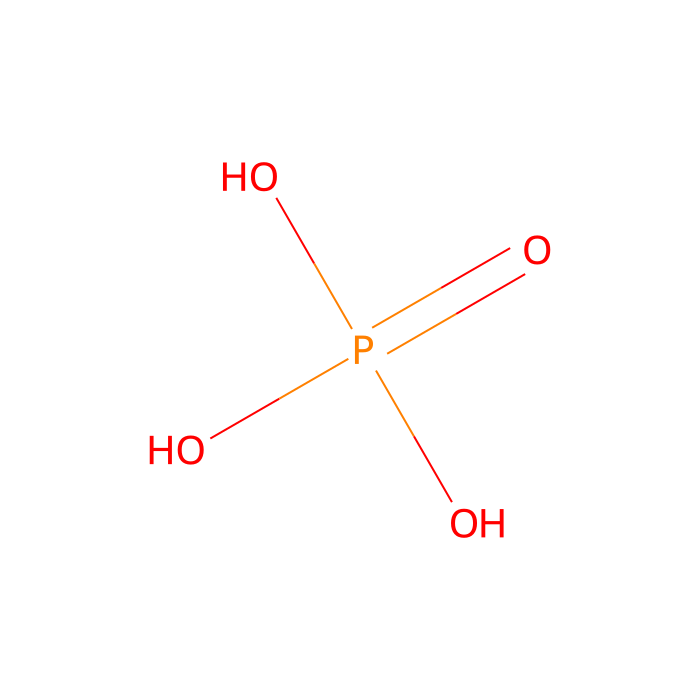
Phosphoric acid is a colorless orthorhombic crystalline compound in its pure form and is highly deliquescent. It is soluble in water and ethanol. While its acidity is weaker than strong acids such as sulfuric acid, hydrochloric acid, and nitric acid, it is stronger than weak acids like acetic acid and boric acid. It can irritate the skin, causing inflammation and damaging tissue. When dissolved in water, phosphoric acid releases heat. Upon high-temperature heating, it dehydrates to form pyrophosphoric acid and metaphosphoric acid. Prolonged exposure to low temperatures results in crystallization. It is corrosive and hygroscopic. It is used for determining chromium, nickel, and vanadium content in steel, metal rust prevention, and as a rubber coagulant. It is also applied in measuring non-protein nitrogen, total cholesterol in serum, and whole blood glucose levels. Crystalline phosphoric acid is primarily used in manufacturing processes such as microelectronics, high-energy batteries, and laser glass, serving as a high-purity catalyst and medical material.
Taxonomy Tree
| Kingdom | Inorganic compounds |
|---|---|
| Superclass | Homogeneous non-metal compounds |
| Classe | Non-metal oxoanionic compounds |
| Subclass | Non-metal phosphates |
| Intermediate Tree Nodes | Not available |
| Direct Parent | Non-metal phosphates |
| Alternative Parents | Inorganic oxides |
| Molecular Framework | Not available |
| Substituents | Non-metal phosphate - Inorganic oxide |
| Description | This compound belongs to the class of inorganic compounds known as non-metal phosphates. These are inorganic non-metallic compounds containing a phosphate as its largest oxoanion. |
| External Descriptors | phosphoric acids |
| Activity Type | Relation | Activity value | Units | Action Type | Journal | PubMed Id | doi | Assay Aladdin ID |
|---|
| Activity Type | Relation | Activity value | Units | Action Type | Journal | PubMed Id | doi | Assay Aladdin ID |
|---|
| Activity Type | Relation | Activity value | Units | Action Type | Journal | PubMed Id | doi | Assay Aladdin ID |
|---|
| Activity Type | Relation | Activity value | Units | Action Type | Journal | PubMed Id | doi | Assay Aladdin ID |
|---|
| Activity Type | Relation | Activity value | Units | Action Type | Journal | PubMed Id | doi | Assay Aladdin ID |
|---|
| Activity Type | Relation | Activity value | Units | Action Type | Journal | PubMed Id | doi | Assay Aladdin ID |
|---|
| Activity Type | Relation | Activity value | Units | Action Type | Journal | PubMed Id | doi | Assay Aladdin ID |
|---|
Find and download the COA for your product by matching the lot number on the packaging.
| Lot Number | Certificate Type | Date | Article |
|---|---|---|---|
 J2626513 | Certificate of Analysis | Oct 28, 2026 | P112029 |
| K2605988 | Certificate of Analysis | Oct 28, 2026 | P112029 |
| K2605987 | Certificate of Analysis | Oct 28, 2026 | P112029 |
| K2605744 | Certificate of Analysis | Oct 28, 2026 | P112029 |
| J2626514 | Certificate of Analysis | Oct 28, 2026 | P112029 |
| J2626516 | Certificate of Analysis | Oct 28, 2026 | P112029 |
| I2608238 | Certificate of Analysis | Sep 16, 2026 | P112029 |
| I2608236 | Certificate of Analysis | Sep 16, 2026 | P112029 |
| I2608235 | Certificate of Analysis | Sep 16, 2026 | P112029 |
| H2624091 | Certificate of Analysis | Sep 03, 2026 | P112029 |
| H2624089 | Certificate of Analysis | Sep 03, 2026 | P112029 |
| H2624090 | Certificate of Analysis | Sep 03, 2026 | P112029 |
| G2607151 | Certificate of Analysis | Jul 08, 2026 | P112029 |
| G2607150 | Certificate of Analysis | Jul 08, 2026 | P112029 |
| G2607149 | Certificate of Analysis | Jul 08, 2026 | P112029 |
| F2609284 | Certificate of Analysis | Jun 13, 2026 | P112029 |
| F2609281 | Certificate of Analysis | Jun 13, 2026 | P112029 |
| F2609332 | Certificate of Analysis | Jun 11, 2026 | P112029 |
| E2625193 | Certificate of Analysis | May 28, 2026 | P112029 |
| E2625207 | Certificate of Analysis | May 28, 2026 | P112029 |
| E2625211 | Certificate of Analysis | May 28, 2026 | P112029 |
| C2619386 | Certificate of Analysis | Mar 31, 2026 | P112029 |
| C2619251 | Certificate of Analysis | Mar 31, 2026 | P112029 |
| H2212473 | Certificate of Analysis | Mar 19, 2026 | P112029 |
| A2620190 | Certificate of Analysis | Jan 23, 2026 | P112029 |
| A2620192 | Certificate of Analysis | Jan 23, 2026 | P112029 |
| H2522224 | Certificate of Analysis | Aug 26, 2025 | P112029 |
| H2522225 | Certificate of Analysis | Aug 26, 2025 | P112029 |
| F2511419 | Certificate of Analysis | Jun 23, 2025 | P112029 |
| F2511418 | Certificate of Analysis | Jun 23, 2025 | P112029 |
| F2505259 | Certificate of Analysis | Jun 11, 2025 | P112029 |
| F2513189 | Certificate of Analysis | Jun 10, 2025 | P112029 |
| F2505223 | Certificate of Analysis | Jun 10, 2025 | P112029 |
| A2507288 | Certificate of Analysis | Jan 14, 2025 | P112029 |
| J2424872 | Certificate of Analysis | Nov 01, 2024 | P112029 |
| J2424873 | Certificate of Analysis | Nov 01, 2024 | P112029 |
| C2430130 | Certificate of Analysis | Apr 13, 2024 | P112029 |
| C2430129 | Certificate of Analysis | Apr 13, 2024 | P112029 |
| L2304345 | Certificate of Analysis | Dec 18, 2023 | P112029 |
| K2322402 | Certificate of Analysis | Dec 05, 2023 | P112029 |
| H2318577 | Certificate of Analysis | Sep 02, 2023 | P112029 |
| E23231379 | Certificate of Analysis | May 27, 2023 | P112029 |
| E23231378 | Certificate of Analysis | May 27, 2023 | P112029 |
| D2320953 | Certificate of Analysis | Apr 24, 2023 | P112029 |
| D2320926 | Certificate of Analysis | Apr 24, 2023 | P112029 |
| F2220086 | Certificate of Analysis | Mar 23, 2023 | P112029 |
| C2314470 | Certificate of Analysis | Mar 23, 2023 | P112029 |
| K22291019 | Certificate of Analysis | Dec 03, 2022 | P112029 |
| J2210668 | Certificate of Analysis | Oct 12, 2022 | P112029 |
| J2210670 | Certificate of Analysis | Oct 12, 2022 | P112029 |
| H2212472 | Certificate of Analysis | Aug 18, 2022 | P112029 |
| G1803024 | Certificate of Analysis | May 06, 2022 | P112029 |
| B2211254 | Certificate of Analysis | Feb 17, 2022 | P112029 |
| B2211310 | Certificate of Analysis | Feb 16, 2022 | P112029 |
| B2211303 | Certificate of Analysis | Feb 16, 2022 | P112029 |
| Sensibilité | Moisture sensitive. |
|---|---|
| Point d'ébullition (°C) | 158°C |
| Point de fusion (°C) | 42.35°C |
| Poids moléculaire | 98 |
| XLogP3 | -2.100 |
| Hydrogen Bond Donor Count | 3 |
| Hydrogen Bond Acceptor Count | 4 |
| Rotatable Bond Count | 0 |
| Exact Mass | 97.9769 Da |
| Monoisotopic Mass | 97.9769 Da |
| Topological Polar Surface Area | 77.800 Ų |
| Heavy Atom Count | 5 |
| Formal Charge | 0 |
| Complexity | 49.800 |
| Isotope Atom Count | 0 |
| Defined Atom Stereocenter Count | 0 |
| Undefined Atom Stereocenter Count | 0 |
| Defined Bond Stereocenter Count | 0 |
| Undefined Bond Stereocenter Count | 0 |
| The total count of all stereochemical bonds | 0 |
| Covalently-Bonded Unit Count | 1 |
H290:May be corrosive to metals
H302:Harmful if swallowed
H314:Causes severe skin burns and eye damage
P234:Keep only in original container.
P264:Wash hands [and …] thoroughly after handling.
P270:Do not eat, drink or smoke when using this product.
P280:Wear protective gloves/protective clothing/eye protection/face protection.
P310:Immediately call a POISON CENTER or doctor/physician.
P330:Rinse mouth.
P363:Wash contaminated clothing before reuse.
P390:Absorb spillage to prevent material damage.
P301+P312:IF SWALLOWED: call a POISON CENTER/doctor/... IF you feel unwell.
P301+P330+P331:IF SWALLOWED: Rinse mouth. Do NOT induce vomiting.
P303+P361+P353:IF ON SKIN (or hair): Take off Immediately all contaminated clothing. Rinse SKIN with water [or shower].
P304+P340:IF INHALED: Remove person to fresh air and keep comfortable for breathing.
P305+P351+P338:IF IN EYES: Rinse cautiously with water for several minutes. Remove contact lenses if present and easy to do - continue rinsing.
P405:Store locked up.
P406:Store in corrosive resistant/... container with a resistant inner liner.
P501:Dispose of contents/container to an approved waste disposal plant.