Determine the necessary mass, volume, or concentration for preparing a solution.
| Activity Type | Relation | Activity value | Units | Action Type | Journal | PubMed Id | doi | Assay Aladdin ID |
|---|

average Mₙ 80,000 for sensitive chromatographic and analytical workflows requiring minimal baseline interference.
Room temperature Ships Check lot-specific COA for exact specifications.
SDS, COA, datasheet, and spec sheet available for download. Lot-specific COA accessible via lot number lookup.
Cited in 212 peer-reviewed publications across chromatography, organic synthesis, and cross-coupling reactions.
Polycaprolactone (PCL) is a semi crystalline hydrophobic biodegradable polyester which finds major applications as a drug delivery agent because of its cost efficiency, high toughness and biocompatibility. PCL possesses some unique properties such as:It degrades slower than other biodegradable polyesters in physiological condition, this property can be exploited in the controlled release of drugs in target tissues over a period of time.Its poor surface wetting and interaction with biological fluids on account of its hydrophobicity leads to poor cell adhesion and proliferation, hence it is blended with other synthetic /natural polymers.PCL loaded with antibiotics may be used to treat infections of the respiratory tract, like tuberculosis.Investigations were carried out based upon phenotypic responses of human bone marrow mesenchymal cells (hBMSCs) for different ratio of chitosan/ polycaprolactone (PCL) blends.PCL/biomedical ceramic materials have been studied for possible osteo tissue regeneration.Action of PCL/graded insulin/beta-5 glycerophosphate concentrations on osteochondral tissue formation through adipose-derived stromal cell differentiation.Other general uses include:extrusion aid, die lubricant, mold release, pigment and filler dispersion aid and polyester segments in urethanes and block polyesters.
Comprehensive hazard, handling, storage, and regulatory compliance document.
Download SDS →Lot-specific quality data. Enter your lot number to retrieve the exact COA.
Look up COA →Full quality attributes and acceptance criteria for this grade.
View spec sheet →Taxonomy Tree
| Kingdom | Organic compounds |
|---|---|
| Superclass | Organoheterocyclic compounds |
| Classe | Lactones |
| Subclass | Not available |
| Intermediate Tree Nodes | Not available |
| Direct Parent | Lactones |
| Alternative Parents | Oxepanes Carboxylic acid esters Oxacyclic compounds Monocarboxylic acids and derivatives Organic oxides Hydrocarbon derivatives Carbonyl compounds |
| Molecular Framework | Aliphatic heteromonocyclic compounds |
| Substituents | Caprolactone - Oxepane - Lactone - Carboxylic acid ester - Oxacycle - Monocarboxylic acid or derivatives - Carboxylic acid derivative - Organic oxygen compound - Organic oxide - Hydrocarbon derivative - Organooxygen compound - Carbonyl group - Aliphatic heteromonocyclic compound |
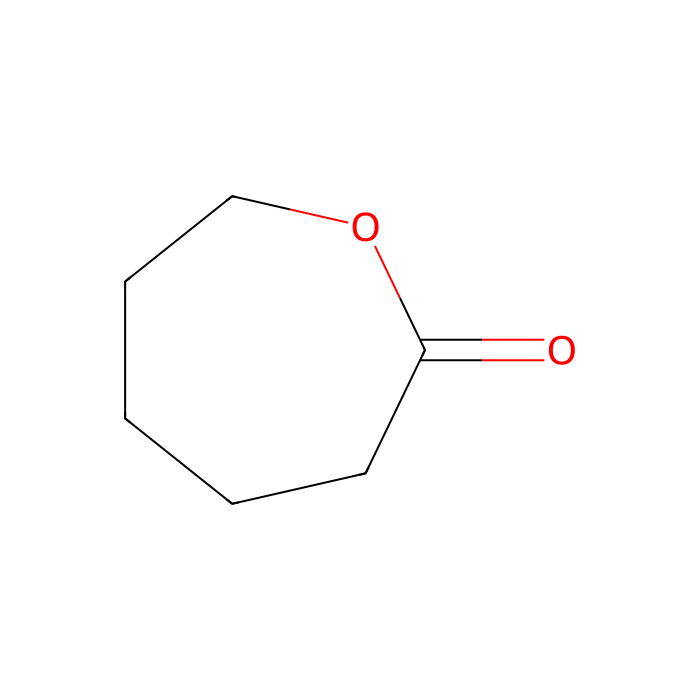
| Description | This compound belongs to the class of organic compounds known as lactones. These are cyclic esters of hydroxy carboxylic acids, containing a 1-oxacycloalkan-2-one structure, or analogues having unsaturation or heteroatoms replacing one or more carbon atoms of the ring. |
| External Descriptors | a small molecule |
| Activity Type | Relation | Activity value | Units | Action Type | Journal | PubMed Id | doi | Assay Aladdin ID |
|---|
Find and download the COA for your product by matching the lot number on the packaging.
| Lot Number | Certificate Type | Date | Article |
|---|---|---|---|
 H2607591 H2607591 | Certificate of Analysis | Jul 31, 2026 | P478241 |
| H2607582 | Certificate of Analysis | Jul 31, 2026 | P478241 |
| H2607552 | Certificate of Analysis | Jul 31, 2026 | P478241 |
| I2328517 | Certificate of Analysis | Jul 03, 2026 | P478241 |
| I2328332 | Certificate of Analysis | Jul 03, 2026 | P478241 |
| I2328331 | Certificate of Analysis | Jul 03, 2026 | P478241 |
| K2514642 | Certificate of Analysis | Nov 07, 2025 | P478241 |
| K2514641 | Certificate of Analysis | Nov 07, 2025 | P478241 |
| K2514640 | Certificate of Analysis | Nov 07, 2025 | P478241 |
| C2507523 | Certificate of Analysis | Mar 01, 2025 | P478241 |
| C2507522 | Certificate of Analysis | Mar 01, 2025 | P478241 |
| C2507521 | Certificate of Analysis | Mar 01, 2025 | P478241 |
| G2422254 | Certificate of Analysis | Jul 09, 2024 | P478241 |
| G2422255 | Certificate of Analysis | Jul 09, 2024 | P478241 |
| G2422252 | Certificate of Analysis | Jul 09, 2024 | P478241 |
| A2513252 | Certificate of Analysis | Jul 09, 2024 | P478241 |
| B24231127 | Certificate of Analysis | Jan 25, 2024 | P478241 |
| B24231126 | Certificate of Analysis | Jan 25, 2024 | P478241 |
| B24231125 | Certificate of Analysis | Jan 25, 2024 | P478241 |
| B24231124 | Certificate of Analysis | Jan 25, 2024 | P478241 |
| I2328514 | Certificate of Analysis | Sep 22, 2023 | P478241 |
| I2328515 | Certificate of Analysis | Sep 22, 2023 | P478241 |
| I2328516 | Certificate of Analysis | Sep 22, 2023 | P478241 |
| Sensibilité | Moisture sensitive |
|---|---|
| Point d'éclair (°C) | > 110°C |
| Point de fusion (°C) | 60°C |
| Poids moléculaire | 114.140 g/mol |
| XLogP3 | 0.000 |
| Hydrogen Bond Donor Count | 0 |
| Hydrogen Bond Acceptor Count | 2 |
| Rotatable Bond Count | 0 |
| Exact Mass | 114.068 Da |
| Monoisotopic Mass | 114.068 Da |
| Topological Polar Surface Area | 26.300 Ų |
| Heavy Atom Count | 8 |
| Formal Charge | 0 |
| Complexity | 88.500 |
| Isotope Atom Count | 0 |
| Defined Atom Stereocenter Count | 0 |
| Undefined Atom Stereocenter Count | 0 |
| Defined Bond Stereocenter Count | 0 |
| Undefined Bond Stereocenter Count | 0 |
| The total count of all stereochemical bonds | 0 |
| Covalently-Bonded Unit Count | 1 |