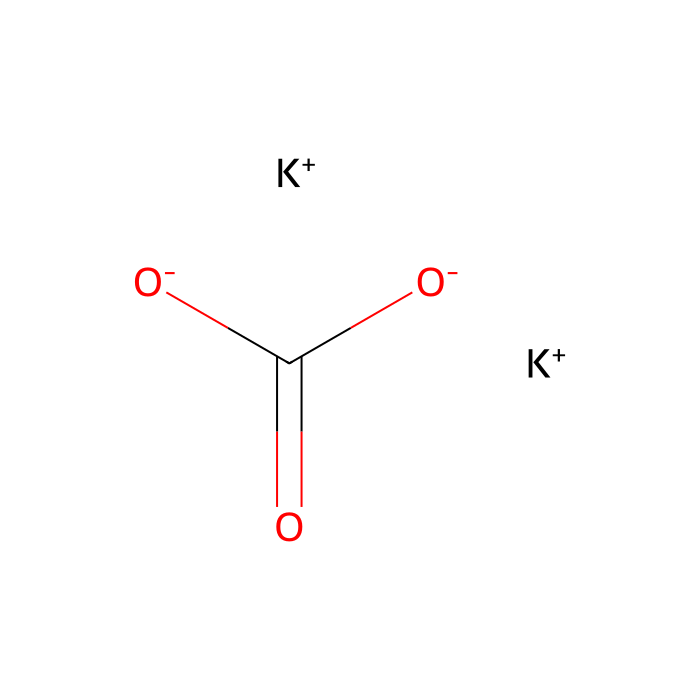
Potassium carbonate - UltraBio™, Ultra pure, ≥99% , CAS No.584-08-7

CAS: 584-08-7 Cat. No.: P432991 Formule: K2CO3 Poids moléculaire: 138.21 Beilstein Registry Number: 4267587 Numéro CE: 209-529-3
DISPONIBLE À COMMANDE
QUALITÉ & PURETÉ UltraBio™ ? UltraBio™ — Aladdin's line for molecular-biology applications. Use for nuclease-free, high-consistency reagents across molecular workflows. Ultra pure ? Ultra-pure grade with very low impurity content across the board. Use for trace analysis, electronics, or processes intolerant of contamination. ≥99%
Synonyms
FOOD-S|INS-501(I)|KALI CARBONICUM [HPUS]|Potassium carbonate (USP)|POTASSIUM CARBONATE [INCI]|POTASSIUM CARBONATE [VANDF]|SANITALK COMY-ANIMAL SANITIZER(COVID-19)|potasiumcarbonate|Potassium carbonate (2:1)|Potassium carbonate (K2CO3)|Potassium carbonate (K2(CO3))|POTASSIUM CARBONATE (USP MONOGRAPH)|NARO QUINN|Potassium carbonate-13C|potassium carbon ate|potassium carbon- ate|Racol|Kali Carb|CLEANING-S|NARO AMOR|NARO TIAMO|POTASSIUM CARBONATE (ANHYDROUS)|POTASSIUM CARBONATE [USP MONOGRAPH]|Dipotassium carbonate|Kalium carbonicum|POTASSIUM CARBONATE|potassium carbon-ate|potassium carbonate-|Carbonic acid, potassium salt (1:2)|Potassium carbonate (JP17/USP)|USEPA/OPP Pesticide Code: 073504|Kaliumcarbonat [German]|POTASSIUM CARBONATE (USP-RS)|POTASSIUM CARBONATE [JAN]|POTASSIUM CARBONATE [WHO-DD]|potasium cabonate|potasium carbonate|potassium potassium carbonate|POTASSIUM CARBONATE [MI]|Carbonate of potash|Potassium carbonate - granular|Potassium carbonate [USP]|Kali Carbonicum Kit Refill|Kaliumcarbonat|MOONSTAR HAIR MIST|Pearl ash|potassium carbonat|POTASSIUM CARBONATE [EP MONOGRAPH]|potassiumcarbonat|Dcad plus|dipotassium;carbonate|POTASSIUM CARBONATE (EP MONOGRAPH)|POTASSIUM CARBONATE [MART.]|ZEROQ PET|K-Gran|potassium cabonate|POTASSIUM CARBONATE [HSDB]|POTASSIUM CARBONATE [II]|ZEROQ FOOD|INS NO.501(I)|ZEROQ|Carbonic acid, dipotassium salt|Potassium Carbonate Nanopowder|Potassium carbonate, anhydrous|POTASSIUM CARBONATE (MART.)|SANITALK-SANITIZER(COVID-19)|Greenfish, Cleaning-S|Kalium carbonicum 12 Special Order|potassiumcarbonate|Racol (TN)|Kali carbonicum|NARO COMO
Storage
Room temperature
Shipped In
Normal
★
Taille
Allemagne (EU)
USA*
Prix
Qté
500g
P432991-500g
1 En stock
1 En stock
95,36€
Enter a quantity for the sizes you want to add.

Spécifications

Synonymes
FOOD-S | INS-501(I) | KALI CARBONICUM [HPUS] | Potassium carbonate (USP) | POTASSIUM CARBONATE [INCI] | POTASSIUM CARBONATE [VANDF] | SANITALK COMY-ANIMAL SANITIZER(COVID-19) | potasiumcarbonate | Potassium carbonate (2:1) | Potassium carbonate (K2CO3) | Potassium carbonate (K2(CO3)) | POTASSIUM CARBONATE (USP MONOGRAPH) | NARO QUINN | Po Afficher plus
Spécifications et pureté
UltraBio™, Ultra pure, ≥99%
Conditions de stockage de stockage
Room temperature
Expédié en
Normal
Grade
Ultra pure, UltraBio™
Pureté
≥99%
Noms et identifiants
Pubchem Sid
Pubchem Sid Url
https://pubchem.ncbi.nlm.nih.gov/substance/528774278
SMILES
C(=O)([O-])[O-].[K+].[K+]
IUPAC Name
dipotassium;carbonate
InChIKey
BWHMMNNQKKPAPP-UHFFFAOYSA-L
InChI
1S/CH2O3.2K/c2-1(3)4;;/h(H2,2,3,4);;/q;2*+1/p-2
Isomères SMILES
C(=O)([O-])[O-].[K+].[K+]
WGK Allemagne
1
RTECS
TS7750000
Poids moléculaire
138.21
Beilstein
4267587
Reaxys
4267587
Reaxys-RN_link_address
https://www.reaxys.com/reaxys/secured/hopinto.do?context=S&query=IDE.XRN=4267587&ln=

Données avancées

Taxonomic Classification

Taxonomy Tree

KingdomOrganic compounds
SuperclassOrganic acids and derivatives
ClasseOrganic carbonic acids and derivatives
SubclassOrganic carbonic acids
Intermediate Tree Nodes Not available
Direct ParentOrganic carbonic acids
Alternative Parents Carbonate salts  Organic potassium salts  Organic oxides  Hydrocarbon derivatives  Carbonyl compounds  
Molecular FrameworkAliphatic acyclic compounds
Substituents Carbonate salt - Carbonic acid - Organic alkali metal salt - Organic oxygen compound - Organic oxide - Hydrocarbon derivative - Organic potassium salt - Organic salt - Organooxygen compound - Carbonyl group - Aliphatic acyclic compound
DescriptionThis compound belongs to the class of organic compounds known as organic carbonic acids. These are compounds comprising the carbonic acid functional group.
External Descriptors Not available
Structure 3D
Modèle de structure chimique interactif


Cibles associées (non humaines)
Pseudomonas aeruginosa (123386 Activities)
Activity TypeRelationActivity valueUnitsAction TypeJournalPubMed IddoiAssay Aladdin ID
Mécanismes d'action
Certificats (CoA, COO, BSE/TSE et tableau d'analyse)
C of A & Other Certificates(BSE/TSE, COO):
Analytical Chart:

Find and download the COA for your product by matching the lot number on the packaging.

4 results found

Lot NumberCertificate TypeDateArticle
G2601145G2601145Certificate of AnalysisJul 10, 2026 P432991
G2601146G2601146Certificate of AnalysisJul 10, 2026 P432991
F2609123F2609123Certificate of AnalysisJun 11, 2026 P432991
K2406145K2406145Certificate of AnalysisNov 12, 2024 P432991
Propriétés chimiques et physiques
SolubilitéH2O: 1M, clear, colorless
Point de fusion (°C)891°C
Poids moléculaire138.21
XLogP3
Hydrogen Bond Donor Count0
Hydrogen Bond Acceptor Count3
Rotatable Bond Count0
Exact Mass137.912 Da
Monoisotopic Mass137.912 Da
Topological Polar Surface Area63.200 Ų
Heavy Atom Count6
Formal Charge0
Complexity18.800
Isotope Atom Count0
Defined Atom Stereocenter Count0
Undefined Atom Stereocenter Count0
Defined Bond Stereocenter Count0
Undefined Bond Stereocenter Count0
The total count of all stereochemical bonds0
Covalently-Bonded Unit Count3
Sécurité et dangers (GHS)
Pictogramme(s)
Signal
Warning
Mentions de danger

H302:Harmful if swallowed

H315:Causes skin irritation

H319:Causes serious eye irritation

H335:May cause respiratory irritation

Conseils de prudence

P261:Avoid breathing dust/fume/gas/mist/vapors/spray.

P264:Wash hands [and …] thoroughly after handling.

P270:Do not eat, drink or smoke when using this product.

P271:Use only outdoors or in a well-ventilated area.

P280:Wear protective gloves/protective clothing/eye protection/face protection.

P321:Specific treatment (see ... on this label).

P330:Rinse mouth.

P302+P352:IF ON SKIN: wash with plenty of water.

P304+P340:IF INHALED: Remove person to fresh air and keep comfortable for breathing.

P305+P351+P338:IF IN EYES: Rinse cautiously with water for several minutes. Remove contact lenses if present and easy to do - continue rinsing.

P362+P364:Take off contaminated clothing and wash it before reuse.

P405:Store locked up.

P403+P233:Store in a well-ventilated place. Keep container tightly closed.

P501:Dispose of contents/container to an approved waste disposal plant.

P264+P265:Wash hands [and …] thoroughly after handling. Do not touch eyes.

P301+P317:IF SWALLOWED: Get medical help.

P337+P317:If eye irritation persists: Get medical help.

P332+P317:If skin irritation occurs: Get medical help.

P319:Get medical help if you feel unwell.

WGK Allemagne
1
RTECS
TS7750000
Reaxys
4267587
Reaxys-RN_link_address
https://www.reaxys.com/reaxys/secured/hopinto.do?context=S&query=IDE.XRN=4267587&ln=
FAQ et articles
UltraBio™: Defining Excellence in Molecular Biology Applications
One-Stop Handbook for Palladium-Catalyzed Reactions: Catalytic Cycles, Deactivation Troubleshooting, Ligand/Precatalyst Selection, and an Aladdin Reference List
TEMPO-Catalyzed Oxidation Quick Reference (Alcohol Oxidation Focus): Three Regeneration Routes (NaOCl / Cu–O₂ / PIDA) + Selection & Troubleshooting
Strategies and Progress in the Asymmetric Catalytic Synthesis of Chiral 1,2-Bis(boronic) Esters: Route Types, Selectivity Challenges, and Sequential Site Utilization (with Product Selection Navigator and Tables 1–4)
Late-Stage Fluorination Toolbox: “Minimally Invasive Upgrades” for Lead Candidates: Four “Fluorine Knobs” → Two major routes (electrophilic vs nucleophilic) → An ¹⁸F-PET tracer branch → Selection navigation & representative product list
OSF/ASF Dual-Channel Toolbox: Divergent Reactions of Four-Membered Ring Sulfonyl Fluorides, Condition “Knobs,” and Selection Navigation
From Piperidine to Pyridine: The “Most Common N-Heterocycle” Shift in FDA Small-Molecule New Drugs (2013–2023) and a Selection Guide (Tables 1–4)
Light-Emitting Polymers (LEPs): A Practical Panorama - A Core PL/EL Mechanistic Framework, Material Family Map, and Structural “Design Knobs” (including Product Tables 1–4 and a selection guide)
Structural–Functional Analysis of the Methoxy Group (–OCH₃) in Approved Small-Molecule Drugs: Mechanisms, Evidence Chains, and Product-Selection Navigation (with Related Product Tables)
Selection of Common Research Salts: A Task Map for Alkali Metal Salts & Alkaline Earth Metal Salts (with Product Tables 1–6)
Cinchona Alkaloid Chiral Toolbox: Selection & Troubleshooting from Pseudoenantiomer Switching to PTC/Sharpless AD/Chiral Resolution (including Product Tables A–D)
Make “Aryl Chlorides + Low Pd Loading + Scale-Up Reproducibility” Reliable: The Initiation and Durability Logic of Pd–NHC (Palladium–N-Heterocyclic Carbene) Cross-Coupling (with Selection Navigation and Product Tables)
Choosing Boron Sources to Make Reactions Robust: How Boronic Acids, Boronate Esters, BF₃K Salts, and MIDA Improve Suzuki–Miyaura Start-Up and Scale-Up Reproducibility (with Product Tables 1–5)
How to Make the Suzuki–Miyaura Reaction Robust: Pinpoint the Bottleneck and Lock in a Reproducible Operating Window (with Selection Navigation and Product Tables 1–5)
Haloheterocycles and Cross-Coupling: A Research-Oriented Selection Framework from Substrate Identification to Bond-Forming Routes (Including Product Navigation and Tables 1–5)
From “Reduction First, Then Acylation” to “Direct Amidation”: An Unconventional Route to Amide Bond Formation from Nitro and Nitroso Substrates with α-Keto Carboxylic Acids
Reconsidering N-Acyl Amino Protecting Groups: Deprotection Differences, Strategic Roles, and Experimental Selection of Ac, Bz, and Tfa
Selective Deprotection and Sulfonyl Group Migration of N-Aryl Sulfonamides Mediated by TfOH (Trifluoromethanesulfonic Acid): Reaction Patterns and Synthetic Implications
Boc₂O Selection Cannot Be Judged by Protection Installation Alone: Experimental Decision-Making from Substrate Nucleophilicity and Medium Effects to Deprotection Pathways
Experimental Assessment of Fmoc Introduction Routes: Impurity Profile Differences, Raw Material Carryover, and Quality Control
Experimental Judgment for TFPN in Carboxylic Acid Activation: Suitable Scenarios, Intermediate Distribution, and Nucleophile Compatibility
Experimental Selection Logic for Phase-Transfer Catalysts: Choosing Catalysts by Phase-State System, Source of Anionic Species, and Reaction Task
Experimental Decision-Making for Cross-Coupling Reactions: Target Bond Type, Substrate Combination, and Catalytic System Selection
Potassium Fatty Acid Soaps: Structure and Formulation Applications—Production Processes, Alkalinity, Foam Control, and Low-Foam Cleaning
Differences, Functions, and Selection Guidelines for Sodium Hydroxide Flakes, Granules, Liquid Caustic Soda, and Caustic Soda in Household and Personal Care Product Manufacturing: The Functional and Application Logic of Sodium Hydroxide
Why Daily Chemical Formulations Need Alkaline Ingredients: From pH Adjustment and Saponification to Detergency Boosting and Selection Logic
Deoxyfluorination of Hydroxyalkyl-Substituted Aryl/Alkenyl Boronates: C–F Bond Construction and C–B Bond Retention via a BF3K Intermediate
CTSOBt Benzotriazole–Sulfonate Coupling Reagent: Carboxylic Acid Activation and Synthetic Application Value
Medicinal Chemistry Design of the Indazole Scaffold: Tautomerism, Molecular Recognition, Substitution-Site Design, and Synthetic Strategies
Discovery and Structural Optimization of the Noncovalent 3CL Protease Inhibitor S-217622
Overcoming the Electronic-Effect Limitations of Nucleophilic Aromatic Substitution in Fluoroarenes: Anion Activation, Concerted Substitution, and HF Capture by t-Bu-P4
Build the Three-Membered Ring First, or Form the Carbon–Nitrogen Bond First?—Retrosynthetic Strategies, Route Selection, and Stereochemical Control in Cyclopropylamine Synthesis
Route Selection for Thiol Synthesis: C–S Bond Construction, Sulfur Source Forms, and Thiol Release
3,3-Spiro-α-Proline Building Blocks: Structural Features, Complementary Synthetic Routes, and Multigram-Scale Preparation
Direct Construction of Methylsulfonyl-Containing Heterocycles: Synthesis and Applications of Prefunctionalized Three-Carbon Vinamidinium Salts
Synthetic Route Design for Azaheterocyclic Phosphonates: Timing of C–P Bond Formation and Three Route Strategies
Kinetic Matching in Photoredox/Nickel C(sp²)–C(sp³) Coupling: Radical Generation, Nickel-Species Stability, and Photon Flux
Tether Effects in Intramolecular [2+2] Photocycloadditions: Straight and Crossed Regioselectivity and Stepwise C–C Bond Formation
Citations of This Product
Calculateurs de solution
Avis

Avis des clients

Souhaitez-vous que nous vous envoyions un message lorsque des réductions seront disponibles?

Me rappeler plus tard

Merci ! Veuillez vérifier votre boîte de réception e-mail pour confirmer.

Oups ! Les notifications sont désactivées.