Tesidolumab (anti-Complement C5) - Anticorps primaire, specific to C5, >95%, Human IgG1, BINDING AGENT of Complement C5 binding agent, BINDING AGENT of Complement C5 binding agent

CAS: 1531594-08-7 Cat. No.: Ab176617
DISPONIBLE À COMMANDE
QUALITÉ & PURETÉ Animal Free ? Animal-free — produced without animal-derived components to reduce contamination risk. Use in biomanufacturing and culture avoiding animal-origin material. Carrier Free ? Carrier-free — supplied without added carrier protein/stabilizer. Use when carriers (e.g. BSA) would interfere with conjugation or sensitive assays. Recombinant ? Recombinant — produced via recombinant expression for defined sequence and consistency. Use for reproducible, animal-free proteins of known origin. ExactAb™ ? ExactAb™ — Aladdin's antibody line emphasizing precision and validated quality. Use for reliable, specificity-validated antibody applications. Low Endotoxin ? Low-endotoxin grade — endotoxin reduced to low controlled levels. Use in sensitive biological work where high endotoxin would interfere. Azide Free ? Azide-free — without sodium azide preservative. Use in conjugations, cell work, or assays where azide is toxic or inhibitory. Validated ? Validated grade — performance confirmed in defined applications before release. Use when you want documented assurance the reagent works as stated. ≥95%(SDS-PAGE&SEC-HPLC) See COA
Application
Animal Model, ELISA, Flow Cytometry, Functional Assay
Host species
Humain
Reactive species
Humain, Souris
Isotype
Human IgG1
Conjugation
Unconjugated
★
Taille
Allemagne (EU)
USA*
Prix
Qté
100μg
Ab176617-100μg
—
En stock ≥10
59,79€
1mg
Ab176617-1mg
—
5 En stock
293,21€
5mg
Ab176617-5mg
—
1 En stock
1 023,85€
10mg
Ab176617-10mg
Sur commande · 8–12 semaines
1 613,91€
Enter a quantity for the sizes you want to add.
🧪
Pourquoi cette qualité

Carrier Free, Recombinant, ExactAb™, Low Endotoxin, Azide Free, Validated, Animal Free, ≥95%(SDS-PAGE&SEC-HPLC), See COA Animal Free,Azide Free,Carrier Free,ExactAb™,Low Endotoxin,Recombinant,Validated pour les flux de travail chromatographiques et analytiques sensibles nécessitant une interférence de ligne de base minimale.

🌡

Stockage & expédition

Store at -80°C,Avoid repeated freezing and thawing Expédition Dry ice packs + Cold packs. Consultez le COA spécifique au lot pour les spécifications exactes.

📋

Documents qualité

SDS, COA, fiche technique et fiche de spécifications disponibles au téléchargement. COA spécifique au lot accessible via la recherche par numéro de lot.

📚

Preuve documentaire

Cité dans 0 publications à comité de lecture couvrant la chromatographie, la synthèse organique et les réactions de couplage croisé.

Vue d’ensemble

Tesidolumab (anti-Complement C5) is a fully-human IgG1/λ anti-C5 monoclonal antibody. Tesidolumab (anti-Complement C5) blocks cleavage of C5 and prevents subsequent formation of the membrane attack complex.
Purity
>95% (SDS-PAGE&SEC)
Endotoxin Level
< 1.0EU/mg

Spécifications

Product Name
Tesidolumab (anti-Complement C5) - Anticorps primaire, specific to C5, >95%, Human IgG1, BINDING AGENT of Complement C5 binding agent
Synonymes
Anaphylatoxin C5a analog antibody | C3 and PZP-like alpha-2-macroglobulin domain-containing protein 4 antibody | C5 antibody | C5a anaphylatoxin antibody | C5a antibody | C5b antibody | CO5_HUMAN antibody | Complement C5 alpha'' chain antibody | Complemen
Spécifications et pureté
Carrier Free, Recombinant, ExactAb™, Low Endotoxin, Azide Free, Validated, Animal Free, ≥95%(SDS-PAGE&SEC-HPLC), See COA
Espèce hôte
Humain
Spécificité
C5
Conjugation
Unconjugated
Grade
Animal Free, Azide Free, Carrier Free, ExactAb™, Low Endotoxin, Recombinant, Validated
Type d'action
BINDING AGENT
Mécanisme d'action
BINDING AGENT of Complement C5 binding agent
Isotype
Human IgG1
Type de chaîne lumineuse
lambda
SDS-PAGE
142.92 kDa
Méthode de purification
Protein A purified
La pureté
>95%
Concentration
See COA
CAS
1531594-08-7
Product Line
Produits biologiques
Stockage et expédition
Forme
Liquid
Conditions de stockage de stockage
Store at -80°C,Avoid repeated freezing and thawing
Expédié en
Dry ice packs + Cold packs
Stabilité et stockage
Store at -80℃ for 24 months. Upon receipt, it is recommended to aliquot. Avoid freeze/thaw cycle.
Images

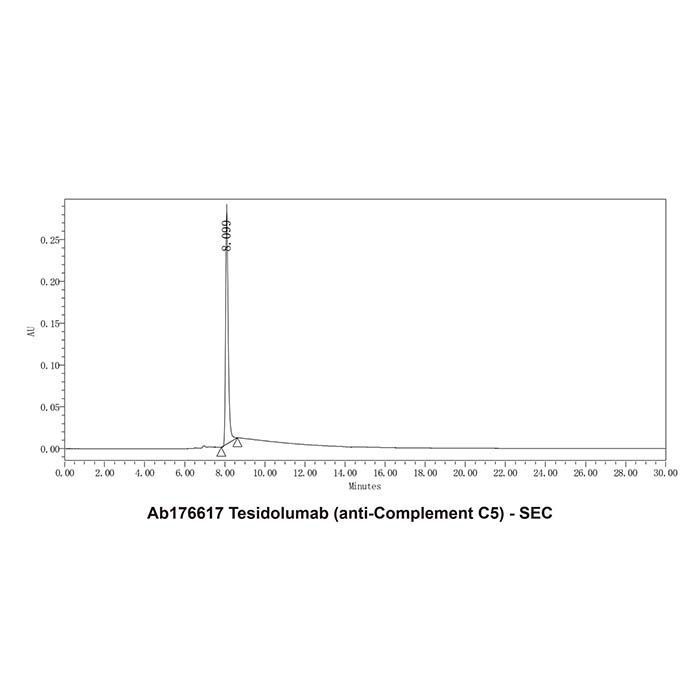
Tesidolumab (anti-Complement C5) (Ab176617) - SEC
The purity of Tesidolumab (anti-Complement C5) (Ab176617) is more than 95% verified by HPLC.

Documentation

📋 Fiche de données de sécurité (FDS)

Document complet couvrant les dangers, la manipulation, le stockage et la conformité réglementaire.

<<<<<<< HEAD Télécharger la SDS → ======= Télécharger la SDS → >>>>>>> release248-p3

✅ Certificat d'analyse (COA)

Données qualité spécifiques au lot. Saisissez votre numéro de lot pour récupérer le COA exact.

Rechercher le COA →

📊 Fiche technique

Résumé de référence rapide des spécifications et applications du produit.

Voir la fiche technique →

🔬 Fiche de spécifications

Attributs de qualité complets et critères d'acceptation pour cette qualité.

Voir la fiche de spécifications →

Données avancées

Cibles associées (humaines)
C5 Tclin Complement C5 (0 Activities)
Activity TypeActivity Value -log(M)Mechanism of ActionActivity ReferencePublications (PubMed IDs)
Mécanismes d'action
Certificats (CoA, COO, BSE/TSE et tableau d'analyse)
C of A & Other Certificates(BSE/TSE, COO):
Analytical Chart:

Find and download the COA for your product by matching the lot number on the packaging.

5 results found

Lot NumberCertificate TypeDateArticle
ZJ24F1214795ZJ24F1214795Certificate of AnalysisSep 02, 2026 Ab176617
ZJ24F1214796ZJ24F1214796Certificate of AnalysisSep 02, 2026 Ab176617
ZJ24F1214797ZJ24F1214797Certificate of AnalysisSep 02, 2026 Ab176617
ZJ23F1202004ZJ23F1202004Certificate of AnalysisDec 13, 2023 Ab176617
ZJ23F1202003ZJ23F1202003Certificate of AnalysisDec 13, 2023 Ab176617
FAQ et articles
Calculateurs de solution
Avis

Avis des clients

Application Protocols

Item-specific tested applications, recommended dilutions, and positive controls are not provided in the Product Data; refer to CoA/Spec Sheet.

General protocol frameworks (not item-specific):

  • Direct ELISA for C5 binding: Coat plates with purified C5 (e.g., 1–2 µg/mL) in carbonate buffer overnight, block, incubate with serial dilutions of the antibody, detect with anti-species Fc secondary. Record EC50 and construct standard binding curves.
  • Competitive ELISA: Pre-incubate antibody with C5, then add to C5-coated plates to determine competition with reference anti-C5 reagents.
  • Functional inhibition (hemolysis) assay: Assemble classical pathway CH50 assay using antibody pre-incubated with serum at defined concentrations; measure hemoglobin release from sensitized erythrocytes. Include serum-only, isotype, and heat-inactivated controls.
  • SPR/BLI kinetics: Immobilize C5 or capture antibody via anti-Fc; run multi-cycle kinetics to obtain KD under defined buffer, temperature, and flow rates.
  • Immunodepletion: Couple antibody to NHS-activated sepharose; incubate with serum/plasma, collect flow-through, and quantify C5 depletion by ELISA or MS.

Optimize concentrations and incubation conditions empirically. Maintain cold chain and avoid azide for live-cell or enzymatic assays.

Biological Roles

Target overview (general biology):

  • Complement component C5 is a central protein in the complement cascade. Upon convertase-mediated cleavage, C5 yields C5a (a potent anaphylatoxin and chemoattractant) and C5b (initiates assembly of the membrane attack complex, MAC: C5b-9) leading to cell lysis.
  • C5 sits at the convergence of classical, lectin, and alternative pathways, making it a strategic node for modulating terminal complement activity.

Relevance to research:

  • Inhibiting C5 cleavage reduces C5a-mediated inflammation and blocks MAC formation, allowing dissection of complement’s roles in inflammation, cytotoxicity, and host-pathogen interactions.
  • Anti-C5 antibodies are useful tools to: (a) parse upstream vs. downstream complement pathway contributions; (b) model complement inhibition in ex vivo human blood or serum; (c) study complement-dependent cytotoxicity (CDC) mechanisms; and (d) evaluate complement cross-talk with coagulation and innate immune signaling.

Assay endpoints commonly monitored (general):

  • Hemolysis readouts (CH50/AH50), C5a quantification, MAC (sC5b-9) ELISA, deposition assays (C3b/iC3b/C5b-9) on surfaces or cells, and functional bactericidal assays.

Item-specific biological activity, epitope, affinity, species cross-reactivity, and isotype for Tesidolumab are not specified in the Product Data; consult the CoA/Spec Sheet for precise details.

Buffer Applications

While not a classical buffer component, appropriate buffer systems are critical for handling Tesidolumab and executing complement assays.

General buffer recommendations (not item-specific):

  • Storage/working buffer: PBS (10–50 mM phosphate, 150 mM NaCl, pH 7.2–7.4). For functional assays, ensure buffers are free of azide (this item is Azide Free) and reduce extraneous amines for conjugation workflows.
  • Complement activity assays: Use veronal-buffered saline (VBS) or HEPES-buffered saline with Mg2+/Ca2+ to support complement activation; for alternative pathway assays, include MgEGTA as appropriate to control pathway specificity.
  • Blocking additives: 0.1% casein or 1–5% BSA for ELISA/plate-based assays (ensure compatibility with Carrier Free antibody and downstream readouts). Avoid serum proteins if they confound C5 measurements.
  • Stabilizers: For repeated handling, addition of 10–20% glycerol or 0.01% nonionic surfactant may improve stability, if compatible with your assay; these are not supplied with this item unless indicated on the CoA.

Practical tips:

  • Filter-sterilize buffers (0.22 µm) and maintain cold chain to minimize proteolysis/aggregation.
  • For conjugation (e.g., HRP, fluorophore), exchange into amine-free buffers (PBS without Tris/glycine) at pH 7.4–8.3 for NHS-based chemistries.

Item-specific buffer composition and pH are not provided; refer to the CoA/Spec Sheet.

Green Alternatives

Sustainability considerations for antibody reagents focus on sourcing and processing rather than organic solvent replacement.

Greener attributes of this item:

  • Recombinant and Animal Free: Avoids animal-derived production (e.g., ascites), reducing animal use and improving supply consistency.
  • Carrier Free & Azide Free: Minimizes additive burden; simplifies downstream processing and waste handling.

Best practices to reduce environmental impact (general):

  • Minimize freeze–thaw cycles by aliquoting to reduce wastage.
  • Use recyclable cold-chain materials where possible and consolidate shipments.
  • Employ micro-scale assay formats (96/384-well) to lower reagent consumption.

Alternative formats and tradeoffs (general):

  • Antibody fragments (Fab, scFv, VHH) can offer lower protein mass per experiment and improved tissue penetration, but may reduce half-life and avidity.
  • Engineered Fc variants with enhanced stability may permit lower working concentrations, balancing performance with reduced material usage.

Comparison (general, not item-specific):

  • Hybridoma-derived mAbs: Animal-derived components likely; batch variability higher; potential ethical concerns.
  • Recombinant (this item): No animal-derived components in production; high lot-to-lot consistency; potentially lower environmental footprint per mg produced.

Always evaluate performance parity before switching formats; confirm with pilot experiments using your specific assays.

Pharmaceutical Uses

This product is for research use only.

Contextual information (general; not a therapeutic claim):

  • Anti-C5 monoclonal antibodies are widely used in biopharmaceutical research to study complement modulation, evaluate manufacturability attributes (aggregation, charge variants), and develop analytical methods (binding assays, bioactivity potency assays).
  • As a carrier-free, azide-free recombinant antibody with low endotoxin, the material is suited for process development studies, conjugation method development, and in vitro or ex vivo pharmacology models where preservative-free conditions are preferred.
  • Researchers may use anti-C5 reagents as in-process controls, reference standards in ligand-binding assays, or surrogates in bioassay qualification.

Any clinical or therapeutic usage is outside the scope of this listing. No pharmacopeia monograph or drug product status is implied. For GMP or clinical applications, obtain appropriate quality documentation and regulatory-grade materials; this research-grade item does not include such certifications.

Physical Properties

Item-specific properties:

  • Appearance: Not specified for this item; refer to CoA/Spec Sheet.
  • Molecular Weight: Not specified for this item; refer to CoA/Spec Sheet.
  • Formulation/buffer, concentration, pH: Not specified for this item; refer to CoA/Spec Sheet.
  • Endotoxin: Low Endotoxin (grade attribute; quantitative limit not specified for this item).

General/literature guidance for IgG antibodies (not item-specific):

  • Typical molecular mass: ~150 kDa for full-length IgG; Fab ~50 kDa, Fc ~50 kDa.
  • Isoelectric point (pI): Commonly pI ~7–9 for human IgG1 subclasses (sequence-dependent).
  • Solubility: Antibodies are water-soluble in physiological buffers (e.g., PBS, HEPES) and typically insoluble in most organic solvents.
  • Stability: Enhanced at lower temperatures; susceptible to aggregation at elevated temperature, extreme pH, interfacial stress, or repeated freeze–thaw.
  • UV absorbance: Proteins show A280 due to Trp/Tyr; typical IgG extinction coefficient ~1.3–1.6 (mg/mL)−1 cm−1 (sequence-dependent; not specified for this item).

Important: Do not treat these general values as specifications. For exact physical parameters, formulation, concentration, and extinction coefficient of Tesidolumab (Ab176617), refer to the product’s CoA/Spec Sheet.

Quality and Grades

Item-specific quality attributes:

  • Grade/Purity: Animal Free, Carrier Free, Recombinant, ExactAb™, Low Endotoxin, Azide Free, Validated.

What these designations mean (general definitions; not item-specific specs):

  • Animal Free: Manufactured without animal-derived components in the production process, reducing risk of adventitious agents and animal-origin contaminants.
  • Recombinant: Sequence-defined antibody produced in a controlled expression system for batch-to-batch consistency versus hybridoma-derived material.
  • ExactAb™: Denotes sequence-verified, recombinant antibody engineered for high lot reproducibility; ensures defined heavy/light chain sequences (platform descriptor; consult CoA for lot-specific sequence confirmation).
  • Carrier Free: Supplied without protein carriers such as BSA, gelatin, or Tris stabilizers, facilitating conjugation, labeling, or functional assays where carriers can interfere.
  • Low Endotoxin: Suitable for sensitive cell-based assays where endotoxin can confound results; quantitative EU/mg limit is not specified for this item.
  • Azide Free: No sodium azide preservative, benefiting cells/enzymes sensitive to azide and compatible with conjugation chemistries.
  • Validated: Indicates internal performance verification on relevant targets/assays (specific validation methods, applications, and species reactivity are not specified for this item; refer to CoA/Spec Sheet).

Notes for users:

  • Absence of carriers and azide can reduce stability after thaw; maintain cold chain and aliquot immediately upon receipt.
  • For QC: Confirm concentration, endotoxin level, and purity by A280, LAL assay, and SEC-HPLC per your lab’s standards; obtain lot-specific CoA for precise numbers.
Reaction and Applications

For an anti-Complement C5 monoclonal antibody, “applications” are functional/analytical rather than synthetic reactions.

Potential research applications (general; expand per your experimental needs):

  • Complement inhibition assays: Assess blockade of C5 activation and membrane attack complex (MAC) formation in classical, lectin, or alternative pathway hemolysis assays.
  • Neutralization studies: Quantify inhibition of C5a generation using ELISA or LC–MS-based complement split product profiling.
  • Immunodepletion: Remove C5 from serum/plasma using antibody-conjugated beads; monitor depletion via Western blot or targeted proteomics.
  • Binding assays: Determine affinity/kinetics for C5 by BLI/SPR or ELISA; evaluate epitope overlap/competition with other anti-C5 reagents.
  • Structural/biophysical: Map epitope via HDX-MS or mutagenesis of C5; perform SEC-MALS or AUC to characterize complex formation.

Practical notes (general):

  • Use Carrier Free, Azide Free material for conjugation to enzymes/fluorophores or for live-cell/functional assays where azide interferes.
  • Maintain divalent cations (Mg2+/Ca2+) in complement activity assays as appropriate; avoid chelators if assessing native pathway function.
  • Verify the antibody’s isotype and Fc engineering from the CoA if Fc effector interactions or complement engagement by the Fc are relevant to your design.

Item-specific validated applications are not provided in the Product Data; consult the CoA/Spec Sheet.

Reaction Conditions

Classical chemical reaction conditions are not applicable to antibody function. However, for functional and conjugation workflows (general guidance; not item-specific):

  • Binding/neutralization assays: Perform at 4–37°C in PBS or HEPES-buffered saline. Incubation times typically range 30–120 min for equilibrium binding; optimize based on affinity and antigen concentration.
  • Complement activity assays: Maintain physiological ionic strength with Mg2+/Ca2+ present. Run at 37°C to match complement enzyme kinetics; time courses often 30–60 min in hemolysis assays.
  • Conjugation: For NHS-ester labeling, pH 7.5–8.5 in amine-free buffer, 4–25°C, minutes to hours depending on molar excess. For maleimide–thiol coupling, reduce selectively and perform at pH 6.5–7.5 to limit hydrolysis.
  • Storage during procedures: Keep on ice when not actively incubating; avoid vigorous mixing and air–liquid interfaces to reduce aggregation.

Expected yields/stoichiometry are assay- and method-dependent and not specified for this item. Always verify via pilot experiments and analytical QC. For lot-specific parameters (concentration, extinction coefficient), consult the CoA/Spec Sheet.

Safety and Handling

Hazard Information (item-specific):

  • GHS Classification: Not specified for this item; refer to SDS.
  • Signal Word / Pictograms / H-Statements: Not specified for this item; refer to SDS.

General safety considerations for protein biologics (research use only):

  • Handle using good laboratory practices in a biosafety cabinet if aerosol generation is possible. While antibodies are typically of low acute toxicity, they are biological macromolecules and should be treated as potential sensitizers.
  • PPE: Laboratory coat, gloves (nitrile), and safety glasses. Change gloves frequently to avoid cross-contamination.
  • Avoid repeated freeze–thaw; thaw on ice and keep cold during use to reduce denaturation and aerosol formation.
  • Incompatibilities: Avoid strong oxidizers, extreme pH (<3 or >10), and organic solvents that can precipitate proteins. Surfactant-containing buffers may reduce surface adsorption if compatible with your assay.
  • First aid (general): If skin contact occurs, wash with soap and water. If eye contact occurs, rinse cautiously with water for several minutes and seek medical attention if irritation persists. If inhaled as aerosol, move to fresh air. If ingested, rinse mouth and seek medical attention as needed.
  • Spill/cleanup: Absorb with inert material, disinfect work surfaces, and dispose of waste per institutional biosafety procedures.

Always consult the product SDS and your institutional EHS guidelines for authoritative safety information.

Solvent Selection

Not typically applicable to monoclonal antibodies, which are handled in aqueous buffers rather than organic solvents.

Practical guidance (general, not item-specific):

  • Use isotonic, neutral buffers (e.g., PBS pH 7.2–7.4 or 20–50 mM HEPES with 150 mM NaCl) to maintain conformational stability and activity.
  • Avoid organic solvents (e.g., methanol, acetonitrile, DMSO) that can denature or precipitate antibodies. If co-solvents are unavoidable in an assay, keep organic content as low as feasible (<5%) and assess stability.
  • For conjugation workflows, select carrier-free antibody (this item is Carrier Free) and use buffer-exchange into amine-free buffers (e.g., PBS without Tris, glycine) for NHS-ester labeling.
  • Additives: Low levels of nonionic surfactant (e.g., 0.01% Tween-20) can reduce surface adsorption if compatible with your assay; glycerol (10–50%) may improve freeze–thaw stability but is not present in this item unless specified.

Refer to the CoA for the supplied buffer and adjust by gentle buffer exchange (spin columns/dialysis) if your application requires a different composition.

Storage and Reconstitution

Item-specific instructions (from Product Data):

  • Storage Conditions: Store at -80°C. Avoid repeated freezing and thawing.
  • Shipped In: Dry ice packs + Cold packs.

Practical guidance (general; not item-specific):

  • Upon receipt: Verify package temperature. Immediately place at -80°C.
  • Aliquoting: After first thaw, gently mix by slow inversion, briefly centrifuge to collect liquid, and aliquot into low-binding tubes to single-use volumes to prevent repeated freeze–thaw. Keep on ice during aliquoting.
  • Thawing: Thaw on ice or at 4°C. Do not warm above 25°C. Avoid vigorous vortexing or foaming.
  • Working buffer: If needed, perform buffer exchange into your assay buffer (e.g., PBS or HEPES, pH 7.2–7.4) using spin columns or dialysis. This item is Carrier Free and Azide Free, facilitating conjugation and cell-based assays.
  • Short-term storage: Keep at 2–8°C for the working day; for >24–72 h, consider adding stabilizers compatible with your assay (e.g., 0.01% nonionic surfactant, 10–20% glycerol) after pilot testing. These additives are not part of this item unless specified in the CoA.
  • Long-term storage: Maintain at -80°C in aliquots. Avoid frost-free freezers. Protect from repeated freeze–thaw cycles and from light if fluorescently labeled by the user.

For exact formulation, concentration, and any stabilizers present, consult the lot-specific CoA/Spec Sheet.

Structure and Identity

Tesidolumab is a recombinant monoclonal antibody directed against complement component C5.

Item-specific identifiers (from Product Data):

  • SKU: Ab176617
  • Product Name: Tesidolumab (anti-Complement C5)
  • CAS: 1531594-08-7
  • InChIKey: Not specified for this item; refer to CoA/Spec Sheet.
  • SMILES: Not specified for this item; refer to CoA/Spec Sheet.
  • Molecular Formula: Not specified for this item; refer to CoA/Spec Sheet.
  • Molecular Weight: Not specified for this item; refer to CoA/Spec Sheet.

Structural features (general, literature):

  • Antibody class: Recombinant monoclonal IgG (isotype/subclass not specified for this item). Typical IgG architecture: two heavy chains and two light chains with disulfide bonds, forming a Y-shaped molecule with two Fab antigen-binding domains and one Fc region.
  • Approximate size: Typical full-length IgG is ~150 kDa (literature). Exact mass depends on amino acid sequence and glycosylation and is not specified for this item.
  • Functional domains: Variable regions mediate high-affinity binding to complement C5; Fc region may interact with Fc receptors and complement (exact Fc engineering, if any, not specified).

2D description (general):

  • Protein biopolymer with repeating peptide backbone; no small-molecule SMILES/InChI are applicable. Antigen-binding sites are located at the tips of the Fab arms (CDR loops).
Synthetic Utility

Not typically applicable. Tesidolumab is a recombinant monoclonal antibody used as a biological binding reagent rather than a synthetic building block or catalyst.

Relevant practical notes for conjugation/derivatization (general, not item-specific):

  • Chemical conjugation: The Carrier Free, Azide Free format is suitable for NHS-ester (lysine), maleimide (reduced cysteine), click chemistry (azide/alkyne after prior derivatization), and enzyme-mediated conjugations (e.g., Sortase A) after appropriate buffer exchange.
  • Site-specific methods: Enzymatic glycan remodeling (Fc N297), engineered cysteines, or Fc/Fab tag strategies can yield defined drug–antibody ratios for ADC method development.
  • Analytical QC post-conjugation: SEC-HPLC for aggregation, UV–Vis for DAR estimation (if chromophores used), and MS/CE-SDS for integrity.

If your intent is chemical synthesis, consider that antibodies are not amenable to standard small-molecule reaction conditions; maintain aqueous, near-neutral pH and low temperatures to preserve activity.

Target Specificity

Item-specific targeting information available:

  • Target name: Complement component C5 (anti-Complement C5), as indicated by the product name.

Not specified for this item; refer to CoA/Spec Sheet for:

  • Epitope/epitope bin and mechanism of inhibition (e.g., blocking C5 cleavage).
  • Species reactivity (human, cross-reactivity to non-human C5).
  • Isotype/subclass and Fc engineering (if any).
  • Affinity/kinetic constants (KD, kon, koff) and assay conditions.
  • Validation data (WB, ELISA, neutralization, flow, IHC), positive control materials, and application-specific performance.

Foire aux questions

What does Animal Free mean?
Animal Free indicates that the material has been processed and tested for specialty industrial processing. Specifications focus on the impurities that affect performance in that application — for example, metal content for electronics, particle size for batteries, refractive index for optics, or moisture content for moisture-sensitive processes.
What does Carrier Free mean?
Carrier Free indicates that the material has been processed and tested for specialty industrial processing. Specifications focus on the impurities that affect performance in that application — for example, metal content for electronics, particle size for batteries, refractive index for optics, or moisture content for moisture-sensitive processes.
How should this product be stored?
Store at ?80 °C. Avoid repeated freeze–thaw cycles. Aliquot into single-use volumes before freezing.
How is this product shipped?
This product ships frozen with dry ice and cold packs. Unpack on arrival and transfer it to the storage condition stated above; handle dry ice with insulated gloves in a ventilated area.
What are the CAS number, molecular formula and molecular weight?
The CAS Number is 1531594-08-7.
What documentation is provided?
Available product documentation, including Certificates of Analysis (COA), Safety Data Sheets (SDS), and specification sheets, is shown in the product document area. Document availability and access follow the current site policy.
Which species reactivity has this antibody been validated against?
Validated reactivity is listed on the PDP and on each lot's datasheet. We validate against the most commonly tested species for the target (Tesidolumab (anti-Complement C5)); cross-reactivity in untested species may exist but is not guaranteed. Contact technical support for specific species inquiries.

Besoin d'aide pour choisir la qualité ?

Notre guide de sélection des qualités couvre la pureté, le statut du stabilisant et l'adéquation à l'application pour toutes les variantes de notre catalogue.

Voir le guide des qualités Animal Free → Voir le guide des qualités Carrier Free → Voir le guide des qualités Recombinant → Voir le guide des qualités Validated → Voir le guide des qualités ExactAb™ → Voir le guide des qualités Low Endotoxin → Voir le guide des qualités Azide Free →

Produits apparentés

Mouse Anti-Human IgM Antibody - Anticorps secondaire, for ELISA various applications, from Human, generated in Mouse, IgG1
Mouse Anti-Human IgG H&L (HRP) - Anticorps secondaire, for ELISA various applications, from Human, generated in Mouse, IgG1
Goat Anti-Human IgG H&L (HRP) - Anticorps secondaire, for WB,ELISA,IHC various applications, from Human, generated in Goat, IgG
Mouse Anti-Human IgG Antibody - Anticorps secondaire, for ELISA,CLIA various applications, from Human, generated in Rat, IgG1
Human IgG - Anticorps de contrôle isotype, for WB,CLIA,LF,EIA,PRTIA various applications, generated in Human, >95%, IgG
Goat Anti-Human IgG Antibody - Anticorps secondaire, ≥ 95%
Mouse Anti-Human IgA H&L Antibody - Anticorps secondaire, Mouse IgG1
Goat Anti-Human IgG (HRP) - Anticorps secondaire
Goat Anti-Human IgG (Biotin) - Anticorps secondaire
Goat Anti-Human IgG (Cy5) - Anticorps secondaire
Goat Anti-Human IgG (APC) - Anticorps secondaire
Goat Anti-Human IgG (PE) - Anticorps secondaire
Goat Anti-Human IgG (TRITC) - Anticorps secondaire
Goat Anti-Human IgG (FITC) - Anticorps secondaire
Ravulizumab (anti-Complement C5) - Anticorps primaire, specific to C5, >95%, Human IgG2, INHIBITOR of Complement C5 inhibitor
Mouse Anti-Human IgE epsilon chain Antibody - Anticorps secondaire
Eculizumab (anti-Complement C5) - Anticorps primaire, specific to C5, >95%, Human IgG2+Human IgG4, INHIBITOR of Complement C5 inhibitor
Goat Anti-Human IgG Fc Antibody - Anticorps secondaire, Goat IgG
Crovalimab (anti-Complement C5) - Anticorps primaire, specific to C5, Human IgG1, INHIBITOR of Complement C5 inhibitor
Pozelimab (anti-Complement C5) - Anticorps primaire, specific to C5, Human IgG4SP, INHIBITOR of Complement C5 inhibitor
Human IgG2-Kappa - Anticorps de contrôle isotype, Human IgG2
Human IgG3-kappa - Anticorps de contrôle isotype, Human IgG3
Vilobelimab (anti-Complement C5) - Anticorps primaire, specific to C5, Human IgG4SP, INHIBITOR of Complement C5 inhibitor
Human IgG1-kappa, anti-Spike RBD - Anticorps de contrôle isotype, specific to Spike RBD, Human IgG1
Human IgG4-kappa - Anticorps de contrôle isotype, IgG4
Goat Anti-Human IgG (AF647) - Anticorps secondaire, IgG
Goat Anti-Human IgG (AF405) - Anticorps secondaire, IgG
Human IgG (FITC) - Anticorps de contrôle isotype, IgG
Human IgG (APC) - Anticorps de contrôle isotype, IgG
Human IgG (PE) - Anticorps de contrôle isotype, IgG
Human IgG1(P331S/E430G)-kappa, anti-HEL - Anticorps de contrôle isotype, specific to HEL, Human IgG1(P331S/E430G)
Human IgG1(D265A/N297A)-kappa, anti-HEL - Anticorps de contrôle isotype, specific to HEL, Human IgG1(D265A/N297A)
Human IgG1(K409R/E356D/M358L)-kappa, anti-HEL - Anticorps de contrôle isotype, specific to HEL, Human IgG1(K409R/E356D/M358L)
Human IgG1(P329G/E356D/M358L)-kappa, anti-HEL - Anticorps de contrôle isotype, specific to HEL, Human IgG1(P329G/E356D/M358L)
Human IgG1(F405L)-kappa, anti-HEL - Anticorps de contrôle isotype, specific to HEL, Human IgG1(F405L)
Human IgG1(N297Q)-kappa, anti-HEL - Anticorps de contrôle isotype, specific to HEL, Human IgG1(N297Q)
Human IgG (Biotin) - Anticorps de contrôle isotype, IgG
Human IgG1(N297S)-kappa, anti-HEL - Anticorps de contrôle isotype, specific to HEL, Human IgG1(N297S)
Human IgG1(E233A/L235A)-kappa, anti-HEL - Anticorps de contrôle isotype, specific to HEL, Human IgG1(E233A/L235A)
Human IgG1(K214R/N297A)-kappa, anti-HEL - Anticorps de contrôle isotype, specific to HEL, Human IgG1(K214R/N297A)
Human IgG1(K214R/L234A/L235A)-kappa, anti-HEL - Anticorps de contrôle isotype, specific to HEL, Human IgG1(K214R/L234A/L235A)
Human IgG1(N297A/E356D/M358L)-kappa, anti-HEL - Anticorps de contrôle isotype, specific to HEL, Human IgG1(N297A/E356D/M358L)
Human IgG1(L234F/L235E)-kappa, anti-HEL - Anticorps de contrôle isotype, specific to HEL, Human IgG1(L234F/L235E)
Human IgG1(D265A)-kappa, anti-HEL - Anticorps de contrôle isotype, specific to HEL, Human IgG1(D265A)
Human IgG1(K214R/L234F/L235E/P331S)-kappa, anti-HEL - Anticorps de contrôle isotype, specific to HEL, Human IgG1(K214R/L234F/L235E/P331S)
Human IgG1(K214R/E356D/M358L)-kappa, anti-HEL - Anticorps de contrôle isotype, specific to HEL, Human IgG1(K214R/E356D/M358L)
Human IgG1(L234A/L235A/G237A)-kappa, anti-HEL - Anticorps de contrôle isotype, specific to HEL, Human IgG1(L234A/L235A/G237A)
Human IgG1(L234A/L235A/F405L)-kappa, anti-HEL - Anticorps de contrôle isotype, specific to HEL, Human IgG1(L234A/L235A/F405L)
Human IgG1(D270N)-kappa, anti-HEL - Anticorps de contrôle isotype, specific to HEL, Human IgG1(D270N)
Human IgG4(S228P)-kappa, anti-HEL - Anticorps de contrôle isotype, specific to HEL, Human IgG4(S228P)
Human IgG1(N297A)-kappa, anti-HEL - Anticorps de contrôle isotype, specific to HEL, Human IgG1(N297A)
Human IgG4(S228P/L235E/P329G)-kappa, anti-HEL - Anticorps de contrôle isotype, specific to HEL, Human IgG4(S228P/L235E/P329G)
Human IgG1-lambda1, anti-Spike RBD - Anticorps de contrôle isotype, specific to Spike RBD, Human IgG1
Human IgG1-lambda2, anti-Spike RBD - Anticorps de contrôle isotype, specific to Spike RBD, Human IgG1
IgG anti-humain de chèvre (AF555) - Anticorps secondaire, IgG
Lendalizumab (anti-Complement C5) - Anticorps primaire, specific to C5, Human IgG2SA
Human IgG1-kappa (AF405), anti-Spike RBD - Anticorps de contrôle isotype, specific to Spike RBD
Human IgG1-kappa (AF647), anti-Spike RBD - Anticorps de contrôle isotype, specific to Spike RBD
Human IgG1-kappa (APC), anti-Spike RBD - Anticorps de contrôle isotype, specific to Spike RBD
Human IgG1-kappa (Biotin), anti-Spike RBD - Anticorps de contrôle isotype, specific to Spike RBD
Human IgG1-kappa (AF700), anti-Spike RBD - Anticorps de contrôle isotype, specific to Spike RBD
Human IgG1-kappa (FITC), anti-Spike RBD - Anticorps de contrôle isotype, specific to Spike RBD
Human IgG1-kappa (AF555), anti-Spike RBD - Anticorps de contrôle isotype, specific to Spike RBD
Centrose patent anti-dysadherin (anti-Dysadherin) - Anticorps primaire, specific to FXYD5
Human IgG (AF647) - Anticorps de contrôle isotype
Human IgG (AF488) - Anticorps de contrôle isotype
Human IgG (AF700) - Anticorps de contrôle isotype
Human IgG (AF405) - Anticorps de contrôle isotype
Goat Anti-Human IgG (AF488) - Anticorps secondaire
Goat Anti-Human IgG Fc (Cy5) - Anticorps secondaire
Goat Anti-Human IgG Fc (AF555) - Anticorps secondaire, specific to Human IgG Fc
Goat Anti-Human IgG Fc (TRITC) - Anticorps secondaire
Goat Anti-Human IgG Fc (AF700) - Anticorps secondaire, specific to Human IgG Fc
Goat Anti-Human IgG Fc (AF405) - Anticorps secondaire
Goat Anti-Human IgG Fc (Biotin) - Anticorps secondaire, specific to Human IgG Fc
Goat Anti-Human IgG Fc (AF647) - Anticorps secondaire
Goat Anti-Human IgG Fc (FITC) - Anticorps secondaire, specific to Human IgG Fc
Human IgG (AF555) - Anticorps de contrôle isotype

Souhaitez-vous que nous vous envoyions un message lorsque des réductions seront disponibles?

Me rappeler plus tard

Merci ! Veuillez vérifier votre boîte de réception e-mail pour confirmer.

Oups ! Les notifications sont désactivées.