Titanium oxide - ≥99.5% metals basis, 150nm,anatase,hydrophilic , CAS No.13463-67-7

CAS: 13463-67-7 Cat. No.: T299267 Formule: TiO2 Poids moléculaire: 79.87 Numéro CE: 236-675-5
DISPONIBLE À COMMANDE
GRADE & PURITY ≥99.5% metals basis 150nm,anatase,hydrophilic
Synonyms
Aerosil P 25 | A-Fil | Anatase (TiO2) | Bayertitan A | Bayertitan AN 3 | Calcotone White T | NCI-C0424O | Tronox | Tioxide RSM | Tioxide R-SM | Aerosil T 805 | Cosmetic White C47-5175 | Rutiox CR | Kronos RN 40P | Kronos titanium dioxide | Amperit 780.0 |
Storage
Room temperature
Shipped In
Normal
★
Size
Allemagne (EU)
USA*
Price
Qty
100g
T299267-100g
—
En stock ≥10

25,95€

34,62€
Enregistrer 8,68 € (25.06%)
500g
T299267-500g
1 En stock
1 En stock

102,31€

121,40€
Enregistrer 19,09 € (15.73%)
Enter a quantity for the sizes you want to add.
🧪
Why this grade

≥99.5% metals basis, 150nm,anatase,hydrophilic for sensitive chromatographic and analytical workflows requiring minimal baseline interference.

🌡

Storage & shipping

Room temperature Ships Normal Check lot-specific COA for exact specifications.

📋

Quality documents

SDS, COA, datasheet, and spec sheet available for download. Lot-specific COA accessible via lot number lookup.

📚

Literature proof

Cited in 2596 peer-reviewed publications across chromatography, organic synthesis, and cross-coupling reactions.

Specifications

Synonymes
Aerosil P 25 | A-Fil | Anatase (TiO2) | Bayertitan A | Bayertitan AN 3 | Calcotone White T | NCI-C0424O | Tronox | Tioxide RSM | Tioxide R-SM | Aerosil T 805 | Cosmetic White C47-5175 | Rutiox CR | Kronos RN 40P | Kronos titanium dioxide | Amperit 780.0 |
Spécifications et pureté
≥99.5% metals basis, 150nm,anatase,hydrophilic
Conditions de stockage de stockage
Room temperature
Expédié en
Normal
Pureté
≥99.5% metals basis
Noms et identifiants
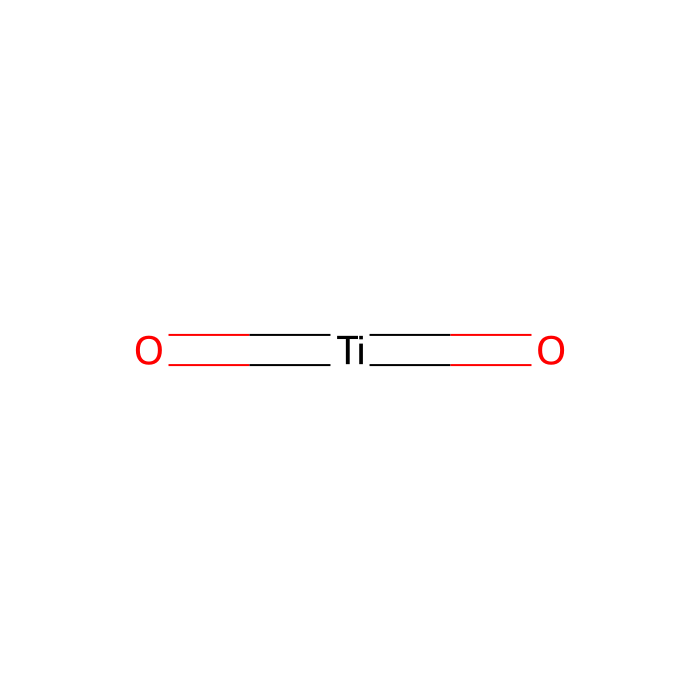
Sourires canoniquesO=[Ti]=O
IUPAC Namedioxotitanium
InChIKeyGWEVSGVZZGPLCZ-UHFFFAOYSA-N
INCHI1S/2O.Ti
Isomères SMILES O=[Ti]=O
Poids moléculaire 79.87

Documentation

📋 Safety Data Sheet (SDS)

Comprehensive hazard, handling, storage, and regulatory compliance document.

Download SDS →

✅ Certificate of Analysis (COA)

Lot-specific quality data. Enter your lot number to retrieve the exact COA.

Look up COA →

📊 Datasheet

Quick-reference summary of product specifications and applications.

View datasheet →

🔬 Specification Sheet

Full quality attributes and acceptance criteria for this grade.

View spec sheet →

Advanced Data

Taxonomic Classification

Taxonomy Tree

KingdomInorganic compounds
SuperclassMixed metal/non-metal compounds
ClasseTransition metal organides
SubclassTransition metal oxides
Intermediate Tree Nodes Not available
Direct ParentTransition metal oxides
Alternative Parents Inorganic salts  Inorganic oxides  
Molecular FrameworkNot available
Substituents Transition metal oxide - Inorganic oxide - Inorganic salt
DescriptionThis compound belongs to the class of inorganic compounds known as transition metal oxides. These are inorganic compounds containing an oxygen atom of an oxidation state of -2, in which the heaviest atom bonded to the oxygen is a transition metal.
External Descriptors titanium molecular entity
Structure 3D
Modèle de structure chimique interactif


Certificats (CoA, COO, BSE/TSE et tableau d'analyse)
C of A & Other Certificates(BSE/TSE, COO):
Analytical Chart:

Find and download the COA for your product by matching the lot number on the packaging.

13 results found

Lot NumberCertificate TypeDateArticle
I2108505Certificate of AnalysisJun 09, 2025 T299267
D2517645Certificate of AnalysisApr 02, 2025 T299267
D2517654Certificate of AnalysisApr 02, 2025 T299267
H2322472Certificate of AnalysisSep 06, 2023 T299267
H2322473Certificate of AnalysisSep 06, 2023 T299267
H2322474Certificate of AnalysisSep 06, 2023 T299267
D2306752Certificate of AnalysisNov 26, 2022 T299267
D2306764Certificate of AnalysisNov 26, 2022 T299267
D2306882Certificate of AnalysisNov 26, 2022 T299267
D2306982Certificate of AnalysisNov 26, 2022 T299267
C2202142Certificate of AnalysisDec 21, 2021 T299267
C2202149Certificate of AnalysisDec 21, 2021 T299267
C2202150Certificate of AnalysisDec 21, 2021 T299267
Propriétés chimiques et physiques
SolubilitéSlightly soluble in hydrofluoric acid and hot concentrated sulfuric acid. Insoluble in water, hydrochloric acid, dilute sulfuric acid, and organic solvents.
Point d'ébullition (°C)2900 °C/1013 hPa
Point de fusion (°C)1855 °C
Poids moléculaire79.866 g/mol
XLogP3
Hydrogen Bond Donor Count0
Hydrogen Bond Acceptor Count2
Rotatable Bond Count0
Exact Mass79.9378 Da
Monoisotopic Mass79.9378 Da
Topological Polar Surface Area34.100 Ų
Heavy Atom Count3
Formal Charge0
Complexity18.300
Isotope Atom Count0
Defined Atom Stereocenter Count0
Undefined Atom Stereocenter Count0
Defined Bond Stereocenter Count0
Undefined Bond Stereocenter Count0
The total count of all stereochemical bonds0
Covalently-Bonded Unit Count1
FAQ et articles
Silicon carbide provides technical solutions for the photovoltaic field
Semiconductor Materials: A Summary of Questions
Structure, Synthesis, and Applications of Barium Titanate – A Closer Look at the Core Dielectric Material in MLCCs
Applications of Nanoclay in Materials and Formulations: Dispersion Mechanisms, Performance Enhancement, and Product Selection
High-Refractive-Index vs Low-Refractive-Index Coating Materials: From AR/Waveguide Principles to a Formulation & Material-Selection Map (Including Product Category Tables A/B/C)
Panorama Guide to Lithium-Ion Battery Electrode Materials: Working Principles, Materials Map, and Selection Navigation (incl. Tables 1–4)
The Complete Guide to UV Absorbers: Definition & Scope, Key Engineering Metrics, Validation Methods, and Selection Navigation (Tables 1–3)
Optical & Optoelectronic Materials Selection Guide:Positioning materials, key metrics, and validation paths along “Generation → Guiding → Control → Readout” (with product navigation and Tables 1–4)
Ceramic Materials Guide: Basic Definitions, Classification Framework, and Research-Task-Oriented Selection (with Product Navigation and Tables 1–4)
Why Metal Nanocatalysts Can “Save Energy Yet Lose Performance Easily”: Durability Logic from Active Sites to Support/Interface Engineering (Including Selection Guide and Product Tables A–D)
Applications of Self-Assembled Monolayers (SAMs), Microcontact Printing, and Soft Lithography in Surface Functionalization and Micro/Nanopatterning
Polyetherimide (PEI): Structural Features, Main Properties, and Typical Application Directions
TCA-KTTS, a Titanate Coupling Agent Suitable for Use in Cosmetics: Basic Information, Application Characteristics, and Differences from 130 and 105
Metal Halide Perovskite Solar Cells: Sources of High Efficiency, Stability Bottlenecks, and Experimental Decision Logic
From Barium Titanate Dielectrics to Multilayer Ceramic Capacitors: Dielectric Properties and Experimental Evaluation of Barium Titanate-Based Ceramics
Application and Selection Guide for Alkyd Resin Coatings: Advantages, Limitations, Formulation Control, and Modification Directions
Four Core Applications of Epoxy Resins: Bonding, Protection, Load-Bearing, and Insulation Protection
Why Fluorocarbon Resins Are Weatherable: Structural Stability, Low Surface Energy, and Coating Film Appearance Retention
Fluorocarbon Resin Coating Formulation Design: Resin Selection, Supporting Systems, and Key Application Control Points
Structure–Property Relationship of Silicone Resins: Mechanisms of Heat Resistance, Weatherability, Hydrophobicity, and Coating Performance Analysis
Silicone Resin Coating Formulation Design: From Application Conditions to Matching Resins, Pigments and Fillers, Curing, and Substrates
Applications and Selection of Acrylic Resins in Coatings: Analysis of Architectural, Industrial, and Supporting Materials
Vinyl Acetate-Acrylic Emulsion (Vinyl Acrylic Emulsion): A Cost-Performance Balance Solution for Architectural Coatings
PVAc, VAE, and Vinyl Acetate-Based Emulsions: Film-Forming Logic and Performance Boundaries in Architectural Coatings
How Should Montmorillonite Be Rationally Modified? Organic Modification, Inorganic Modification, and Application-Oriented Selection and Validation
Epoxy Phenolic Coatings: Why Are They Commonly Used for Chemical Resistance, Solvent Resistance, Heat Resistance, and Internal Metal Surface Protection?
Selection and Formulation Design Guidelines for Phenolic Resins in Coatings: Applicable Scenarios, Application Limitations, and Performance Verification
Application Positioning, Scenario Selection, and Key Use Considerations for Chlorinated Rubber Resin in Coatings
Formulation Design of Chlorinated Rubber Coatings: Component Synergy and Performance Control
What Is Silica Sol: Mechanism of Action, Application Scenarios, and Selection Criteria for Nanosilica Dispersions
Applications and Selection of Polyester Resins in Industrial Coatings: Powder, Coil, Baking, Packaging, and Metal Coating Scenarios
How to Select Vinyl-Related Resins: Building Formulation Judgment Based on Substrate, Performance Targets, and Failure Risks
Applicability Boundaries, Failure Risks, and Alternative System Selection for Chlorinated Rubber Resin in Coatings
Waterborne Resin Application Guide: Formulation Synergy, Troubleshooting, and Technology Development Trends
Mechanisms and Control of Coating Yellowing: From Chromophoric Structure Formation to Source Diagnosis and Formulation Optimization
Resin Polarity in Coating Formulations: From Molecular Structure to Dissolution, Compatibility, Interfacial Interactions, and Formulation Design
Why Do Daily Chemical Products Become Opaque? Formation Mechanisms of Milky Turbidity, Pearlescence, and Coverage, and How to Select the Right Ingredients
Color-Development Mechanisms, Formulation Forms, and Selection/Application Logic of Colorants in Personal Care Products
Analysis of the Production Process of Hydroxypropyl Methylcellulose (HPMC) for Putty: Understanding Differences in Substitution Structure and Gelation Temperature from High-Ratio and Low-Ratio Formulations
Key Variable in the Long-Term Stability of Waterborne Pigment Concentrates: How Dispersant Molecular Weight Distribution (MWD) Affects Pigment Dispersion, Surface Adsorption-Layer Formation, and Storage Stability
Types, Mechanisms of Action, Key Quality Indicators, and Selection and Application of Common Cellulose Ethers in Wall Putty
Influencing Factors and Control Strategies for Blistering in Neutral Wall Putty: An Experimental Analysis Based on HPMC Dosage, Viscosity, and Ground Calcium Carbonate Fineness
How to Select Binding/Gel Materials for Neutral Wall Putty? A Comparison of Pregelatinized Starch, PVA, and Redispersible Polymer Powder Based on Four Application Trials
Causes and Mechanism Analysis of Delamination During Sanding of Water-Resistant Putty
What Are the Differences Between Polyvinyl Alcohol 1788, 2488, and 2699? Understanding Workability, Bonding Strength, and Relative Water Resistance from the Perspective of Degree of Polymerization and Degree of Hydrolysis
Differences and Application Selection of Cassava- and Corn-Based Pregelatinized Starch in Neutral Putty Formulations
The Role, Selection, Cracking Risk Analysis, and Dosage Control of Bentonite in Neutral Putty
Mechanism of Kojic Acid in Reducing Hyperpigmentation: From Tyrosinase Inhibition to Melanin Production Regulation
The Dual-Targeted Skin-Brightening Mechanism of 4-MSK: Inhibiting Melanin Production and Reducing Epidermal Pigment Retention
Molecular Structure, Photochemical Behavior, and Role of Octocrylene in Sunscreen Formulations
UVA Absorption Mechanism of Avobenzone: Keto–Enol Tautomerism, Photochemical Instability, and Formulation Photostabilization Strategies
Anti-Photoaging Potential of Artemia Extract: UV-Induced Damage Cascades, HSP70-Related Stress Protection, and GP4G Metabolic Insights
Mechanism of Action of Tranexamic Acid in Pigmentation Care: From the Plasmin System to Regulation of Inflammation-Driven Pro-Melanogenic Signaling
Citations of This Product
Calculateurs de solution
Avis

Avis des clients

Produits apparentés

Titanium oxide - ≥99.8% metals basis, 30nm,anatase,hydrophilic , CAS No.13463-67-7
Titanium oxide - ≥99.8% metals basis, 100nm,rutile,lipophilic(Before coating) , CAS No.13463-67-7
Titanium oxide, rutile - PrimorTrace™, ≥99.99% metals basis , CAS No.13463-67-7
Titanium dioxide, anatase - ≥99.8% metals basis, <60nm particle size,hydrophilic , CAS No.13463-67-7
Titanium oxide, anatase - ≥99.8% metals basis, nanopowder, 5-10 nm ,hydrophilic , CAS No.13463-67-7
Titanium oxide, rutile - ≥99.8% metals basis, 40 nm particle size,hydrophilic , CAS No.13463-67-7
Titanium oxide - ≥98% metals basis, nanopowder,≤100nm,rutile,hydrophilic , CAS No.13463-67-7
Oxyde de titane - AR, ≥99% , CAS No.13463-67-7
Oxyde de titane(IV) - ≥99,8% base métaux, <40nm taille des particules, hydrophile , CAS No.13463-67-7
Titanium oxide, rutile - ≥99.5% metals basis, powder,<60nm particle size , CAS No.13463-67-7
Titanium dioxide - Ph.Eur., average particle size:0.1-0.3μm , CAS No.13463-67-7
Titanium oxide, anatase - ≥99.8% metals basis , CAS No.13463-67-7
Titanium oxide, rutile - ≥99.8% metals basis, <100 nm particle size, hydrophilic , CAS No.13463-67-7
Titanium(IV) oxide - PrimorTrace™, ≥99.99% metals basis , CAS No.13463-67-7
Titanium oxide - ≥99.8% metals basis, 100-300nm,hydrophilic , CAS No.13463-67-7
Titanium oxide, anatase - ≥99.8% metals basis, 10nm-25 nm particle size,hydrophilic , CAS No.13463-67-7
Titanium oxide, anatase - ≥99.8% metals basis, 100nm ,hydrophilic , CAS No.13463-67-7
Titanium oxide, rutile - ≥99.8% metals basis, nanopowder,
Titanium oxide - ≥99% metals basis, ≤100nm , CAS No.13463-67-7
Titanium oxide - ≥99.8% metals basis, 5 -10nm particle size,hydrophilic/lipophilic , CAS No.13463-67-7
Titanium oxide - ≥99.8% metals basis, 60nm,anatase,lipophilic(stearic acid treatment) , CAS No.13463-67-7
Titanium oxide, rutile - ≥99.8% metals basis, nanopowder, 25 nm particle size, hydrophilic , CAS No.13463-67-7
Titanium(IV) oxide - ≥99% , CAS No.13463-67-7
Titanium oxide - ≥99% metals basis, 100-300nm,hydrophilic,rutile , CAS No.13463-67-7
Titanium(IV) oxide - pellets,diam. × thickness 12.5 mm × 5.5 mm , CAS No.13463-67-7
Titanium(IV) oxide - ≥97%, nanopowder,contains 1% Mn as dopant,<100nm particle size (bET) , CAS No.13463-67-7
Titanium(IV) oxide - PharmPure™, USP, BP, puriss., Ph.Eur., ≥99% , CAS No.13463-67-7
Titanium(IV) oxide, mixture of rutile and anatase - ≥99.5% metals basis, nanopowder,<100nm particle size (bET) , CAS No.13463-67-7
Titanium(IV) oxide - Nanowires, diameter x length~10nm x 10 μ m , CAS No.13463-67-7
Titanium(IV) oxide - nanowires,diam. × L ~100 nm × 10 μm , CAS No.13463-67-7
Titanium(IV) oxide - ≥99.5% metals basis, nanopowder,21nm , CAS No.13463-67-7
Titanium dioxide - nanotubes,25 nm average diameter,powder , CAS No.13463-67-7
Titanium(IV) oxide, mixture of rutile and anatase - ≥99.5% metals basis, Particle size ≤ 150nm,40 wt. % in H2O , CAS No.13463-67-7
Titanium(IV) oxide - PharmPure™,USP,ChP,JP,BP,Ph.Eur. , CAS No.13463-67-7
Titanium dioxide, anatase - PrimorTrace™,≥99.99% metals basis,≤ 50nm, anatase, hydrophilic , CAS No.13463-67-7
Titanium oxide, rutile - ≥99.6% metals basis, 150nm, golden red, oleophilic , CAS No.13463-67-7
Titanium oxide, anatase - ≥99.5% metals basis, ≤ 400nm, anatase, hydrophilic type , CAS No.13463-67-7
Titanium oxide, anatase - ≥99.8% metals basis, ≤ 10nm, anatase, hydrophilic type , CAS No.13463-67-7

Shall we send you a message when we have discounts available?

Remind me later

Thank you! Please check your email inbox to confirm.

Oops! Notifications are disabled.