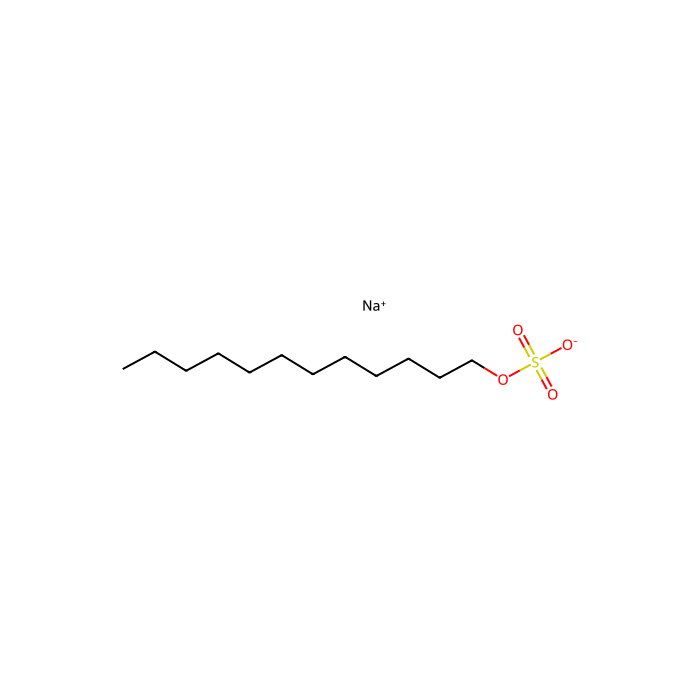
Sodium dodecyl sulfate(SDS) - Ultra pure, ≥99%(GC) , CAS No.151-21-3

CAS: 151-21-3 Cat. No.: S108349 Formula: C₁₂H₂₅NaO₄S Peso molecolare: 288.38 Numero EC: 205-788-1
Disponibile su ordine
QUALITÀ & PUREZZA Ultra pure ? Ultra-pure grade with very low impurity content across the board. Use for trace analysis, electronics, or processes intolerant of contamination. ≥99%(GC)
Synonyms
Monogen Y 100|Cycloryl 21|NALS|Quolac EX-UB|Lauryl sodium sulfate|sodiumdodecylsulfate|Conco Sulfate WAS|Duponol|Perlandrol L|Sipon PD|Solsol needles|Stepanol methyl dry aw|Maprofix WAC-LA|Duponol WAQE|Gardinol|Maprofix NEU|Stepanol waq|Duponal|Sinnopon LS 100|Sipex sb|SODIUM LAURYL SULFATE|Empicol LX 28|Cycloryl 580|Melanol CL 30|Richonol C|Sipex UB|Sodium monolauryl sulfate|Stepanol WA-100|Maprofix 563|Conco sulfate WA|Maprofix LK|Sulfuric acid monododecyl ester sodium salt|Carsonol SLS Special|Duponol WA|Emersal 6400|Lauryl sulfate sodium salt|n-Dodecyl sulfate sodium|Richonol A|Sodium dodecyl sulfate|Sodium lauryl sulphate|Standapol 112 conc|Irium|Neutrazyme|Stepanol T 28|Aquarex ME|Empicol LS 30|Sipon LS 100|Steinapol NLS 90|Duponal WAQE|Standapol WAQ|Anticerumen|Hexamol SLS|Conco Sulfate WAN|Dodecyl sodium sulfate|Duponol Me|Duponol waqa|Sodium dodecylsulfate|Lauyl sodium sulfate|Sintapon L|sodium;dodecyl sulfate|Carsonol SLS|Orvus WA Paste|Sipex SP|Stepanol WA|Stepanol wac|Duponol WAQM|Sipex sd|Sterling wa paste|Dodecyl sulfate, sodium salt|Sodium laurilsulfate|Sterling WAQ-CH|Aquarex methyl|Nikkol SLS|Standapol was 100|Avirol 101|Duponol QC|Berol 452|Detergent 66|Sipon WD|Stepanol me dry|Stepanol ME Dry AW|Standapol waq special|Carsonol SLS Paste B|Conco Sulfate WAG|Conco sulfate WN|Sipon LSB|Akyposal SDS|Cycloryl 31|Sodium monododecyl sulfate|Duponol qx|Maprofix WAC|Melanol CL|Perlankrol L|Duponol WA dry|Montopol La Paste|Standapol wa-ac|Avirol 118 conc|Dreft|Dupanol WAQ|Empicol LPZ|Maprobix NEU|Sodium dodecyl sulphate|Monododecyl sodium sulfate|Sinnopon LS 95|Sipex OP|Stepanol ME|Dodecyl sulfate sodium salt|Stepanol WA Paste|Duponol methyl|Sodiumlauryl ether sulfate|Cycloryl 585N|EMAL O|Richonol af
Storage
Room temperature,Argon charged,Desiccated
Shipped In
Normal
★
Dimensione
Germania (EU)
USA*
Prezzo
Qtà
5g
S108349-5g
—
Disponibile ≥10
8,59€
25g
S108349-25g
—
4 Disponibile
25,95€
100g
S108349-100g
—
4 Disponibile
72,80€
500g
S108349-500g
—
5 Disponibile
255,03€
Enter a quantity for the sizes you want to add.

Panoramica

Sodium dodecyl sulfate (SDS), also known as sodium lauryl sulfate, is a versatile anionic surfactant with a broad range of applications in cell biology, biochemistry, and various industries. Its amphiphilic nature, characterized by a hydrophobic hydrocarbon tail and a hydrophilic sulfate head group, makes it an effective detergent capable of solubilizing and denaturing proteins, lipids, and other hydrophobic molecules.
In protein biochemistry, SDS plays a pivotal role in protein extraction and SDS-PAGE (sodium dodecyl sulfate-polyacrylamide gel electrophoresis). Its ability to denature proteins by disrupting their secondary and tertiary structures allows for their uniform migration through a polyacrylamide gel matrix based on their molecular weight. This technique, SDS-PAGE, has become an indispensable tool for analyzing protein size and purity.
Beyond protein analysis, SDS also finds applications in nucleic acid extraction and hybridization techniques. Its detergent properties aid in the lysis of cells and the solubilization of cellular components, facilitating the extraction of DNA and RNA. This makes SDS a valuable reagent in various molecular biology protocols, including PCR (polymerase chain reaction) and Southern blotting. Sodium dodecyl sulfate stands as a versatile and widely used surfactant with a diverse range of applications due to its ability to solubilize, denature, and separate biological molecules for cell biology and biochemical research.

Specifiche

Sinonimi
Monogen Y 100 | Cycloryl 21 | NALS | Quolac EX-UB | Lauryl sodium sulfate | sodiumdodecylsulfate | Conco Sulfate WAS | Duponol | Perlandrol L | Sipon PD | Solsol needles | Stepanol methyl dry aw | Maprofix WAC-LA | Duponol WAQE | Gardinol | Maprofix NEU | Stepanol waq | Duponal | Sinnopon LS 100 | Sipex sb | SODIUM LAURYL SULFATE | Empico Mostra altro
Specifiche e purezza
Ultra pure, ≥99%(GC)
Meccanismi biochimici e fisiologici
Sodium dodecyl sulfate (SDS) is an anionic detergent that can form complexes with proteins through hydrophobic interactions. Previous studies have reported that the hydrodynamic function of protein SDS complexes is controlled by the length of their polypeptide chains. Therefore, SDS based electrophoresis technology can separate protein molecules based on their molecular weight. In addition, SDS can also dissolve cell membranes and extract membrane binding proteins.
Condizioni di conservazione di stoccaggio
Room temperature,Argon charged,Desiccated
Spedito in
Normal
Grado
Ultra pure
Purezza
≥99%(GC)
Nomi e identificatori
Pubchem Sid
Pubchem Sid Url
https://pubchem.ncbi.nlm.nih.gov/substance/488194393
SMILES
[Na+].CCCCCCCCCCCCOS([O-])(=O)=O
IUPAC Name
sodium;dodecyl sulfate
InChIKey
DBMJMQXJHONAFJ-UHFFFAOYSA-M
InChI
1S/C12H26O4S.Na/c1-2-3-4-5-6-7-8-9-10-11-12-16-17(13,14)15;/h2-12H2,1H3,(H,13,14,15);/q;+1/p-1
Isomeri SMILES
CCCCCCCCCCCCOS(=O)(=O)[O-].[Na+]
Numero UN
1325
Gruppo di imballaggio
III
Peso molecolare
288.38

Dati avanzati

Taxonomic Classification

Taxonomy Tree

KingdomOrganic compounds
SuperclassOrganic acids and derivatives
ClasseOrganic sulfuric acids and derivatives
SubclassSulfuric acid esters
Intermediate Tree Nodes Not available
Direct ParentSulfuric acid monoesters
Alternative Parents Alkyl sulfates  Organooxygen compounds  Organic sodium salts  Organic oxides  Hydrocarbon derivatives  
Molecular FrameworkAliphatic acyclic compounds
Substituents Alkyl sulfate - Sulfate-ester - Sulfuric acid monoester - Organic alkali metal salt - Organic oxygen compound - Organic oxide - Hydrocarbon derivative - Organic sodium salt - Organic salt - Organooxygen compound - Aliphatic acyclic compound
DescrizioneThis compound belongs to the class of organic compounds known as sulfuric acid monoesters. These are organic compounds containing the sulfuric acid monoester functional group, with the generic structure ROS(O)(=O)=O, (R=organyl group).
External Descriptors alkyl sulfate
Struttura 3D
Modello di struttura chimica interattiva


Obiettivi associati (umani)
VDR Tclin Vitamin D receptor (26531 Activities)
Activity TypeRelationActivity valueUnitsAction TypeJournalPubMed IddoiAssay Aladdin ID
TSHR Tclin Thyroid stimulating hormone receptor (29986 Activities)
Activity TypeRelationActivity valueUnitsAction TypeJournalPubMed IddoiAssay Aladdin ID
PPARG Tclin Peroxisome proliferator-activated receptor gamma (15191 Activities)
Activity TypeRelationActivity valueUnitsAction TypeJournalPubMed IddoiAssay Aladdin ID
PPARA Tclin Peroxisome proliferator-activated receptor alpha (9197 Activities)
Activity TypeRelationActivity valueUnitsAction TypeJournalPubMed IddoiAssay Aladdin ID
THRB Tclin Thyroid hormone receptor beta-1 (7926 Activities)
Activity TypeRelationActivity valueUnitsAction TypeJournalPubMed IddoiAssay Aladdin ID
CXCL8 Tchem Interleukin-8 (642 Activities)
Activity TypeRelationActivity valueUnitsAction TypeJournalPubMed IddoiAssay Aladdin ID
GLA Tclin Alpha-galactosidase A (5444 Activities)
Activity TypeRelationActivity valueUnitsAction TypeJournalPubMed IddoiAssay Aladdin ID
NR1H4 Tclin Bile acid receptor FXR (6228 Activities)
Activity TypeRelationActivity valueUnitsAction TypeJournalPubMed IddoiAssay Aladdin ID
EPHX2 Tchem Epoxide hydratase (3844 Activities)
Activity TypeRelationActivity valueUnitsAction TypeJournalPubMed IddoiAssay Aladdin ID
AKT1 Tchem Serine/threonine-protein kinase AKT (9192 Activities)
Activity TypeRelationActivity valueUnitsAction TypeJournalPubMed IddoiAssay Aladdin ID
Homo sapiens (32628 Activities)
Activity TypeRelationActivity valueUnitsAction TypeJournalPubMed IddoiAssay Aladdin ID
HCT-116 (91556 Activities)
Activity TypeRelationActivity valueUnitsAction TypeJournalPubMed IddoiAssay Aladdin ID
Lymphoblastoid cell (5959 Activities)
Activity TypeRelationActivity valueUnitsAction TypeJournalPubMed IddoiAssay Aladdin ID
LMNA Tbio Prelamin-A/C (36751 Activities)
Activity TypeRelationActivity valueUnitsAction TypeJournalPubMed IddoiAssay Aladdin ID
RECQL Tbio ATP-dependent DNA helicase Q1 (5575 Activities)
Activity TypeRelationActivity valueUnitsAction TypeJournalPubMed IddoiAssay Aladdin ID
HPGD Tchem 15-hydroxyprostaglandin dehydrogenase [NAD+] (24926 Activities)
Activity TypeRelationActivity valueUnitsAction TypeJournalPubMed IddoiAssay Aladdin ID
GMNN Tbio Geminin (128009 Activities)
Activity TypeRelationActivity valueUnitsAction TypeJournalPubMed IddoiAssay Aladdin ID
USP1 Tchem Ubiquitin carboxyl-terminal hydrolase 1 (22556 Activities)
Activity TypeRelationActivity valueUnitsAction TypeJournalPubMed IddoiAssay Aladdin ID
Obiettivi associati (non umani)
Cruzipain (33337 Activities)
Activity TypeRelationActivity valueUnitsAction TypeJournalPubMed IddoiAssay Aladdin ID
Mapk1 MAP kinase ERK2 (650 Activities)
Activity TypeRelationActivity valueUnitsAction TypeJournalPubMed IddoiAssay Aladdin ID
Pseudomonas aeruginosa (123386 Activities)
Activity TypeRelationActivity valueUnitsAction TypeJournalPubMed IddoiAssay Aladdin ID
Enterobacter cloacae (7976 Activities)
Activity TypeRelationActivity valueUnitsAction TypeJournalPubMed IddoiAssay Aladdin ID
Staphylococcus aureus (210822 Activities)
Activity TypeRelationActivity valueUnitsAction TypeJournalPubMed IddoiAssay Aladdin ID
Acinetobacter baumannii (41033 Activities)
Activity TypeRelationActivity valueUnitsAction TypeJournalPubMed IddoiAssay Aladdin ID
Escherichia coli (133304 Activities)
Activity TypeRelationActivity valueUnitsAction TypeJournalPubMed IddoiAssay Aladdin ID
Proteus mirabilis (3894 Activities)
Activity TypeRelationActivity valueUnitsAction TypeJournalPubMed IddoiAssay Aladdin ID
Mycobacterium tuberculosis (203094 Activities)
Activity TypeRelationActivity valueUnitsAction TypeJournalPubMed IddoiAssay Aladdin ID
Enterococcus faecalis (29875 Activities)
Activity TypeRelationActivity valueUnitsAction TypeJournalPubMed IddoiAssay Aladdin ID
Candida albicans (78123 Activities)
Activity TypeRelationActivity valueUnitsAction TypeJournalPubMed IddoiAssay Aladdin ID
Nakaseomyces glabratus (9108 Activities)
Activity TypeRelationActivity valueUnitsAction TypeJournalPubMed IddoiAssay Aladdin ID
Candida parapsilosis (8521 Activities)
Activity TypeRelationActivity valueUnitsAction TypeJournalPubMed IddoiAssay Aladdin ID
Rattus norvegicus (775804 Activities)
Activity TypeRelationActivity valueUnitsAction TypeJournalPubMed IddoiAssay Aladdin ID
RAW264.7 (28094 Activities)
Activity TypeRelationActivity valueUnitsAction TypeJournalPubMed IddoiAssay Aladdin ID
lef Anthrax lethal factor (7585 Activities)
Activity TypeRelationActivity valueUnitsAction TypeJournalPubMed IddoiAssay Aladdin ID
GCN5 Histone acetyltransferase GCN5 (89 Activities)
Activity TypeRelationActivity valueUnitsAction TypeJournalPubMed IddoiAssay Aladdin ID
Luciferin 4-monooxygenase (66902 Activities)
Activity TypeRelationActivity valueUnitsAction TypeJournalPubMed IddoiAssay Aladdin ID
Nfe2l2 Nuclear factor erythroid 2-related factor 2 (214 Activities)
Activity TypeRelationActivity valueUnitsAction TypeJournalPubMed IddoiAssay Aladdin ID
Meccanismi d'azione
Certificati (CoA, COO, BSE/TSE e tabella di analisi)
C of A & Other Certificates(BSE/TSE, COO):
Analytical Chart:

Find and download the COA for your product by matching the lot number on the packaging.

58 results found

Lot NumberCertificate TypeDataOggetto
K2225821K2225821Certificate of AnalysisSep 04, 2026 S108349
K2225790K2225790Certificate of AnalysisSep 04, 2026 S108349
G2606475G2606475Certificate of AnalysisJun 22, 2026 S108349
G2606476G2606476Certificate of AnalysisJun 22, 2026 S108349
G2606477G2606477Certificate of AnalysisJun 22, 2026 S108349
G2606478G2606478Certificate of AnalysisJun 22, 2026 S108349
H2611289H2611289Certificate of AnalysisJun 22, 2026 S108349
H2611296H2611296Certificate of AnalysisJun 22, 2026 S108349
H2611301H2611301Certificate of AnalysisJun 22, 2026 S108349
I2607743I2607743Certificate of AnalysisJun 22, 2026 S108349
H2611324H2611324Certificate of AnalysisJun 22, 2026 S108349
I2607727I2607727Certificate of AnalysisJun 22, 2026 S108349
I2607742I2607742Certificate of AnalysisJun 22, 2026 S108349
I2607741I2607741Certificate of AnalysisJun 22, 2026 S108349
E2613480E2613480Certificate of AnalysisJan 12, 2026 S108349
E2613479E2613479Certificate of AnalysisJan 12, 2026 S108349
C2609519C2609519Certificate of AnalysisJan 06, 2026 S108349
C2609492C2609492Certificate of AnalysisJan 06, 2026 S108349
A2620617A2620617Certificate of AnalysisJan 06, 2026 S108349
A2620601A2620601Certificate of AnalysisJan 06, 2026 S108349
A2620600A2620600Certificate of AnalysisJan 06, 2026 S108349
L2526396L2526396Certificate of AnalysisDec 06, 2025 S108349
L2522550L2522550Certificate of AnalysisDec 06, 2025 S108349
L2522558L2522558Certificate of AnalysisDec 06, 2025 S108349
A2604533A2604533Certificate of AnalysisDec 03, 2025 S108349
G2522482G2522482Certificate of AnalysisJun 20, 2025 S108349
G2522384G2522384Certificate of AnalysisJun 20, 2025 S108349
G2522483G2522483Certificate of AnalysisJun 20, 2025 S108349
K2510133K2510133Certificate of AnalysisJun 20, 2025 S108349
K2510122K2510122Certificate of AnalysisJun 20, 2025 S108349
F2530258F2530258Certificate of AnalysisJun 20, 2025 S108349
F2530257F2530257Certificate of AnalysisJun 20, 2025 S108349
F2530226F2530226Certificate of AnalysisJun 20, 2025 S108349
F2530225F2530225Certificate of AnalysisJun 20, 2025 S108349
I2503007I2503007Certificate of AnalysisJun 20, 2025 S108349
G2515576G2515576Certificate of AnalysisJun 04, 2025 S108349
B2521571B2521571Certificate of AnalysisJan 10, 2025 S108349
B2521580B2521580Certificate of AnalysisJan 10, 2025 S108349
G2321134G2321134Certificate of AnalysisJul 26, 2023 S108349
J2317122J2317122Certificate of AnalysisJul 26, 2023 S108349
C2425080C2425080Certificate of AnalysisSep 16, 2022 S108349
B2420067B2420067Certificate of AnalysisSep 16, 2022 S108349
K2303187K2303187Certificate of AnalysisSep 16, 2022 S108349
J2225010J2225010Certificate of AnalysisSep 16, 2022 S108349
J2225009J2225009Certificate of AnalysisSep 16, 2022 S108349
J2225008J2225008Certificate of AnalysisSep 16, 2022 S108349
J2222495J2222495Certificate of AnalysisSep 16, 2022 S108349
J2222488J2222488Certificate of AnalysisSep 16, 2022 S108349
E2304422E2304422Certificate of AnalysisSep 16, 2022 S108349
F2418092F2418092Certificate of AnalysisSep 16, 2022 S108349
F2418093F2418093Certificate of AnalysisSep 16, 2022 S108349
H2223042H2223042Certificate of AnalysisAug 31, 2022 S108349
K2225789K2225789Certificate of AnalysisAug 25, 2022 S108349
F2418119F2418119Certificate of AnalysisAug 25, 2022 S108349
K2225791K2225791Certificate of AnalysisAug 25, 2022 S108349
K2225818K2225818Certificate of AnalysisAug 25, 2022 S108349
L2406290L2406290Certificate of AnalysisAug 25, 2022 S108349
H2210055H2210055Certificate of AnalysisAug 20, 2022 S108349
Proprietà chimiche e fisiche
SolubilitàSoluble in water, slightly soluble in alcohol, insoluble in chloroform and ether.
SensibilitàMoisture and Air sensitive
Punto di fusione (°C)204-207°C
Peso molecolare288.38
XLogP3
Hydrogen Bond Donor Count0
Hydrogen Bond Acceptor Count4
Rotatable Bond Count12
Exact Mass288.137 Da
Monoisotopic Mass288.137 Da
Topological Polar Surface Area74.800 Ų
Heavy Atom Count18
Formal Charge0
Complexity249.000
Isotope Atom Count0
Defined Atom Stereocenter Count0
Undefined Atom Stereocenter Count0
Defined Bond Stereocenter Count0
Undefined Bond Stereocenter Count0
The total count of all stereochemical bonds0
Covalently-Bonded Unit Count2
Sicurezza e pericoli (GHS)
Pictogrammi
GHS02,   GHS05,   GHS07
Segnale
Danger
Indicazioni di pericolo

H228:Flammable solid

H302:Harmful if swallowed

H315:Causes skin irritation

H319:Causes serious eye irritation

H335:May cause respiratory irritation

H411:Toxic to aquatic life with long lasting effects

Precauzioni

P210:Keep away from heat, hot surface, sparks, open flames and other ignition sources. - No smoking.

P240:Ground/bond container and receiving equipment.

P241:Use explosion-proof [electrical/ventilating/lighting/.../] equipment.

P261:Avoid breathing dust/fume/gas/mist/vapors/spray.

P264:Wash hands [and …] thoroughly after handling.

P270:Do not eat, drink or smoke when using this product.

P271:Use only outdoors or in a well-ventilated area.

P273:Avoid release to the environment.

P280:Wear protective gloves/protective clothing/eye protection/face protection.

P391:Collect spillage.

P305+P351+P338:IF IN EYES: Rinse cautiously with water for several minutes. Remove contact lenses if present and easy to do - continue rinsing.

P332+P313:IF SKIN irritation occurs: Get medical advice/attention.

P337+P313:IF eye irritation persists: Get medical advice/attention.

P361+P364:Take off immediately all contaminated clothing and wash it before reuse.

P370+P378:In case of fire: Use ... to extinguish.

P405:Store locked up.

P403+P233:Store in a well-ventilated place. Keep container tightly closed.

P501:Dispose of contents/container to an approved waste disposal plant.

P302+P352+P312:IF ON SKIN: Wash with plenty of water.Call a POISON CENTER/ doctor if you feel unwell.

P301+P312+P330:IF SWALLOWED: Call a POISON CENTER/ doctor if you feel unwell. Rinse mouth.

P304+P340+P312:IF INHALED: Remove person to fresh air and keep comfortable for breathing.Call a POISON CENTER or doctor. if you feel unwell.

Classe
4.1
Indice Merck
8636
Domande frequenti e articoli
Nucleic Acid Electrophoresis Workflow—5 Main Steps
Aladdin@Guidelines for the formulation of commonly used buffers for biological experiments
In Situ Hybridization (ISH) Protocol
The Head–Tail Logic of Sodium Dodecyl Sulfate: From Micelles to Biochemical Applications
Buffer exchange of a sample using a dialysis bag
Common Questions and Answers for SDS-PAGE Experiments
Common Questions and Answers for Protein Marker Products — Membrane Transfer
Standard Operating Procedure (SOP) for Bis-Tris Polyacrylamide Gel Electrophoresis (SDS-PAGE)
Protein Tris-Acetate Electrophoresis System Standard Operating Procedure
Buffer Additives to Prevent Protein Precipitation
Standard Operating Procedure (SOP) for the Protein Tris–Glycine Electrophoresis System
Protein Tris-Tricine Electrophoresis System Standard Operating Procedure
Common Protein Gel Staining Methods
Eight Common Lysis Buffers
11 Common Methods for Protein Concentration Determination
Differences Among Antibodies for WB/FC/IP/ChIP/IF/IHC
GST-Tagged Protein Purification
How to Choose a Hydrogen Evolution (HER) Catalyst: Kinetic Barriers in Water Electrolysis, AWE/PEM/AEM Pathways, and a Materials-Family Roadmap (with a Product Map)
RNA Pull-Down Standard Operating Procedure (SOP)
DNA Pull-Down Standard Operating Procedure (SOP)
A Complete Guide to Ion-Pair Reversed-Phase Chromatography (IPC / IP-RP): Mechanisms, Four Tuning Knobs, Troubleshooting, and Ion-Pair Reagent Families (Tables 1–4)
Electrophoretic Mobility Shift Assay (EMSA) Standard Operating Procedure (SOP)
A Panoramic Guide to Surfactants: Definitions & Mechanisms, Key Metrics, Application Scenarios, and Selection Navigation (Tables 1–3)
A Practical Guide to Small-Molecule Chemical Probes: Concept Clarification, Causal Validation, and Experimental Selection (with Product Navigation and Tables A–D)
Practical Guide to Carbon Nanotube (CNT) Dispersion: Three Key Knobs, SOP, and Selection Roadmap (Tables A–F)
A Review of Ten Commonly Used Techniques for Detection, Quantification, and Interaction Analysis in Nucleic Acid Research
Protein Tags Demystified: Classification, Properties, and Suitable Experimental Applications
Proteinase K: Frequently Asked Questions
Plant Omics Panorama: Workflow Frameworks and Multi-Omics Integration from Genomics to Transcriptomics, Proteomics, and Metabolomics
Deoxyribonuclease (DNase): DNA Hydrolytic Cleavage Properties, Methodological Value, and Multi-Context Applications
Chymosin: A Review of Molecular Features, Coagulation Kinetics, and Activity Evaluation
Micrococcal Nuclease (MNase): A Technical Review of Enzymatic Properties, Reaction Control, and Research and Biomanufacturing Applications
Interleukin-29 (IL-29/IFN-λ1): Molecular Features, Signaling Networks, and a Systematic Framework for Research Applications
Whey Protein: Composition Profile, Manufacturing Routes, and Key Product-Type Essentials
dsDNase-Mediated Hydrolysis of Double-Stranded DNA: Enzymatic Characteristics, Methodological Strategies, and Bioanalytical Applications
Review of Chymotrypsin: Enzymological Properties, Catalytic Mechanism, and Research Applications
Clostridial Proteases: Classification, Molecular Mechanisms, and Research Applications
Methodological Studies on Glycoprotein Structural Characterization and Quality Attribute Analysis
Research Framework for Multi-Enzyme Digestion Strategies and Optimization of Proteomic Coverage
Significance of CK, CK-MB, and CK-MM Testing in the Interpretation of Tissue Injury
Application Comparison of the Neutral Red Assay and the MTT/CCK-8 Assays in Cytotoxicity Testing
Preparation Methods and Precautions for Silane Coupling Agent Primer Solutions
Structural and Performance Design of Acrylic Resins for Coatings: Monomer Composition, Key Parameters, and Film Formation/Curing Mechanisms
From Natural Cellulose to Nanocrystals: Structural Characteristics, Application Directions, and Industrialization Challenges of CNC
Potassium Fatty Acid Soaps: Structure and Formulation Applications—Production Processes, Alkalinity, Foam Control, and Low-Foam Cleaning
Causes, Diagnosis, and Control Strategies for Elevated Off-State Current in Semiconducting Single-Walled Carbon Nanotube Transistors
PVAc, VAE, and Vinyl Acetate-Based Emulsions: Film-Forming Logic and Performance Boundaries in Architectural Coatings
Waterborne Resin Technology Explained: Waterborne Forms, Performance Balance, and a Technology Map
Waterborne Resin Application Guide: Formulation Synergy, Troubleshooting, and Technology Development Trends
Resin Polarity in Coating Formulations: From Molecular Structure to Dissolution, Compatibility, Interfacial Interactions, and Formulation Design
Why LABSA (Sulfonic Acid) Is Commonly Used in Household Cleaning Formulations: Neutralization Mechanism, Detergency Action, and Formulation Application Points
Application of Fatty Acid Methyl Ester Sulfonate (MES) in Household Detergent and Cleaning Formulations: Detergency, Hard-Water Tolerance, and Selection Criteria
How Alkyl Polyglucosides (APG) Differ from Cocamidopropyl Betaine (CAPB): Structure, Foam Performance, and Applications in Personal Care and Household-Care Formulations
K12 (Sodium Lauryl Sulfate/SLS) Is More Than a Foaming Agent: Structure, Properties, and Applications in Personal Care and Household Care Formulations
From Structure to Rheology: How Carbomer Forms Gel Structures and Enables Thickening, Suspension, and Auxiliary Emulsion Stabilization
What Is the Difference Between Triethanolamine and Diethanolamine: Understanding Their Formulation Functions, Application Differences, and Selection Logic from a Molecular-Structure Perspective
Thickening, Suspension, Auxiliary Stabilization, and Agglomeration Mechanisms of Xanthan Gum in Personal Care Formulations: From Molecular Structure to Processing Applications
Why Can 6501 (Cocamide DEA) Stabilize Foam and Build Viscosity? Structural Mechanism, 1:1/1:1.5 Differences, and Application Selection
Differences, Functions, and Selection Guidelines for Sodium Hydroxide Flakes, Granules, Liquid Caustic Soda, and Caustic Soda in Household and Personal Care Product Manufacturing: The Functional and Application Logic of Sodium Hydroxide
Role of Alkyl Glucosides APG in Cleaning Formulations: Structural Features, Core Performance, and Selection Considerations
AES (Fatty Alcohol Polyoxyethylene Ether Sulfate) in Personal and Home-Care Cleansing Formulations: An Analysis of Structure, Performance, and Low-Temperature Flowability
Why Limonene Can Soften Greasy Soils Yet Is Difficult to Dissolve in Water: Understanding the Cleaning Mechanism and Formulation Applications of Naturally Derived Solvents from Molecular Structure
Degreasing Agents from a Molecular-Structure Perspective: How AEO, APG, and Related Surfactants Can Replace Nonylphenol Ethoxylates (NPE)
Understanding CAPB from Its Structure: How Cocamidopropyl Betaine Improves Foam, Enhances Mildness, and Supports Thickening
Interfacial Mechanism and Formulation Applications of AEO-9 (Fatty Alcohol Polyoxyethylene Ether): An Analysis of Emulsification, Wetting, Oil Soil Removal, and Co-Formulation Compatibility
More Than a pH Adjuster: Mechanisms, Selection Logic, and Alternative Acid Source Analysis of Citric Acid in Home-Care Cleaning
Wetting and Penetration Mechanisms of Penetrating Agents in Household and Personal Care Cleaning Systems: Representative Structural Analysis Using JFC, OEP-70, and DOSS as Examples
What Are the Differences Among Sodium Dodecylbenzenesulfonate/SDBS, LAS, and Sodium α-Olefin Sulfonate/AOS: A Comparative Overview of Synthesis, Structure, Mechanism of Action, and Formulation Selection
From Structure to Selection: Mechanisms and Application Assessment of Low-Foam Oil and Wax Removal with Fatty Acid Methyl Ester Ethoxylates (FMEE)
Sodium Metasilicate in Cleaning Applications: Hydration-Form Differences, Mechanisms of Action, and Selection Logic
Analysis of the Foaming Performance Differences Between K12 and AOS: Structure, Acid–Base Stability, and Formulation Selection
Understanding Anionic Surfactants in Household and Personal-Care Formulations from a Structural Perspective: Structural and Performance Differences among Representative Raw Materials such as LAS, AES, K12, AOS, MES, and FMES
Structural Characteristics, Low-Temperature Flowability, and Home-Care Cleaning Applications of Palm-Derived Isomeric Alcohol Polyoxyethylene Ether PLE-S9
The Structural Logic of Amphoteric Surfactants: Representative Ingredients, Performance Mechanisms, and Formulation Applications in Personal Care and Home Care
Mechanisms and Troubleshooting of Foam Reduction in Personal and Household Care Formulations: Film Rupture, Weak Interfacial Films, Insufficient Surfactant Supply, and Phase-State Disturbance
Why Are Daily Chemical Products Prone to Viscosity Thinning in Summer? Core Mechanisms, Troubleshooting Methods, and Solutions
Application of Conductive Carbon Black in Coatings: Selection Criteria, Dispersion Control, and Conductive Network Construction
Key Variable in the Long-Term Stability of Waterborne Pigment Concentrates: How Dispersant Molecular Weight Distribution (MWD) Affects Pigment Dispersion, Surface Adsorption-Layer Formation, and Storage Stability
Understanding the Four Classes of Surfactants Through Molecular Charge: Application Logic of Anionic, Cationic, Amphoteric and Zwitterionic, and Nonionic Surfactants in Personal Care and Home Care
Bacterial Cell Wall Degradation Technology
Probiotics, Prebiotics, and Postbiotics in Skin Care: Conceptual Distinctions, Mechanisms of Action, and Their Applications in the Care of Dry, Itchy, and Rough Skin
Protective and Potential Reparative Mechanisms of Prinsepia utilis Seed Oil on the Skin Barrier: Fatty Acid Composition, Epidermal Lipid Metabolism, and Research Evidence
Mechanism of Action of Porous Silica in Oil-Control Loose Powder: Pore Structure, Capillary Imbibition, and Surface Modification
Structure, Stratum Corneum Distribution, and Stratum Corneum Conditioning Mechanism of Capryloyl Salicylic Acid: Barrier Effects and Safety Evaluation
Gentiana Root Extract and Gentiopicroside: Chemical Composition, Antioxidant and Inflammation-Modulating Mechanisms, and Their Potential Effects on Skin Barrier Homeostasis
Mechanisms by Which Fructan-Rich Ophiopogon japonicus Tuberous Root Extract Supports Skin Moisturization and Barrier Function
Phase-Partitioning Principles, System Differences, and Application Selection in Phenol-Based DNA and RNA Extraction
What Is “Plant Collagen”? Distinguishing Ingredient Types, Structural Differences, Production Methods, and Skincare Effects
What Is Direct Compression? Process Characteristics, Suitability Criteria, and Excipient Selection
Differences Between Animal-Derived Collagen and Recombinant Collagen in Skincare: Sequence and Structure, Safety, Skin Effects, and Evidence Evaluation
Stratum Corneum Penetration and Skin Mechanisms of Panthenol: Moisturization, Barrier Repair, and Soothing Effects
Citations of This Product
Calcolatori di soluzioni
Recensioni

Recensioni dei clienti

Hai bisogno di aiuto per scegliere la qualità?

La nostra guida alla selezione delle qualità copre purezza, stato dello stabilizzatore e idoneità all'applicazione per tutte le varianti del nostro catalogo.

Visualizza la guida alle qualità Ultra pure →

Desidera che le inviamo un messaggio quando avremo sconti disponibili?

Ricordamelo più tardi

Grazie! Controlli la sua casella di posta per confermare.

Ops! Le notifiche sono disabilitate.