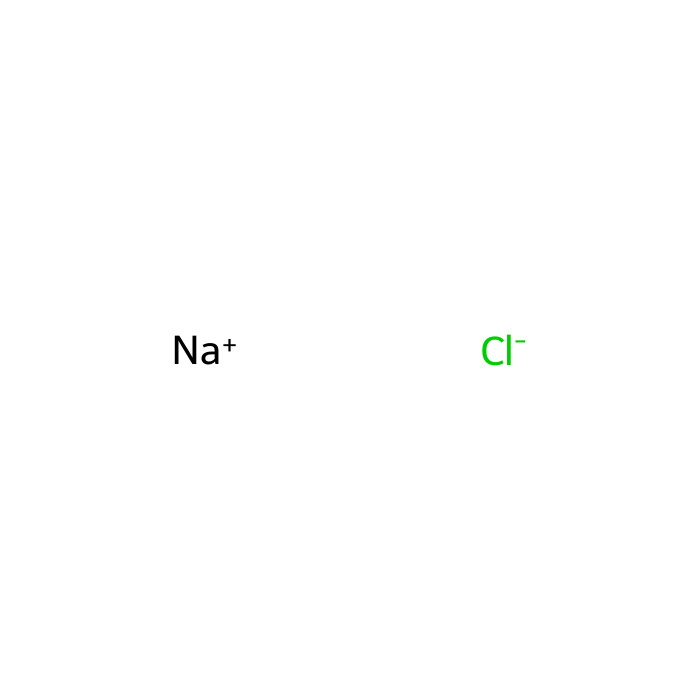
Sodium chloride - HPLC grade, ≥99.5%(AT) , CAS No.7647-14-5

CAS: 7647-14-5 Cat. No.: C111541 Fórmula: NaCl Peso molecular: 58.44 Beilstein Registry Number: 3534976 Número CE: 231-598-3
Disponível para encomenda
GRADE & PURITY HPLC grade ? HPLC grade — purity and low UV-absorbing impurities suited to liquid chromatography. Use as the everyday solvent/reagent for routine HPLC. ≥99.5%(AT)
Synonyms
Sea water | Sodium chloride (NaCl) | Entsol | Natriumchlorid [German] | Cleanoz | Halite | Sodium chloric | Sodium chloride [USP:JAN] | Sodium-36 chloride | Saline Mist | Top flake | CCRIS 982 | Purex | Sodium chloride 0.9% in sterile plastic container |
Storage
Room temperature
Shipped In
Normal
★
Size
Alemanha (EU)
USA*
Price
Qty
250g
C111541-250g
—
3 Em stock
23,34€
Enter a quantity for the sizes you want to add.
🧪
Why this grade

HPLC grade, ≥99.5%(AT) HPLC grade for sensitive chromatographic and analytical workflows requiring minimal baseline interference.

🌡

Storage & shipping

Room temperature Ships Normal Check lot-specific COA for exact specifications.

📋

Quality documents

SDS, COA, datasheet, and spec sheet available for download. Lot-specific COA accessible via lot number lookup.

📚

Literature proof

Cited in 6701 peer-reviewed publications across chromatography, organic synthesis, and cross-coupling reactions.

Specifications

Sinónimos
Sea water | Sodium chloride (NaCl) | Entsol | Natriumchlorid [German] | Cleanoz | Halite | Sodium chloric | Sodium chloride [USP:JAN] | Sodium-36 chloride | Saline Mist | Top flake | CCRIS 982 | Purex | Sodium chloride 0.9% in sterile plastic container |
Especificações e pureza
HPLC grade, ≥99.5%(AT)
Condições de armazenamento de armazenamento
Room temperature
Enviado em
Normal
Grau
HPLC grade
Pureza
≥99.5%(AT)
Nomes e identificadores
Pubchem Sid
Pubchem Sid Url
https://pubchem.ncbi.nlm.nih.gov/substance/508814256
Sorrisos canónicos
[Na+].[Cl-]
IUPAC Name
sodium;chloride
InChIKey
FAPWRFPIFSIZLT-UHFFFAOYSA-M
INCHI
1S/ClH.Na/h1H;/q;+1/p-1
SMILES isoméricas
[Na+].[Cl-]
WGK Alemanha
1
RTECS
VZ4725000
Peso molecular
58.44
Beilstein
3534976

Documentation

📋 Safety Data Sheet (SDS)

Comprehensive hazard, handling, storage, and regulatory compliance document.

Download SDS →

✅ Certificate of Analysis (COA)

Lot-specific quality data. Enter your lot number to retrieve the exact COA.

Look up COA →

📊 Datasheet

Quick-reference summary of product specifications and applications.

View datasheet →

🔬 Specification Sheet

Full quality attributes and acceptance criteria for this grade.

View spec sheet →

Advanced Data

Taxonomic Classification

Taxonomy Tree

KingdomInorganic compounds
SuperclassMixed metal/non-metal compounds
ClasseAlkali metal salts
SubclassAlkali metal chlorides
Intermediate Tree Nodes Not available
Direct ParentAlkali metal chlorides
Alternative Parents Inorganic sodium salts  Inorganic chloride salts  
Molecular FrameworkNot available
Substituents Alkali metal chloride - Inorganic chloride salt - Inorganic sodium salt - Inorganic salt
DescriçãoThis compound belongs to the class of inorganic compounds known as alkali metal chlorides. These are inorganic compounds in which the largest halogen atom is Chlorine, and the heaviest metal atom is an alkali metal.
External Descriptors inorganic chloride - inorganic sodium salt
Estrutura 3D
Modelo de Estrutura Química Interativa


Alvos associados (humanos)
CA2 Tclin Carbonic anhydrase II (17698 Activities)
Activity TypeRelationActivity valueUnitsAction TypeJournalPubMed IddoiAssay Aladdin ID
CA1 Tclin Carbonic anhydrase I (13240 Activities)
Activity TypeRelationActivity valueUnitsAction TypeJournalPubMed IddoiAssay Aladdin ID
ST14 Tchem Matriptase (677 Activities)
Activity TypeRelationActivity valueUnitsAction TypeJournalPubMed IddoiAssay Aladdin ID
Alvos associados (não humanos)
Carbonic anhydrase (69 Activities)
Activity TypeRelationActivity valueUnitsAction TypeJournalPubMed IddoiAssay Aladdin ID
Colletotrichum musae (107 Activities)
Activity TypeRelationActivity valueUnitsAction TypeJournalPubMed IddoiAssay Aladdin ID
Trypanosoma cruzi (99888 Activities)
Activity TypeRelationActivity valueUnitsAction TypeJournalPubMed IddoiAssay Aladdin ID
Mus musculus (284745 Activities)
Activity TypeRelationActivity valueUnitsAction TypeJournalPubMed IddoiAssay Aladdin ID
Fusarium verticillioides (912 Activities)
Activity TypeRelationActivity valueUnitsAction TypeJournalPubMed IddoiAssay Aladdin ID
Lasiodiplodia theobromae (193 Activities)
Activity TypeRelationActivity valueUnitsAction TypeJournalPubMed IddoiAssay Aladdin ID
Astrosclerin-3 (80 Activities)
Activity TypeRelationActivity valueUnitsAction TypeJournalPubMed IddoiAssay Aladdin ID
Musa acuminata AAA Group (20 Activities)
Activity TypeRelationActivity valueUnitsAction TypeJournalPubMed IddoiAssay Aladdin ID
Mecanismos de ação
Certificados(CoA,COO,BSE/TSE e Mapa de Análise)
C of A & Other Certificates(BSE/TSE, COO):
Analytical Chart:

Find and download the COA for your product by matching the lot number on the packaging.

44 results found

Lot NumberCertificate TypeDataItem
J2614292Certificate of AnalysisOct 16, 2026 C111541
J2614290Certificate of AnalysisOct 16, 2026 C111541
H2604604Certificate of AnalysisAug 08, 2026 C111541
G2613235Certificate of AnalysisJul 27, 2026 C111541
G2615243Certificate of AnalysisJul 22, 2026 C111541
A2622162Certificate of AnalysisJan 29, 2026 C111541
A2608191Certificate of AnalysisJan 19, 2026 C111541
A2608195Certificate of AnalysisJan 19, 2026 C111541
L2510251Certificate of AnalysisDec 20, 2025 C111541
L2510250Certificate of AnalysisDec 20, 2025 C111541
K2520269Certificate of AnalysisNov 29, 2025 C111541
I2516220Certificate of AnalysisSep 23, 2025 C111541
I2516219Certificate of AnalysisSep 23, 2025 C111541
H2505318Certificate of AnalysisAug 20, 2025 C111541
E2526454Certificate of AnalysisJun 05, 2025 C111541
E2526461Certificate of AnalysisJun 05, 2025 C111541
D2529098Certificate of AnalysisMay 13, 2025 C111541
D2529107Certificate of AnalysisMay 13, 2025 C111541
A2514491Certificate of AnalysisJan 17, 2025 C111541
L2409343Certificate of AnalysisDec 13, 2024 C111541
K2406081Certificate of AnalysisNov 14, 2024 C111541
J2414331Certificate of AnalysisOct 29, 2024 C111541
H2408326Certificate of AnalysisAug 15, 2024 C111541
G2410280Certificate of AnalysisJul 29, 2024 C111541
G2402188Certificate of AnalysisJul 10, 2024 C111541
F2417127Certificate of AnalysisJun 24, 2024 C111541
E2410342Certificate of AnalysisMay 16, 2024 C111541
J2318875Certificate of AnalysisOct 25, 2023 C111541
A2314078Certificate of AnalysisAug 02, 2023 C111541
F2301285Certificate of AnalysisJun 09, 2023 C111541
F2301280Certificate of AnalysisJun 09, 2023 C111541
E2308529Certificate of AnalysisMay 16, 2023 C111541
E2308535Certificate of AnalysisMay 16, 2023 C111541
B2310530Certificate of AnalysisFeb 20, 2023 C111541
B2310524Certificate of AnalysisFeb 20, 2023 C111541
J2212177Certificate of AnalysisOct 15, 2022 C111541
J2212178Certificate of AnalysisOct 15, 2022 C111541
J2210193Certificate of AnalysisOct 14, 2022 C111541
J2210194Certificate of AnalysisOct 14, 2022 C111541
F2208507Certificate of AnalysisJun 11, 2022 C111541
F2211072Certificate of AnalysisJun 11, 2022 C111541
F2211074Certificate of AnalysisJun 11, 2022 C111541
C2203045Certificate of AnalysisMar 10, 2022 C111541
C2203137Certificate of AnalysisMar 09, 2022 C111541
Propriedades químicas e físicas
SensibilidadeMoisture sensitive.
Ponto de fusão (°C)800 °C
Peso molecular58.440 g/mol
XLogP3
Hydrogen Bond Donor Count0
Hydrogen Bond Acceptor Count1
Rotatable Bond Count0
Exact Mass57.9586 Da
Monoisotopic Mass57.9586 Da
Topological Polar Surface Area0.000 Ų
Heavy Atom Count2
Formal Charge0
Complexity2.000
Isotope Atom Count0
Defined Atom Stereocenter Count0
Undefined Atom Stereocenter Count0
Defined Bond Stereocenter Count0
Undefined Bond Stereocenter Count0
The total count of all stereochemical bonds0
Covalently-Bonded Unit Count2
FAQs e artigos
E. coli Competence Protocol for Plasmid Transformation
ADC Conjugation by DTT Reduction with Maleimide Drug Linker
Introduction: “Suitable for HPLC” (HPLC Grade)
Comparing Guanidine Hydrochloride and Urea for Inclusion-Body Solubilization
Buffer exchange of a sample using a dialysis bag
Professional Guide to Streptavidin-Modified Proteins
Common Types of Buffer Solutions
Buffer Additives to Prevent Protein Precipitation
Why Did My Ni-Agarose Beads Turn Black or Brown?
Why Does Protein A Keep Leaching?
How to Optimize Buffer Components for Ni-Agarose Beads
Stripping, Cleaning, and Metal Recharging Workflow for Ni²⁺–Agarose Resins
Salting-In and Salting-Out: “Salt” Strategies in Protein Purification
Differences Between Transformation and Transfection
Eight Common Lysis Buffers
How should laboratory strains be preserved?
How to Choose the Best Protein Purification Technique
FAQ on Molecular Interaction Assays
Differences Among Antibodies for WB/FC/IP/ChIP/IF/IHC
His-Tagged Protein Purification
GST-Tagged Protein Purification
7 Types of DNA Ligases: Functions and Features
What is Ion Exchange Chromatography Used For? 4 Important Applications for Protein Purification
Mag-Fluo-4 AM Magnesium/Calcium Ion Fluorescent Probe: Properties, Experimental Use, and Aladdin Metal Ion Fluorescent Probe Selection Guide
Fundamentals and Applications of Etching Solutions: Using Metallic Copper / PCB Etching as an Example
His-Tag Protein Purification: Common Troubleshooting Questions and Practical Solutions
RNA Pull-Down Standard Operating Procedure (SOP)
How to Purify Proteins by Ion-Exchange Chromatography Under Denaturing Condition
Electrophoretic Mobility Shift Assay (EMSA) Standard Operating Procedure (SOP)
Installing a Redox Switch on Biomolecules: Principles, Conjugation Essentials, and an Application Guide for ATTO MB2 NHS ester
Calcium Gluconate: Physicochemical Properties, Pharmacopoeial Quality Control, and Application Guidelines
Practical Guide to Sodium Carboxymethyl Cellulose (CMC-Na): Thickening/Stabilizing Mechanisms, Key Controls for Solution Preparation, and Selection Navigation (including Table 1 and Tables A–C)
A Review of Ten Commonly Used Techniques for Detection, Quantification, and Interaction Analysis in Nucleic Acid Research
Selection of Common Research Salts: A Task Map for Alkali Metal Salts & Alkaline Earth Metal Salts (with Product Tables 1–6)
Perovskite PV/PeLED Precursor Guide: Selecting Metal Halide Salts, Key Conditions, and Reproducible Performance (including Product Tables 1–4 and a Selection Navigation Guide)
Protein Tags Demystified: Classification, Properties, and Suitable Experimental Applications
Recent Progress in Types, Mechanisms, and Food Applications of In Vitro Digestion Models
Proteinase K: Frequently Asked Questions
Methodological essentials for mineralization visualization: Alizarin Red S staining vs. Von Kossa silver staining
Recent Advances in Methods for Measuring Plant Protein-Related Indices and Application-Oriented Selection
Phycocyanin: A Review of Sources, Structural Features, Production Processes, Applications, and Claimed Benefits
Acid Phosphatase: Dephosphorylation Reactions in Acidic Microenvironments and Their Research, Assay, and Detection Applications
Diaphorase: NAD(P)H-Dependent Electron-Transfer Activity and Its Applications in Detection and Research
Haptoglobin (Hp): A Key Carrier in the Free Hemoglobin Clearance–Detoxification Axis, with Assays and Applications
Angiotensin-Converting Enzyme (ACE): A Review of Molecular Features, Catalytic Functions, and Research and Translational Applications
Chymosin: A Review of Molecular Features, Coagulation Kinetics, and Activity Evaluation
Micrococcal Nuclease (MNase): A Technical Review of Enzymatic Properties, Reaction Control, and Research and Biomanufacturing Applications
Hemicellulases: A Review of Substrate Specificity, Catalytic Systems, and Research and Industrial Applications
Phytase: Enzymological Properties, Mechanism of Action, and Applications in Feed and Food
Chlorophyll: Structural Features, Physicochemical Properties, and Key Points for Research and Industrial Applications
Chitinases: Substrate-Specific Degradation Mechanisms, Enzymatic Properties, and Application Directions
Paeonol: Physicochemical Features, Uses, and Key Points for Research Applications
Research Value of Polyelectrolyte Multilayers: Layer-by-Layer Design of Interfacial Composition, Mass Transport, and Function
The Positioning of pNPP in ALP Testing: Quantitative Detection Logic, Application Scenarios, and Selection Criteria
Selection Strategy for PBS, TBS, PBST, and TBST Washing Systems in IHC
Why Fluorocarbon Resins Are Weatherable: Structural Stability, Low Surface Energy, and Coating Film Appearance Retention
Failure Mechanisms, Application Limitations, and Systematic Improvement Directions for Polyester Coatings
Capable of Swelling, Adsorption, and Cation Exchange: What Makes Montmorillonite Clay Different?
How Should Montmorillonite Be Rationally Modified? Organic Modification, Inorganic Modification, and Application-Oriented Selection and Validation
Selection and Formulation Design Guidelines for Phenolic Resins in Coatings: Applicable Scenarios, Application Limitations, and Performance Verification
Why LABSA (Sulfonic Acid) Is Commonly Used in Household Cleaning Formulations: Neutralization Mechanism, Detergency Action, and Formulation Application Points
Application of Fatty Acid Methyl Ester Sulfonate (MES) in Household Detergent and Cleaning Formulations: Detergency, Hard-Water Tolerance, and Selection Criteria
K12 (Sodium Lauryl Sulfate/SLS) Is More Than a Foaming Agent: Structure, Properties, and Applications in Personal Care and Household Care Formulations
From Structure to Rheology: How Carbomer Forms Gel Structures and Enables Thickening, Suspension, and Auxiliary Emulsion Stabilization
Thickening, Suspension, Auxiliary Stabilization, and Agglomeration Mechanisms of Xanthan Gum in Personal Care Formulations: From Molecular Structure to Processing Applications
Why Can 6501 (Cocamide DEA) Stabilize Foam and Build Viscosity? Structural Mechanism, 1:1/1:1.5 Differences, and Application Selection
Practical Guide to TSA Tyramide Signal Amplification: How to Select Reagents, Optimize the Workflow, and Reduce Background When Detection Signals Are Weak for Low-Abundance Targets
AES (Fatty Alcohol Polyoxyethylene Ether Sulfate) in Personal and Home-Care Cleansing Formulations: An Analysis of Structure, Performance, and Low-Temperature Flowability
Signal Transduction Mechanism of Graphene Biosensors: From Molecular Recognition to Electrical/Optical Signal Readout and Materials Selection
Understanding CAPB from Its Structure: How Cocamidopropyl Betaine Improves Foam, Enhances Mildness, and Supports Thickening
What Is Synthetic Biology? The Industrialization Pathway from Upstream Reagent Toolchains to Biomanufacturing Applications
What Are the Differences Among Sodium Dodecylbenzenesulfonate/SDBS, LAS, and Sodium α-Olefin Sulfonate/AOS: A Comparative Overview of Synthesis, Structure, Mechanism of Action, and Formulation Selection
Analysis of the Foaming Performance Differences Between K12 and AOS: Structure, Acid–Base Stability, and Formulation Selection
Mechanisms and Troubleshooting of Foam Reduction in Personal and Household Care Formulations: Film Rupture, Weak Interfacial Films, Insufficient Surfactant Supply, and Phase-State Disturbance
Why Are Daily Chemical Products Prone to Viscosity Thinning in Summer? Core Mechanisms, Troubleshooting Methods, and Solutions
Exosome-Related Ingredients in Skincare Products: Sources and Preparation, Quality Control, Evidence of Efficacy, and Safety Assessment
Discovery and Structural Optimization of the Noncovalent 3CL Protease Inhibitor S-217622
Moisturizing Mechanisms of Tremella fuciformis Polysaccharides: From Polysaccharide Structure and Hydration Rheology to Dynamic Film Formation on the Skin Surface
Multilevel Moisturizing Mechanisms of Sodium Hyaluronate and Its Derivatives: Molecular Weight Modulation, Crosslinking, Acetylation, and Major Sites of Action
Phase-Partitioning Principles, System Differences, and Application Selection in Phenol-Based DNA and RNA Extraction
Why Primary and Secondary Amines Have Difficulty Participating Directly in the Classical Mitsunobu Reaction: Mechanism, Inversion of Configuration, and Reaction Scope of BEHT-Mediated Alcohol Amination
Differences Between Animal-Derived Collagen and Recombinant Collagen in Skincare: Sequence and Structure, Safety, Skin Effects, and Evidence Evaluation
3,3-Spiro-α-Proline Building Blocks: Structural Features, Complementary Synthetic Routes, and Multigram-Scale Preparation
Citations of This Product
Calculadoras de soluções
Revisões

Avaliações dos Clientes

Need help choosing the grade?

Our grade selection guide covers purity, stabilizer status, and application suitability for all variants in our catalog.

View HPLC grade grade guide →

Shall we send you a message when we have discounts available?

Remind me later

Thank you! Please check your email inbox to confirm.

Oops! Notifications are disabled.