
Recent Progress in Types, Mechanisms, and Food Applications of In Vitro Digestion Models
Recent Progress in Types, Mechanisms, and Food Applications of In Vitro Digestion Models
In vitro digestion simulates key physiological conditions of the gastrointestinal tract in vitro, and is used to study the transformation, interactions, and bioaccessibility of nutrients in foods. In recent years, static, semi-dynamic, and dynamic in vitro digestion models have been continuously improved, and their application scope has expanded from digestibility and stability evaluation to structural changes, bioactivity evaluation and allergen research. Different models differ substantially in equipment complexity, throughput, and physiological relevance; standardization and transparent parameter disclosure have become key to improving comparability and reproducibility.
Keywords: in vitro digestion models; foods; allergens; antioxidant activity; functionality
I. Overview of In Vitro Digestion Models
In vitro digestion models aim to reconstruct key physicochemical conditions of the digestive tract to study structural changes, component release, hydrolytic conversion, and bioaccessibility of foods during digestion. Real digestion involves multi-organ coordination as well as hormonal and neural regulation; however, from a process perspective, it can be summarized along two main lines: the gastric phase is dominated by mechanical processes such as storage, mixing, grinding, and emptying, whereas the small-intestinal phase is dominated by enzymatic hydrolysis and absorption-related processes. In vivo research is constrained by ethics and cost, making in vitro digestion an important methodological platform for food-digestion studies.
Current in vitro simulation studies for the upper gastrointestinal tract are relatively mature. Depending on whether parameters change over time and whether dynamic processes such as secretion and emptying are introduced, models are often classified as static, semi-dynamic, and dynamic. Differences among these models are mainly reflected in digestion-stage coverage, digestive-fluid composition and enzyme-system settings, and mixing/shear and hydrodynamic conditions. These differences determine the trade-off among throughput, cost, and physiological relevance.
1.1 Static models
Static in vitro digestion models are among the most widely used in vitro digestion systems in laboratories. They are typically built using basic apparatus such as conical flasks, beakers, or centrifuge tubes. By adding simulated digestive fluids and applying constant-temperature control together with stirring or shaking, the simulation can be performed. The system is generally operated in a 37°C water bath or air incubator, combined with magnetic stirring or shaker incubation, and pH can be adjusted by titrating acid or base as needed. The core feature is fixed parameters: within each digestion phase, secretion ratios, pH, and concentrations of enzymes or bile and other bioactive components remain constant. Static models are commonly used for endpoint sampling and cross-sample comparisons.
【Key points for building and running static models】
① Temperature control and vessels: using basic reaction vessels operated at 37°C meets most needs.
② Mixing: magnetic stirring, shaker incubation, or intermittent shaking are commonly used; for structure-sensitive samples, evaluate bias from non-physiological intensive mixing that may disrupt structure.
③ pH control: typically constant within a phase, maintained by manual titration to the target pH; more suitable for endpoint evaluation and comparative studies.
【Examples of typical simulated digestive fluids and condition settings】
① Oral phase: mechanical grinding can be used to simulate chewing; simulated saliva (SSF) may include salivary enzymes, NaCl, KCl, mucin, preservatives, etc.; pH is commonly set to 6.5–7.5 at 37°C.
② Gastric phase: a water-bath shaker incubated for ~2 h can simulate gastric peristalsis; simulated gastric fluid (SGF) may include pepsin, an acidification system, NaCl, preservatives, etc.; pH is commonly set to 1–2 at 37°C.
③ Small-intestinal phase: simulated intestinal fluid (SIF) can be based on a phosphate-buffer system with Ca2+, bile salts, and components related to pancreatic enzymes; pH is commonly set to 6.5–7.5 at 37°C. The small-intestinal phase is often simulated for ~2 h under constant pH with shaking.
【Standardization value and limitations of the INFOGEST static model】
① Standardization value: by regulating key parameters such as gastrointestinal-fluid preparation, temperature, pH, ionic composition, enzyme types and levels, and digestion time, it improves inter-laboratory comparability and reproducibility, and is suitable for parallel comparisons and multi-sample screening.
② Major limitation: gastric pH changes dynamically in vivo; the instantaneous pH after food entry and its subsequent evolution affect structural transitions and hydrolysis routes. Fixed-pH settings may bias bioaccessibility or kinetic characterization.
③ System-stability risk: in longer experiments, enzyme activity in the system may decay or drift, affecting digestive capacity and result stability.
1.2 Semi-dynamic models
Semi-dynamic models lie between static and dynamic models and introduce at least one dynamic feature of the gastrointestinal tract. Common implementations include dynamic adjustment of gastric-phase pH, controlling secretion rates of acid or enzymes, or introducing controlled emptying. Compared with static models, semi-dynamic models can provide kinetic information on nutrient digestion and food-structure changes in the gastric phase, making them more suitable for process interpretation and mechanistic analysis.
【Key simulated elements of semi-dynamic models】
① Dynamic changes in gastric pH: pH changes affect protein conformation and pepsin activity, thereby altering hydrolysis rates and product spectra, and may also affect digestion of other nutrients.
② Gastric motility and shear: peristalsis, shear, and mixing influence the structural evolution of chyme; engineering implementations often substitute stirring or shaking for real peristalsis, requiring evaluation of non-physiological structural perturbations.
③ Geometry and mixing mechanism: the stomach is J-shaped and difficult to model structurally; semi-dynamic systems often use cylindrical vessels. Vessel shape changes the shear-field distribution and affects the extent of structural breakdown.
【Applicability and advantages of semi-dynamic models】
① Can obtain gastric-phase process data and kinetic information, suitable for food systems that are pH-sensitive or prone to rapid emptying.
② Cost and complexity are generally lower than multi-compartment dynamic systems; parameters are more tunable, facilitating laboratory adoption.
③ Easier to extend to simulations for different age groups or specific physiological conditions.
【Limitations of semi-dynamic models】
① Often focuses on the gastric phase; incomplete stage coverage limits interpretation of cross-stage coupling effects.
② Mixing devices and vessel-shape designs may introduce bias; for structure-sensitive samples, mechanical-condition controls and validation are needed.
1.3 Dynamic models
Dynamic models introduce secretion, pH evolution, peristaltic shear, transport, and emptying processes, bringing simulations closer to in vivo digestion environments. Compared with static and semi-dynamic models, dynamic systems require higher-end equipment, higher costs, and more complex operation and maintenance, but they enable process sampling and stage-resolved tracking and are more suitable for kinetic and mechanistic research. Dynamic models are typically divided into single-compartment and multi-compartment types.
【Structural and mechanistic points of single-compartment dynamic models】
① System positioning: single-compartment models often focus on a single stage such as the stomach or colon, emphasizing reproduction of mechanical processes and dynamic secretion/emptying.
② DGM model features: the vessel structure distinguishes the fundus and antrum regions. The fundus can implement periodic pressurization to form a dynamic environment; the antrum provides stronger shear and grinding to improve mixing efficiency and reduce particle size. Gastric-emptying rhythms can be simulated through valves and computer control.
③ Applicability boundary: provides higher time-resolution process sampling and coupled mechanics–hydrolysis information, but has limited stage coverage; studies involving whole-process bioaccessibility or cross-stage mechanisms often require combination with other systems.
【Structural and control-logic points of multi-compartment dynamic models】
① TIM platform: a typical configuration includes compartments for the stomach, duodenum, jejunum, and ileum; it can realize 37°C temperature control, peristalsis simulation, closed-loop pH control, and secretion supply, and has multiple variants to suit different research needs.
② Advantages of TIM: can coordinate control of secretion, pH, gastric emptying, and absorption across time and location, with high controllability and reproducibility; it can parameterize average gastrointestinal conditions for different populations or species.
③ SHIME system: multi-compartment coverage spans the stomach and small intestine and extends to the colon. The colon segment establishes a stable microbial community by fecal inoculation and configures pH regulation and a constant-volume system, enabling studies of metabolic transformation of food components under microbiome action.
④ Limitations and application boundary: multi-compartment systems have stronger physiological relevance but weaker economy and practicality, with complex operation and maintenance, and are usually unsuitable for high-throughput screening in ordinary laboratories; differences among platforms and parameter details may also reduce cross-study comparability.
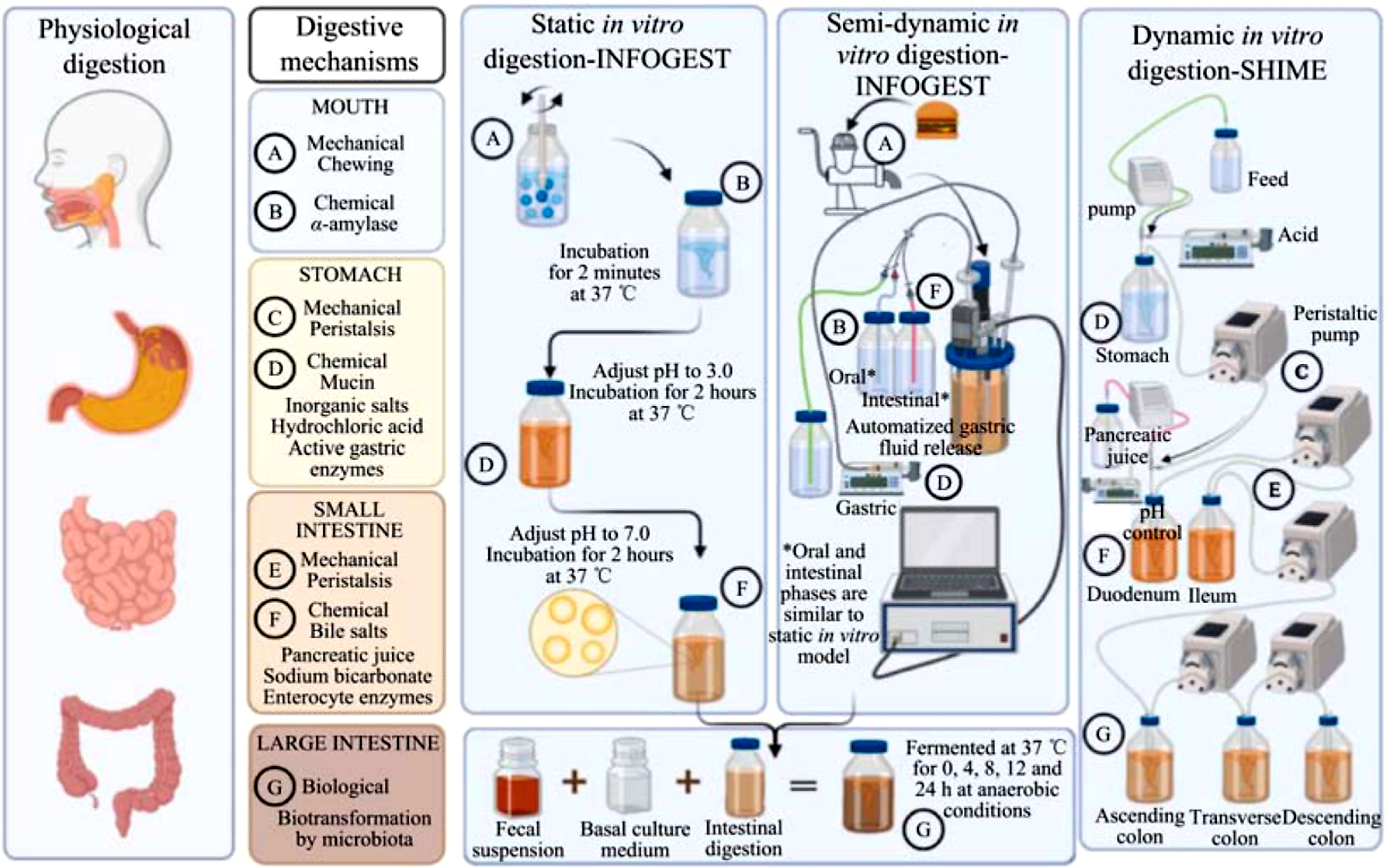
Fig.1 Diagram of static INFOGEST digestion model and dynamic SHIME digestion model
II. Applications of In Vitro Digestion Models
2.1 Nutrient-digestion research and functional-food development
In vitro digestion models can be used to evaluate transformation and bioaccessibility of proteins, carbohydrates, fats, and phytochemicals during digestion, and to compare differences among formulations, processing, and structural conditions. In general, static models are more suitable for screening and endpoint comparisons; semi-dynamic models are more suitable for gastric-phase kinetics and structural-change studies; and dynamic models are more suitable for process tracking and cross-stage coupling questions.
(1) Starch and carbohydrate digestion research
① Starch-digestion kinetics are a common research focus; digestion rate and release behavior are closely related to postprandial glycemic responses.
② Gastric emptying and release kinetics in the small-intestinal phase have substantial impacts on glycemic responses; using only static endpoint evaluation may underestimate hydrolysis or fail to explain structure-driven kinetic differences.
③ When comparability or sample screening is needed, standardized static frameworks facilitate parallel comparisons; when interpreting the causal chain of structure–digestion–absorption, (semi-)dynamic systems with emptying and pH dynamics are preferable.
(2) Protein digestion and functional evaluation of digestion products
① Beyond digestibility and amino-acid-related indices, the potential bioactivity and mechanisms of protein digestion products have attracted more attention.
② Dynamic pH changes and peristaltic shear significantly affect protein-hydrolysis kinetics, giving semi-dynamic and dynamic models advantages in protein kinetic studies.
③ Coupling in vitro digestion with cell models can further evaluate trans-membrane transport and absorption potential of digestion products, supporting evidence-chain construction for functionality.
(3) Application routes in functional-food development
① Formulation screening: comparing probiotic survival, active-component release, and system stability under in vitro digestion can help screen more suitable carriers and combination strategies.
② Process optimization: combining encapsulation, nanosizing, and other processing strategies with digestion simulation can compare impacts of different material systems on stability and release behavior.
③ Reverse design: optimizing food structure and processing parameters based on structure–digestion-behavior data can achieve specific digestion rates or release curves to meet differentiated nutritional needs.
2.2 Post-digestion antioxidant evaluation
The antioxidant effects of bioactive compounds such as polyphenols, vitamins, and carotenoids are closely related to the effective fraction that becomes releasable, transportable, and absorbable after digestion. However, studies often show inconsistency between changes in bioactive-compound levels and changes in antioxidant activity, and even contradictory conclusions across different studies.
(1) Possible causes of contradictory results
① Matrix effects: particle scale, degree of structural disruption, and binding states influence release and transformation pathways of bioactive compounds.
② Differences in digestion conditions: differences in pH, bile salts, enzyme systems, and mechanical conditions across models can change stability, solubility, and reaction mechanisms of bioactive compounds, affecting antioxidant characterization.
③ Methodological differences: different sampling stages, sample pretreatment, and antioxidant measurement systems can make results not directly comparable.
(2) Recommendations for model selection and evaluation strategies
① Mechanistic analysis and kinetic research: prioritize semi-dynamic or dynamic systems; couple with cell models when necessary to improve evidence-chain completeness.
② Sample screening and hypothesis validation: standardized static models are more conducive to parallel comparisons and inter-laboratory reproducibility.
③ Reporting norms: clearly disclose enzyme-to-substrate ratio, pH-control method, mixing conditions, sampling points, and analytical methods to reduce apparent conflicts caused by methodological differences.
2.3 Digestibility research of food allergens
Food allergy is generally divided into IgE-mediated and non-IgE-mediated types. Allergenicity and digestive stability do not show a strict one-to-one relationship: digestion may reduce, have no effect on, or even enhance sensitization potential; therefore, judging risk solely based on digestive stability is limited. Nevertheless, in the absence of unified physicochemical features that clearly distinguish allergens from non-allergenic proteins, in vitro digestion remains an important tool for assessing potential sensitization of novel proteins.
(1) Key factors affecting digestibility-evaluation results
① Differences in digestion systems: pH, surfactants, food matrices, and processing-modification factors may alter protein structure and proteolytic pathways.
② Differences in enzyme-to-substrate ratio and enzyme-activity measurement: can significantly change apparent digestive stability and product spectra.
③ Differences in endpoint evaluation: different indicator systems (e.g., protein integrity, IgE-binding capacity, or sensitization capacity) make studies difficult to compare directly.
(2) The need for standardization and research recommendations
① For similar research needs, prioritize in vitro digestion conditions with higher standardization and avoid arbitrary adjustment of key parameters that weakens comparability.
② When the research purpose requires conditions closer to terminal small-intestinal degradation and exposure environments, consider coupling in vitro digestion with brush-border membrane enzymes or cell models to improve physiological relevance.
③ Establish unified norms for parameter disclosure and data reporting to provide a basis for cross-study integration and consistency in risk assessment.
III. Establishment of Common In Vitro Digestion Models
3.1 Experimental Setup and Key Parameters
(1) Basic Setup
① Operate the entire system at 37°C under constant temperature control, and record temperature throughout the experiment.
② Fix the mixing mode and intensity, and record the container type, reaction volume, stirring speed, or shaking frequency.
③ Construct the system in a sequence of “oral–gastric–small intestinal”; extend to the colon stage when necessary.
(2) Key Parameters
① pH control: In the static model, keep pH constant within each stage; in the semi-dynamic model, adjust gastric pH according to a predefined profile; in the dynamic model, apply closed-loop control.
② Enzyme system: Report using enzyme activity units and the enzyme-to-substrate ratio, and verify or calibrate activity before each batch.
③ Small intestinal stage: Record bile salt concentration, key ions (e.g., Ca2+), and the buffer system to ensure batch-to-batch consistency.
(3) Controls and Version Selection
① Enzyme-free control: Used to distinguish “pH/ion/bile-salt environment effects” from “enzyme-catalyzed hydrolysis effects”.
② Sterile system: Used for contamination-sensitive scenarios (e.g., allergen assessment, coupling with cell models, colon-stage experiments).
③ Method alignment: When alignment with standard protocols or historical data is required, select the corresponding framework and avoid arbitrary changes in key parameters.
3.2 Operational Workflow and Sampling Termination
(1) Sample Pretreatment
① Weigh samples on a unified basis (dry matter or edible portion), and record moisture content or the conversion method.
② For solid materials, grind or disperse to a consistent state, and record the particle size range or homogenization conditions and time.
(2) Operation and Sampling
① Oral stage: Add simulated salivary fluid, mix briefly, then sample at the defined time point and label as the oral-stage sample.
② Gastric stage: Add simulated gastric fluid and acidify to the target pH; start timing after adding pepsin; sample at predefined time points and record pH changes concurrently.
③ Small intestinal stage: Adjust the system to neutral or near-neutral pH; start timing after adding simulated intestinal fluid, pancreatic enzymes, and bile salts; sample at defined time points; separate micellar and non-micellar fractions when needed and record separation conditions.
(3) Termination and Storage
① Terminate enzymatic reactions immediately after sampling (e.g., shift pH to an inactivating range or place on an ice bath), and record the termination method, terminal pH, and processing time.
② Clarify samples by centrifugation or filtration, aliquot, protect from light, store at low temperature, and record freeze–thaw cycles and storage duration.
(4) Minimum Reporting Set
① Disclose the origin and version of digestion fluids (e.g., sterile, enzyme-free), enzyme activity and enzyme-to-substrate ratio, pH control approach, mixing conditions, sampling time points, and the sample-handling workflow.
② Disclose the key conditions for reaction termination and pretreatment (e.g., centrifugation/filtration parameters, phase-separation method), to ensure the reproducibility and comparability of results.
IV. Aladdin-Related Products
Catalog No. | Product Name |
Artificial Intestinal Fluid | |
Artificial Intestinal Fluid (Sterile) | |
Artificial Intestinal Fluid (Enzyme-Free) | |
Artificial Intestinal Fluid (Enzyme-Free, Sterile) | |
Artificial Colonic Fluid | |
Artificial colon fluid (sterile) | |
Artificial Gastric Juice (USP) | |
Artificial gastric juice (USP, sterile) | |
Artificial Gastric Fluid (USP, Enzyme-free) | |
Artificial Gastric Fluid (USP, Enzyme-free, Sterile) | |
Artificial Gastric Fluid (ChP) | |
Artificial Gastric Fluid (ChP, Sterile) | |
Artificial gastric juice (ChP, enzyme free) | |
Artificial gastric juice (ChP, enzyme free, sterile) | |
Artificial Urine |
Overall, in vitro digestion models have irreplaceable value in studies of food-digestion mechanisms and functionality-oriented development. In the future, through more consistent standardized frameworks, more sufficient validation against in vivo references, and the maturation of dynamic regulation and multi-model coupling strategies, in vitro digestion models will be better able to provide comparable, interpretable, and more in vivo-like predictive results across different food systems, offering more reliable methodological support for nutrition-and-health research and food innovation.
References
[1]LUCAS-GONZÁLEZ R,VIUDA-MARTOS M,PÉREZ-ALVAREZ J A,et al.In vitro digestion models suitable for foods:Opportunities for new fields of application and challenges[J].Food Research International,2018,107:423-436.
[2]LI C,YU W,WU P,et al.Current in vitro digestion systems for understanding food digestion in human upper gastrointestinal tract[J].Trends in Food Science & Technology,2020,96:114-126.
[3]DUPONT D,FERRANTI P,MACKIE A.The 5th international conference on food digestion[J].Food Research International,2019,118:1-3.
[4]JOHANSSON D P,GUTIÉRREZ J L V,LANDBERG R,et al.Impact of food processing on rye product properties and their in vitro digestion[J].European Journal of Nutrition,2018,57(4):1651-1666.
[5]HUR S J,LIM B O,DECKER E A,et al.In vitro human digestion models for food applications[J].Food Chemistry,2011,125(1):1-12.
[6]MACKIE A,MULET-CABERO A I,TORCELLO-GÓMEZ A.Simulating human digestion:Developing our knowledge to create healthier and more sustainable foods[J].Food & Function,2020,11:9397-9431.
[7]MINEKUS M,ALMINGER M,ALVITO P,et al.A standardised static in vitro digestion method suitable for food—An international consensus[J].Food & Function,2014,5(6):1113-1124.
[8]BRODKORB A,EGGER L,ALMINGER M,et al.INFOGEST static in vitro simulation of gastrointestinal food digestion[J].Nature Protocols:Recipes for Researchers,2019,14(4):991-1014.
[9]SANCHÓN J,FERNÁNDEZ-TOMÉ S,MIRALLES B,et al.Protein degradation and peptide release from milk proteins in human jejunum.Comparison with in vitro gastrointestinal simulation[J].Food Chemistry,2018,239:486-494.
[10]EGGER L,SCHLEGEL P,BAUMANN C,et al.Physiological comparability of the harmonized INFOGEST in vitro digestion method to in vivo pig digestion[J].Food Research International,2017,102:567-574.
For more related articles, please see below:
[1] Experiments on the observation of the microstructure of the digestive system
[2] Experiments on the gross anatomy of the digestive system
Aladdin: https://www.aladdinsci.com/