Determine the necessary mass, volume, or concentration for preparing a solution.
for fluorescence analysis, ≥90% for Fluorescence analysis for sensitive chromatographic and analytical workflows requiring minimal baseline interference.
Protected from light,Store at -20°C,Desiccated Ships Ice chest + Ice pads Check lot-specific COA for exact specifications.
SDS, COA, datasheet, and spec sheet available for download. Lot-specific COA accessible via lot number lookup.
Cited in 1 peer-reviewed publications across chromatography, organic synthesis, and cross-coupling reactions.
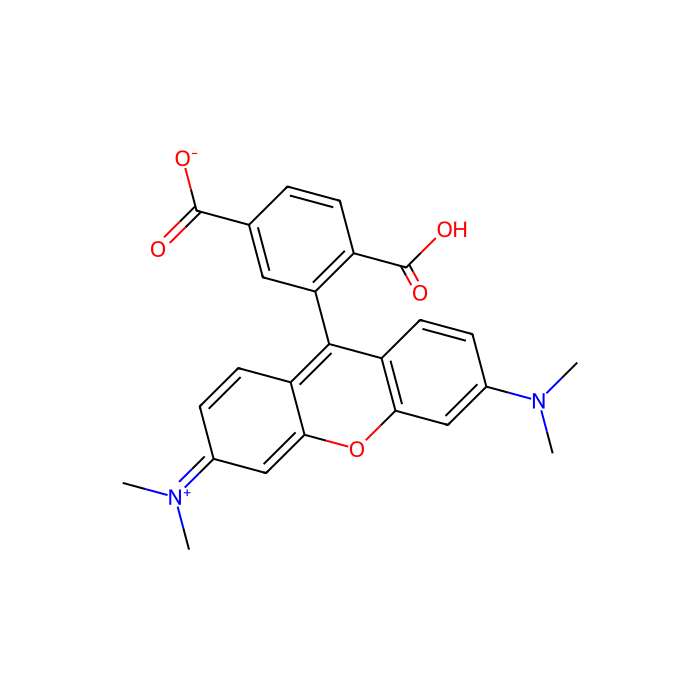
6-Carboxytetramethylrhoda?mine (6-TAMRA) is used to create fluorescent DNA probes and labeled proteins/peptides. The corresponding succinimidyl ester is a single isomer fluorophore most commonly used in automated DNA sequencing.
1).Solvents:For the most part, reactive dyes are hydrophobic molecules and should be dissolved in anhydrous dimethylformamide (DMF) or dimethylsulfoxide (DMSO).
2).Reaction pH:The labeling reactions of amines with succinimidyl esters are strongly pH dependent. Amine-reactive reagents react with non-protonated aliphatic amine groups, including the terminal amines of proteins and the e-amino groups of lysines. Thus amine acylation reactions are usually carried out above pH 7.5. Protein modifications by succinimidyl esters can typically be done at pH 7.5-8.5, whereas isothiocyanates may require a pH 9.0-10.0 for optimal conjugations.
3).Reaction Buffers:Buffers that contain free amines such as Tris and glycine and thiol compounds must be avoided when using an amine-reactive reagent. Ammonium salts (such as ammonium sulfate and ammonium acetate) that are widely used for protein precipitation must also be removed (such as viadinlysis) before performing dye conjugations.
4).Reaction Temperature:Most conjugations are done at room temperature. However, either elevated or reduced temperature may be required for a particular labeling reaction.
| Sonrisas canónicas | CN(C)C1=CC2=C(C=C1)C(=C3C=CC(=[N+](C)C)C=C3O2)C4=C(C=CC(=C4)C(=O)[O-])C(=O)O |
|---|---|
| IUPAC Name | 4-carboxy-3-[3-(dimethylamino)-6-dimethylazaniumylidenexanthen-9-yl]benzoate |
| InChIKey | COCMHKNAGZHBDZ-UHFFFAOYSA-N |
| INCHI | 1S/C25H22N2O5/c1-26(2)15-6-9-18-21(12-15)32-22-13-16(27(3)4)7-10-19(22)23(18)20-11-14(24(28)29)5-8-17(20)25(30)31/h5-13H,1-4H3,(H-,28,29,30,31) |
| Isómeros SMILES | CN(C)C1=CC2=C(C=C1)C(=C3C=CC(=[N+](C)C)C=C3O2)C4=C(C=CC(=C4)C(=O)[O-])C(=O)O |
| WGK Alemania | 3 |
| Peso molecular | 430.45 |
| Reaxy-Rn | 11035433 |
| Reaxys-RN_link_address | https://www.reaxys.com/reaxys/secured/hopinto.do?context=S&query=IDE.XRN=11035433&ln= |
Comprehensive hazard, handling, storage, and regulatory compliance document.
Download SDS →Lot-specific quality data. Enter your lot number to retrieve the exact COA.
Look up COA →Full quality attributes and acceptance criteria for this grade.
View spec sheet →Taxonomy Tree
| Kingdom | Organic compounds |
|---|---|
| Superclass | Organoheterocyclic compounds |
| Clase | Benzopyrans |
| Subclass | 1-benzopyrans |
| Intermediate Tree Nodes | Dibenzopyrans |
| Direct Parent | Xanthenes |
| Alternative Parents | P-phthalic acid and derivatives Benzoic acids Benzoyl derivatives Dialkylarylamines Dicarboxylic acids and derivatives Secondary ketimines Heteroaromatic compounds Amino acids Carboxylic acid salts Oxacyclic compounds Carboxylic acids Hydrocarbon derivatives Organic oxides Organic salts Organic zwitterions Organooxygen compounds Organopnictogen compounds |
| Molecular Framework | Aromatic heteropolycyclic compounds |
| Substituents | Xanthene - Para_phthalic_acid - Benzoic acid or derivatives - Benzoic acid - Benzoyl - Dialkylarylamine - Tertiary aliphatic/aromatic amine - Monocyclic benzene moiety - Dicarboxylic acid or derivatives - Benzenoid - Heteroaromatic compound - Secondary ketimine - Amino acid or derivatives - Amino acid - Carboxylic acid salt - Tertiary amine - Carboxylic acid derivative - Oxacycle - Carboxylic acid - Organic salt - Organic nitrogen compound - Amine - Hydrocarbon derivative - Organic oxide - Organopnictogen compound - Organic oxygen compound - Organonitrogen compound - Organooxygen compound - Organic zwitterion - Aromatic heteropolycyclic compound |
| Descripción | This compound belongs to the class of organic compounds known as xanthenes. These are polycyclic aromatic compounds containing a xanthene moiety, which consists of two benzene rings joined to each other by a pyran ring. |
| External Descriptors | Not available |
Find and download the COA for your product by matching the lot number on the packaging.
| Lot Number | Certificate Type | Fecha | Articulo |
|---|---|---|---|
| Certificate of Analysis | May 20, 2026 | C115506 | |
| Certificate of Analysis | May 20, 2026 | C115506 | |
| Certificate of Analysis | May 20, 2026 | C115506 | |
| Certificate of Analysis | May 20, 2026 | C115506 | |
| Certificate of Analysis | Aug 03, 2022 | C115506 |
| Solubilidad | Soluble in methanol, DMSO, DMF or aqueous buffers (pH > 6.5). , Soluble in methanol, DMSO, DMF or aqueous buffers (pH > 6.5). |
|---|---|
| Sensibilidad | light sensitive for argon |
| Peso molecular | 430.500 g/mol |
| XLogP3 | 3.200 |
| Hydrogen Bond Donor Count | 1 |
| Hydrogen Bond Acceptor Count | 6 |
| Rotatable Bond Count | 3 |
| Exact Mass | 430.153 Da |
| Monoisotopic Mass | 430.153 Da |
| Topological Polar Surface Area | 92.900 Ų |
| Heavy Atom Count | 32 |
| Formal Charge | 0 |
| Complexity | 875.000 |
| Isotope Atom Count | 0 |
| Defined Atom Stereocenter Count | 0 |
| Undefined Atom Stereocenter Count | 0 |
| Defined Bond Stereocenter Count | 0 |
| Undefined Bond Stereocenter Count | 0 |
| The total count of all stereochemical bonds | 0 |
| Covalently-Bonded Unit Count | 1 |
| 1. Xianfeng Lin, Changxin Li, Chuxian He, You Zhou, Zhouping Wang, Nuo Duan, Shijia Wu. (2021) Upconversion Nanoparticles Assembled with Gold Nanourchins as Luminescence and Surface-Enhanced Raman Scattering Dual-Mode Aptasensors for Detection of Ochratoxin A. ACS Applied Nano Materials, [PMID:] [10.1021/acsanm.1c01421] |
Our grade selection guide covers purity, stabilizer status, and application suitability for all variants in our catalog.
View for Fluorescence analysis grade guide →