This product is an affinity chromatography separation medium formed by coupling dextrin to agarose base beads. The dextrin ligand specifically binds to maltose-binding protein (MBP), enabling the purification of MBP-tagged fusion proteins. The product allows for target protein purification under near-physiological conditions, maximizing the retention of protein activity.
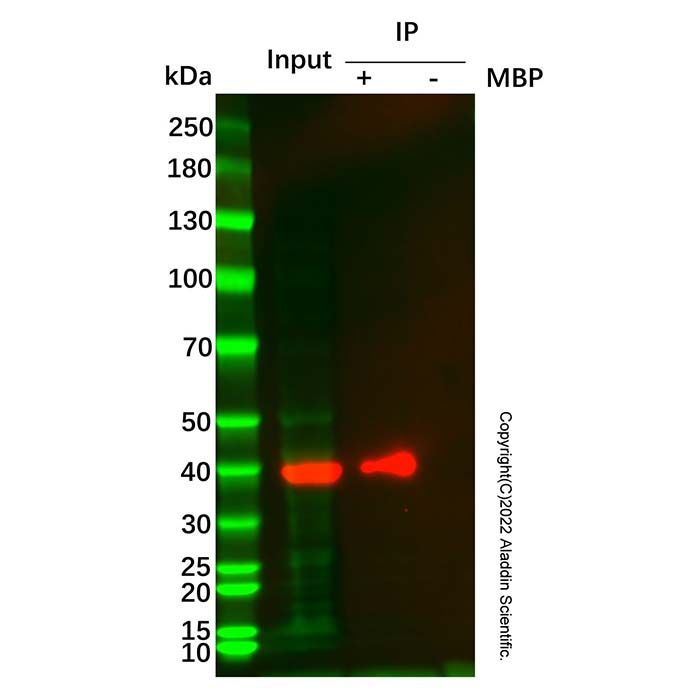
The MBP tag is relatively large, with a molecular weight of approximately 42 kDa. Its main functions include promoting correct protein folding, enhancing expression levels, and improving the solubility of the target protein. MBP-tagged fusion proteins can be purified using specific affinity resins. The MBP tag is commonly used in E. coli expression systems and is typically removed by specific enzymatic cleavage after affinity chromatography.
Aladdin Dextrin Agarose Resin is stored in 20% ethanol, with a settled gel to storage solution ratio of 1:1. The product specification refers to the actual volume of the settled gel.
Parameter
| Value / Description
|
Matrix
| 6% cross-linked agarose
|
Ligand
| Dextrin
|
Particle Size Range ①
| 45~165 μm
|
Average Particle Size
| ~90 μm
|
Binding Capacity ②
| 3–5 mg MBP (≈42 kDa) / mL resin
|
Recommended Operating Flow Rate
| 60~150 cm/h
|
Maximum Flow Rate & Pressure ③
| 900 cm/h, 0.3 MPa
|
Operating pH Range
| 7–9 (recommended), 2–13 (CIP)
|
Chemical Stability
| Stable in common aqueous buffers and 0.5 M NaOH
|
Storage Conditions
| 20% ethanol, 2–8°C
|
Shelf Life
| 3 years
|
Notes:
① Over 90% of the beads fall within this size range.
② Binding capacity is equivalent to DBC10%, measured as pure protein yield per mL resin from bacterial lysate.
③ Maximum tested flow rate at 10 cm column height.
Protocol
1. Column Packing
The following procedure describes column packing when connected to a chromatography system:
(1) Equilibrate all materials to the operating temperature. Degas liquids if possible.
(2) Resin Quantity Calculation:
Settled resin volume = Column volume × Compression factor (1.15 for this resin).
(3) Resin Preparation: Resuspend the resin slurry thoroughly. Measure the required volume, remove storage solution by filtration, and wash 3 times with ~3 resin volumes of purified water.
(4) Packing Slurry Preparation: Transfer resin to a suitable container and add packing solution to achieve a 50–75% (v/v) slurry. Mix well before use.
(5) Pre-packing Setup: Fill the bottom of the clean column with packing solution to remove air from the bottom frit and outlet. Retain a small amount of liquid, tighten the bottom end fitting, and ensure the column is vertical.
(6) Packing: Pour the well-mixed slurry into the column in one slow, continuous motion (use a packing reservoir if needed). After adding all resin, fill the reservoir with packing solution, attach the top lid, and connect the column to the system.
(7) Compression: Allow the resin to settle naturally (or use a low flow rate of 50–150 cm/h). Apply a high flow rate (600 cm/h; ensure pressure ≤0.3 MPa) until the interface is stable. Mark the stable height, stop the pump, and lower the adapter to the position corresponding to the compression factor (1.15). Tighten the adapter and equilibrate the column at a high flow rate.
Packing Condition
| Dextrin Agarose Resin
|
Compression Factor
| 1.15
|
Packing Flow Rate
| 600 cm/h |
2. Column Efficiency Testing
After packing, assess column efficiency using HETP (Height Equivalent to a Theoretical Plate) and As (Asymmetry Factor) with acetone or NaCl as tracers:
Tracer
| 1.0% Acetone
| 0.8~1.0 M NaCl
|
Sample Volume
| 1.0% CV
| 1.0% CV
|
Mobile Phase
| Pure Water
| 0.4 M NaCl
|
Flow Rate
| 30 cm/h
| 30 cm/h
|
Detector
| UV-280 nm
| Conductivity
|
Calculate HETP, N, and As using:
HETP = L / N
N = 5.54 × (Vʀ / Wₕ)²
As = a / b
HETP should be <3× the average particle diameter (HETP/D₅₀ < 3), and As should be 0.8–1.5.
3. Recommended Buffers
Binding Buffer: 20 mM Tris-HCl, 200 mM NaCl, 1 mM EDTA, pH 7.4
Elution Buffer: Binding Buffer + 10 mM maltose
Regeneration Buffer: 0.5 M NaOH
4. Sample Purification
(1) Equilibration: Equilibrate with 5 CV Binding Buffer at ~150 cm/h.
(2) Loading: Load sample at 20–100 cm/h. Pre-treat sample (dialysis, ultrafiltration, or dilution) to match Binding Buffer. Filter through 0.45 μm or centrifuge to remove particulates.
(3) Wash: Wash with 5–10 CV Binding Buffer at ~150 cm/h until baseline is stable.
(4) Elution: Elute with 6–10 CV Elution Buffer at ~150 cm/h.
(5) Regeneration: Wash with 3–5 CV water, regenerate with 3–5 CV 0.5 M NaOH, rinse to neutral pH, and store in 20% ethanol or re-equilibrate with Binding Buffer.
5. Storage
Store in 20% ethanol at 2–8°C. Do not freeze.

 ZJ26F0636676