Determine the necessary mass, volume, or concentration for preparing a solution.
| Activity Type | Activity Value -log(M) | Mechanism of Action | Activity Reference | Publications (PubMed IDs) |
|---|

Moligand™, 10mM in DMSO Moligand™ for sensitive chromatographic and analytical workflows requiring minimal baseline interference.
Store at -80°C Ships Dry ice packs + Cold packs Check lot-specific COA for exact specifications.
SDS, COA, datasheet, and spec sheet available for download. Lot-specific COA accessible via lot number lookup.
Cited in 0 peer-reviewed publications across chromatography, organic synthesis, and cross-coupling reactions.
Information
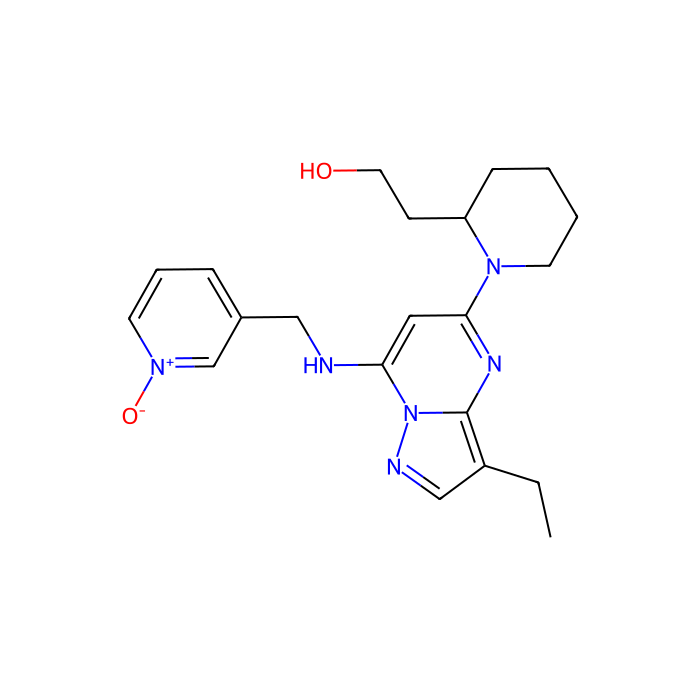
Dinaciclib (SCH727965, PS-095760) is a novel and potent CDK inhibitor forCDK2,CDK5,CDK1andCDK9withIC50of 1 nM, 1 nM, 3 nM and 4 nM in cell-free assays, respectively. It also blocks thymidine (dThd) DNA incorporation. Dinaciclib induces apoptosis through t
In vitro
Dinaciclib is also a potent DNA replication inhibitor that blocks thymidine (dThd) DNA incorporation in A2780 cells with IC50 of 4 nM. Dinaciclib strongly suppresses phosphorylation of Rb on Ser 807/811 at concentrations >6.25 nM, which is in agreement with the observation that 4 nM concentrations are required for 50% inhibition of dThd DNA incorporation in the same cell model. Significantly, complete suppression of Rb phosphorylation is correlated with the onset of apoptosis, as indicated by the appearance of the p85 PARP cleavage product in cells exposed to >6.25 nM Dinaciclib. Dinaciclib is active against a broad spectrum of human tumor cell lines. Addition of Dinaciclib during hydroxyurea exposure also suppresses accumulation of γ-H2AX, in a dose-dependent manner. Dinaciclib inhibits melanoma cell proliferation, and drives melanoma cells into massive apoptosis. Dinaciclib induces the apoptosis of several osteosarcoma cell lines including those resistant to doxorubicin and dasatinib. Dinaciclib attenuates the phosphorylation of RNAP II at serine 2 and the phosphorylation of the CDK inhibitor p27Kip1 at threonine 187. Reductions in phosphorylation activity occurrs at 12 - 40 nM Dinaciclib (4 to 16 hours post-Dinaciclib addition). Dinaciclib also reduces the phosphorylation of Rb at serine 807/811. Dinaciclib induces the apoptosis of mock- and p53-depleted U2OS cells to a similar extent.
In vivo
Dinaciclib i.p. administration at 8, 16, 32, and 48 mg/kg daily for 10 days results in tumor inhibition by 70%, 70%, 89%, and 96%, respectively. Dinaciclib MED (minimum effective dose) appears to be <8 mg/kg. Dinaciclib is well tolerated, and the maximum body weight loss in the highest dosage group is 5%. Dinaciclib has dose-dependent antitumor activity in vivo, and that nearly complete inhibition of tumor growth occurs at a dose level below the MTD (maximum tolerated dose). Dinaciclib has a short plasma half-life in mouse.
Cell Data
cell lines:
Concentrations:0 μM -5 μM
Incubation Time:24 hours
Powder Purity:≥98%
| ALogP | 1.9 |
|---|
| Isómeros SMILES | CCC1=C2N=C(C=C(N2N=C1)NCC3=C[N+](=CC=C3)[O-])N4CCCC[C@H]4CCO |
|---|---|
| Peso molecular | 396.49 |
| Reaxy-Rn | 29384530 |
| Reaxys-RN_link_address | https://www.reaxys.com/reaxys/secured/hopinto.do?context=S&query=IDE.XRN=29384530&ln= |
Comprehensive hazard, handling, storage, and regulatory compliance document.
Download SDS →Lot-specific quality data. Enter your lot number to retrieve the exact COA.
Look up COA →Full quality attributes and acceptance criteria for this grade.
View spec sheet →| Activity Type | Activity Value -log(M) | Mechanism of Action | Activity Reference | Publications (PubMed IDs) |
|---|
| Activity Type | Activity Value -log(M) | Mechanism of Action | Activity Reference | Publications (PubMed IDs) |
|---|
| Activity Type | Activity Value -log(M) | Mechanism of Action | Activity Reference | Publications (PubMed IDs) |
|---|
| Activity Type | Activity Value -log(M) | Mechanism of Action | Activity Reference | Publications (PubMed IDs) |
|---|
| Activity Type | Activity Value -log(M) | Mechanism of Action | Activity Reference | Publications (PubMed IDs) |
|---|
| Activity Type | Activity Value -log(M) | Mechanism of Action | Activity Reference | Publications (PubMed IDs) |
|---|
| Activity Type | Activity Value -log(M) | Mechanism of Action | Activity Reference | Publications (PubMed IDs) |
|---|
| Activity Type | Activity Value -log(M) | Mechanism of Action | Activity Reference | Publications (PubMed IDs) |
|---|
| Activity Type | Activity Value -log(M) | Mechanism of Action | Activity Reference | Publications (PubMed IDs) |
|---|
| Activity Type | Activity Value -log(M) | Mechanism of Action | Activity Reference | Publications (PubMed IDs) |
|---|
| Activity Type | Activity Value -log(M) | Mechanism of Action | Activity Reference | Publications (PubMed IDs) |
|---|
| Solubilidad | Solubility (25°C) In vitro DMSO: 63 mg/mL (200.4 mM); Water: Insoluble; Ethanol: Insoluble; |
|---|---|
| Punto de fusión (°C) | 107-111°C |
Our grade selection guide covers purity, stabilizer status, and application suitability for all variants in our catalog.
View Moligand™ grade guide →