CALIDAD & PUREZAfor Cell culture?Cell-culture grade — low endotoxin and contaminants to support viable cell growth. Use in mammalian/other cell culture media and supplements.Suitable for insect cell culture?Insect cell-culture grade — suited to insect cell systems (e.g. Sf9, baculovirus). Use for protein expression and culture in insect cell lines.
Malic acid is used as a component of insect tissue culture. It is also useful as an acidulant in soft drinks, jams, fruit and vegetable juices. Product Application Malic acid has been used: to induce basal respiration in mitochondrial cell culture. to measure the mitochondrial ETC (electron transport chain) activity. as a component of mitochondrial substrate stock.
Malic acid is a part of cellular metabolism. Its application is recognized in pharmaceutics. It is useful in the treatment of hepatic malfunctioning, effective against hyper-ammonemia. It is used as a part of amino acid infusion. Malic acid also serves as a nanomedicine in the treatment of brain neurological disorders. A TCA (Krebs cycle) intermediate and partner in the malic acid aspartate shuttle.
Condiciones de almacenamiento de almacenamiento
Protected from light,Argon charged,Desiccated,Room temperature
Enviado en
Normal
Grado
for Cell culture, Suitable for insect cell culture
This compound belongs to the class of organic compounds known as beta hydroxy acids and derivatives. These are compounds containing a carboxylic acid substituted with a hydroxyl group on the C3 carbon atom.
External Descriptors
malic acid
1. Djoumbou Feunang Y, Eisner R, Knox C, Chepelev L, Hastings J, Owen G, Fahy E, Steinbeck C, Subramanian S, Bolton E, Greiner R, and Wishart DS. ClassyFire: Automated Chemical Classification With A Comprehensive, Computable Taxonomy. Journal of Cheminformatics, 2016, 8:61.
Determine the necessary mass, volume, or concentration for preparing a solution.
Dilution Calculator
Determine the dilution needed to prepare a stock solution.
Reconstitution Calculator
Reseñas
Reseñas de cliente
Application Protocols
No item-specific, validated application protocols are provided in the Product Data. The following general, research-use-only procedures are typical for L-(−)-malic acid in lab settings. Adjust to your system and verify empirically.
Preparation of sterile 1.0 M L-malic acid stock (general)
Dissolve 134.1 g L-(−)-malic acid in ~800 mL ultrapure water with stirring.
Bring volume to 1 L; check pH (expect ~1.6–2.0). For use as malate buffer, partially neutralize to target pH with sterile NaOH.
Filter through 0.22 µm PES membrane into sterile containers; store at 2–8 °C; prepare aliquots to minimize repeated handling.
Malate buffer pH 5.0, 0.1 M (general)
Dissolve 13.41 g L-(−)-malic acid in ~800 mL water.
Titrate with ~4 M NaOH to pH 5.0 while monitoring temperature.
QS to 1 L, mix, and filter sterilize if required.
Insect cell culture use (general guidance)
Role: pH adjustment or component of custom media formulations. Typical working concentrations for pH adjustment are process-defined; start with small-scale DoE to assess effects on growth and viability.
Quality controls to consider for sterile use (item-specific status not provided)
Endotoxin, bioburden, and conductivity/pH confirmation. For this item, exact limits are Not specified for this item; refer to CoA/Spec Sheet.
Biological Roles
L-(−)-Malic acid (malate in its ionized forms) is a core intermediate in central metabolism.
TCA cycle and energy metabolism (literature/general)
L-malate is formed from fumarate via fumarase and oxidized to oxaloacetate by NAD+-dependent malate dehydrogenase (MDH), linking to gluconeogenesis and amino acid biosynthesis.
Cytosolic malic enzyme (ME) decarboxylates malate to pyruvate with NADP(H) coupling, generating NADPH for biosynthesis and redox homeostasis.
Anaplerosis and shuttles
Malate–aspartate shuttle transfers reducing equivalents across the mitochondrial membrane by cycling malate/oxaloacetate and aspartate/oxoglutarate.
Provides anaplerotic replenishment of TCA intermediates in proliferating cells (including insect and mammalian systems).
Ionic and chelation effects
Malate chelates Mg2+/Ca2+ moderately, modulating enzyme activities and membrane stability in vitro depending on concentration and pH.
Culture media context (general)
As an acidulant or malate salt, can adjust medium pH in the mildly acidic range with lower volatility than acetic acid.
Some cells utilize malate as an auxiliary carbon/energy source; optimal supplementation is system-specific and should be empirically determined.
Stereochemistry relevance
Biological systems predominantly handle the L isomer; D-malic acid is often metabolized less efficiently. Enzymes such as L-malate dehydrogenase are stereospecific for L-malate.
Buffer Applications
L-(−)-Malic acid and its salts (malate) form useful buffers in the mildly acidic range.
Effective pH range (literature/general)
Between its two pKa values, malate buffers effectively from ~pH 2.8 to ~6.0, with optimal regions near pKa1 ≈ 3.4 and pKa2 ≈ 5.1.
Common buffer systems
Malic acid/NaOH (sodium malate): Simple, chloride-free buffer suitable for biochemical assays and some cell culture workflows.
Malic acid/Tris or Bis–Tris: Extends buffering closer to neutral while retaining malate’s ligand properties.
Example preparations (general guidance; adjust to need)
0.1 M malate buffer pH 5.0 (1 L): Dissolve 13.41 g L-malic acid in ~800 mL H2O, adjust to pH 5.0 with ~4 M NaOH (titrate to setpoint), bring to 1 L with H2O. Filter sterilize if used in cell culture.
1.0 M L-malic acid stock: Dissolve 134.1 g in H2O, QS to 1 L; store refrigerated; sterile-filter for sterile applications.
Metal binding: Moderate chelation may sequester Mg2+/Ca2+; supplement accordingly in assays requiring divalent cations.
UV transparency: Good transparency above ~220–230 nm; verify for spectroscopic assays.
Not typically used for electrophoresis running buffers; citrate or acetate are more common in acidic gels, while Tris-based systems dominate near neutral.
Green Alternatives
Context: L-(−)-Malic acid is a bio-based, biodegradable organic acid. In many applications it can replace stronger mineral acids or petrochemical-derived acids, with trade-offs to consider.
Sustainability profile (general)
Sourced via fermentation of renewable carbohydrates (industrial practice), offering lower fossil carbon intensity compared with purely petrochemical acids.
Potential substitutions and trade-offs (literature/general)
As pH adjuster/buffer vs HCl/H2SO4: Safer handling (solid, weak acid), improved buffering; however, adds organic load and potential chelation effects.
vs Acetic acid: Broader buffering (two pKa’s) and lower volatility/odor; may increase ionic strength when neutralized.
vs Citric acid: Lower functionality (diacid vs triacid) means simpler speciation and sometimes reduced metal chelation—beneficial where excessive complexation is undesirable.
Comparison snapshot (general)
Feedstock: Malic (often renewable) vs acetic (often fossil/biogenic) vs citric (renewable)
Volatility: Non-volatile solid (malic, citric) vs volatile liquid (acetic)
Use aqueous media and room temperature dissolution to minimize energy use.
Favor malate salts to avoid corrosive mineral acids in bioprocessing.
Manage wastewater by neutralization and biological treatment; malate is readily metabolized.
Pharmaceutical Uses
No therapeutic or clinical claims are made. The following describes typical roles of L-(−)-malic acid in formulations and manufacturing (literature/general).
Function classes
Acidulant and pH adjuster in oral liquids, chewables, and topical products; provides sustained tartness and lower volatility vs acetic acid.
Buffer component in the mildly acidic range (pH ~3–6) when paired with sodium/potassium bases or organic amines.
Chelation/modifier: α-Hydroxy dicarboxylate can modulate metal-catalyzed degradation pathways by sequestering trace metals.
Salt formation: Malates (e.g., drug–malate salts) used to improve API solubility or solid-state properties.
Manufacturing considerations
Solid handling advantages (non-volatile) simplify incorporation with minimal odor.
Hygroscopicity and flow: May require controlled humidity and anti-caking strategies for direct compression blends.
Compatibility notes
Potential interactions with amines (salt formation), polyols (esterification under harsh conditions), and divalent cations (complexation).
Generally compatible with common flavor systems; malate esters can form under strong acid/heat—avoid prolonged high-temperature processing when ester formation is undesirable.
Regulatory/compendial
Widely used in foods and consumer products; pharmacopeial listings may exist depending on jurisdiction and grade. For this specific item, compendial status and limits are Not specified for this item; refer to CoA/Spec Sheet.
For sterile products: Use cell-culture-appropriate handling; sterile-filtration of aqueous solutions is standard when feasible.
Physical Properties
Note: Where specific numerical specifications are not provided in the Product Data, values below are literature/general references and are not item specifications.
Appearance (item-specific): Not specified for this item; refer to CoA/Spec Sheet.
Physical state: Solid (literature)
Melting point: ~100–103 °C (literature; reported for L-(−)-malic acid, may soften/dehydrate before melting depending on humidity/rate)
Boiling point: Decomposes before boiling (literature)
Density: ~1.60 g/cm³ at 20 °C (literature)
Refractive index: Not applicable to solids; not commonly reported
Solubility (literature)
Water: Highly soluble; miscible at typical lab concentrations (e.g., ≥50–60 g/100 mL at 20–25 °C reported)
Alcohols: Soluble in methanol and ethanol; lower solubility in isopropanol
Polar aprotic: Limited solubility in acetone, acetonitrile; poor in ethers and hydrocarbons
Partition coefficient: logP (octanol/water) ≈ −1.3 to −1.4 (literature, indicative of high hydrophilicity)
Acid dissociation constants (aqueous, 25 °C, literature)
pKa1 ≈ 3.40 (carboxyl proximal to OH)
pKa2 ≈ 5.11 (distal carboxyl)
Hygroscopicity: Mildly hygroscopic; can absorb moisture and form hydrates (general)
Optical rotation (literature, example): [α]D 20 ≈ −(2 to 3)° (c ≈ 5, H2O), value varies with concentration and pH
Practical implication: High water solubility and moderate acidity make L-malic acid a useful pH adjuster/buffer component in the mildly acidic range.
Quality and Grades
Item-specific grade (from Product Data)
Grade/Purity: For cell culture; suitable for insect cell culture.
Research Use Note: For research use only.
What “for cell culture” generally entails (general guidance; not item specifications)
Tight control of bioburden and particulates to reduce risk of contamination in media.
Low levels of adventitious agents and typically screened for common impurities that can impact cell performance (e.g., heavy metals, endotoxin, residual solvents). Exact limits are manufacturer- and lot-specific.
May be supported by enhanced documentation (traceability, CoA release testing) relevant to media preparation.
Insect cell culture suitability (general)
Malate/malic acid can be used as a pH adjuster, carbon source supplement, or buffer component in serum-free or defined insect media formulations. Suitability indicates evaluation in such contexts, but optimal concentrations are process-specific.
Critical quality attributes (CQAs) to verify per lot (item-specific status)
Endotoxin: Not specified for this item; refer to CoA/Spec Sheet.
Bioburden: Not specified for this item; refer to CoA/Spec Sheet.
Trace metals: Not specified for this item; refer to CoA/Spec Sheet.
Residual solvents/UV-Vis profile: Not specified for this item; refer to CoA/Spec Sheet.
Optical purity (L- vs D- content): Not specified for this item; refer to CoA/Spec Sheet.
Stabilizers/additives
None indicated in Product Data. If stabilizers are present, they will be declared on the CoA/specification.
Reaction and Applications
Focus: L-(−)-Malic acid functions as a chiral α-hydroxy dicarboxylic acid in synthesis and as a metabolic acid in bioprocess media.
Synthetic and preparative uses (literature/general)
Esterification to mono- and di-malates (Fischer conditions; acid-catalyzed alcoholysis) for plasticizers, pro-flavor esters, and protecting strategies.
Selective protection/activation: Convert one carboxyl to anhydride/acid chloride; protect OH as acetonide or silyl ether for downstream transformations.
Dehydration to fumaric acid (or maleic under certain conditions) using acid catalysts or thermal methods.
Oxidation of the secondary alcohol to oxaloacetic acid derivatives (chemical or enzymatic) and reduction to tartaric-series motifs via dihydroxylation/chain editing.
Chiral pool applications: The single S stereocenter enables access to enantioenriched β-hydroxy acids, 1,2-diols, and lactones via intramolecular cyclization or Mitsunobu inversion.
Bioprocess/media applications (general)
pH adjustment and buffering in the mildly acidic range for mammalian and insect cell culture; forms malate salts with Na+/K+ and divalent cations.
Carbon source supplement in certain microbial and eukaryotic cultures; participates in TCA flux and anaplerosis.
Practical tips
Drying prior to esterification: Desiccate under vacuum at ambient-to-40 °C to minimize water in Fischer reactions.
Control stereochemistry: Under strongly acidic/high-temperature conditions, minimize racemization at the α-stereocenter by limiting exposure time and temperature.
Metal complexation: The α-hydroxy–carboxylate binds Ca2+, Mg2+, Fe3+; consider chelation in formulation and catalysis design.
Reaction Conditions
General, literature-based conditions for common transformations of L-(−)-malic acid. Adjust to your substrate scale and equipment; these are not product specifications.
Fischer esterification to dimethyl/diethyl malate
Typical: ROH (MeOH or EtOH, 10–20 equiv), catalytic H2SO4 or p-TsOH (1–5 mol%), reflux 6–24 h; remove water by Dean–Stark (EtOH) or molecular sieves.
Workup: Neutralize, concentrate, and purify by distillation or chromatography; 70–90% yields commonly reported.
Steglich esterification (monoprotection)
DCC (1.1–1.5 equiv), DMAP (5–10 mol%), ROH (1.1–2.0 equiv), CH2Cl2 or THF, 0 °C to rt, 2–16 h; filter DCU and concentrate. Good to excellent yields with mild conditions.
Dehydration to fumaric acid
Conc. H2SO4 or PPA, 80–140 °C, 1–6 h; or catalytic acid (e.g., Amberlyst) under reduced pressure. Fumaric acid typically predominates; isolate by crystallization.
Mitsunobu inversion at C2
PPh3 (1.1–1.5 equiv), DEAD/DIAD (1.1–1.5 equiv), nucleophile (e.g., PhCO2H), THF or toluene, 0 °C to rt, 2–12 h; stereochemical inversion observed.
Oxidation of secondary alcohol
TEMPO/NaOCl (pH 6–7, 0–5 °C) or Dess–Martin periodinane in CH2Cl2 at 0 °C to rt affords α-keto diacid derivatives; immediate derivatization recommended due to instability.
Salt formation/buffering (process)
Neutralize aqueous L-malic acid with NaOH/KOH to desired pH (3–6); control temperature as neutralization is exothermic; filter-sterilize when needed.
Notes
Control moisture and temperature to limit racemization.
Consider chelation with divalent metals altering reactivity and solubility.
Always validate conditions on small scale before scale-up.
Safety and Handling
Authoritative safety guidance should be taken from the product SDS. The Product Data do not specify GHS classification or hazard statements for this item.
GHS classification and pictograms (item-specific): Not specified for this item; refer to SDS.
General hazards (literature/general)
Organic acid; solutions may be irritating to skin, eyes, and mucous membranes.
Dusts can be irritating; avoid inhalation. Not known as a strong oxidizer/reducer.
Storage guidance (item-specific from Product Data)
Store at room temperature.
Protect from light.
Keep under argon (argon charged) and desiccated to minimize moisture uptake and racemization/oxidation.
Avoid prolonged contact with reactive metals in the presence of moisture (corrosion due to acidity).
PPE and handling (general best practice)
Wear lab coat, safety goggles, and appropriate chemical-resistant gloves (e.g., nitrile). Use dust mask/respirator if dust generation is likely and local regulations require.
Handle powders in a fume hood or ventilated enclosure to avoid aerosolization.
First aid (overview; defer to SDS)
Skin/eye contact: Rinse with water for several minutes; remove contact lenses; seek medical attention if irritation persists.
Inhalation: Move to fresh air; seek medical attention if symptoms occur.
Ingestion: Rinse mouth; do not induce vomiting; seek medical attention.
Waste disposal (general)
Neutralize aqueous residues appropriately; dispose according to institutional and local regulations for organic acids.
Solvent Selection
This product is a solid acid (not a solvent). For solution preparation and processing, consider the following solvation profile and selection notes.
Polarity and solubility (literature/general)
Highly polar; readily dissolves in water across a wide pH range (fastest dissolution above pH ~3 as partial neutralization improves solvation).
Soluble in lower alcohols (MeOH, EtOH); limited in acetone and acetonitrile; negligible in nonpolar solvents.
Practical dissolution tips
For concentrated stocks (0.5–2.0 M): Add gradually to stirred water; allow endothermic dissolution and CO2 degassing (if neutralizing) before pH finalization. Gentle warming (≤40 °C) expedites dissolution.
To prepare malate buffers: Adjust pH using NaOH/KOH or appropriate amines while monitoring temperature (neutralization is exothermic).
For anhydrous processing: Use dry alcohols or water–miscible polar aprotics with minimal water; protect from atmospheric moisture.
When to choose alternatives
If lower acidity or different buffering range is required, consider citrate (pH 3–6.2) or acetate (pH 3.6–5.6). For very low UV background in HPLC mobile phases near pH 3–5, formate is often preferred.
Small comparison (literature/general)
Malate vs acetate: broader dual-pKa buffering (pH ~2.8–6.0) and stronger metal chelation due to α-hydroxycarboxylate.
Malate vs citrate: less polyvalent chelation and typically milder taste/ionic strength contribution; citrate offers wider pH utility and stronger multidentate binding.
Storage and Reconstitution
Item-specific storage (from Product Data)
Store at room temperature.
Protect from light.
Maintain under argon (argon charged).
Keep desiccated to avoid moisture uptake and maintain quality.
Shipped under normal conditions.
Solid handling tips (general)
Reseal promptly after opening; purge headspace with inert gas if possible.
Use in a low-humidity environment or desiccator; if material cakes due to moisture, gently break up in a dry glovebox or desiccated cabinet.
Reconstitution (general guidance)
For aqueous stocks: Dissolve the weighed solid in ultrapure water to desired molarity (e.g., 0.1–1.0 M). Adjust pH as needed with NaOH/KOH to form malate buffer. For sterile applications, filter through 0.22 µm membranes.
For anhydrous solutions (synthetic use): Use dry alcohols or polar aprotics; minimize exposure to ambient moisture; store solutions in sealed, inerted vials.
Solution storage (general)
Aqueous acidic solutions are typically stable refrigerated (2–8 °C) for weeks; neutralized malate buffers stable for similar periods depending on bioburden control. For long-term storage, prepare aliquots and freeze (−20 °C); avoid repeated freeze–thaw.
Spec limits and stabilizers
Any item-specific stabilizers, solution shelf-life, or impurity limits are Not specified for this item; refer to CoA/Spec Sheet.
Compliance note
For research use only. Not for diagnostic or therapeutic use.
Structure and Identity
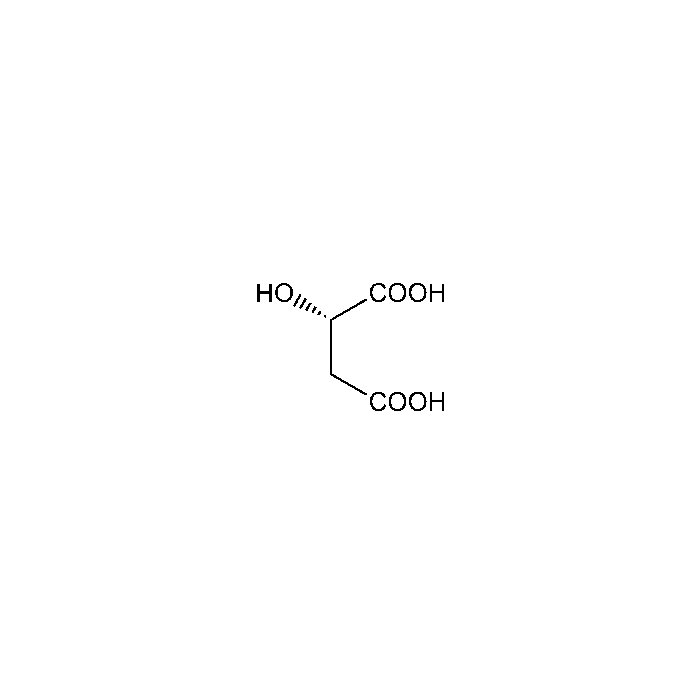
Brief: L-(−)-Malic acid is the naturally occurring L enantiomer of hydroxybutanedioic acid, a chiral α-hydroxy dicarboxylic acid and central metabolite in the tricarboxylic acid (TCA) cycle.
Item-specific identifiers (from Product Data)
CAS: 97-67-6
InChIKey: Not specified for this item; refer to CoA/Spec Sheet. (Product Data provided an incomplete key)
SMILES: Not specified for this item; refer to CoA/Spec Sheet.
Molecular Formula: Not specified for this item; refer to CoA/Spec Sheet.
Molecular Weight: Not specified for this item; refer to CoA/Spec Sheet.
Literature identity data (for reference only; not item specifications)
Common name: L-(−)-Malic acid; (S)-malic acid; (S)-2-hydroxysuccinic acid
Molecular formula (literature): C4H6O5
Molecular weight (literature): 134.09 g/mol
Stereochemistry: Single stereocenter at C2 with S configuration (L series); optical rotation negative in water.
Functional groups: two carboxylic acids (diacid) and one secondary alcohol (α-hydroxy).
Ring systems: none; acyclic four-carbon backbone (butanedioic acid framework).
2D description: HOOC–CH2–CH(OH)–COOH with the C3 carbon bearing the hydroxyl group and defined S chirality.
Implications of structure (general)
Amphiprotic acidity (two pKa values) and capacity to form inner hydrogen bonds; strong hydrophilicity and metal-chelation via α-hydroxy–carboxylate motif.
Readily forms mono- and di-malate salts with metals and amines; participates in esterification at one or both carboxyls and in selective protection strategies.
Synthetic Utility
As an enantiopure α-hydroxy dicarboxylic acid, L-(−)-malic acid is a versatile chiral pool building block.
Functional group handles
Two carboxylic acids enable differential activation/protection: formation of acid chlorides, anhydrides, esters, or amides; selective mono-functionalization is achievable via stepwise protection or transient mixed anhydrides.
The secondary alcohol at C2 allows for oxidation (to ketoacids), reduction (to diols/lactones), substitution (e.g., via tosylates/mesylates), and intramolecular cyclizations.
Esterification/transesterification: Fischer acid-catalyzed with MeOH/EtOH; Steglich esterification (DCC/DMAP) for milder conditions.
Dehydration: Conversion to fumaric acid using strong acid (e.g., H2SO4) or PPA; stereocontrol determined by mechanism (E1/E2-like) and water activity.
Mitsunobu inversion: OH inversion to access D-malic derivatives or to install other nucleophiles with inversion at C2.
Oxidation: TEMPO/(Oxoammonium), or Swern-type oxidation to the α-keto diacid (oxaloacetic derivatives), often stabilized as esters.
Cyclization: Formation of malolactone/malolactates under dehydrative conditions.
Retrosynthetic value
Provides a chiral C4 synthon; elaboration to β-hydroxy-α-amino acids (via Curtius/Hofmann or Strecker on activated derivatives), C2-extension to tartaric-type frameworks, or C–C bond-forming strategies from malate esters.
Practical cautions
Racemization risk under strong acid/base at elevated temperatures; maintain mild conditions and short exposure.
Water content critically affects selectivity in esterification/dehydration; pre-dry the substrate and solvents when necessary.
Target Specificity
Not applicable. This product is a small-molecule organic acid, not an antibody, enzyme, or affinity reagent. No antigen/epitope or species reactivity applies. For biological relevance, see the Biological Roles and Buffer Applications sections.
Nuestra guía de selección de calidades cubre la pureza, el estado del estabilizador y la idoneidad de la aplicación para todas las variantes de nuestro catálogo.
Utilizamos cookies para garantizar el correcto funcionamiento del sitio web y, cuando esté permitido, para mejorar su experiencia. Puede gestionar sus preferencias en cualquier momento en Configuración. Más información en nuestra Política de Cookies.
¿Quieres que te enviemos un mensaje cuando tengamos descuentos disponibles?
Recordármelo más tarde
¡Gracias! Por favor, revisa tu bandeja de entrada de correo electrónico para confirmar.
Products are supplied to verified businesses, institutions, and qualified professionals for research and development use only. Not for use in humans, animals, diagnosis, or therapy.

 A2215437