
 A2605001
Determine the necessary mass, volume, or concentration for preparing a solution.
| Activity Type | Relation | Activity value | Units | Action Type | Journal | PubMed Id | doi | Assay Aladdin ID |
|---|
≥97%(HPLC), 30% aqueous solution for sensitive chromatographic and analytical workflows requiring minimal baseline interference.
Room temperature Ships Check lot-specific COA for exact specifications.
SDS, COA, datasheet, and spec sheet available for download. Lot-specific COA accessible via lot number lookup.
Cited in 8 peer-reviewed publications across chromatography, organic synthesis, and cross-coupling reactions.
Description
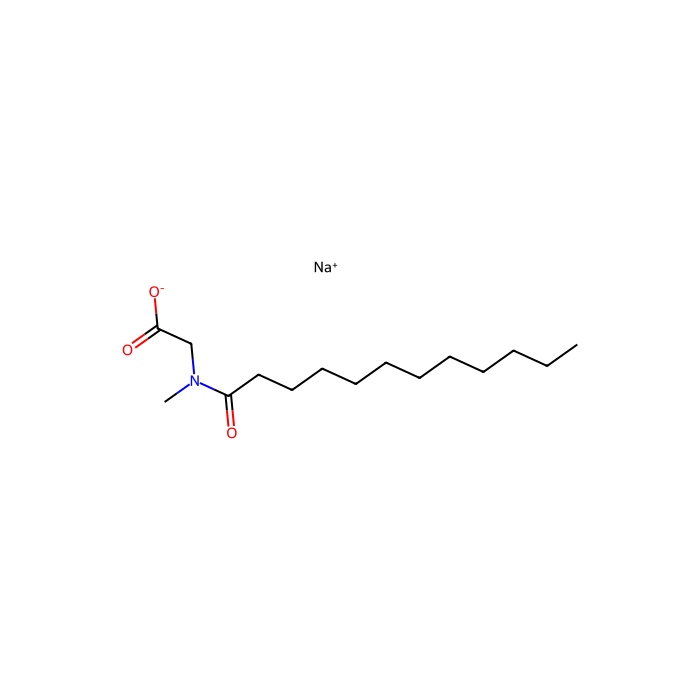
N-Lauroylsarcosine (Sarcosyl) is an ionic surfactant useful in a wide range of solubilization and permeation applications from solubilization of membrane proteins to enhancement of skin permeability in transdermal applications.
| PH | 7.0-9.0 (25 °C) |
|---|---|
| Sonrisas canónicas | CCCCCCCCCCCC(=O)N(C)CC(=O)[O-].[Na+] |
| IUPAC Name | sodium;2-[dodecanoyl(methyl)amino]acetate |
| InChIKey | KSAVQLQVUXSOCR-UHFFFAOYSA-M |
| INCHI | 1S/C15H29NO3.Na/c1-3-4-5-6-7-8-9-10-11-12-14(17)16(2)13-15(18)19;/h3-13H2,1-2H3,(H,18,19);/q;+1/p-1 |
| Isómeros SMILES | CCCCCCCCCCCC(=O)N(C)CC(=O)[O-].[Na+] |
| WGK Alemania | 1 |
| RTECS | MC0598960 |
| Peso molecular | 293.39 |
| Beilstein | 5322974 |
| Reaxy-Rn | 5322974 |
| Reaxys-RN_link_address | https://www.reaxys.com/reaxys/secured/hopinto.do?context=S&query=IDE.XRN=5322974&ln= |
Comprehensive hazard, handling, storage, and regulatory compliance document.
Download SDS →Lot-specific quality data. Enter your lot number to retrieve the exact COA.
Look up COA →Full quality attributes and acceptance criteria for this grade.
View spec sheet →Taxonomy Tree
| Kingdom | Organic compounds |
|---|---|
| Superclass | Organic acids and derivatives |
| Clase | Carboxylic acids and derivatives |
| Subclass | Amino acids, peptides, and analogues |
| Intermediate Tree Nodes | Amino acids and derivatives - Alpha amino acids and derivatives - N-acyl-alpha amino acids and derivatives |
| Direct Parent | N-acyl-alpha amino acids |
| Alternative Parents | N-acyl amines Tertiary carboxylic acid amides Carboxylic acid salts Monocarboxylic acids and derivatives Carboxylic acids Organopnictogen compounds Organonitrogen compounds Organic zwitterions Organic sodium salts Organic oxides Hydrocarbon derivatives Carbonyl compounds |
| Molecular Framework | Aliphatic acyclic compounds |
| Substituents | N-acyl-alpha-amino acid - N-acyl-amine - Tertiary carboxylic acid amide - Carboxamide group - Carboxylic acid salt - Carboxylic acid - Monocarboxylic acid or derivatives - Organic alkali metal salt - Organic zwitterion - Hydrocarbon derivative - Organooxygen compound - Organonitrogen compound - Organic oxide - Organopnictogen compound - Carbonyl group - Organic oxygen compound - Organic salt - Organic sodium salt - Organic nitrogen compound - Aliphatic acyclic compound |
| Descripción | This compound belongs to the class of organic compounds known as n-acyl-alpha amino acids. These are compounds containing an alpha amino acid which bears an acyl group at its terminal nitrogen atom. |
| External Descriptors | Not available |
| Activity Type | Relation | Activity value | Units | Action Type | Journal | PubMed Id | doi | Assay Aladdin ID |
|---|
| Activity Type | Relation | Activity value | Units | Action Type | Journal | PubMed Id | doi | Assay Aladdin ID |
|---|
| Activity Type | Relation | Activity value | Units | Action Type | Journal | PubMed Id | doi | Assay Aladdin ID |
|---|
| Activity Type | Relation | Activity value | Units | Action Type | Journal | PubMed Id | doi | Assay Aladdin ID |
|---|
| Solubilidad | Soluble in water at 20 °C |
|---|---|
| Punto de inflamación (°F) | 512.6 °F |
| Punto de inflamación (°C) | 267 °C |
| Punto de fusión (°C) | 46°C(lit.) |
| Peso molecular | 293.380 g/mol |
| XLogP3 | |
| Hydrogen Bond Donor Count | 0 |
| Hydrogen Bond Acceptor Count | 3 |
| Rotatable Bond Count | 12 |
| Exact Mass | 293.197 Da |
| Monoisotopic Mass | 293.197 Da |
| Topological Polar Surface Area | 60.400 Ų |
| Heavy Atom Count | 20 |
| Formal Charge | 0 |
| Complexity | 260.000 |
| Isotope Atom Count | 0 |
| Defined Atom Stereocenter Count | 0 |
| Undefined Atom Stereocenter Count | 0 |
| Defined Bond Stereocenter Count | 0 |
| Undefined Bond Stereocenter Count | 0 |
| The total count of all stereochemical bonds | 0 |
| Covalently-Bonded Unit Count | 2 |
| 1. Yuying Zhang, Ying Wang, Xuhui Huang, Jie Zheng, Libo Qi, Baoshang Fu, Lei Qin. (2023) Nutritional value of different parts from sea eel (Astroconger myriaster) determined by untargeted-lipidomic approach. FOOD RESEARCH INTERNATIONAL, [PMID:37803738] [10.1016/j.foodres.2023.113402] |
| 2. Siwenjie Qian, Yanju Chen, Cheng Peng, Xiaofu Wang, Hui Wu, Yang Che, Huanying Wang, Junfeng Xu, Jian Wu. (2022) Dipstick-based rapid nucleic acids purification and CRISPR/Cas12a-mediated isothermal amplification for visual detection of African swine fever virus. TALANTA, [PMID:35149424] [10.1016/j.talanta.2022.123294] |
| 3. Mengle Huang, Yanjun Tang, Peng Zhu. (2021) Effect of sodium N-lauroylsarcosinate/hypromellose on the dispersibility and rheological behavior of carbon black for paper coating application. PROGRESS IN ORGANIC COATINGS, [PMID:] [10.1016/j.porgcoat.2021.106514] |
| 4. Yu Luo, Shenyu Huang, Lie Ma. (2021) A novel detergent-based decellularization combined with carbodiimide crosslinking for improving anti-calcification of bioprosthetic heart valve. Biomedical Materials, 16 (4): (045022). [PMID:33979785] [10.1088/1748-605X/ac0088] |
| 5. Yu-Ying Zhang, Yu-Xi Liu, Zheng Zhou, Da-Yong Zhou, Ming Du, Bei-Wei Zhu, Lei Qin. (2019) Improving Lipidomic Coverage Using UPLC-ESI-Q-TOF-MS for Marine Shellfish by Optimizing the Mobile Phase and Resuspension Solvents. JOURNAL OF AGRICULTURAL AND FOOD CHEMISTRY, [PMID:31293164] [10.1021/acs.jafc.9b01343] |
| 6. Shaoxin Deng, Chengxiang Shi, Xueyan Xu, Hui Zhao, Pingchuan Sun, Tiehong Chen. (2014) Synergy between Polyamine and Anionic Surfactant: A Bioinspired Approach for Ordered Mesoporous Silica. LANGMUIR, [PMID:24571136] [10.1021/la404478b] |
| 7. Liang Wang, Zheng Zhou, Ji Wang, Xu-Song Wang, Da-Yong Zhou, Lei Qin, Xu-Hui Huang. (2024) Mechanism of differentiated and targeted catalysis in complex lipid system under lipase and lipoxygenase mediation. FOOD CHEMISTRY, [PMID:39709915] [10.1016/j.foodchem.2024.142503] |
| 8. Li Zhang, Shanxia Jin, Xiaofeng Guo, Yi Yu, Ping Zhou. (2026) Laser-induced photochemical click reaction enabling on-line tagging and detection of phosphatidylethanolamine by MALDI-mass spectrometry. MICROCHEMICAL JOURNAL, [PMID:] [10.1016/j.microc.2026.116916] |