Iparomlimab (anti-PDCD1) - 1차 항체, specific to PDCD1, Human IgG4SP

CAS: 2417649-33-1 Cat. No.: Ab190143
주문 가능
등급 & 순도 Animal Free ? Animal-free — produced without animal-derived components to reduce contamination risk. Use in biomanufacturing and culture avoiding animal-origin material. Carrier Free ? Carrier-free — supplied without added carrier protein/stabilizer. Use when carriers (e.g. BSA) would interfere with conjugation or sensitive assays. Recombinant ? Recombinant — produced via recombinant expression for defined sequence and consistency. Use for reproducible, animal-free proteins of known origin. ExactAb™ ? ExactAb™ — Aladdin's antibody line emphasizing precision and validated quality. Use for reliable, specificity-validated antibody applications. Low Endotoxin ? Low-endotoxin grade — endotoxin reduced to low controlled levels. Use in sensitive biological work where high endotoxin would interfere. Azide Free ? Azide-free — without sodium azide preservative. Use in conjugations, cell work, or assays where azide is toxic or inhibitory. Validated ? Validated grade — performance confirmed in defined applications before release. Use when you want documented assurance the reagent works as stated. ≥95%(SDS-PAGE&SEC-HPLC) See COA
Application
Animal Model, ELISA, Flow Cytometry, Functional Assay
Host species
인간
Reactive species
인간
Isotype
Human IgG4SP
Conjugation
Unconjugated
★
크기
USA
독일 (EU)*
가격
수량
100μg
Ab190143-100μg
5 재고 있음
—
US$133.90
1mg
Ab190143-1mg
2 재고 있음
—
US$663.90
5mg
Ab190143-5mg
1 재고 있음
—
US$1,999.90
10mg
Ab190143-10mg
US 주문제작 · 2–4주 ·
—
US$3,199.90
Enter a quantity for the sizes you want to add.

개요

Iparomlimab (anti-PDCD1) is a human IgG4κ monoclonal antibody targated against PD-1/CD279/PDCD1. Iparomlimab (anti-PDCD1) can be used for oncology research.

사양

Product Name
Iparomlimab (anti-PDCD1) - 1차 항체, specific to PDCD1, Human IgG4SP
동의어
CD279 antibody|CD279 antigen antibody|hPD 1 antibody|hPD l antibody|hPD-1 antibody|hSLE1 antibody|PD 1 antibody|PD-1 antibody|PD1 antibody|PDCD 1 antibody|PDCD1 antibody|Programmed cell death 1 antibody|Programmed cell death 1 protein antibody|Programmed cell death protein 1 antibody|Protein PD 1 antibody|Protein PD-1 antibody|SLEB2 antibody|Systemic lupus erythematosus susceptibility 2 antibody|CD279 antigen|CD279|hPD-1|PD1|PD-1|PDCD1|programmed cell death 1|programmed cell death protein 1|Protein PD-1|SLEB2
사양 및 순도
Carrier Free, Recombinant, ExactAb™, Low Endotoxin, Azide Free, Validated, Animal Free, ≥95%(SDS-PAGE&SEC-HPLC), See COA
생화학 및 생리적 메커니즘
Possible cell death inducer, in association with other factors.
숙주 종
인간
특이성
PDCD1
변화
Unconjugated
등급
Animal Free, Azide Free, Carrier Free, ExactAb™, Low Endotoxin, Recombinant, Validated
작업 유형
INHIBITOR
아이소타입
Human IgG4SP
라이트 체인 유형
kappa
SDS-PAGE
145 kDa
정화 방법
Protein A purified
집중력
See COA
CAS
2417649-33-1
Product Line
생물 제품
보관 및 배송
보관 조건
Store at -80°C,Avoid repeated freezing and thawing
배송
Dry ice packs + Cold packs
안정성 및 스토리지
Store at -80℃ for 24 months. Upon receipt, it is recommended to aliquot. Avoid freeze/thaw cycle.
이미지

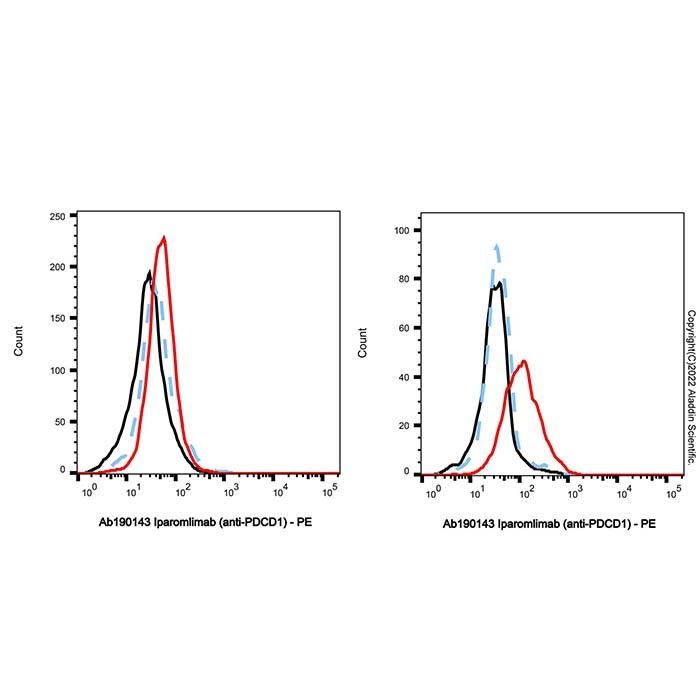
Iparomlimab (anti-PDCD1) (Ab190143) - Flow Cytometry
Flow Cytometry analysis of unstimulated (left) or 500 ng/mL Ionomycin (I139530) and 10 ng/mL PMA (P408905) co-stimulated (right) Jurkat cells labelling PDCD1 (red) with Iparomlimab (anti-PDCD1) (Ab190143) at 0.1 μg/mL for 1 hour at 4°C. Goat Anti-Human IgG (PE) (Ab175838) at a dilution of 1/1000 was used as the secondary antibody. Blue - Isotype control, human IgG (Ab170213). Black - Unlabelled control, cells without incubation with primary antibody.

Iparomlimab (anti-PDCD1) (Ab190143) - ELISA
Immobilized Recombinant Human PD-1 protein (rp176241) at 1.0 μg/mL can bind Iparomlimab (anti-PDCD1) (Ab190143) with the EC₅₀ of 61.89 ng/mL.

Iparomlimab (anti-PDCD1) (Ab190143) - SEC
The purity of Iparomlimab (anti-PDCD1) (Ab190143) is more than 95% verified by HPLC.

고급 데이터

관련 대상(인간)
PDCD1 Tclin Programmed cell death protein 1 (0 Activities)
Activity TypeActivity Value -log(M)Mechanism of ActionActivity ReferencePublications (PubMed IDs)
PDCD1 Tclin Programmed cell death protein 1 (14 Activities)
Activity TypeRelationActivity valueUnitsAction TypeJournalPubMed IddoiAssay Aladdin ID
작용 메커니즘
인증서(CoA, COO, BSE/TSE 및 분석 차트)
C of A & Other Certificates(BSE/TSE, COO):
Analytical Chart:

Find and download the COA for your product by matching the lot number on the packaging.

3 results found

Lot NumberCertificate Type날짜항목
ZJ24F1216305ZJ24F1216305Certificate of AnalysisOct 08, 2026 Ab190143
ZJ24F1216306ZJ24F1216306Certificate of AnalysisOct 08, 2026 Ab190143
ZJ24F1216307ZJ24F1216307Certificate of AnalysisOct 08, 2026 Ab190143
솔루션 계산기
리뷰

고객 리뷰

Application Protocols

Tested applications, recommended dilutions, incubation times, and positive controls: Not specified for this item; refer to CoA/Spec Sheet.

General guidance (non‑validated, for planning only):

  • Start with small‑scale titrations to identify the optimal working concentration in your matrix (cell type, fixation, antigen abundance).
  • Validate species cross‑reactivity and matrix compatibility (cells, tissues, lysates) before large studies.
  • For conjugation or detection strategies (enzymatic/fluorescent), ensure buffer compatibility and absence of interfering carriers/preservatives.

Because this product is carrier‑free and azide‑free, it is suitable for downstream conjugation and live‑cell applications, provided sterile technique is used. Defer to the product CoA for any vendor‑validated protocols.

Biological Roles

Target: PDCD1 (Programmed Cell Death Protein 1, PD‑1)

General biology (literature; not product‑specific):

  • PD‑1 is a type I transmembrane receptor expressed on activated T cells, B cells, NK cells, and some myeloid cells. Its cytoplasmic tail contains ITIM and ITSM motifs that recruit SHP2 phosphatase to attenuate TCR/BCR signaling.
  • Ligands PD‑L1 (CD274) and PD‑L2 (PDCD1LG2) are expressed on antigen‑presenting cells and many tissue types; engagement modulates immune tolerance, exhaustion, and peripheral homeostasis.
  • PD‑1 surface levels are dynamically regulated by activation state, cytokines, and chronic antigen exposure.

Research relevance:

  • Mapping of immune checkpoint pathways, T‑cell functional states, and exhaustion signatures in cancer immunology and chronic infection models (in vitro/ex vivo).
  • Mechanistic dissection of SHP2‑dependent inhibitory signaling, co‑receptor crosstalk (e.g., with CD28), and transcriptional programs linked to PD‑1 signaling.
  • Biomarker development workflows: Quantitation of PD‑1 expression on immune subsets by flow cytometry and spatial profiling by immunohistochemistry.

Notes for use:

  • Verify species cross‑reactivity of the antibody against your sample source (human/mouse/other). Species reactivity for this item is not specified; consult the CoA.
  • Control strategies: Include isotype controls and PD‑1 knockout/blocked controls to confirm specificity in your assay context.
Buffer Applications

Item‑specific buffer composition and concentration: Not specified for this item; refer to CoA/Spec Sheet.

General buffer guidance for antibody handling and assays:

  • Handling/dilution buffers: PBS (10–50 mM phosphate, 150 mM NaCl, pH 7.2–7.6) or 20–50 mM HEPES, 150 mM NaCl, pH 7.2–7.6. Maintain isotonicity for live‑cell work.
  • Additives: Since this product is carrier‑free and azide‑free, consider low levels of non‑interfering stabilizers when compatible with your assay (e.g., 2–5% glycerol, sugars) to reduce adsorption and freeze–thaw stress. Do not add sodium azide if planning HRP‑based detection or live‑cell assays.
  • Blocking buffers for ELISA/IF/FC: 1–5% BSA or casein can reduce nonspecific binding, but avoid carriers during conjugation workflows. For flow cytometry, include Fc‑block reagents where appropriate.
  • Storage buffer adjustments: If long‑term storage at −20 to −80°C is required, aliquot and consider cryoprotectants (e.g., 10–50% glycerol) only if compatible with downstream use. This item’s supplied buffer and recommended storage diluent are not specified.

pH considerations:

  • Most IgGs are stable near neutral pH; avoid prolonged exposure to pH <5 or >9 to limit aggregation or deamidation unless performing controlled elutions or conjugation steps.
Green Alternatives

Antibody reagents inherently minimize organic solvent usage; environmental impact centers on cold‑chain logistics and single‑use plastics.

Greener practice recommendations (general):

  • Format efficiency: Use concentrated stocks and prepare small aliquots to reduce waste from stability losses. If lyophilized formats are available for similar reagents, they can lower shipping mass and dry‑ice use (format for this item is not specified).
  • Shipment consolidation: Combine orders to reduce cumulative dry ice and packaging.
  • Reusable cold packs and insulated shippers where validated by your institution.
  • Plastic reduction: Employ low‑bind, recyclable plastics where compatible; plan experiments to minimize consumable waste.
  • Buffer choices: Prefer phosphate or HEPES buffers and avoid hazardous preservatives; this item is azide‑free by design.

Comparison (general):

  • Azide‑containing antibodies: Convenient for long‑term refrigeration but hazardous for drains and incompatible with live cells/HRP systems.
  • Azide‑free (this item): Environmentally preferable for disposal and compatible with live‑cell/enzymatic systems, with the tradeoff of requiring stricter aseptic handling and frozen storage.
Pharmaceutical Uses

No clinical or therapeutic claims are made for this product. For research use only.

Relevant roles in pharmaceutical R&D and manufacturing (general):

  • Analytical reagent: Reference binder for PD‑1 in ligand‑binding assays (ELISA, SPR/BLI) during development of PD‑1/PD‑L1 pathway biologics.
  • Bioassay controls: Positive controls in cell‑based reporter assays evaluating PD‑1 pathway modulation in vitro.
  • Process development: Tool for assessing expression and purification of recombinant PD‑1 ectodomains or for affinity purification matrices after conjugation (if validated internally).
  • Companion assay development: Characterization of PD‑1 expression on engineered cell lines used in potency assay systems.

Regulatory and compendial status:

  • Not a pharmacopeial standard material. Not intended for human or veterinary administration.
  • GMP status is not indicated; use within non‑GxP or as per your quality system requirements. For regulated use, qualify the reagent internally and retain CoA/lot traceability.
Physical Properties

Item‑specific physicochemical specifications (concentration, buffer composition, absorbance, extinction coefficient, pI, osmolality): Not specified for this item; refer to CoA/Spec Sheet.

Literature/general properties for IgG‑class antibodies (for context only; not product specifications):

  • Apparent molecular mass: ~150 kDa for full‑length IgG; fragments (Fab/F(ab')2) are smaller. Actual mass depends on subclass, sequence, and glycosylation.
  • Isoelectric point (pI): Commonly in the 6–9 range depending on sequence (literature).
  • Solubility: Highly soluble in aqueous buffers (PBS, HEPES) with stability enhancers (e.g., sugars, proteins) when present; this item is carrier‑free per product data (no added protein carrier).
  • Optical properties: Protein A280 for concentration estimation; typical IgG A280 1.0 ≈ ~0.7 mg/mL using ε ≈ 1.4 (mg/mL)⁻¹·cm⁻¹ (literature; sequence‑dependent).
  • Physical state/appearance: Not specified for this item; refer to CoA/Spec Sheet.
  • Density, refractive index, BP/MP, logP: Not applicable to protein solutions; not specified.

Practical notes (general): Maintain cold chain to preserve tertiary structure; avoid surface adsorption in low‑protein matrices (carrier‑free format) by using low‑bind plastics and minimizing air–liquid interfaces.

Quality and Grades

This antibody is supplied with multiple quality designations aimed at reproducible, assay‑ready performance:

  • Animal Free: Manufactured without animal‑derived components to reduce adventitious agent risk and variability; compatible with studies sensitive to animal components.
  • Carrier Free: No protein carriers (e.g., BSA) are added—facilitates precise protein quantitation, conjugation, and functional assays without carrier interference. Handle carefully to minimize adsorption.
  • Recombinant: Sequence‑defined production in controlled expression systems for lot‑to‑lot consistency compared to hybridoma‑derived materials.
  • ExactAb™: Proprietary manufacturing/standardization approach (vendor program) indicating heightened batch consistency and identity control. Specific metrics are not disclosed here.
  • Low Endotoxin: Manufactured to low endotoxin levels suitable for cell‑based assays sensitive to TLR4 activation. Exact endotoxin specification: Not specified for this item; refer to CoA/Spec Sheet.
  • Azide Free: Lacks sodium azide preservative—preferred for live‑cell applications and enzyme‑based detection systems; requires aseptic handling.
  • Validated: Indicates internal application verification; precise tested applications and species: Not specified for this item; refer to CoA/Spec Sheet.

What this means practically:

  • Greater reproducibility across lots for binding and functional studies.
  • Ready for sensitive cell‑based experiments where carriers, azide, or endotoxin are concerns.
  • Users should review the CoA for exact assay validations, concentration, and binding QC (e.g., ELISA/SPR acceptance criteria) specific to the received lot.
Reaction and Applications

As a recombinant anti‑PDCD1 antibody, Iparomlimab is designed for immunochemical and functional cell‑biology assays. Typical research applications (general guidance; item‑specific validations are not provided here):

  • Target detection: Capture/detection of PD‑1 (PDCD1) in ELISA, Western blot, and immunoprecipitation. Binding to the extracellular domain is generally required for native cell‑surface detection.
  • Cell‑based assays: Flow cytometry for PD‑1 expression profiling on T, B, and myeloid subsets; immunofluorescence of fixed cells/tissues where PD‑1 is expressed. Permeabilization requirements depend on epitope accessibility.
  • Functional blockade/ligand interference (in vitro): Probing PD‑1/PD‑L1 or PD‑1/PD‑L2 interactions and downstream signaling in cell culture systems (e.g., reporter assays) to study checkpoint biology. Blocking capability of this specific item is not specified; verify in the CoA.
  • Affinity/kinetics characterization: Suitable as analyte or ligand in BLI/SPR assays to quantify PD‑1 binding interactions.
  • Conjugation: Carrier‑free, azide‑free format is suitable for site‑nonspecific labeling (e.g., NHS esters for dyes/enzymes) or site‑specific approaches when sequence permits. Buffer exchange into amine‑free media before NHS conjugation.

Practical tips:

  • Titrate antibody for each assay and cell type. Validate specificity using PD‑1–positive and PD‑1–knockout controls.
  • Maintain cold chain; minimize freeze–thaw to preserve affinity and reduce aggregation.
Reaction Conditions

Not applicable in the context of chemical reactions. As a biological reagent, performance depends on immunoassay conditions rather than synthetic reaction parameters.

General assay condition guidance (literature; not product‑specific):

  • ELISA: Coating with PD‑1 antigen at 0.5–2 µg/mL in carbonate buffer (pH ~9.6), blocking with 1–5% BSA/casein, antibody titration, detection via anti‑species secondary if unconjugated.
  • Flow cytometry: Stain on ice or at 4°C in PBS + 1–2% protein + 0.1% sodium azide if compatible (this item is azide‑free as supplied; add preservatives only if appropriate for your assay). Include Fc block where needed. Optimize antibody concentration empirically.
  • SPR/BLI: Use HBS‑EP or PBS‑based running buffers, 0.005–0.05% surfactant to minimize non‑specific binding; capture via Protein A/G or anti‑Fc where applicable.

Exact working concentrations, incubation times, and validated conditions for this specific product: Not specified; consult the CoA/Spec Sheet and optimize for your system.

Safety and Handling
  • GHS classification / pictograms / H‑statements: Not specified for this item; consult the SDS.
  • Expected hazard profile: Protein research reagent without sodium azide (azide‑free). Nevertheless, handle using good laboratory practice.

PPE and handling:

  • Wear lab coat, gloves, and eye protection when handling solutions and frozen vials.
  • Work on ice or at 2–8°C during set‑up to limit proteolysis/aggregation.

Incompatibilities and stability:

  • Avoid repeated freeze–thaw cycles (explicit in product data). Aliquot immediately upon first thaw to minimize activity loss and aggregation.
  • Avoid microbial contamination; use sterile tools and biosafety cabinet where appropriate.
  • Do not mix with strong oxidizers or proteases. Avoid foaming and vigorous vortexing that increase air–liquid interfaces.

First‑aid (general guidance; defer to SDS):

  • Skin/eye contact: Rinse with water. Remove contaminated clothing. Seek medical attention if irritation persists.
  • Ingestion/inhalation: Rinse mouth, move to fresh air, seek medical advice.

Spill & disposal:

  • Absorb small spills with inert material, disinfect surfaces, and dispose according to institutional biosafety procedures for biological materials.

Shipping & storage risks:

  • Shipped on dry ice + cold packs (per product data). Keep frozen at receipt. Thermal excursions and refreezing after thaw can reduce performance.
Solvent Selection

Not typically applicable to antibodies. This product is an aqueous protein reagent, and performance is governed by buffer composition rather than organic solvent selection.

Practical guidance:

  • Use physiological buffers (e.g., PBS, HEPES) at neutral pH for handling and dilution unless your assay requires otherwise. Buffer composition for this item is not specified; consult the CoA/Spec Sheet.
  • For carrier‑free, azide‑free antibodies, include sterile technique and consider low‑bind plastics to minimize adsorption.
  • If preparing conjugates (enzymes, fluorophores), ensure the buffer lacks primary amines or competing nucleophiles when using amine‑reactive chemistries.

For details on suitable buffer systems and additives, see the Buffer Applications and Storage & Reconstitution sections.

Storage and Reconstitution
  • Storage conditions: Store at −80°C (per product data). Avoid repeated freezing and thawing.
  • Shipment: Dry ice packs + cold packs (per product data). Upon receipt, place immediately at the recommended storage temperature.
  • Appearance/formulation/concentration: Not specified for this item; refer to CoA/Spec Sheet.

Handling recommendations (general):

  • Thaw on ice and mix gently by slow inversion; avoid foaming. Brief, low‑speed centrifugation can collect contents from the cap.
  • Aliquot immediately after the first thaw to single‑use volumes to prevent freeze–thaw cycles.
  • Use low‑bind tubes and sterile technique, especially for carrier‑free, azide‑free materials.
  • If buffer exchange or concentration adjustment is needed, employ sterile centrifugal filters with appropriate MWCO under cold conditions.

Reconstitution: Not specified for this item; refer to CoA/Spec Sheet. If the product is supplied lyophilized (not specified here), reconstitute with sterile, neutral pH buffer (e.g., PBS) to the desired concentration and allow complete dissolution on ice before use.

Stability: Item‑specific shelf life and post‑thaw stability are not provided; consult the CoA/SDS and validate stability in your application.

Research Use Only: For research use only; not for diagnostic or therapeutic procedures.

Structure and Identity

A recombinant monoclonal antibody research reagent directed against PDCD1 (Programmed Cell Death 1, PD‑1), provided as an animal‑free, carrier‑free, azide‑free, low‑endotoxin ExactAb™ format.

  • Product name: Iparomlimab (anti‑PDCD1)
  • CAS: 2417649-33-1
  • Category: Antibody (recombinant monoclonal)
  • Intended use: Research use only (not for diagnostic/therapeutic use)
  • Structural class: Immunoglobulin (antibody) protein comprising two heavy and two light chains with inter‑ and intra‑chain disulfide bonds (general antibody architecture; literature)
  • Epitope/clone/isotype: Not specified for this item; refer to CoA/Spec Sheet.
  • Molecular formula: Not specified for this item; refer to CoA/Spec Sheet.
  • Molecular weight: Not specified for this item; refer to CoA/Spec Sheet. • Typical full‑length IgG ~150 kDa (literature)
  • Sequence/SMILES/InChI/InChIKey: Not applicable to proteins; not provided for this item.

2D description (general for IgG; literature): Y‑shaped heterotetramer with two antigen‑binding Fab arms (variable domains VH/VL containing CDRs) and one Fc region (CH2/CH3) mediating effector interactions. Glycosylation at conserved Fc Asn site is typical for IgG unless engineered otherwise (not specified here). This item specifically recognizes PDCD1; further epitope mapping details are not provided in the product data.

Synthetic Utility

Not applicable. This product is a recombinant antibody, not a small‑molecule building block or catalyst. It is not typically used in organic synthesis.

For researchers seeking chemical modification:

  • Conjugation chemistries (general): NHS‑ester labeling of lysines, maleimide coupling to reduced cysteines, enzymatic Fc glycan remodeling, or site‑specific methods (e.g., Sortase A, click chemistry) can be applied to antibodies. Buffer exchange into amine‑free, reducing‑agent‑free media is usually required.
  • Note: Any conjugation workflow should be qualified in‑house. No conjugation specifications or recommended protocols are provided for this item.
Target Specificity
  • Antigen: PDCD1 (Programmed Cell Death Protein 1, PD‑1)
  • Alternate names: CD279
  • Host/Isotype/Clone: Not specified for this item; refer to CoA/Spec Sheet.
  • Species reactivity: Not specified for this item; refer to CoA/Spec Sheet.
  • Epitope: Not specified for this item; refer to CoA/Spec Sheet.
  • Conjugate: None specified; refer to CoA/Spec Sheet.
  • Validation status: Validated (per product data). Specific validated applications/conditions are not provided here; consult the CoA.

Notes:

  • PD‑1 is a cell‑surface receptor; confirm whether this antibody recognizes native (non‑denatured) epitopes for flow cytometry/live‑cell staining versus denatured epitopes for Western blot.
  • Always include appropriate positive/negative controls (e.g., PD‑1–expressing vs knockout cells) to verify specificity in your assay context.

자주 묻는 질문

What does Animal Free mean?
Animal Free indicates that the material has been processed and tested for specialty industrial processing. Specifications focus on the impurities that affect performance in that application — for example, metal content for electronics, particle size for batteries, refractive index for optics, or moisture content for moisture-sensitive processes.
What does Carrier Free mean?
Carrier Free indicates that the material has been processed and tested for specialty industrial processing. Specifications focus on the impurities that affect performance in that application — for example, metal content for electronics, particle size for batteries, refractive index for optics, or moisture content for moisture-sensitive processes.
How should this product be stored?
Store at ?80 °C. Avoid repeated freeze–thaw cycles. Aliquot into single-use volumes before freezing.
How is this product shipped?
This product ships frozen with dry ice and cold packs. Unpack on arrival and transfer it to the storage condition stated above; handle dry ice with insulated gloves in a ventilated area.
What are the CAS number, molecular formula and molecular weight?
The CAS Number is 2417649-33-1.
What documentation is provided?
Available product documentation, including Certificates of Analysis (COA), Safety Data Sheets (SDS), and specification sheets, is shown in the product document area. Document availability and access follow the current site policy.
Which species reactivity has this antibody been validated against?
Validated reactivity is listed on the PDP and on each lot's datasheet. We validate against the most commonly tested species for the target (Iparomlimab (anti-PDCD1)); cross-reactivity in untested species may exist but is not guaranteed. Contact technical support for specific species inquiries.

등급 선택에 도움이 필요하신가요?

당사의 등급 선택 가이드는 카탈로그의 모든 변형 제품에 대해 순도, 안정제 상태 및 용도 적합성을 다룹니다.

Animal Free 등급 가이드 보기 → Carrier Free 등급 가이드 보기 → Recombinant 등급 가이드 보기 → Validated 등급 가이드 보기 → ExactAb™ 등급 가이드 보기 → Low Endotoxin 등급 가이드 보기 → Azide Free 등급 가이드 보기 →

관련 상품

Camrelizumab (anti-PD-1) - 1차 항체, for Flow,ELISA,Functional Assay,Kinetics (BLI),Kinetics (SPR) various applications, specific to PDCD1, >95%, Human IgG4SP, ANTAGONIST of Programmed cell death protein 1 antagonist
Cemiplimab (anti-PD-1) - 1차 항체, for ELISA,Functional Assay,Kinetics (BLI),Kinetics (SPR),Flow Cyt various applications, specific to PDCD1, >95%, Human IgG4, Antibody of programmed cell death 1 (CD279)
Nivolumab (anti-PD-1) - 1차 항체, for ELISA,Functional Assay,Flow cytometry,Kinetics (BLI),Kinetics (SPR) various applications, specific to PDCD1/PD-1/CD279, >95%, Human IgG4SP, Antibody of programmed cell death 1 (CD279)
Pembrolizumab (anti-PD-1) - 1차 항체, for ELISA,Functional Assay,Flow cytometry,Kinetics (BLI),Kinetics (SPR) various applications, specific to PDCD1, >95%, Human IgG4SP, Antibody of programmed cell death 1 (CD279)
Mouse Anti-Human IgM Antibody - 2차 항체, for ELISA various applications, from Human, generated in Mouse, IgG1
Mouse Anti-Human IgG H&L (HRP) - 2차 항체, for ELISA various applications, from Human, generated in Mouse, IgG1
Goat Anti-Human IgG H&L (HRP) - 2차 항체, for WB,ELISA,IHC various applications, from Human, generated in Goat, IgG
Mouse Anti-Human IgG Antibody - 2차 항체, for ELISA,CLIA various applications, from Human, generated in Rat, IgG1
Human IgG - 아이소타입 대조 항체, for WB,CLIA,LF,EIA,PRTIA various applications, generated in Human, >95%, IgG
Spartalizumab (anti-PD-1) - 1차 항체, for ELISA,Functional Assay,Kinetics (BLI),Kinetics (SPR),Flow Cyt various applications, specific to PDCD1, >95%, Human IgG4SP, Antibody of programmed cell death 1 (CD279)
Penpulimab (anti-PDCD1) - 1차 항체, for ELISA,Functional Assay,Flow cytometry,Kinetics (BLI),Kinetics (SPR) various applications, specific to PDCD1, >95%, Human IgG1, Antibody of programmed cell death 1 (CD279)
Sintilimab (anti-PD-1) - 1차 항체, >95%, Human IgG4SP, ANTAGONIST of Programmed cell death protein 1 antagonist
Dostarlimab (anti-PD-1) - 1차 항체, specific to PDCD1, >95%, Human IgG4SP, Antibody of programmed cell death 1 (CD279)
Pidilizumab (anti-PD-1) - 1차 항체, specific to PDCD1, Human IgG1, INHIBITOR of Programmed cell death protein 1 inhibitor
Retifanlimab (anti-PD-1) - 1차 항체, specific to PDCD1, >95%, Human IgG4SP, Antibody of programmed cell death 1 (CD279)
Zimberelimab (anti-PD-1) - 1차 항체, specific to PDCD1, >95%, Human IgG4SP, Antibody of programmed cell death 1 (CD279)
Tislelizumab (anti-PDCD1) - 1차 항체, specific to PDCD1, >95%, Human IgG4SP, INHIBITOR of Programmed cell death protein 1 inhibitor
Goat Anti-Human IgG Antibody - 2차 항체, ≥ 95%
Mouse Anti-Human IgA H&L Antibody - 2차 항체, Mouse IgG1
Goat Anti-Human IgG (HRP) - 2차 항체
Goat Anti-Human IgG (Biotin) - 2차 항체
PD1 Mouse mAb - 1차 항체, specific to PD1, Mouse IgG1
Goat Anti-Human IgG (Cy5) - 2차 항체
Goat Anti-Human IgG (APC) - 2차 항체
Goat Anti-Human IgG (PE) - 2차 항체
Goat Anti-Human IgG (TRITC) - 2차 항체
Goat Anti-Human IgG (FITC) - 2차 항체
Serplulimab (anti-PDCD1) - 1차 항체, specific to PDCD1, >95%, Human IgG4SP, ANTAGONIST of Programmed cell death protein 1 antagonist
Mouse Anti-Human IgE epsilon chain Antibody - 2차 항체
Cetrelimab (anti-PDCD1) - 1차 항체, specific to PDCD1, >95%, Human IgG4SP, INHIBITOR of Programmed cell death protein 1 inhibitor
Geptanolimab (anti-PDCD1) - 1차 항체, specific to PDCD1, >95%, Human IgG4SP
Goat Anti-Human IgG Fc Antibody - 2차 항체, Goat IgG
Budigalimab (anti-PD-1) - 1차 항체, specific to PDCD1, Human IgG1, INHIBITOR of Programmed cell death protein 1 inhibitor
Sasanlimab (anti-PD-1) - 1차 항체, specific to PDCD1, Human IgG4SP, ANTAGONIST of Programmed cell death protein 1 antagonist
Balstilimab (anti-PD-1) - 1차 항체, specific to PDCD1, Human IgG4SP-Opti, ANTAGONIST of Programmed cell death protein 1 antagonist
Pimivalimab (anti-PD-1) - 1차 항체, specific to PDCD1, >95% (SDS-PAGE&SEC), Human IgG4SP, INHIBITOR of Programmed cell death protein 1 inhibitor
Ezabenlimab (anti-PD-1) - 1차 항체, specific to PDCD1, >95% (SDS-PAGE&SEC), Human IgG4SP
Toripalimab (anti-PD-1) - 1차 항체, specific to PDCD1, Human IgG1, ANTAGONIST of Programmed cell death protein 1 antagonist
Human IgG2-Kappa - 아이소타입 대조 항체, Human IgG2
Human IgG3-kappa - 아이소타입 대조 항체, Human IgG3
Finotonlimab (anti-PD-1) - 1차 항체, specific to PDCD1, Human IgG4SP, INHIBITOR of Programmed cell death protein 1 inhibitor
PD1 Mouse mAb (FITC) - 1차 항체, specific to PD1, Mouse IgG1
PD1 Mouse mAb (PE) - 1차 항체, specific to PD1, Mouse IgG1
PD1 Mouse mAb (APC) - 1차 항체, specific to PD1, Mouse IgG1
PD1 Mouse mAb (Biotin) - 1차 항체, specific to PD1, Mouse IgG1
Peresolimab (anti-PD-1) - 1차 항체, specific to PDCD1, Human IgG1
Rosnilimab (anti-PD-1) - 1차 항체, specific to PDCD1, Human IgG1
PD1/CD279 Mouse mAb - 1차 항체, specific to PD1/CD279, Mouse IgG1
Human IgG1-kappa, anti-Spike RBD - 아이소타입 대조 항체, specific to Spike RBD, Human IgG1
Human IgG4-kappa - 아이소타입 대조 항체, IgG4
Goat Anti-Human IgG (AF647) - 2차 항체, IgG
Goat Anti-Human IgG (AF405) - 2차 항체, IgG
Human IgG (FITC) - 아이소타입 대조 항체, IgG
Human IgG (APC) - 아이소타입 대조 항체, IgG
Human IgG (PE) - 아이소타입 대조 항체, IgG
Human IgG1(P331S/E430G)-kappa, anti-HEL - 아이소타입 대조 항체, specific to HEL, Human IgG1(P331S/E430G)
Human IgG1(D265A/N297A)-kappa, anti-HEL - 아이소타입 대조 항체, specific to HEL, Human IgG1(D265A/N297A)
Human IgG1(K409R/E356D/M358L)-kappa, anti-HEL - 아이소타입 대조 항체, specific to HEL, Human IgG1(K409R/E356D/M358L)
Human IgG1(P329G/E356D/M358L)-kappa, anti-HEL - 아이소타입 대조 항체, specific to HEL, Human IgG1(P329G/E356D/M358L)
Human IgG1(F405L)-kappa, anti-HEL - 아이소타입 대조 항체, specific to HEL, Human IgG1(F405L)
Human IgG1(N297Q)-kappa, anti-HEL - 아이소타입 대조 항체, specific to HEL, Human IgG1(N297Q)
Human IgG (Biotin) - 아이소타입 대조 항체, IgG
Human IgG1(N297S)-kappa, anti-HEL - 아이소타입 대조 항체, specific to HEL, Human IgG1(N297S)
Human IgG1(E233A/L235A)-kappa, anti-HEL - 아이소타입 대조 항체, specific to HEL, Human IgG1(E233A/L235A)
Human IgG1(K214R/N297A)-kappa, anti-HEL - 아이소타입 대조 항체, specific to HEL, Human IgG1(K214R/N297A)
Human IgG1(K214R/L234A/L235A)-kappa, anti-HEL - 아이소타입 대조 항체, specific to HEL, Human IgG1(K214R/L234A/L235A)
Human IgG1(N297A/E356D/M358L)-kappa, anti-HEL - 아이소타입 대조 항체, specific to HEL, Human IgG1(N297A/E356D/M358L)
Human IgG1(L234F/L235E)-kappa, anti-HEL - 아이소타입 대조 항체, specific to HEL, Human IgG1(L234F/L235E)
Human IgG1(D265A)-kappa, anti-HEL - 아이소타입 대조 항체, specific to HEL, Human IgG1(D265A)
Human IgG1(K214R/L234F/L235E/P331S)-kappa, anti-HEL - 아이소타입 대조 항체, specific to HEL, Human IgG1(K214R/L234F/L235E/P331S)
Human IgG1(K214R/E356D/M358L)-kappa, anti-HEL - 아이소타입 대조 항체, specific to HEL, Human IgG1(K214R/E356D/M358L)
Human IgG1(L234A/L235A/G237A)-kappa, anti-HEL - 아이소타입 대조 항체, specific to HEL, Human IgG1(L234A/L235A/G237A)
Human IgG1(L234A/L235A/F405L)-kappa, anti-HEL - 아이소타입 대조 항체, specific to HEL, Human IgG1(L234A/L235A/F405L)
Human IgG1(D270N)-kappa, anti-HEL - 아이소타입 대조 항체, specific to HEL, Human IgG1(D270N)
Human IgG4(S228P)-kappa, anti-HEL - 아이소타입 대조 항체, specific to HEL, Human IgG4(S228P)
Human IgG1(N297A)-kappa, anti-HEL - 아이소타입 대조 항체, specific to HEL, Human IgG1(N297A)
Human IgG4(S228P/L235E/P329G)-kappa, anti-HEL - 아이소타입 대조 항체, specific to HEL, Human IgG4(S228P/L235E/P329G)
Human IgG1-lambda1, anti-Spike RBD - 아이소타입 대조 항체, specific to Spike RBD, Human IgG1
Human IgG1-lambda2, anti-Spike RBD - 아이소타입 대조 항체, specific to Spike RBD, Human IgG1
Prolgolimab (anti-PDCD1) - 1차 항체, specific to PDCD1, Human IgG1
Nofazinlimab (anti-PDCD1) - 1차 항체, specific to PDCD1, Human IgG4SP
Rulonilimab (anti-PDCD1) - 1차 항체, specific to PDCD1, Human IgG1
Goat Anti-Human IgG (AF555) - 2차 항체, IgG
Human IgG1-kappa (AF405), anti-Spike RBD - 아이소타입 대조 항체, specific to Spike RBD
Human IgG1-kappa (AF647), anti-Spike RBD - 아이소타입 대조 항체, specific to Spike RBD
Human IgG1-kappa (APC), anti-Spike RBD - 아이소타입 대조 항체, specific to Spike RBD
Human IgG1-kappa (Biotin), anti-Spike RBD - 아이소타입 대조 항체, specific to Spike RBD
Human IgG1-kappa (AF700), anti-Spike RBD - 아이소타입 대조 항체, specific to Spike RBD
Human IgG1-kappa (FITC), anti-Spike RBD - 아이소타입 대조 항체, specific to Spike RBD
Human IgG1-kappa (AF555), anti-Spike RBD - 아이소타입 대조 항체, specific to Spike RBD
Centrose patent anti-dysadherin (anti-Dysadherin) - 1차 항체, specific to FXYD5
Human IgG (AF647) - 아이소타입 대조 항체
Human IgG (AF488) - 아이소타입 대조 항체
Human IgG (AF700) - 아이소타입 대조 항체
Human IgG (AF405) - 아이소타입 대조 항체
Goat Anti-Human IgG (AF488) - 2차 항체
Goat Anti-Human IgG Fc (Cy5) - 2차 항체
Goat Anti-Human IgG Fc (AF555) - 2차 항체, specific to Human IgG Fc
Goat Anti-Human IgG Fc (TRITC) - 2차 항체
Goat Anti-Human IgG Fc (AF700) - 2차 항체, specific to Human IgG Fc
Goat Anti-Human IgG Fc (AF405) - 2차 항체
Goat Anti-Human IgG Fc (Biotin) - 2차 항체, specific to Human IgG Fc
Goat Anti-Human IgG Fc (AF647) - 2차 항체
Goat Anti-Human IgG Fc (FITC) - 2차 항체, specific to Human IgG Fc
Human IgG (AF555) - 아이소타입 대조 항체

Shall we send you a message when we have discounts available?

Remind me later

Thank you! Please check your email inbox to confirm.

Oops! Notifications are disabled.