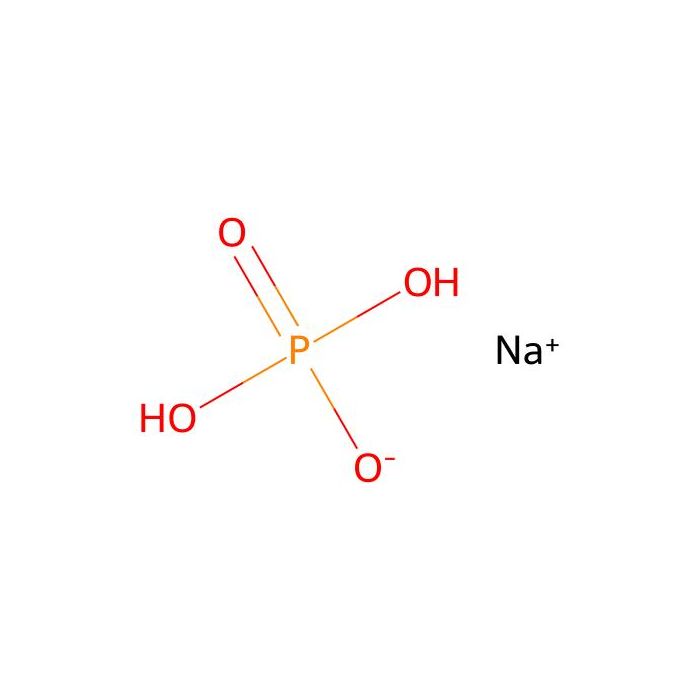
Sodium phosphate monobasic - Anhydrous Grade, purum p.a., ≥99%(T) , CAS No.7558-80-7

CAS: 7558-80-7 Cat. No.: S755544 분자식: NaH2PO4 분자량: 119.98 Beilstein Registry Number: 3903772 EC 번호: 231-449-2
주문 가능
GRADE & PURITY Anhydrous Grade ? Anhydrous grade — water removed and packaged dry for moisture-sensitive chemistry. Use in reactions where even trace water would interfere or quench. purum p.a. ? Purum pro analysi — pure grade meeting analytical specifications. Use for analytical applications where purum-level purity is validated for analysis. ≥99%(T)
Storage
Room temperature
Shipped In
Normal
★
Size
USA
독일 (EU)*
Price
Qty
250g
S755544-250g
주문제작 · 8~12주
US$184.90
Enter a quantity for the sizes you want to add.
🧪
Why this grade

Anhydrous Grade, purum p.a., ≥99%(T) Anhydrous Grade,purum p.a. for sensitive chromatographic and analytical workflows requiring minimal baseline interference.

🌡

Storage & shipping

Room temperature Ships Normal Check lot-specific COA for exact specifications.

📋

Quality documents

SDS, COA, datasheet, and spec sheet available for download. Lot-specific COA accessible via lot number lookup.

📚

Literature proof

Cited in 2174 peer-reviewed publications across chromatography, organic synthesis, and cross-coupling reactions.

개요

Sodium dihydrogen phosphate can be used for colon cleansing before a colonoscopy.
Sodium dihydrogen phosphate has been used for:
As a source of inorganic phosphate in cell culture media.
Used for preparing phosphate buffered saline.
Used to prepare phosphate buffer solution for glucose determination.

Specifications

사양 및 순도
Anhydrous Grade, purum p.a., ≥99%(T)
보관 조건
Room temperature
배송
Normal
등급
Anhydrous Grade, purum p.a.
순수함
≥99%(T)
이름과 식별자
PH
4.0-4.5 (25 °C, 50 mg/mL in H 2 O)
정식 스마일
OP(=O)(O)[O-].[Na+]
IUPAC Name
sodium;dihydrogen phosphate
InChIKey
AJPJDKMHJJGVTQ-UHFFFAOYSA-M
INCHI
1S/Na.H3O4P/c;1-5(2,3)4/h;(H3,1,2,3,4)/q+1;/p-1
이성체 SMILES
OP(=O)(O)[O-].[Na+]
WGK 독일
1
분자량
119.98
Beilstein
3903772

Documentation

📋 Safety Data Sheet (SDS)

Comprehensive hazard, handling, storage, and regulatory compliance document.

Download SDS →

✅ Certificate of Analysis (COA)

Lot-specific quality data. Enter your lot number to retrieve the exact COA.

Look up COA →

📊 Datasheet

Quick-reference summary of product specifications and applications.

View datasheet →

🔬 Specification Sheet

Full quality attributes and acceptance criteria for this grade.

View spec sheet →

Advanced Data

Taxonomic Classification

Taxonomy Tree

KingdomInorganic compounds
SuperclassMixed metal/non-metal compounds
분류Alkali metal oxoanionic compounds
SubclassAlkali metal phosphates
Intermediate Tree Nodes Not available
Direct ParentAlkali metal phosphates
Alternative Parents Inorganic sodium salts  Inorganic oxides  
Molecular FrameworkNot available
Substituents Alkali metal phosphate - Inorganic sodium salt - Inorganic oxide - Inorganic salt
설명This compound belongs to the class of inorganic compounds known as alkali metal phosphates. These are inorganic compounds in which the largest oxoanion is phosphate, and in which the heaviest atom not in an oxoanion is an alkali metal.
External Descriptors sodium phosphate
3D 구조
상호 작용 화학 구조 모델


인증서(CoA, COO, BSE/TSE 및 분석 차트)
C of A & Other Certificates(BSE/TSE, COO):
Analytical Chart:

Find and download the COA for your product by matching the lot number on the packaging.

1 results found

Lot NumberCertificate Type날짜항목
F2625565Certificate of AnalysisJun 26, 2026 S755544
화학 및 물리적 특성
용해성water: 0.5 g/10 mL, clear, colorless
녹는점(°C)60°C
분자량119.977 g/mol
XLogP3
Hydrogen Bond Donor Count2
Hydrogen Bond Acceptor Count4
Rotatable Bond Count0
Exact Mass119.959 Da
Monoisotopic Mass119.959 Da
Topological Polar Surface Area80.600 Ų
Heavy Atom Count6
Formal Charge0
Complexity61.900
Isotope Atom Count0
Defined Atom Stereocenter Count0
Undefined Atom Stereocenter Count0
Defined Bond Stereocenter Count0
Undefined Bond Stereocenter Count0
The total count of all stereochemical bonds0
Covalently-Bonded Unit Count2
자주 묻는 질문과 기사
The Guide to Anhydrous Grade for Reagents
Common Types of Buffer Solutions
Operational Guide for Fluorescent Labeling of Antibodies Using AF594 NHS Ester
General Principles of Antibody Labeling with NHS-Activated Esters, F/P Calculation, and Troubleshooting Guide
How to Choose a Hydrogen Evolution (HER) Catalyst: Kinetic Barriers in Water Electrolysis, AWE/PEM/AEM Pathways, and a Materials-Family Roadmap (with a Product Map)
TEMPO-Catalyzed Oxidation Quick Reference (Alcohol Oxidation Focus): Three Regeneration Routes (NaOCl / Cu–O₂ / PIDA) + Selection & Troubleshooting
Installing a Redox Switch on Biomolecules: Principles, Conjugation Essentials, and an Application Guide for ATTO MB2 NHS ester
A Review of Ten Commonly Used Techniques for Detection, Quantification, and Interaction Analysis in Nucleic Acid Research
Selection of Common Research Salts: A Task Map for Alkali Metal Salts & Alkaline Earth Metal Salts (with Product Tables 1–6)
Recent Advances in Methods for Measuring Starch-Related Indices in Plants and Their Application-Oriented Selection
Phycocyanin: A Review of Sources, Structural Features, Production Processes, Applications, and Claimed Benefits
Amino Acid Oxidases: Oxygen-Dependent Oxidative Deamination Systems and Their Analytical and Applied Uses
Diaphorase: NAD(P)H-Dependent Electron-Transfer Activity and Its Applications in Detection and Research
Glutathione (GSH) Quantification: Method Systems, Experimental Workflows, and Key Quality-Control Considerations
Haptoglobin (Hp): A Key Carrier in the Free Hemoglobin Clearance–Detoxification Axis, with Assays and Applications
Lipase (Triacylglycerol Hydrolase): Interfacial Catalysis, Selectivity Classes, and Assay/Application Systems
Bromelain: Enzymological Properties and Key Points for Food, Pharmaceutical, and Industrial Applications
Chlorophyll: Structural Features, Physicochemical Properties, and Key Points for Research and Industrial Applications
AmpC β-Lactamases (Cephalosporinases): Mechanisms of Production, Diagnostic Pathways, and Research and Clinical Applications
Chitinases: Substrate-Specific Degradation Mechanisms, Enzymatic Properties, and Application Directions
Whey Protein: Composition Profile, Manufacturing Routes, and Key Product-Type Essentials
From Sucrose to Monosaccharides: Key Enzymatic Nodes and Regulatory Logic in Sugar Conversion
Acetyl-Group Metabolic Enzyme Network and In Vitro Enzymology Analysis
Structural Characteristics, Operational Methods, and Separation Applications of Dextran Gels
Selection Strategy for PBS, TBS, PBST, and TBST Washing Systems in IHC
Preparation Methods and Precautions for Silane Coupling Agent Primer Solutions
The Chemical Basis of Natural Lacquer Durability: Urushiol Structure, Oxidative Polymerization Film Formation, and Coating Film Properties
Comparison of Bilirubin Detection Methods: Application Selection of the Diazo Method, Vanadate Oxidation Method, Bilirubin Oxidase Method, and HPLC
Plant Tissue and Cell Wall Staining Methods: Selection of Light Green, Safranin, Fast Green, and Composite Staining Systems
1,8-Naphthyridine-Based Aldose Reductase Inhibitors: Scaffold Construction, In Vitro Inhibitory Activity, and Directions for Structural Optimization
What Grade Is Purum? From Grade Meaning and Specification Interpretation to Reagent Selection
Citations of This Product
솔루션 계산기
리뷰

고객 리뷰

Need help choosing the grade?

Our grade selection guide covers purity, stabilizer status, and application suitability for all variants in our catalog.

View Anhydrous Grade grade guide → View purum p.a. grade guide →

Shall we send you a message when we have discounts available?

Remind me later

Thank you! Please check your email inbox to confirm.

Oops! Notifications are disabled.