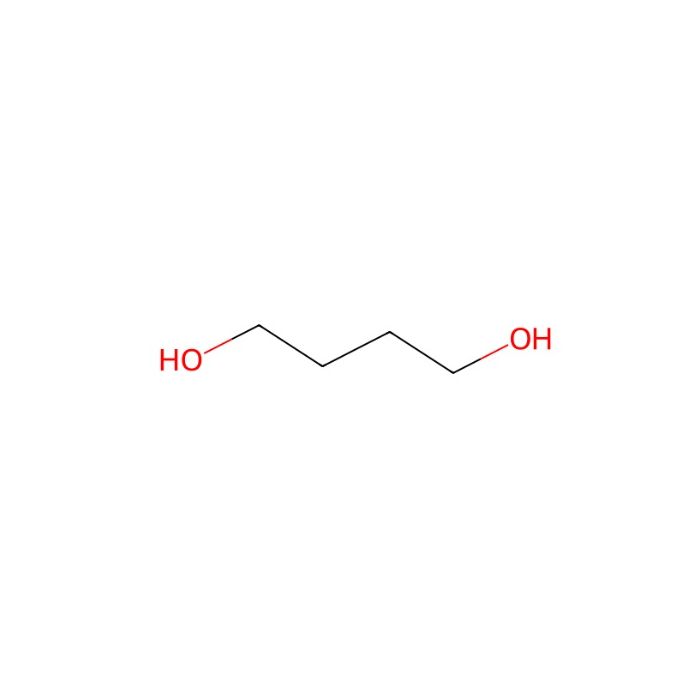
1,4-Butanediol(BDO) - Anhydrous Grade, ≥99%, used for 1,4-Butanediol can be used as a reactant to prepare: Homoallyl alcohol (3-buten-1-ol) and tetrahydrofuran via vapor-phase dehydration using ZrO2 as a catalyst. Poly(1,4-butanediol succinate) polymer by

CAS: 110-63-4 Cat. No.: B1508458 Summenformel: C4H10O2 Molekulargewicht: 90.12 Beilstein Registry Number: 1633445 EG-Nummer: 203-786-5
Zu bestellen verfügbar
QUALITÄT & REINHEIT Anhydrous Grade ? Anhydrous grade — water removed and packaged dry for moisture-sensitive chemistry. Use in reactions where even trace water would interfere or quench. ≥99%
Synonyms
1,4-Butylene Glycol|1,4-Dihydroxybutane|Tetramethylene Glycol
Storage
Room temperature,Argon charged
Shipped In
Normal
★
Größe
Deutschland (EU)
USA*
Preis
Menge
25g
B1508458-25g
Auf Bestellung · 8–12 Wochen
17,27€
100g
B1508458-100g
Auf Bestellung · 8–12 Wochen
43,30€
500g
B1508458-500g
Auf Bestellung · 8–12 Wochen
112,72€
Enter a quantity for the sizes you want to add.

Spezifikationen

Synonyme
1,4-Butylene Glycol | 1,4-Dihydroxybutane | Tetramethylene Glycol
Spezifikationen & Reinheit
Anhydrous Grade, ≥99%
Anmeldung
1,4-Butanediol can be used as a reactant to prepare: Homoallyl alcohol (3-buten-1-ol) and tetrahydrofuran via vapor-phase dehydration using ZrO2 as a catalyst. Poly(1,4-butanediol succinate) polymer by reacting with succinic anhydride. Biodegradable homop
Storage
Room temperature,Argon charged
Verschickt in
Normal
Note
Anhydrous Grade
Reinheit
≥99%
Namen und Kennungen
SMILES
C(CCO)CO
IUPAC Name
butane-1,4-diol
InChIKey
WERYXYBDKMZEQL-UHFFFAOYSA-N
InChI
1S/C4H10O2/c5-3-1-2-4-6/h5-6H,1-4H2
Isomere SMILES
C(CCO)CO
WGK Deutschland
1
RTECS
EK0525000
Molekulargewicht
90.12
Beilstein
1633445
Reaxys
1633445
Reaxys-RN_link_address
https://www.reaxys.com/reaxys/secured/hopinto.do?context=S&query=IDE.XRN=1633445&ln=

Erweiterte Daten

Taxonomic Classification

Taxonomy Tree

KingdomOrganic compounds
SuperclassOrganic oxygen compounds
KlasseOrganooxygen compounds
SubclassAlcohols and polyols
Intermediate Tree Nodes Not available
Direct ParentPrimary alcohols
Alternative Parents Hydrocarbon derivatives  
Molecular FrameworkAliphatic acyclic compounds
Substituents Hydrocarbon derivative - Primary alcohol - Aliphatic acyclic compound
BeschreibungThis compound belongs to the class of organic compounds known as primary alcohols. These are compounds comprising the primary alcohol functional group, with the general structure RCOH (R=alkyl, aryl).
External Descriptors a glycol
3D-Struktur
Interaktives chemisches Strukturmodell


Zertifikate (CoA, COO, BSE/TSE und Analyse-Diagramm)
C of A & Other Certificates(BSE/TSE, COO):
Analytical Chart:

Find and download the COA for your product by matching the lot number on the packaging.

14 results found

Lot NumberCertificate TypeDatumArtikel
K2618257K2618257Certificate of AnalysisNov 04, 2026 B1508458
K2618258K2618258Certificate of AnalysisNov 04, 2026 B1508458
F2630211F2630211Certificate of AnalysisJul 07, 2026 B1508458
J2608152J2608152Certificate of AnalysisJul 07, 2026 B1508458
J2609080J2609080Certificate of AnalysisJul 07, 2026 B1508458
F2630208F2630208Certificate of AnalysisJul 03, 2026 B1508458
F2630209F2630209Certificate of AnalysisJul 03, 2026 B1508458
F2630210F2630210Certificate of AnalysisJul 03, 2026 B1508458
A2630265A2630265Certificate of AnalysisJan 20, 2026 B1508458
A2630266A2630266Certificate of AnalysisJan 20, 2026 B1508458
A2630267A2630267Certificate of AnalysisJan 20, 2026 B1508458
D2627077D2627077Certificate of AnalysisJan 20, 2026 B1508458
D2627078D2627078Certificate of AnalysisJan 20, 2026 B1508458
E2622159E2622159Certificate of AnalysisJan 20, 2026 B1508458
Chemische und physikalische Eigenschaften
LöslichkeitSlightly soluble in ether, miscible with water, soluble in ethanol, etc.
EmpfindlichkeitHygroscopic
Gefrierpunkt (°C)20 °C
Brechungsindex1.442-1.448
Flammpunkt (°F)273.2 °F
Flammpunkt (°C)134℃
Siedepunkt (°C)230°C
Schmelzpunkt (°C)16°C
Molekulargewicht90.12
XLogP3-0.800
Hydrogen Bond Donor Count2
Hydrogen Bond Acceptor Count2
Rotatable Bond Count3
Exact Mass90.0681 Da
Monoisotopic Mass90.0681 Da
Topological Polar Surface Area40.500 Ų
Heavy Atom Count6
Formal Charge0
Complexity17.500
Isotope Atom Count0
Defined Atom Stereocenter Count0
Undefined Atom Stereocenter Count0
Defined Bond Stereocenter Count0
Undefined Bond Stereocenter Count0
The total count of all stereochemical bonds0
Covalently-Bonded Unit Count1
Sicherheit und Gefahren (GHS)
Piktogramm(e)
Signal
Warning
Gefahrenhinweise

H302:Harmful if swallowed

H336:May cause drowsiness or dizziness

Sicherheitshinweise

P261:Avoid breathing dust/fume/gas/mist/vapors/spray.

P264:Wash hands [and …] thoroughly after handling.

P270:Do not eat, drink or smoke when using this product.

P271:Use only outdoors or in a well-ventilated area.

P405:Store locked up.

P403+P233:Store in a well-ventilated place. Keep container tightly closed.

P501:Dispose of contents/container to an approved waste disposal plant.

P301+P312+P330:IF SWALLOWED: Call a POISON CENTER/ doctor if you feel unwell. Rinse mouth.

P304+P340+P312:IF INHALED: Remove person to fresh air and keep comfortable for breathing.Call a POISON CENTER or doctor. if you feel unwell.

WGK Deutschland
1
RTECS
EK0525000
Reaxys
1633445
Reaxys-RN_link_address
https://www.reaxys.com/reaxys/secured/hopinto.do?context=S&query=IDE.XRN=1633445&ln=
FAQs und Artikel
4-[(tert-Butyldimethylsilyl)oxy]butan-1-ol: Experimental Selection Logic as a Monoprotected 1,4-Butanediol Building Block and a Protected C4 Linker
Adding a Temperature-Triggered Switch to NCO: How Blocked Isocyanates Affect the Storage, Curing, and Film Performance of 1K Baking Coatings
How Do Isocyanates and Polyols Affect the Performance of Polyurethane Coating Films: Structure, Raw Material Selection, and Performance Design Essentials
Comprehensive Performance Analysis of Polyurethane Coating Films: Soft/Hard Segment Structure, Microphase Separation, Crosslinking and Curing, and Selection of Representative Chemicals
When Should You Choose Silicone Resin? Selection Comparison with Epoxy, Acrylic, Polyurethane, Fluororesin, and Other Coating Resins
Understanding Polyester Resins for Coatings: Structure Design, Key Indicators, and Coating Film Performance
Polyurethane Coating Resins: Not a Single Resin, but a Designable High-Performance System
Cashew Nut Shell Liquid (CNSL): From Cashew Processing By-Product to Reactive Bio-Based Raw Material for Coating Resins
Waterborne Resin Technology Explained: Waterborne Forms, Performance Balance, and a Technology Map
Guide to Common Waterborne Resin Types and Application-Based Selection: How to Choose Acrylics, PUD, Waterborne Epoxy, Waterborne Alkyd, VAE, and Related Chemicals
Mechanisms and Control of Coating Yellowing: From Chromophoric Structure Formation to Source Diagnosis and Formulation Optimization
Bis-Oxazolidine Latent Curing Agents: Turning Moisture from a Foaming Risk into a Trigger for Moisture Curing
Structure, Degradation Behavior, and Applications of Poly(trimethylene carbonate) (PTMC) in Flexible Absorbable Materials
Differences Between Cast CPU and Thermoplastic TPU in Structure, Processing, Performance, and Applications
Rotary-Evaporation-Assisted Reversible Dehydration Reactions: Reduced-Pressure Evaporation, Removal of Volatile Components, and Equilibrium Response
Citations of This Product
Lösungsrechner
Bewertungen

Kundenbewertungen

Dürfen wir Sie über Rabattaktionen informieren?

Später erinnern

Vielen Dank! Bitte überprüfen Sie Ihren E-Mail-Posteingang, um zu bestätigen.

Hoppla! Benachrichtigungen sind deaktiviert.