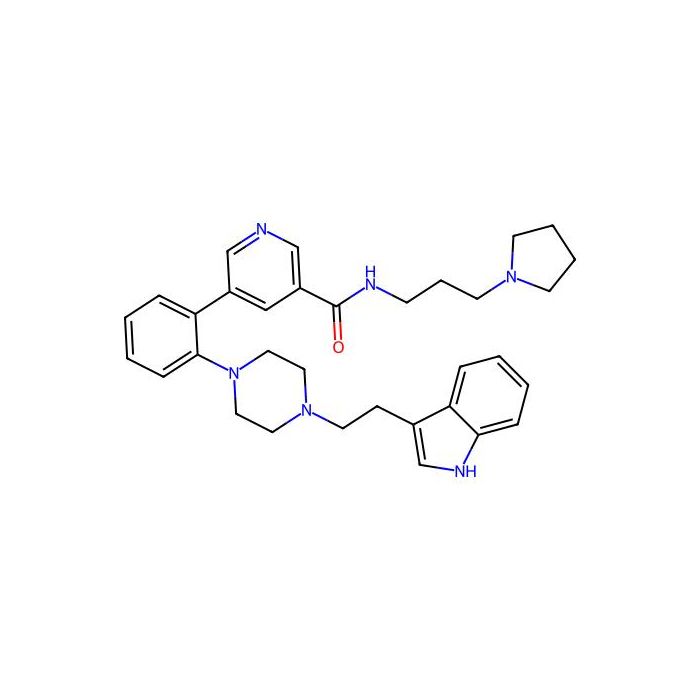
AZ506 is a potent SMYD2 inhibitor with an IC 50 of 17 nM. AZ506 inhibits SMYD2 methyltransferase activity in cells, leading to a decrease in the SMYD2-mediated methylation signal
In Vitro
AZ506 inhibits SMYD2 mediated methylation of monomethyl p53 peptide in U2OS cells with an EC 50 of 1.2 μM. AZ506 inhibits SMYD2-mediated methylation (p53-me in U2OS cells) with an IC 50 of 2.43 μM. MCE has not independently confirmed the accuracy of these methods. They are for reference only.
Form:Solid
IC50& Target:SMYD2 17 nM (IC 50 )
Spezifikationen
Spezifikationen & Reinheit
≥99%
Biochemische und physiologische Mechanismen
AZ506 is a potent SMYD2 inhibitor with an IC 50 of 17 nM. AZ506 inhibits SMYD2 methyltransferase activity in cells, leading to a decrease in the SMYD2-mediated methylation signal.
Storage
Store at -20°C
Verschickt in
Ice chest + Ice pads
Dieses Produkt erfordert Kühlkettenversand. Grundversand und andere Economy-Optionen sind nicht verfügbar.
This compound belongs to the class of organic compounds known as phenylpiperazines. These are compounds containing a phenylpiperazine skeleton, which consists of a piperazine bound to a phenyl group.
External Descriptors
Not available
1. Djoumbou Feunang Y, Eisner R, Knox C, Chepelev L, Hastings J, Owen G, Fahy E, Steinbeck C, Subramanian S, Bolton E, Greiner R, and Wishart DS. ClassyFire: Automated Chemical Classification With A Comprehensive, Computable Taxonomy. Journal of Cheminformatics, 2016, 8:61.
Zertifikate (CoA, COO, BSE/TSE und Analyse-Diagramm)
C of A & Other Certificates(BSE/TSE, COO):
Analytical Chart:
Chemische und physikalische Eigenschaften
Löslichkeit
DMSO : 50 mg/mL (93.16 mM; Need ultrasonic)
Lösungsrechner
Molarity Calculator
Determine the necessary mass, volume, or concentration for preparing a solution.
Dilution Calculator
Determine the dilution needed to prepare a stock solution.
Reconstitution Calculator
Bewertungen
Kundenbewertungen
Application Protocols
No validated, item-specific application protocols are provided for AZ506 in this listing. The following is general guidance for small-molecule testing in plate-based assays.
General protocol (example: 10-point dose–response in 96-well format)
Stock preparation: Dissolve AZ506 in anhydrous DMSO to 10 mM. Vortex and, if needed, sonicate briefly. Filter (0.2 µm PTFE) if particulates persist. Confirm concentration if critical (qNMR or UV–vis).
Serial dilution: Prepare a 1:3 serial dilution series in DMSO to obtain 10 concentrations. Keep DMSO constant in all wells (e.g., final 0.3% v/v).
Plate setup: Add assay buffer/substrate/cells according to your SOP. Add compound aliquots to achieve desired final concentrations. Include vehicle-only and positive/negative controls.
Incubation/readout: Incubate under defined conditions (time/temp/protection from light). Record signal using the validated instrument/assay (e.g., fluorescence, luminescence, absorbance, radiometric, label-free).
Data analysis: Normalize to controls, fit curves (four-parameter logistic), and report IC50/EC50 with Hill slope and confidence intervals. Document batch, lot, and vehicle %.
Notes
Check compound stability over the assay timeframe and avoid repeated freeze–thaw by aliquoting stocks.
Confirm absence of assay interference (inner-filter effects, autofluorescence, redox cycling) with orthogonal assays.
For detailed, AZ506-specific protocols, request documentation accompanying your lot.
Biological Roles
Item-specific biological function/target information for AZ506 is not provided in this listing. No claims are made regarding mechanism of action, selectivity, or physiological roles.
General considerations for small-molecule library members
Such compounds may be screened as putative chemical probes or starting points in target identification and validation. Any inferred biological role must be established experimentally in your system of interest.
If activity is observed, pursue orthogonal assays, evaluate structure–activity relationships (SAR) with analogs, and confirm on-target effects using genetic tools (e.g., overexpression/knockdown) to exclude off-target or assay-interference effects.
Assess ADME-relevant properties in vitro (solubility, stability in media/sera, microsomal stability, permeability, and plasma protein binding) before interpreting cellular phenotypes. These are not specified here for AZ506 and should be determined empirically.
Caution
Results may be context-dependent (cell line, assay conditions, vehicle concentration). Report the exact batch, vehicle %, and exposure time when publishing.
For any in vivo-like models or primary cells, ensure vehicle biocompatibility and verify absence of endotoxin/contaminants if required for sensitive systems.
Summary
Biological roles for AZ506 are undefined in this catalog entry; all performance characteristics should be generated and verified by the end user.
Buffer Applications
AZ506 is a small organic research compound and is not a buffer component. Therefore, standard buffer system guidance (pKa ranges, buffer capacities) does not directly apply.
Practical notes for use in buffered assays (general)
Vehicle control: Maintain consistent co-solvent (e.g., DMSO 0.1–1% v/v) in all wells/tubes, including controls, to isolate compound effects from vehicle effects.
Precipitation avoidance: When diluting DMSO stocks into aqueous buffers (PBS, HEPES, Tris), add slowly with vigorous mixing and at least 100–1000× dilution to minimize local supersaturation.
Surfactants: For hydrophobic or aggregating compounds, include 0.01–0.05% non-ionic surfactant compatible with your assay to reduce nonspecific adsorption and colloid formation.
pH stability: If AZ506 is later found to contain pH-sensitive motifs, select buffers that maintain target pH and avoid reactive components (e.g., primary amines in Tris may interfere with certain assays).
If you require a validated buffer recipe specific to AZ506 (e.g., for kinetic enzyme assays), please request the CoA/Spec Sheet and provide assay details so we can advise within the constraints of the compound’s stability profile.
Green Alternatives
Because AZ506 is used primarily as a research test compound (rather than a process solvent or reagent), “green alternatives” considerations focus on dissolution vehicles and assay media.
General guidance
Prefer ethanol or methanol over DMF/NMP when solubility allows, due to lower toxicity and easier removal. Use minimal co-solvent in aqueous assays (≤0.1–0.5% v/v where performance permits).
Explore aqueous solubilization aids: 2-hydroxypropyl-β-cyclodextrin (HP-β-CD), PEG 300/400, or polysorbates can reduce reliance on aprotic polar solvents; validate assay compatibility.
Comparison (general, not item-specific)
DMSO: Benchmark solubilizer; good shelf stability; environmental/health profile moderate; typically acceptable at low % in assays.
Ethanol: Renewable routes available; higher volatility; cytotoxic at lower % than DMSO—validate tolerance.
DMF/NMP: Strong solvency but higher worker exposure concerns; avoid when possible or confine to small-scale dissolution under ventilation.
Operational improvements
Minimize solvent volumes via higher-concentration master stocks and precise liquid handling.
Use closed systems and cold storage to reduce evaporative loss and VOC emissions.
Document and cap assay vehicle percentages to avoid overuse and variability.
Note: If you move AZ506 into synthetic campaigns, consult solvent guides (e.g., CHEM21, ACS GCI) to select greener reaction media tailored to the specific transformation.
Pharmaceutical Uses
No pharmaceutical or clinical uses are claimed or implied for AZ506. It is provided strictly for research use only.
Formulation and preformulation context (general)
Solubility screening: Evaluate solubility in pharmaceutically relevant vehicles (e.g., PEG 400, Captisol/HP-β-CD, ethanol/propylene glycol/water cosolvent systems) if conducting preclinical enabling studies in vitro. These recommendations are general and not specific to AZ506.
Salt/solid form: If the compound has ionizable functionalities (unknown here), salt selection and solid-form screening (polymorph, solvate, hydrate) can markedly affect dissolution and stability.
Stability: Assess chemical and physical stability in intended vehicles at target concentrations and storage temperatures; protect from light and moisture unless stability data indicate otherwise.
Regulatory status: No pharmacopeial monograph or excipient designation is provided for AZ506. Any use in regulated studies would require full characterization and suitability assessment.
Reminder
For any work beyond exploratory research, obtain the batch CoA/SDS and generate your own formulation/stability data. Do not administer to humans or animals unless approved under your institution’s regulations and ethics policies.
Physical Properties
Item-specific properties
Appearance: Not specified for this item; refer to CoA/Spec Sheet.
Melting point (MP): Not specified for this item; refer to CoA/Spec Sheet.
Boiling point (BP): Not specified for this item; refer to CoA/Spec Sheet.
Density: Not specified for this item; refer to CoA/Spec Sheet.
Refractive index: Not specified for this item; refer to CoA/Spec Sheet.
Solubility: Not specified for this item; refer to CoA/Spec Sheet.
LogP, pKa: Not specified for this item; refer to CoA/Spec Sheet.
General laboratory guidance (non-item-specific)
For unknown small molecules supplied as solids or films, initial dissolution is commonly attempted in anhydrous DMSO (analytical grade) to produce 10–50 mM stocks. If poorly soluble, consider DMF or NMP, then step down to aqueous buffers with co-solvent (0.1–1% DMSO or ethanol) or use solubilization aids (e.g., 2-hydroxypropyl-β-cyclodextrin).
Rapid solubility screening: perform a micro-scale shake-flask test across DMSO, DMF, MeOH, EtOH, ACN, and PBS (pH 7.4) with visual inspection, nephelometry, or HPLC assay to quantify dissolved concentration.
Hygroscopicity and polymorphism can affect handling; if the CoA indicates sensitivity to moisture or light, handle in a dry box or under inert atmosphere and protect from light accordingly.
Important
Do not treat the above as specifications. Where numerical values are needed for method validation or QC, obtain the CoA/Spec Sheet for the specific batch you will use.
Quality and Grades
Item-specific information
Grade/Purity: Not specified for this item; refer to CoA/Spec Sheet.
Stabilizers/ additives: Not specified for this item; refer to CoA/Spec Sheet.
Context for small-molecule library compounds (general guidance)
Library compounds are typically supplied at high chemical purity suitable for discovery research (commonly ≥95% by HPLC/UPLC), with identity confirmed by LC–MS/HRMS and, when available, NMR. However, this can vary; rely on the batch CoA for exact metrics and methods.
Trace residual solvents and counterions can influence bioassay results. Review residual solvent profiles and salt/free-base status on the CoA, and adjust dosing calculations to the reported assay purity and form (hydrate/solvate/salt).
UV cutoff and low-UV suitability matter for optical assays; if your readout is UV–vis based, request UV absorbance spectra or choose solvents/assays outside the compound’s absorbance range.
If you require additional QC (water content by Karl Fischer, metals by ICP-MS, endotoxin for sensitive systems, or chiral purity), contact us to discuss custom testing. Turnaround and feasibility depend on compound stability and available reference standards.
Best practices
Record batch/lot numbers in ELNs, retain CoAs with your datasets, and re-verify purity after long-term storage or repeated freeze–thaw by spot HPLC/LC–MS to ensure data integrity.
Reaction and Applications
This product is listed in a small-molecule/compound library context and is typically employed as a test article in biochemical, biophysical, or cell-based assays rather than as a synthetic reagent.
Applications in discovery workflows (general)
Primary and secondary screening: Evaluate activity in enzyme or receptor assays, phenotypic screens, or target engagement assays (e.g., thermal shift, CETSA, SPR, DSF), maintaining consistent DMSO levels across wells.
Dose–response studies: Prepare serial dilutions from concentrated DMSO stocks (e.g., 10 mM) to generate full concentration–response curves and derive potency metrics (IC50/EC50) using standardized curve-fitting.
Orthogonal confirmation: Confirm activity with counterscreens and orthogonal readouts (e.g., biochemical vs. cellular, radiometric vs. fluorescence) to de-risk artifacts.
Good practices
Adsorption minimization: Use low-bind plates/tubes for hydrophobic compounds; include wetting steps to reduce edge effects.
Aggregation control: Incorporate low non-ionic detergent (e.g., 0.01–0.02% Triton X-100/Tween-20) and perform detergent-sensitivity checks to rule out colloidal aggregation.
Redox/photoreactivity: Protect from light and peroxides if the structure suggests sensitivity; absent item-specific data, store cold and minimize air exposure.
Note: No named-reaction or synthetic applications are asserted for AZ506 due to lack of structural and reactivity information in this listing.
Reaction Conditions
This section is typically relevant for reagents/building blocks used in chemical synthesis. AZ506 is listed as a small-molecule library compound for screening, and no functional-group information is provided. As such, specific reaction conditions are not applicable here.
General guidance (non-item-specific)
If you intend to derivatize AZ506 or prepare analogs, first obtain its structure and assess stability under common conditions (acid/base, redox, heat, light). Pilot small-scale experiments with analytical monitoring (LC–MS, UPLC) are recommended.
Choose reaction media aligned with the compound’s stability and solubility. For sensitive scaffolds, use mild coupling methods, neutral to slightly basic conditions, and anhydrous, oxygen-free setups when needed.
For accurate, structure-driven recommendations (solvents, temperatures, catalysts, and expected yields), please share the compound structure or request a consult after reviewing the CoA.
Safety and Handling
Item-specific hazard information
Signal word: Not specified for this item; refer to SDS.
GHS hazard statements/classification/pictograms: Not specified for this item; refer to SDS.
General laboratory safety (non-item-specific)
Handle all research chemicals as potentially hazardous. Use appropriate PPE: lab coat, nitrile gloves, safety glasses; consider using a chemical fume hood during weighing, dissolution, and transfers.
Avoid inhalation of dusts/aerosols and contact with skin or eyes. Wash thoroughly after handling.
Storage incompatibilities: Until specific data are available, avoid strong oxidizers and strong acids/bases unless compatibility is confirmed. Keep container tightly closed to minimize moisture uptake and contamination.
First aid overview: In case of eye/skin contact, rinse with water for at least 15 minutes; remove contaminated clothing. If inhaled, move to fresh air. If ingested or if any exposure leads to symptoms, seek medical attention. Always follow your institution’s EHS procedures.
Spill/accidental release: Avoid dust formation. Absorb liquids with inert material; collect solids using HEPA-filtered vacuum or dampened disposable towels; dispose according to local regulations.
Authoritative source
Always consult the product’s SDS for definitive hazard classification, recommended PPE, exposure controls, and first-aid measures. SDS is available upon request for AZ506 (SKU: A650269).
Solvent Selection
Item-specific solubility data are not provided for AZ506; the following guidance is general for small organic molecules used in screening and discovery.
Recommended approach
Primary stock solvent: Anhydrous DMSO is the default due to broad solvating power and assay compatibility at ≤0.5% v/v in most biochemical and cell-based assays.
Secondary options: DMF or NMP for challenging solutes (then dilute into buffer); MeOH/EtOH for greener, more volatile alternatives when solubility permits; ACN for LC-ready stocks.
Aqueous use: Dilute DMSO stocks into PBS, HBSS, or assay buffer; maintain final co-solvent typically ≤0.1–1% v/v to minimize vehicle effects.
Quick selection matrix (general)
DMSO: Very high solubility for diverse chemotypes; low volatility; widely accepted in HTS.
DMF: Similar solvency to DMSO; higher toxicity; harder to remove; use sparingly.
EtOH/MeOH: Greener and volatile; limited for highly lipophilic compounds.
ACN: Useful for analytical work; moderate solvency; mixes well with water.
Practical tips
Warm gently (up to ~40 °C) and vortex/sonicate to aid dissolution; avoid prolonged heating.
Filter 0.2 µm PTFE if particulates remain; verify concentration by UV–vis or quantitative NMR when feasible.
For precipitation upon dilution, pre-formulate with surfactant (e.g., 0.01–0.05% Tween-20) or use cyclodextrin complexes; validate that excipients do not interfere with your assay.
Note: For definitive solvent guidance specific to AZ506, consult its CoA/Spec Sheet or request a small pretest sample.
Storage and Reconstitution
Item-specific instructions (from Product Data)
Storage conditions: Store at -20°C.
Shipping: Shipped in an ice chest with ice pads (cold pack).
General handling guidance (non-item-specific)
Upon receipt: Allow the sealed container to equilibrate to room temperature before opening to prevent moisture condensation. If supplied as a solid/film, briefly purge the headspace with dry inert gas before resealing after first use.
Reconstitution: Dissolve in anhydrous DMSO to prepare a concentrated stock (e.g., 10–50 mM). If aqueous use is required, dilute the DMSO stock into buffer with vigorous mixing, keeping final DMSO ≤0.1–1% v/v as assay allows.
Aliquoting: Prepare single-use aliquots to avoid repeated freeze–thaw. Store aliquots at -20°C (or per CoA). Protect from light if the structure suggests photosensitivity; when in doubt, use amber vials.
Stability: Working solutions in aqueous media are typically less stable than neat solids or DMSO stocks. Use freshly prepared dilutions and discard any turbid or precipitated solutions.
Not specified for this item; refer to CoA/Spec Sheet
Exact solubility limits in DMSO/water
Hygroscopicity/photostability
Shelf life and retest date
Always consult the product’s CoA and SDS for batch-specific storage, stability, and handling information prior to critical experiments.
Structure and Identity
Overview: AZ506 (SKU: A650269) is listed in our small-molecule/compound library category and provided for research use only. Item-specific structural identifiers are limited in this listing.
Item-specific facts (from Product Data)
CAS: 2043321-54-4
PubChem CID: 122705799
InChIKey: 375562 (as provided)
SMILES: Not specified for this item; refer to CoA/Spec Sheet.
Molecular formula: Not specified for this item; refer to CoA/Spec Sheet.
Molecular weight: Not specified for this item; refer to CoA/Spec Sheet.
Structural description
The detailed 2D/3D structure, functional groups, and stereochemical features are not disclosed in this listing. If you require definitive identity information (e.g., IUPAC name, exact SMILES/InChI, stereochemistry), please request the product’s CoA/Spec Sheet and SDS.
Notes for professional users
Identity confirmation in typical small-molecule libraries is supported by analytical data such as HPLC/UPLC purity, LC–MS or HRMS, and where available, 1H/13C NMR. For this catalog entry, those details are not displayed; contact us to obtain batch-specific documentation prior to critical experiments.
If you are cross-referencing external databases (e.g., PubChem, ChEMBL) using the CAS or CID, verify that the structure, salt form, and stereochemistry match your intended application and the batch you receive.
Synthetic Utility
Given that AZ506 is offered as a screening/small-molecule library member and that no structural information is provided here, synthetic applications cannot be defined for this item.
General notes (non-item-specific)
If AZ506’s structure is obtained from the CoA or external databases, medicinal chemists may consider: (a) analogue synthesis for SAR via modular modifications of heterocycles, substituents, or stereocenters; (b) prodrug strategies to adjust solubility/permeability if ionizable centers are present; (c) linker installation for target-engagement assays (e.g., biotinylation, photoaffinity tags) when functional handles are available.
Without knowledge of functional groups, we cannot recommend named reactions or protection strategies specific to AZ506. Standard disconnections (amide couplings, cross-couplings, heteroatom alkylations) may be applicable depending on the actual scaffold.
Actionable step
Obtain the detailed structure and any available synthetic route from the CoA/Spec Sheet. We can then provide tailored synthetic guidance, suggest robust transformations, and flag potential liabilities (e.g., hydrolysis-prone linkages, oxidation-sensitive motifs).
Target Specificity
Item-specific target data are not provided for AZ506. No claims are made about molecular targets, selectivity, or species reactivity.
Guidance for users (general)
If AZ506 shows activity in your assay, determine specificity by testing against close homologs or counterscreens for common off-targets. Use biochemical kinetic analysis, target knockdown/knockout, or CETSA/thermal shift profiling to corroborate on-target engagement.
Profiling panels (e.g., kinases, GPCRs, ion channels) and broad off-target screens can help identify liabilities early. Ensure the batch identity/purity is verified before concluding on specificity.
Wir verwenden Cookies, um die ordnungsgemäße Funktion der Website sicherzustellen und, soweit zulässig, Ihr Nutzererlebnis zu verbessern. Sie können Ihre Einstellungen jederzeit unter „Einstellungen“ verwalten. Weitere Informationen finden Sie in unserer Cookie-Richtlinie.
Dürfen wir Sie über Rabattaktionen informieren?
Später erinnern
Vielen Dank! Bitte überprüfen Sie Ihren E-Mail-Posteingang, um zu bestätigen.
Products are supplied to verified businesses, institutions, and qualified professionals for research and development use only. Not for use in humans, animals, diagnosis, or therapy.