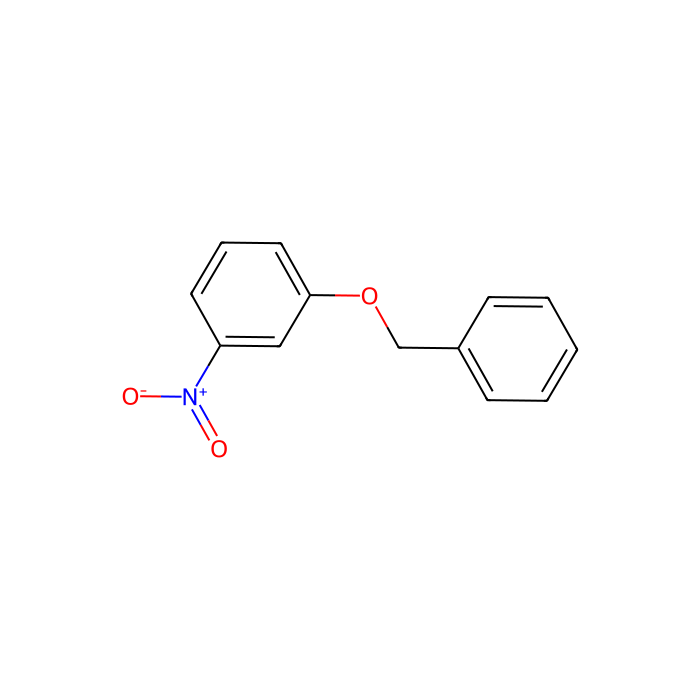
This compound belongs to the class of organic compounds known as nitrophenyl ethers. These are aromatic compounds containing a nitrobenzene moiety that carries an ether group on the benzene ring.
External Descriptors
Not available
1. Djoumbou Feunang Y, Eisner R, Knox C, Chepelev L, Hastings J, Owen G, Fahy E, Steinbeck C, Subramanian S, Bolton E, Greiner R, and Wishart DS. ClassyFire: Automated Chemical Classification With A Comprehensive, Computable Taxonomy. Journal of Cheminformatics, 2016, 8:61.
Determine the necessary mass, volume, or concentration for preparing a solution.
Dilution Calculator
Determine the dilution needed to prepare a stock solution.
Reconstitution Calculator
Bewertungen
Kundenbewertungen
Application Protocols
Not applicable as a validated bioassay reagent. No WB/IHC/IF/FC protocols are associated with this small-molecule intermediate.
General lab protocol suggestions (literature-style, for chemical use only):
Debenzylation screening: Dissolve substrate (0.05–0.1 M) in EtOAc or EtOH, add 10% Pd/C (5–10 wt% relative to substrate), stir under 1–3 bar H2 at room temperature; monitor by TLC/UPLC; filter over celite and concentrate.
O-Benzylation: Combine m-nitrophenol, K2CO3, and benzyl bromide in acetone (0.1–0.5 M); heat to 40–50 °C until completion; filter off salts, concentrate, and purify by silica gel.
These are general references, not product-validated protocols.
Biological Roles
This compound is intended for research and synthetic chemistry use. No biological role is assigned for the aryl benzyl ether itself.
General/literature context (not product-specific; for background only):
Nitroaromatic moieties can influence redox behavior and are sometimes used as reporter or masking groups in chemical biology. However, benzyl 3-nitrophenyl ether is primarily a protecting-group derivative rather than a bioactive small molecule.
The benzyl ether linkage is widely used in organic synthesis because it is stable to many reagents yet cleavable under hydrogenolysis; such derivatives can serve as masked phenols in preparing libraries for biochemical screening where the unmasked phenol is the functional entity.
Metabolism/toxicity: Nitroaromatic compounds can undergo bioreduction to hydroxylamines/anilines in biological systems, which may be associated with toxicity. Accordingly, handle strictly as a laboratory chemical; do not use in vivo.
Research Use Note: For research use only. Not for diagnostic, therapeutic, or other clinical uses.
Buffer Applications
Not typically applicable. Benzyl 3-nitrophenyl ether is a hydrophobic organic building block and is not used as a buffering agent or pH calibrant.
Practical note: If reactions or extractions require aqueous phases, choose compatible buffer systems (e.g., phosphate or carbonate) only as external media and avoid prolonged exposure of the ether to strongly basic aqueous buffers that can promote cleavage or emulsions.
Green Alternatives
As a synthetic intermediate/protecting group, the “greenness” considerations focus on solvent and reagent choices rather than replacing the molecule itself.
Greener solvent choices for common operations:
Hydrogenolysis (debenzylation): Prefer ethanol, 2-propanol, or ethyl acetate over chlorinated solvents; consider 2-MeTHF as a bio-based ether alternative to THF.
Workup and chromatography: Use heptane/ethyl acetate in place of hexane/ethyl acetate; minimize DCM by substituting EtOAc or MTBE when resolution allows.
Greener deprotection methodologies:
Transfer hydrogenation (HCO2NH4 or cyclohexene as hydrogen source) with Pd/C can avoid bottled H2 and reduce risk.
Electrochemical benzylic ether cleavage under mild conditions (reported in literature) can reduce waste and hazards; evaluate scalability.
Oxidative debenzylation with catalytic DDQ/O2 or photoredox conditions can offer milder, selective alternatives, though waste profiles should be assessed.
Comparison snapshot (literature, not item-specific):
Conventional: H2/Pd-C in EtOAc or MeOH; high atom economy but uses compressed gas and Pd.
Transfer hydrogenation: avoids H2 cylinders; may require larger reagent mass but simplifies setup.
Right-size reaction scale and catalyst loading; recover/recycle Pd on carbon where possible.
Use in-process controls (TLC/UPLC) to stop reactions promptly, minimizing over-reduction of the nitro group.
Apply solvent selection guides (e.g., CHEM21, GSK) to choose preferred solvents for each step.
Pharmaceutical Uses
No direct excipient or pharmacopeial status is indicated for this item. It is used as a research/synthetic intermediate.
Process chemistry context (literature/general):
Protecting-group intermediate: Benzyl 3-nitrophenyl ether can serve as a masked form of m-nitrophenol during multistep synthesis of pharmaceutical intermediates, enabling temporary protection of the phenolic OH and modulation of solubility/crystallinity.
Selective deprotection in late-stage routes: The benzyl ether can often be cleaved in the presence of other protecting groups, offering orthogonality valuable to medicinal/process chemistry.
Compliance note: For research use only. If intended for cGMP manufacturing or inclusion as a process intermediate with regulatory filings, appropriate quality agreements, impurity control strategies, and analytical methods must be established. Item-specific pharmacopeial or GMP attributes: Not specified for this item; refer to CoA/Spec Sheet.
Physical Properties
Item-specific specifications (appearance, BP/MP, density, refractive index, UV cutoff, metal/peroxide limits) are Not specified for this item; refer to CoA/Spec Sheet.
Literature/expected properties for reference (not item specifications):
Phase/appearance: Often isolated as a pale solid or viscous oil depending on purity and crystallinity; aryl benzyl ethers commonly melt near or above ambient temperature.
Solubility: Practically insoluble in water; soluble in common organic solvents (e.g., dichloromethane, toluene, THF, ethyl acetate, acetone) due to two aromatic rings and an ether linkage.
Polarity: Moderately nonpolar with limited hydrogen-bond basicity (ether oxygen) and an electron-withdrawing nitro group on the aryl ring.
Partitioning: Expected high logP relative to simple phenyl ethers due to benzyl moiety (literature trend for diaryl/benzyl ethers). Quantitative value not provided here.
Spectroscopic signatures (general):
1H NMR: benzylic –CH2– singlet typically ~5.0–5.2 ppm; aromatic multiplets 6.8–8.3 ppm with downfield shifts near nitro.
13C NMR: benzylic carbon ~70 ppm; aromatic carbons 115–150 ppm with deshielding at ipso/NO2-bearing carbons.
Thermal behavior: Nitroaryl ethers are generally thermally stable under moderate heating but should be handled below decomposition temperatures; avoid distillation under air at elevated temperatures.
Always consult the product’s CoA/SDS for authoritative specifications.
Quality and Grades
Item-specific grade/purity, stabilizers, and UV/GC/HPLC specifications: Not specified for this item; refer to CoA/Spec Sheet.
General guidance on quality considerations for aryl benzyl ethers used in synthesis:
Purity expectations: For most organic synthesis applications, ≥95% purity is typical. Trace impurities may include unreacted m-nitrophenol, dibenzyl ether, or nitration isomers. Review the CoA for assay, residual solvents, and impurity profiling.
Water content: Not typically critical for non-aqueous reactions but can affect sensitive transformations (e.g., alkylations, metal-catalyzed couplings). If needed, verify by Karl Fischer. Item-specific water limit: Not specified for this item; refer to CoA/Spec Sheet.
Chromatographic suitability: If used as a standard/substrate, low UV background impurities are preferred. HPLC/GC suitability should be validated in-house if specs are not provided.
Stabilizers: Generally not required for aryl benzyl ethers; any use of inhibitors would be disclosed on the CoA. Stabilizer information: Not specified for this item; refer to CoA/Spec Sheet.
Lot-to-lot consistency: For multistep synthesis (e.g., protecting group strategies), confirm identity by 1H/13C NMR and mass spectrometry. Nitroaromatic isomers (2-/4-) should be <0.5–1% depending on application.
Regulatory/packaging: Research-use only. If process development requires GMP or pharmacopeial compliance, contact support for custom quality options.
Reaction and Applications
Literature/common applications of benzyl 3-nitrophenyl ether in organic synthesis (not product-specific):
Protecting group strategy for phenols:
Acts as the benzyl-protected form of m-nitrophenol. The benzyl ether can be introduced by O-alkylation (e.g., m-nitrophenol + benzyl halide/base) and later removed by hydrogenolysis to regenerate the phenol under mild conditions (H2/Pd/C), leaving nitro intact in many cases.
Selective deprotection:
Hydrogenolysis of the benzylic C–O bond (Ar–O–CH2Ph) proceeds under Pd/C or Pd(OH)2 conditions in alcohols/ethyl acetate, typically at ambient temperature and pressure (1–3 bar H2). Competing nitro reduction can be minimized by catalyst choice, solvent, and additives (e.g., buffering with carbonate, using lower pressure/temperature).
Nitro group transformations:
Subsequent reduction of the nitro group to the aniline (via catalytic hydrogenation, Fe/AcOH, SnCl2/HCl) affords 3-aminophenyl benzyl ether, enabling further Sandmeyer or coupling chemistry, or after deprotection yields m-aminophenol.
Electrophilic/nucleophilic aromatic substitution:
The nitro group deactivates the aryl ring toward electrophilic substitution but activates ortho/para positions toward nucleophilic aromatic substitution (SNAr) when suitable leaving groups are present. Although this substrate lacks an additional leaving group on the nitro-activated ring, it can serve as a control or intermediate in SNAr studies.
O-Dealkylation alternatives:
Lewis/Brønsted acid-mediated cleavages (e.g., BBr3 typically for aryl–O–Me; for benzyl ether, BF3·OEt2 with nucleophiles, or oxidative conditions such as DDQ) can convert the benzyl ether to m-nitrophenol when hydrogenolysis is undesirable.
Reaction Conditions
General literature conditions (guidance only; optimize per substrate and scale):
O-Benzylation of m-nitrophenol (to form benzyl 3-nitrophenyl ether):
Base-promoted alkylation: m-Nitrophenol (1.0 equiv), K2CO3 (1.5–2.0 equiv), benzyl bromide (1.1–1.3 equiv) in acetone, acetonitrile, or DMF; 20–60 °C; 2–12 h. Typical isolated yields 70–90% with careful control of over-alkylation and elimination of dibenzyl ether.
Mitsunobu: m-Nitrophenol (1.0 equiv), benzyl alcohol (1.2–1.5 equiv), PPh3/DEAD or DIAD in THF at 0–25 °C; 2–6 h; yields often 60–85%; useful for sensitive substrates.
Debenzylation (to regenerate m-nitrophenol):
Hydrogenolysis: H2 (1–3 bar), Pd/C (5–10 wt% of substrate), EtOAc, EtOH, or MeOH, 20–30 °C; 1–6 h. Monitor to limit undesired nitro reduction. Adding a weak base (NaHCO3) can suppress acid-promoted side reactions.
Oxidative cleavage: DDQ (1.2–2.0 equiv) in toluene or CH2Cl2 at 0–25 °C; 1–4 h. Quench with aqueous NaHCO3; extract and purify.
Nitro reduction (if desired):
Fe/AcOH or SnCl2/HCl (3–6 equiv metal/salt) in EtOH/AcOH or EtOH/H2O at reflux; 1–4 h to give the aniline derivative. Alternatively, H2/Pd affords rapid reduction but may also cleave the benzyl ether.
Workup/purification:
Aqueous washes (brine, bicarbonate) and silica gel chromatography using hexanes/EtOAc gradients. Protect from strong acid on silica to avoid cleavage.
Note: The above are literature-style conditions and not product specifications.
Safety and Handling
Item-specific GHS classification, signal word, pictograms, and H-statements: Not specified for this item; refer to SDS.
General safety guidance for nitroaryl benzyl ethers (literature/industry practice):
Hazards (typical): May be harmful if swallowed or inhaled; causes skin/eye irritation; combustible organic compound. Nitroaromatics can present additional toxicity concerns; handle to minimize exposure.
PPE: Use lab coat, safety goggles, and suitable gloves (e.g., nitrile). Work in a chemical fume hood to avoid inhalation of vapors or aerosols.
Handling: Avoid heat, sparks, and open flame. Prevent contact with strong oxidizers, strong reducing agents, and strong acids/bases which may promote cleavage or decomposition. Minimize dust/aerosols.
Special risks: While simple aryl ethers are not classic peroxide formers, prolonged storage of organic liquids in air and light should be minimized. The nitro group can reduce under strongly reducing conditions—avoid inadvertent mixing with reducing metals/hydride reagents without proper controls.
First aid (overview; defer to SDS):
Inhalation: Move to fresh air; seek medical advice if symptoms persist.
Skin: Wash with soap and water; remove contaminated clothing.
Eyes: Rinse cautiously with water for several minutes; remove contact lenses if present and easy; seek medical attention if irritation continues.
Ingestion: Rinse mouth; do not induce vomiting; seek medical advice.
Fire-fighting: Use dry chemical, CO2, alcohol-resistant foam. Combustion may produce CO/CO2 and nitrogen oxides.
Spill response: Absorb with inert material (vermiculite, sand), collect for disposal. Prevent entry to drains.
Solvent Selection
This product is a solid/liquid organic building block, not a solvent. Solvent selection here refers to media for dissolution, reactions, and purification.
Polarity and miscibility (literature/expected):
Soluble in moderately nonpolar to polar aprotic organic solvents: dichloromethane (DCM), chloroform, toluene, THF, acetone, ethyl acetate, acetonitrile.
Practically insoluble in water and highly polar protic solvents without co-solvents.
Typical solvent choices by use case:
Hydrogenolysis (benzyl deprotection): Ethanol, methanol, ethyl acetate, THF, or mixtures with acetic acid; selection balances substrate solubility and catalyst wetting.
SNAr or nitro reduction (on the ring): DMF, DMSO, NMP, or alcohols, depending on transformation; ensure temperature control and compatibility with reagents.
Purification by flash chromatography: Hexanes/ethyl acetate or toluene/ethyl acetate gradients offer good resolution from unreacted phenols or benzylic byproducts.
Practical tips:
Avoid strongly basic aqueous media that can promote ether cleavage or emulsions during workup.
For moisture-sensitive steps downstream, dry solvents (molecular sieves, alumina) can be beneficial since trace water may affect catalytic reductions or alkylations.
Comparison notes:
DCM vs ethyl acetate: DCM provides better solubility for highly aromatic ethers and sharper TLC spots; ethyl acetate offers a greener profile and easier disposal.
THF vs 2-MeTHF: 2-MeTHF can be a greener alternative with similar solubilizing power and improved phase separation.
Storage and Reconstitution
Storage conditions (item-specific from Product Data): Store at room temperature. Protect from direct sunlight and ignition sources. Keep container tightly closed in a dry, well-ventilated place.
Shipping (item-specific): Shipped under normal conditions.
Stability (general): Aryl benzyl ethers are typically stable for years when stored properly. Avoid strong acids/bases and prolonged heating. If the material is an oil, minimizing headspace oxygen and light exposure helps preserve quality.
Reconstitution: Not applicable; supplied neat. For preparing stock solutions, dissolve in a suitable anhydrous organic solvent (e.g., DCM, THF, EtOAc, MeCN) to the desired concentration. Filter if necessary to remove particulates before use.
Freeze/thaw: Not relevant for neat solids/liquids. If stored as a solution, avoid repeated freeze–thaw by aliquoting.
Quality checks on receipt/use: Verify identity by 1H NMR (benzylic singlet ~5.0–5.2 ppm, aromatic region 6.8–8.3 ppm) and LC/MS. Check for residual m-nitrophenol or dibenzyl ether by TLC/HPLC.
For definitive shelf-life, impurity limits, and analytical specifications, refer to the product’s CoA/Spec Sheet and SDS.
Structure and Identity
Benzyl 3-nitrophenyl ether is an aryl–alkyl ether comprising a meta-nitro-substituted phenyl ring linked through oxygen to a benzyl group.
Identity (item-specific):
SKU: B168949
Product Name: BENZYL 3-NITROPHENYL ETHER
CAS: 24318-00-1
InChIKey: Not specified for this item; refer to CoA/Spec Sheet.
SMILES: Not specified for this item; refer to CoA/Spec Sheet.
Computed/literature structural data (for reference, not item specification):
Common structural description: m-nitrophenoxy–CH2–phenyl (anisole-type aryl–O–CH2Ph with nitro at the 3-position on the aryl–O ring)
Functional groups: aryl–alkyl ether (Ar–O–CH2Ph), nitro group (–NO2) meta to the ether oxygen on the phenyl ring; two benzene rings; benzylic methylene.
Stereochemistry: none (achiral, no stereocenters).
2D structure in words: A 3-nitrophenyl ring bearing an –O–CH2– substituent at C1 (phenoxy), which connects to a monosubstituted phenyl (benzyl) ring. The nitro (–NO2) is at the meta position relative to the phenoxy oxygen.
Molecular formula (computed/literature): C13H11NO3
Isomeric considerations: the nitro group specifically at the 3-position (meta) relative to the phenoxy oxygen. Other positional isomers (2- or 4-) are distinct compounds.
Key functional elements and their reactivity (literature/general):
Aryl benzyl ether (Ar–O–CH2Ph):
Stable to many bases, nucleophiles, and mild acids.
Cleavable selectively by hydrogenolysis (H2/Pd) or oxidative conditions (DDQ), enabling use as a protecting group for m-nitrophenol.
Nitro group (–NO2):
Strongly electron-withdrawing; deactivates the ring toward electrophilic substitution, but can direct and activate for SNAr when an appropriate leaving group is installed at ortho/para positions (not present here).
Versatile handle for reduction to an aniline, followed by diazotization and further functionalization (e.g., Sandmeyer, azo coupling).
Retrosynthetic and forward-planning value:
Forward: Starting from m-nitrophenol, O-benzylation with benzyl halides or benzyl alcohol under Mitsunobu or phase-transfer conditions provides the ether. Subsequent transformations can be carried out on either ring without exposing the phenolic OH.
Retro: Deprotect via hydrogenolysis to access m-nitrophenol late in a sequence. Alternatively, reduce NO2 to NH2 first, manipulate amine chemistry, then deprotect.
Named/typical transformations:
O-Benzylation: m-nitrophenol + BnBr/K2CO3 (acetone/DMF), or Mitsunobu (BnOH, DEAD/Ph3P) for complementary chemoselectivity.
Deprotection: H2/Pd-C (EtOAc/EtOH) or DDQ in toluene/CH2Cl2; electrochemical benzylic cleavage reported.
Nitro reduction: H2/Pd or Fe/AcOH or SnCl2/HCl to give m-aminophenyl benzyl ether or m-aminophenol after deprotection.
Target Specificity
Not applicable. This product is a small-molecule organic reagent/intermediate and is not an antibody, enzyme, or affinity reagent. No antigen/epitope specificity, clone, isotype, or species reactivity applies.
Wir verwenden Cookies, um die ordnungsgemäße Funktion der Website sicherzustellen und, soweit zulässig, Ihr Nutzererlebnis zu verbessern. Sie können Ihre Einstellungen jederzeit unter „Einstellungen“ verwalten. Weitere Informationen finden Sie in unserer Cookie-Richtlinie.
Shall we send you a message when we have discounts available?
Remind me later
Thank you! Please check your email inbox to confirm.
Products are supplied to verified businesses, institutions, and qualified professionals for research and development use only. Not for use in humans, animals, diagnosis, or therapy.