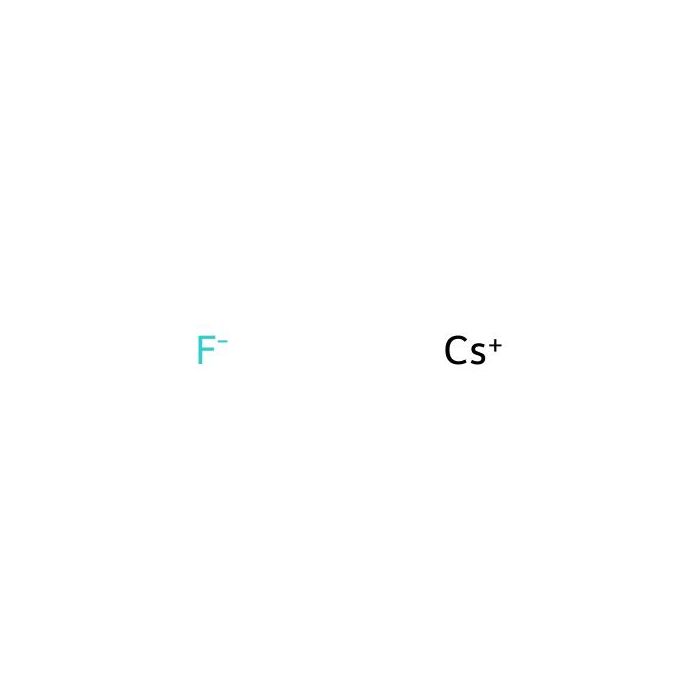
Cäsiumfluorid - UltraBio™, ≥99%(F) , CAS No.13400-13-0

CAS: 13400-13-0 Cat. No.: C755570 Summenformel: CsF Molekulargewicht: 151.9 EG-Nummer: 236-487-3
Zu bestellen verfügbar
QUALITÄT & REINHEIT UltraBio™ ? UltraBio™ — Aladdin's line for molecular-biology applications. Use for nuclease-free, high-consistency reagents across molecular workflows. ≥99%(F)
Storage
Raumtemperatur
Shipped In
FedEx DG Service
★
Größe
Deutschland (EU)
USA*
Preis
Menge
10g
C755570-10g
Auf Bestellung · 8–12 Wochen
155,24€
250g
C755570-250g
Auf Bestellung · 8–12 Wochen
2.026,08€
Enter a quantity for the sizes you want to add.

Übersicht

Reaktant für:
  • Herstellung von Bausteinen für die Synthese von Fluorallylverbindungen
  • Synthese von Alkoholen durch Hydrolyse von Alkylsilylethern bei neutralem pH-Wert in gepufferten gemischt-organisch-wässrigen Lösungen
  • Nukleophile Fluorierung von Alkynyliodoniumsalzen zur Bildung von Fluorvinylverbindungen
  • Nukleophile aromatische Substitutionsreaktionen (SNAr)
Verwendung bei der erfolgreichen Synthese einer einkristallinen Dion-Jacobson-Phase, CsLaTa2O7, die in der Photokatalyse und der Supraleitfähigkeit Anwendung findet.

Spezifikationen

Spezifikationen & Reinheit
UltraBio™, ≥99%(F)
Storage
Raumtemperatur
Verschickt in
FedEx DG Service
Note
UltraBio™
Reinheit
≥99%(F)
Namen und Kennungen
PH
6.5-7.5 (25 °C, 3 M in H 2 O)
Kanonisches Lächeln
[F-].[Cs+]
IUPAC Name
cesium;fluoride
InChIKey
XJHCXCQVJFPJIK-UHFFFAOYSA-M
INCHI
1S/Cs.FH/h;1H/q+1;/p-1
Isomere SMILES
[F-].[Cs+]
WGK Deutschland
3
RTECS
FK9650000
UN-Nummer
3288
Verpackungsgruppe
III
Molekulargewicht
151.9
Reaxy-Rn
6184400

Erweiterte Daten

Taxonomic Classification

Taxonomy Tree

KingdomInorganic compounds
SuperclassMixed metal/non-metal compounds
KlasseAlkali metal salts
SubclassAlkali metal fluorides
Intermediate Tree Nodes Not available
Direct ParentAlkali metal fluorides
Alternative Parents Inorganic salts  
Molecular FrameworkNot available
Substituents Alkali metal fluoride - Inorganic salt
BeschreibungThis compound belongs to the class of inorganic compounds known as alkali metal fluorides. These are inorganic compounds in which the largest halogen atom is fluorine, and the heaviest metal atom is an alkali metal.
External Descriptors Not available
3D-Struktur
Interaktives chemisches Strukturmodell


Zertifikate (CoA, COO, BSE/TSE und Analyse-Diagramm)
C of A & Other Certificates(BSE/TSE, COO):
Analytical Chart:
Chemische und physikalische Eigenschaften
LöslichkeitH 2 O: 3 M at 20 °C, clear, colorless
Siedepunkt (°C)1251°C
Schmelzpunkt (°C)682 °C
Molekulargewicht151.903 g/mol
XLogP3
Hydrogen Bond Donor Count0
Hydrogen Bond Acceptor Count1
Rotatable Bond Count0
Exact Mass151.904 Da
Monoisotopic Mass151.904 Da
Topological Polar Surface Area0.000 Ų
Heavy Atom Count2
Formal Charge0
Complexity2.000
Isotope Atom Count0
Defined Atom Stereocenter Count0
Undefined Atom Stereocenter Count0
Defined Bond Stereocenter Count0
Undefined Bond Stereocenter Count0
The total count of all stereochemical bonds0
Covalently-Bonded Unit Count2
FAQs und Artikel
UltraBio™: Defining Excellence in Molecular Biology Applications
One Atom Can Change a Drug’s Fate: Atom-Level Knobs and a Functional-Group Toolbox for Medicinal Chemistry (Methyl / Halogen Bonding / 3D Building Blocks / Late-Stage Fluorination + Product-Selection Tables)
Late-Stage Fluorination Toolbox: “Minimally Invasive Upgrades” for Lead Candidates: Four “Fluorine Knobs” → Two major routes (electrophilic vs nucleophilic) → An ¹⁸F-PET tracer branch → Selection navigation & representative product list
OSF/ASF Dual-Channel Toolbox: Divergent Reactions of Four-Membered Ring Sulfonyl Fluorides, Condition “Knobs,” and Selection Navigation
Selection of Common Research Salts: A Task Map for Alkali Metal Salts & Alkaline Earth Metal Salts (with Product Tables 1–6)
Perovskite PV/PeLED Precursor Guide: Selecting Metal Halide Salts, Key Conditions, and Reproducible Performance (including Product Tables 1–4 and a Selection Navigation Guide)
How to Make the Suzuki–Miyaura Reaction Robust: Pinpoint the Bottleneck and Lock in a Reproducible Operating Window (with Selection Navigation and Product Tables 1–5)
Silicon Reagent-Assisted Peptide Synthesis: Research Progress and Methodological Value of Peptide Bond Formation from Unprotected Substrates
TMSE, Teoc, and SEM: Functional Roles and Selection Logic of Three 2-(Trimethylsilyl)ethyl-Derived Protecting Systems
Selection Logic for the Teoc Amino Protecting Group: From Fluoride-Triggered Deprotection to Orthogonal Protecting-Group Design
Experimental Selection of SEM-Cl: From O/N-SEM Protection and Directed Functionalization of N-Heterocycles to the Introduction of Protected C1 Fragments
4-[(tert-Butyldimethylsilyl)oxy]butan-1-ol: Experimental Selection Logic as a Monoprotected 1,4-Butanediol Building Block and a Protected C4 Linker
Design Logic of Fluorinated 3,3-Disubstituted Oxetane Building Blocks: Structural Construction and Modulation of Amine Basicity, Lipophilicity, and Metabolic Stability
Selectivity Mechanism of the Triple Aryne–Tetrazine Cascade Reaction: Reaction-Pathway Switching and Intermediate Transformations
Citations of This Product
Lösungsrechner
Bewertungen

Kundenbewertungen

Dürfen wir Sie über Rabattaktionen informieren?

Später erinnern

Vielen Dank! Bitte überprüfen Sie Ihren E-Mail-Posteingang, um zu bestätigen.

Hoppla! Benachrichtigungen sind deaktiviert.