Determine the necessary mass, volume, or concentration for preparing a solution.
| Activity Type | Relation | Activity value | Units | Action Type | Journal | PubMed Id | doi | Assay Aladdin ID |
|---|

≥97% for sensitive chromatographic and analytical workflows requiring minimal baseline interference.
Room temperature,Argon charged Ships Normal Check lot-specific COA for exact specifications.
SDS, COA, datasheet, and spec sheet available for download. Lot-specific COA accessible via lot number lookup.
Cited in 2916 peer-reviewed publications across chromatography, organic synthesis, and cross-coupling reactions.
Comprehensive hazard, handling, storage, and regulatory compliance document.
Download SDS →Lot-specific quality data. Enter your lot number to retrieve the exact COA.
Look up COA →Full quality attributes and acceptance criteria for this grade.
View spec sheet →Taxonomy Tree
| Kingdom | Inorganic compounds |
|---|---|
| Superclass | Mixed metal/non-metal compounds |
| Klasse | Alkaline earth metal salts |
| Subclass | Alkaline earth metal chlorides |
| Intermediate Tree Nodes | Not available |
| Direct Parent | Alkaline earth metal chlorides |
| Alternative Parents | Inorganic chloride salts Inorganic calcium salts |
| Molecular Framework | Not available |
| Substituents | Alkaline earth metal chloride - Inorganic calcium salt - Inorganic chloride salt - Inorganic salt |
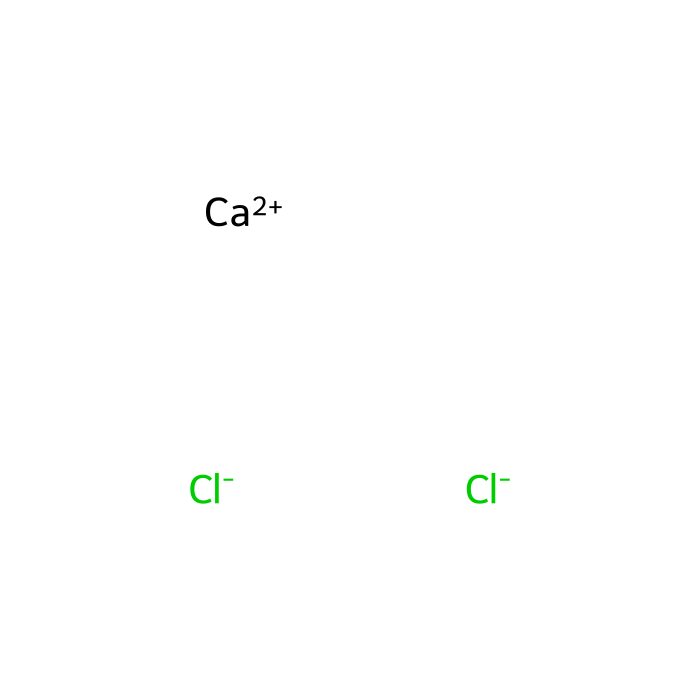
| Beschreibung | This compound belongs to the class of inorganic compounds known as alkaline earth metal chlorides. These are inorganic compounds in which the largest halogen atom is Chlorine, and the heaviest metal atom is a lanthanide. |
| External Descriptors | inorganic chloride - calcium salt |
| Activity Type | Relation | Activity value | Units | Action Type | Journal | PubMed Id | doi | Assay Aladdin ID |
|---|
| Activity Type | Relation | Activity value | Units | Action Type | Journal | PubMed Id | doi | Assay Aladdin ID |
|---|
| Activity Type | Relation | Activity value | Units | Action Type | Journal | PubMed Id | doi | Assay Aladdin ID |
|---|
Find and download the COA for your product by matching the lot number on the packaging.
| Lot Number | Certificate Type | Datum | Artikel |
|---|---|---|---|
 H2631517 | Certificate of Analysis | Aug 13, 2026 | C399250 |
| H2631514 | Certificate of Analysis | Aug 13, 2026 | C399250 |
| E2606221 | Certificate of Analysis | Apr 21, 2026 | C399250 |
| E2606220 | Certificate of Analysis | Apr 21, 2026 | C399250 |
| B2604248 | Certificate of Analysis | Jan 22, 2026 | C399250 |
| B2604277 | Certificate of Analysis | Jan 22, 2026 | C399250 |
| B2610002 | Certificate of Analysis | Jan 22, 2026 | C399250 |
| I2511399 | Certificate of Analysis | Sep 02, 2025 | C399250 |
| I2511280 | Certificate of Analysis | Sep 02, 2025 | C399250 |
| G2511193 | Certificate of Analysis | May 27, 2025 | C399250 |
| G2511283 | Certificate of Analysis | May 27, 2025 | C399250 |
| I2515067 | Certificate of Analysis | May 27, 2025 | C399250 |
| E2513326 | Certificate of Analysis | Mar 04, 2025 | C399250 |
| E2530204 | Certificate of Analysis | Mar 04, 2025 | C399250 |
| E2530318 | Certificate of Analysis | Mar 04, 2025 | C399250 |
| D2518344 | Certificate of Analysis | Mar 04, 2025 | C399250 |
| L2420664 | Certificate of Analysis | Dec 06, 2024 | C399250 |
| L2420665 | Certificate of Analysis | Dec 06, 2024 | C399250 |
| I2429159 | Certificate of Analysis | Sep 14, 2024 | C399250 |
| I2429118 | Certificate of Analysis | Sep 14, 2024 | C399250 |
| F2401107 | Certificate of Analysis | May 20, 2024 | C399250 |
| F2401132 | Certificate of Analysis | May 20, 2024 | C399250 |
| C2408226 | Certificate of Analysis | Feb 27, 2024 | C399250 |
| G2303389 | Certificate of Analysis | Jun 12, 2023 | C399250 |
| G2303399 | Certificate of Analysis | Jun 12, 2023 | C399250 |
| H2316353 | Certificate of Analysis | Jun 12, 2023 | C399250 |
| H2316354 | Certificate of Analysis | Jun 12, 2023 | C399250 |
| C23101340 | Certificate of Analysis | Mar 16, 2023 | C399250 |
| C23101344 | Certificate of Analysis | Mar 16, 2023 | C399250 |
| A2303059 | Certificate of Analysis | Dec 13, 2022 | C399250 |
| J2212128 | Certificate of Analysis | Oct 24, 2022 | C399250 |
| F2208466 | Certificate of Analysis | Jun 13, 2022 | C399250 |
| F2223198 | Certificate of Analysis | Jun 08, 2022 | C399250 |
| F2223199 | Certificate of Analysis | Jun 08, 2022 | C399250 |
| I2209034 | Certificate of Analysis | Jun 07, 2022 | C399250 |
| H2203272 | Certificate of Analysis | Jun 07, 2022 | C399250 |
| H2203271 | Certificate of Analysis | Jun 07, 2022 | C399250 |
| E2225013 | Certificate of Analysis | Feb 17, 2022 | C399250 |
| C2202013 | Certificate of Analysis | Feb 17, 2022 | C399250 |
| C2202012 | Certificate of Analysis | Feb 17, 2022 | C399250 |
| Löslichkeit | Soluble in water, alcohol, ,acetic acid, and acetone. |
|---|---|
| Empfindlichkeit | Sensitive to humidity |
| Siedepunkt (°C) | 1600°C |
| Schmelzpunkt (°C) | 782°C |
| Molekulargewicht | 110.980 g/mol |
| XLogP3 | |
| Hydrogen Bond Donor Count | 0 |
| Hydrogen Bond Acceptor Count | 2 |
| Rotatable Bond Count | 0 |
| Exact Mass | 109.9 Da |
| Monoisotopic Mass | 109.9 Da |
| Topological Polar Surface Area | 0.000 Ų |
| Heavy Atom Count | 3 |
| Formal Charge | 0 |
| Complexity | 0.000 |
| Isotope Atom Count | 0 |
| Defined Atom Stereocenter Count | 0 |
| Undefined Atom Stereocenter Count | 0 |
| Defined Bond Stereocenter Count | 0 |
| Undefined Bond Stereocenter Count | 0 |
| The total count of all stereochemical bonds | 0 |
| Covalently-Bonded Unit Count | 3 |