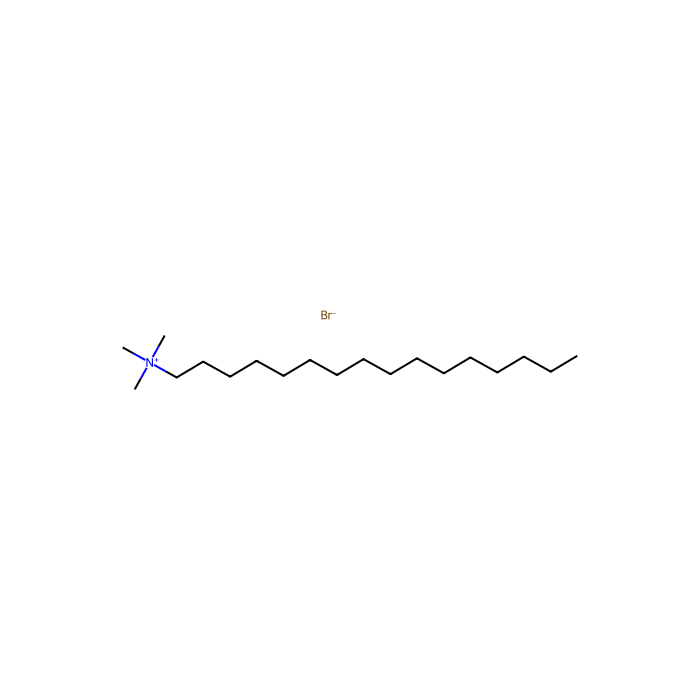
Cetrimonium bromide(CTAB) - High-purity , CAS No.57-09-0

CAS: 57-09-0 Cat. No.: C274355 Summenformel: C19H42BrN Molekulargewicht: 364.45 Beilstein Registry Number: 3598189 EG-Nummer: 200-311-3
Zu bestellen verfügbar
QUALITÄT & REINHEIT High-purity ? High-purity grade with substantially reduced impurity levels. Use when trace contaminants would interfere with your measurement or process.
Synonyms
CTAB | Bromure de cetrimonium [INN-French] | AI3-12209 | cetyl trimethylammonium bromide | cetyl trimethyl-ammonium bromide | Cradocap | hexadecyltrimethylazanium bromide | Pollacid | Cetrimida | CETRIMONIUM BROMIDE [MART.] | CETRIMONIUM BROMIDE [MI] | ce
Storage
Room temperature,Argon charged,Desiccated
Shipped In
Normal
★
Größe
Deutschland (EU)
USA*
Preis
Menge
500g
C274355-500g
—
1 Auf Lager

156,11€

182,14€
Speichern 26,03 € (14.29%)
4×500g
C274355-4×500g
Auf Bestellung · 8–12 Wochen

617,74€

655,92€
Speichern 38,18 € (5.82%)
Enter a quantity for the sizes you want to add.
🧪
Warum diese Qualität

High-purity High-purity für empfindliche chromatographische und analytische Workflows, die minimale Basislinieninterferenzen erfordern.

🌡

Lagerung & Versand

Room temperature,Argon charged,Desiccated Versand Normal. Genaue Spezifikationen finden Sie im chargenspezifischen COA.

📋

Qualitätsdokumente

SDS, COA, Datenblatt und Spezifikationsblatt stehen zum Download bereit. Chargenspezifische COA über Chargennummernsuche abrufbar.

📚

Literaturbeleg

In 3536 peer-reviewten Publikationen zu Chromatographie, organischer Synthese und Kreuzkupplungsreaktionen zitiert.

Spezifikationen

Synonyme
CTAB | Bromure de cetrimonium [INN-French] | AI3-12209 | cetyl trimethylammonium bromide | cetyl trimethyl-ammonium bromide | Cradocap | hexadecyltrimethylazanium bromide | Pollacid | Cetrimida | CETRIMONIUM BROMIDE [MART.] | CETRIMONIUM BROMIDE [MI] | ce
Spezifikationen & Reinheit
High-purity
Storage
Room temperature,Argon charged,Desiccated
Verschickt in
Normal
Note
High-purity
Namen und Kennungen
Pubchem Sid
Pubchem Sid Url
https://pubchem.ncbi.nlm.nih.gov/substance/508812579
Kanonisches Lächeln
CCCCCCCCCCCCCCCC[N+](C)(C)C.[Br-]
IUPAC Name
hexadecyl(trimethyl)azanium;bromide
InChIKey
LZZYPRNAOMGNLH-UHFFFAOYSA-M
INCHI
1S/C19H42N.BrH/c1-5-6-7-8-9-10-11-12-13-14-15-16-17-18-19-20(2,3)4;/h5-19H2,1-4H3;1H/q+1;/p-1
Isomere SMILES
CCCCCCCCCCCCCCCC[N+](C)(C)C.[Br-]
WGK Deutschland
3
RTECS
BQ7875000
UN-Nummer
3077
Verpackungsgruppe
III
Molekulargewicht
364.45
Beilstein
3598189
Reaxy-Rn
3598189
Reaxys-RN_link_address
https://www.reaxys.com/reaxys/secured/hopinto.do?context=S&query=IDE.XRN=3598189&ln=

Dokumentation

📋 Sicherheitsdatenblatt (SDS)

Umfassendes Dokument zu Gefahren, Handhabung, Lagerung und Einhaltung regulatorischer Vorschriften.

<<<<<<< HEAD SDS herunterladen → ======= SDS herunterladen → >>>>>>> release248-p3

✅ Analysezertifikat (COA)

Chargenspezifische Qualitätsdaten. Geben Sie Ihre Chargennummer ein, um das genaue COA abzurufen.

COA nachschlagen →

📊 Datenblatt

Kurzübersicht über Produktspezifikationen und Anwendungen.

Datenblatt ansehen →

🔬 Spezifikationsblatt

Vollständige Qualitätsmerkmale und Akzeptanzkriterien für diese Qualität.

Spezifikationsblatt ansehen →

Erweiterte Daten

Taxonomic Classification

Taxonomy Tree

KingdomOrganic compounds
SuperclassOrganic nitrogen compounds
KlasseOrganonitrogen compounds
SubclassQuaternary ammonium salts
Intermediate Tree Nodes Not available
Direct ParentTetraalkylammonium salts
Alternative Parents Organopnictogen compounds  Organic bromide salts  Hydrocarbon derivatives  Amines  
Molecular FrameworkAliphatic acyclic compounds
Substituents Tetraalkylammonium salt - Organopnictogen compound - Hydrocarbon derivative - Organic bromide salt - Organic salt - Amine - Aliphatic acyclic compound
BeschreibungThis compound belongs to the class of organic compounds known as tetraalkylammonium salts. These are organonitrogen compounds containing a quaternary ammonium substituted with four alkyl chains.
External Descriptors quaternary ammonium salt - organic bromide salt
3D-Struktur
Interaktives chemisches Strukturmodell


Zertifikate (CoA, COO, BSE/TSE und Analyse-Diagramm)
C of A & Other Certificates(BSE/TSE, COO):
Analytical Chart:

Find and download the COA for your product by matching the lot number on the packaging.

16 results found

Lot NumberCertificate TypeDatumArtikel
C2325251C2325251Certificate of AnalysisSep 22, 2026 C274355
G2109081G2109081Certificate of AnalysisSep 22, 2026 C274355
I26081044I26081044Certificate of AnalysisSep 14, 2026 C274355
K2426167K2426167Certificate of AnalysisSep 02, 2026 C274355
F2602296F2602296Certificate of AnalysisJun 13, 2026 C274355
C2611555C2611555Certificate of AnalysisMar 26, 2026 C274355
A2627485A2627485Certificate of AnalysisFeb 05, 2026 C274355
H2507047H2507047Certificate of AnalysisAug 10, 2025 C274355
G2504306G2504306Certificate of AnalysisJul 19, 2025 C274355
C2531222C2531222Certificate of AnalysisApr 26, 2025 C274355
C2531182C2531182Certificate of AnalysisApr 11, 2025 C274355
K2426169K2426169Certificate of AnalysisNov 27, 2024 C274355
G2401102G2401102Certificate of AnalysisJul 05, 2024 C274355
C2426027C2426027Certificate of AnalysisJun 10, 2022 C274355
G2222287G2222287Certificate of AnalysisJun 10, 2022 C274355
G2222288G2222288Certificate of AnalysisJun 10, 2022 C274355
Chemische und physikalische Eigenschaften
LöslichkeitSoluble in water; soluble in alcohol; slightly soluble in acetone; insoluble in benzene and ether
Empfindlichkeitair & Moisture sensitive
Flammpunkt (°F)471.2℉
Flammpunkt (°C)244°C
Schmelzpunkt (°C)248-251°C
Molekulargewicht364.400 g/mol
XLogP3
Hydrogen Bond Donor Count0
Hydrogen Bond Acceptor Count1
Rotatable Bond Count15
Exact Mass363.25 Da
Monoisotopic Mass363.25 Da
Topological Polar Surface Area0.000 Ų
Heavy Atom Count21
Formal Charge0
Complexity181.000
Isotope Atom Count0
Defined Atom Stereocenter Count0
Undefined Atom Stereocenter Count0
Defined Bond Stereocenter Count0
Undefined Bond Stereocenter Count0
The total count of all stereochemical bonds0
Covalently-Bonded Unit Count2
FAQs und Artikel
Stimulus-responsive materials for intelligent drug delivery systems
Chemicals for Battery Research and Development
CTAB Demystified: Structure, Properties, and Practical Uses of a Classic Cationic Surfactant
High-Purity Reagents: Overview and Aladdin Product Selection Guide
Nanowires: Properties, Preparation Routes, and Process Selection (Comprehensive Analysis of Top-Down and Bottom-Up Approaches with Recommended Aladdin Reagents)
Applications of Nanoclay in Materials and Formulations: Dispersion Mechanisms, Performance Enhancement, and Product Selection
How to Choose a Hydrogen Evolution (HER) Catalyst: Kinetic Barriers in Water Electrolysis, AWE/PEM/AEM Pathways, and a Materials-Family Roadmap (with a Product Map)
A Complete Guide to Ion-Pair Reversed-Phase Chromatography (IPC / IP-RP): Mechanisms, Four Tuning Knobs, Troubleshooting, and Ion-Pair Reagent Families (Tables 1–4)
A Panoramic Guide to Surfactants: Definitions & Mechanisms, Key Metrics, Application Scenarios, and Selection Navigation (Tables 1–3)
Why Metal Nanocatalysts Can “Save Energy Yet Lose Performance Easily”: Durability Logic from Active Sites to Support/Interface Engineering (Including Selection Guide and Product Tables A–D)
Preparation Methods and Precautions for Silane Coupling Agent Primer Solutions
How Should Montmorillonite Be Rationally Modified? Organic Modification, Inorganic Modification, and Application-Oriented Selection and Validation
From Structure to Mechanism: Raw Material Structures and Surface Conditioning Mechanisms in Antistatic Systems for Daily Chemical Applications
Structure, Mechanism of Action, and Personal/Home Care Applications of Cationic Surfactants: From Surface Adsorption to Representative Raw Materials
Understanding the Four Classes of Surfactants Through Molecular Charge: Application Logic of Anionic, Cationic, Amphoteric and Zwitterionic, and Nonionic Surfactants in Personal Care and Home Care
Mechanism of Action of Porous Silica in Oil-Control Loose Powder: Pore Structure, Capillary Imbibition, and Surface Modification
Phase-Partitioning Principles, System Differences, and Application Selection in Phenol-Based DNA and RNA Extraction
Citations of This Product
Lösungsrechner
Bewertungen

Kundenbewertungen

Benötigen Sie Hilfe bei der Auswahl der Qualität?

Unser Leitfaden zur Qualitätsauswahl behandelt Reinheit, Stabilisatorstatus und Anwendungseignung für alle Varianten in unserem Katalog.

High-purity Qualitätsleitfaden ansehen →

Dürfen wir Sie über Rabattaktionen informieren?

Später erinnern

Vielen Dank! Bitte überprüfen Sie Ihren E-Mail-Posteingang, um zu bestätigen.

Hoppla! Benachrichtigungen sind deaktiviert.