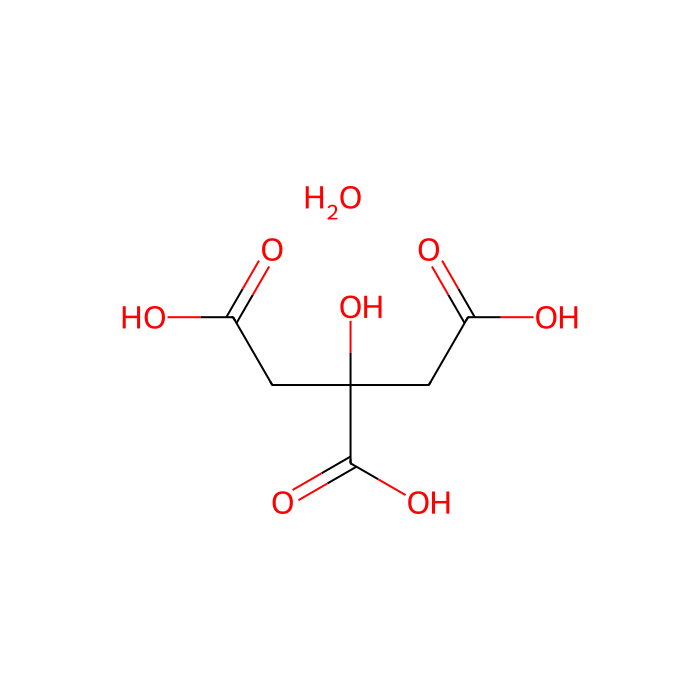
Citric acid monohydrate - analytical standard , CAS No.5949-29-1

CAS: 5949-29-1 Cat. No.: C112631 Summenformel: C6H8O7·H2O Molekulargewicht: 210.14 Beilstein Registry Number: 4018641 EG-Nummer: 611-842-9
Zu bestellen verfügbar
QUALITÄT & REINHEIT Analytical standard ? Analytical standard — certified-purity material for quantitative calibration. Use to prepare calibration standards and validate analytical methods.
Synonyms
INS NO.330|citrate hydrate|Citric acid monohydrat|B1650 [LANGUAL]|CITRIC ACID MONOHYDRATE (USP MONOGRAPH)|CITRATE [II]|CITRIC ACID MONOHYDRATE [WHO-IP]|CITRIC ACID MONOHYDRATE (EP MONOGRAPH)|monohydrate citric acid|CITRIC ACID MONOHYDRATE [II]|CITRIC ACID MONOHYDRATE [VANDF]|Citric acid, hydrous|2-Hydroxypropane-1,2,3-tricarboxylic Acid Hydrate (Tofacitinib Impurity|CITRIC ACID MONOHYDRATE [MI]|Citric acid,hydrous|1,2,3-PROPANETRICARBOXYLIC ACID, 2 HYDROXY-, MONOHYDRATE|2-HYDROXY-1,2,3-PROPANE-TRICARBOXYLIC ACID, MONOHYDRATE|2-hydroxypropane-1,2,3-tricarboxylic acid hydrate|CITRIC ACID [INCI]|CITRIC ACID MONOHYDRATE (II)|2-Hydroxy-1,2,3-propanetricarboxylic acid hydrate (1:1)|ACIDUM CITRICUM MONOHYDRATE [WHO-IP LATIN]|Citric acid monohydrate (USP)|2-hydroxy-1,2,3-propane-tricarboxylic acid|CITRACID-50|Citric acid bp|CITRIC ACID MONOHYDRATE (MART.)|CITRIC ACID MONOHYDRATE [EP IMPURITY]|CITRIC ACID, MONOHYDRATE|Citric acid (monohydrate)|CITRIC ACID [GREEN BOOK]|CITRIC ACID MONOHYDRATE [EP MONOGRAPH]|CITRIC ACID MONOHYDRATE [MART.]|citric acid water|CITRIC ACID, HYDROUS (II)|Surface Wipes|CITRIC ACID [EP MONOGRAPH]|Soothe Chewable|Citric acid (TN)|W.SKIN TREEMON CLEANSING WATER|CITRIC ACID MONOHYDRATE [USP MONOGRAPH]|Desinfectant Solution for Hemodialysis Machine|AQUACETIC-30|CITRIC ACID (II)|Citric acid monohydrate [USP]|2-Hydroxy-1,2,3-propanetricarboxylic acid monohydrate|Cleaning Solution for Hemodialysis Machines|Acidum citricum monohydrate|CITRIC ACID,HYDROUS [VANDF]|Citric acid hydrate|1,2,3-Propanetricarboxylic acid, 2-hydroxy-, monohydrate|Alphacide Activator|Cygzyme|Citric acid monohydrate|2-hydroxypropane-1,2,3-tricarboxylic acid;hydrate|CITRIC ACID [ORANGE BOOK]|NATURE CLEAN|CITRIC ACID (EP MONOGRAPH)|Citric acid hydrate (JP17)|Stop Hair|CITRATE [VANDF]|CITRIC ACID [II]|CITRIC ACID, HYDROUS [II]|Citric Acid, Monohydrate, Crystal, Reagent, ACS|GREEN FRESH|PURILAB|water citric acid|TAUROLOCK COMPONENT CITRATE|CITRIC ACID HYDRATE [JAN]|citric acid mono-hydrate|CITRIC ACID MONOHYDRATE [WHO-DD]
Storage
Room temperature
Shipped In
Normal
★
Größe
Deutschland (EU)
USA*
Preis
Menge
5g
C112631-5g
—
2 Auf Lager

15,53€

19,00€
Speichern 3,47 € (18.26%)
Enter a quantity for the sizes you want to add.

Spezifikationen

Synonyme
INS NO.330 | citrate hydrate | Citric acid monohydrat | B1650 [LANGUAL] | CITRIC ACID MONOHYDRATE (USP MONOGRAPH) | CITRATE [II] | CITRIC ACID MONOHYDRATE [WHO-IP] | CITRIC ACID MONOHYDRATE (EP MONOGRAPH) | monohydrate citric acid | CITRIC ACID MONOHYDRATE [II] | CITRIC ACID MONOHYDRATE [VANDF] | Citric acid, hydrous | 2-Hydroxypropane-1, Show more
Spezifikationen & Reinheit
analytical standard
Storage
Room temperature
Verschickt in
Normal
Note
Analytischer Standard
Namen und Kennungen
Pubchem Sid
SMILES
C(C(=O)O)C(CC(=O)O)(C(=O)O)O.O
IUPAC Name
2-hydroxypropane-1,2,3-tricarboxylic acid;hydrate
InChIKey
YASYEJJMZJALEJ-UHFFFAOYSA-N
InChI
1S/C6H8O7.H2O/c7-3(8)1-6(13,5(11)12)2-4(9)10;/h13H,1-2H2,(H,7,8)(H,9,10)(H,11,12);1H2
Isomere SMILES
C(C(=O)O)C(CC(=O)O)(C(=O)O)O.O
WGK Deutschland
1
RTECS
GE7810000
Molekulargewicht
210.14
Beilstein
4018641
Reaxys
4018641
Reaxys-RN_link_address
https://www.reaxys.com/reaxys/secured/hopinto.do?context=S&query=IDE.XRN=4018641&ln=

Erweiterte Daten

Taxonomic Classification

Taxonomy Tree

KingdomOrganic compounds
SuperclassOrganic acids and derivatives
KlasseCarboxylic acids and derivatives
SubclassTricarboxylic acids and derivatives
Intermediate Tree Nodes Not available
Direct ParentTricarboxylic acids and derivatives
Alternative Parents Alpha hydroxy acids and derivatives  Tertiary alcohols  Carboxylic acids  Organic oxides  Hydrocarbon derivatives  Carbonyl compounds  
Molecular FrameworkAliphatic acyclic compounds
Substituents Tricarboxylic acid or derivatives - Hydroxy acid - Alpha-hydroxy acid - Tertiary alcohol - Carboxylic acid - Organic oxygen compound - Organic oxide - Hydrocarbon derivative - Organooxygen compound - Carbonyl group - Alcohol - Aliphatic acyclic compound
BeschreibungThis compound belongs to the class of organic compounds known as tricarboxylic acids and derivatives. These are carboxylic acids containing exactly three carboxyl groups.
External Descriptors organic molecular entity
3D-Struktur
Interaktives chemisches Strukturmodell


Zertifikate (CoA, COO, BSE/TSE und Analyse-Diagramm)
C of A & Other Certificates(BSE/TSE, COO):
Analytical Chart:

Find and download the COA for your product by matching the lot number on the packaging.

1 results found

Lot NumberCertificate TypeDatumArtikel
F2315842F2315842Certificate of AnalysisMar 04, 2025 C112631
Chemische und physikalische Eigenschaften
EmpfindlichkeitMoisture sensitive.
Flammpunkt (°F)345.0 °F
Flammpunkt (°C)173.9℃
Schmelzpunkt (°C)135-152°C
Molekulargewicht210.14
XLogP3
Hydrogen Bond Donor Count5
Hydrogen Bond Acceptor Count8
Rotatable Bond Count5
Exact Mass210.038 Da
Monoisotopic Mass210.038 Da
Topological Polar Surface Area133.000 Ų
Heavy Atom Count14
Formal Charge0
Complexity227.000
Isotope Atom Count0
Defined Atom Stereocenter Count0
Undefined Atom Stereocenter Count0
Defined Bond Stereocenter Count0
Undefined Bond Stereocenter Count0
The total count of all stereochemical bonds0
Covalently-Bonded Unit Count2
Sicherheit und Gefahren (GHS)
Piktogramm(e)
Signal
Warning
Gefahrenhinweise

H315:Causes skin irritation

H319:Causes serious eye irritation

H335:May cause respiratory irritation

Sicherheitshinweise

P261:Avoid breathing dust/fume/gas/mist/vapors/spray.

P264:Wash hands [and …] thoroughly after handling.

P271:Use only outdoors or in a well-ventilated area.

P280:Wear protective gloves/protective clothing/eye protection/face protection.

P321:Specific treatment (see ... on this label).

P302+P352:IF ON SKIN: wash with plenty of water.

P304+P340:IF INHALED: Remove person to fresh air and keep comfortable for breathing.

P305+P351+P338:IF IN EYES: Rinse cautiously with water for several minutes. Remove contact lenses if present and easy to do - continue rinsing.

P362+P364:Take off contaminated clothing and wash it before reuse.

P405:Store locked up.

P403+P233:Store in a well-ventilated place. Keep container tightly closed.

P501:Dispose of contents/container to an approved waste disposal plant.

P264+P265:Wash hands [and …] thoroughly after handling. Do not touch eyes.

P337+P317:If eye irritation persists: Get medical help.

P332+P317:If skin irritation occurs: Get medical help.

P319:Get medical help if you feel unwell.

WGK Deutschland
1
RTECS
GE7810000
Reaxys
4018641
Reaxys-RN_link_address
https://www.reaxys.com/reaxys/secured/hopinto.do?context=S&query=IDE.XRN=4018641&ln=
FAQs und Artikel
How Organic Acids “Stabilize a System”: Selection Logic via the pH Window, Salt Forms, and Metal-Ion Management (with a navigation guide to Tables A–E)
Phycocyanin: A Review of Sources, Structural Features, Production Processes, Applications, and Claimed Benefits
Technical Comparison and Method Selection for Hydroxyproline Determination
Perovskite Oxides for Energy and Environmental Catalysis: How Oxygen Vacancies, B-Site Metals, and the Metal–Oxygen Bond Network Regulate Reaction Performance
The Role, Selection, and Validation of Chelating Agents in Daily Chemical Formulations
Differences, Functions, and Selection Guidelines for Sodium Hydroxide Flakes, Granules, Liquid Caustic Soda, and Caustic Soda in Household and Personal Care Product Manufacturing: The Functional and Application Logic of Sodium Hydroxide
Practical Guide to TSA Tyramide Signal Amplification: How to Select Reagents, Optimize the Workflow, and Reduce Background When Detection Signals Are Weak for Low-Abundance Targets
How Can Sodium Tripolyphosphate (STPP) Be Replaced? From Detergency Mechanisms to Formulation Choices for Low-Phosphorus/Phosphorus-Free Builder Systems
More Than a pH Adjuster: Mechanisms, Selection Logic, and Alternative Acid Source Analysis of Citric Acid in Home-Care Cleaning
Sodium Metasilicate in Cleaning Applications: Hydration-Form Differences, Mechanisms of Action, and Selection Logic
Establishment and Evaluation Methods of Diabetic Animal Models
Potential Mechanisms of Succinic Acid in Acne Care: From Dicarboxylic Acid–Base Equilibria to Metabolic Antagonism Among Skin Microorganisms
Citations of This Product
Lösungsrechner
Bewertungen

Kundenbewertungen

Dürfen wir Sie über Rabattaktionen informieren?

Später erinnern

Vielen Dank! Bitte überprüfen Sie Ihren E-Mail-Posteingang, um zu bestätigen.

Hoppla! Benachrichtigungen sind deaktiviert.