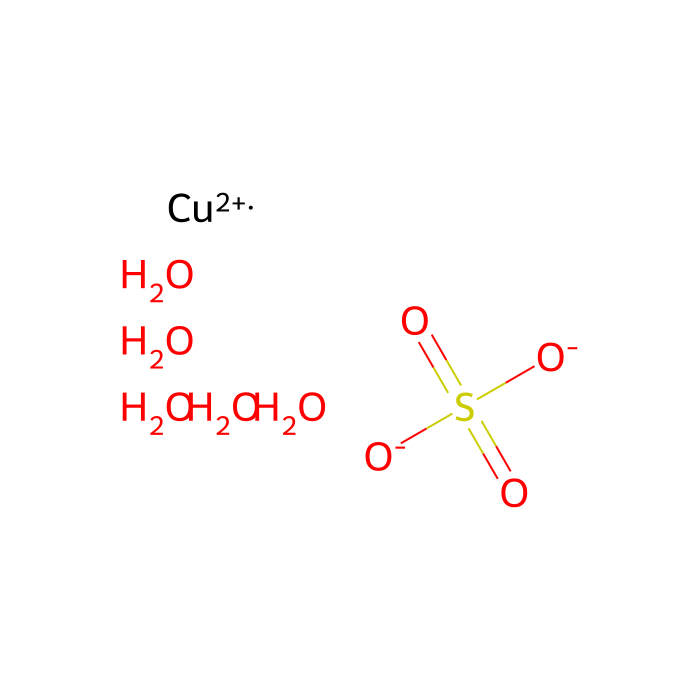
Copper sulfate pentahydrate - for cell culture, ≥98% , CAS No.7758-99-8

CAS: 7758-99-8 Cat. No.: C112411 Summenformel: CuSO4 · 5H2O Molekulargewicht: 249.69 EG-Nummer: 616-477-9
Zu bestellen verfügbar
QUALITÄT & REINHEIT for Cell culture ? Cell-culture grade — low endotoxin and contaminants to support viable cell growth. Use in mammalian/other cell culture media and supplements. ≥98%
Synonyms
Calcanthite|Copper(II) sulfate pentahydrate|Copper(II)sulfatepentahydrate|COPPERFINE-ZINC|Copper(2+) sulfate (1:1) pentahydrate|Cupric sulfate (pentahydrate)|copper(II)sulfate pentahydrate|copper;sulfate;pentahydrate|COPPER SULFATE PENTAHYDRATE [WHO-DD]|Kupfersulfat-pentahydrat|copper(11) sulfate pentahydrate|COPPER(2+) SULPHATE (1:1) PENTAHYDRATE|Cupric sulfate (USP)|Copper sulfate pentahydrate|COPPER (AS CUPRIC SULFATE) [VANDF]|copper (II) sulphate pentahydrate|Kupfervitriol [German]|Copper sulfate, pentahydrate|Cupric sulfate (TN)|copper(2+) sulfate, pentahydrate|Cupric sulfate pentahydrate|Blue copper AS|COPPER SULFATE [VANDF]|copper(2+) sulfate--water (1/5)|Cupric Sulfate [USP]|copper sulfate-penta hydrate|CUPRUM SULPHURICUM [HPUS]|Vencedor|SULFURIC ACID, COPPER (2+) SALT, PENTAHYDRATE|copper (2+) sulfate pentahydrate|Copper sulfate (CuSO4) pentahydrate|Sulfuric acid, copper(2+) salt (1:1), pentahydrate|Copper (II) Sulfate pentahydrate|Salzburg vitriol|Sulfuric acid, copper(2+) salt, pentahydrate|Cupric sulphate pentahydrate|copper sulphate pentahydrate|Blue vitriol|Triangle|CUPRIC SULFATE [VANDF]|Kupfersulfat-pentahydrat [German]|copper sulphate(5.H2O)|copper(II)sulphate-pentahydrate|Kupfervitriol|copper(II) sulphate pentahydrate|Copper(2+) sulfate pentahydrate|COPPER(2+) SULPHATE PENTAHYDRATE|CUPRIC SULFATE PENTAHYDRATE [MI]|COPPER SULFATE PENTAHYDRATE [EP MONOGRAPH]|copper(II)sulphate pentahydrate
Storage
Room temperature,Argon charged,Desiccated,Cool
Shipped In
Normal
★
Größe
Deutschland (EU)
USA*
Preis
Menge
100g
C112411-100g
Auf Bestellung · 8–12 Wochen
25,95€
500g
C112411-500g
—
2 Auf Lager
78,01€
Enter a quantity for the sizes you want to add.

Spezifikationen

Synonyme
Calcanthite | Copper(II) sulfate pentahydrate | Copper(II)sulfatepentahydrate | COPPERFINE-ZINC | Copper(2+) sulfate (1:1) pentahydrate | Cupric sulfate (pentahydrate) | copper(II)sulfate pentahydrate | copper;sulfate;pentahydrate | COPPER SULFATE PENTAHYDRATE [WHO-DD] | Kupfersulfat-pentahydrat | copper(11) sulfate pentahydrate | COPPER( Show more
Spezifikationen & Reinheit
for cell culture, ≥98%
Storage
Room temperature,Argon charged,Desiccated,Cool
Verschickt in
Normal
Note
für die Zellkultur
Reinheit
≥98%
Namen und Kennungen
Pubchem Sid
Pubchem Sid Url
https://pubchem.ncbi.nlm.nih.gov/substance/508815384
SMILES
O.O.O.O.O.[O-]S(=O)(=O)[O-].[Cu+2]
IUPAC Name
copper;sulfate;pentahydrate
InChIKey
JZCCFEFSEZPSOG-UHFFFAOYSA-L
InChI
1S/Cu.H2O4S.5H2O/c;1-5(2,3)4;;;;;/h;(H2,1,2,3,4);5*1H2/q+2;;;;;;/p-2
Isomere SMILES
O.O.O.O.O.[O-]S(=O)(=O)[O-].[Cu+2]
WGK Deutschland
3
RTECS
GL8900000
Alternative CAS-Nummer
10257-54-2
UN-Nummer
UN 3077
Verpackungsgruppe
III
Molekulargewicht
249.69
Reaxys
13154734
Reaxys-RN_link_address
https://www.reaxys.com/reaxys/secured/hopinto.do?context=S&query=IDE.XRN=13154734&ln=

Erweiterte Daten

Taxonomic Classification

Taxonomy Tree

KingdomInorganic compounds
SuperclassMixed metal/non-metal compounds
KlasseTransition metal oxoanionic compounds
SubclassTransition metal sulfates
Intermediate Tree Nodes Not available
Direct ParentTransition metal sulfates
Alternative Parents Inorganic oxides  Inorganic copper salts  
Molecular FrameworkNot available
Substituents Transition metal sulfate - Inorganic copper salt - Inorganic oxide - Inorganic salt
BeschreibungThis compound belongs to the class of inorganic compounds known as transition metal sulfates. These are inorganic compounds in which the largest oxoanion is sulfate, and in which the heaviest atom not in an oxoanion is a transition metal.
External Descriptors hydrate - metal sulfate
3D-Struktur
Interaktives chemisches Strukturmodell


Zertifikate (CoA, COO, BSE/TSE und Analyse-Diagramm)
C of A & Other Certificates(BSE/TSE, COO):
Analytical Chart:

Find and download the COA for your product by matching the lot number on the packaging.

4 results found

Lot NumberCertificate TypeDatumArtikel
A2306318A2306318Certificate of AnalysisSep 22, 2026 C112411
F2608284F2608284Certificate of AnalysisMar 20, 2026 C112411
F2608285F2608285Certificate of AnalysisMar 20, 2026 C112411
G2222222G2222222Certificate of AnalysisJun 16, 2022 C112411
Chemische und physikalische Eigenschaften
EmpfindlichkeitMoisture sensitive.air sensitive
Schmelzpunkt (°C)147 °C
Molekulargewicht249.69
XLogP3
Hydrogen Bond Donor Count5
Hydrogen Bond Acceptor Count9
Rotatable Bond Count0
Exact Mass248.934 Da
Monoisotopic Mass248.934 Da
Topological Polar Surface Area93.600 Ų
Heavy Atom Count11
Formal Charge0
Complexity62.200
Isotope Atom Count0
Defined Atom Stereocenter Count0
Undefined Atom Stereocenter Count0
Defined Bond Stereocenter Count0
Undefined Bond Stereocenter Count0
The total count of all stereochemical bonds0
Covalently-Bonded Unit Count7
Sicherheit und Gefahren (GHS)
Piktogramm(e)
GHS05,   GHS09
Signal
Danger
Gefahrenhinweise

H302:Harmful if swallowed

H315:Causes skin irritation

H319:Causes serious eye irritation

H410:Very toxic to aquatic life with long lasting effects

Sicherheitshinweise

P264:Wash hands [and …] thoroughly after handling.

P270:Do not eat, drink or smoke when using this product.

P273:Avoid release to the environment.

P280:Wear protective gloves/protective clothing/eye protection/face protection.

P330:Rinse mouth.

P391:Collect spillage.

P501:Dispose of contents/container to an approved waste disposal plant.

P264+P265:Wash hands [and …] thoroughly after handling. Do not touch eyes.

P301+P317:IF SWALLOWED: Get medical help.

P305+P354+P338:IF IN EYES: Immediately rinse with water for several minutes. Remove contact lenses if present and easy to do. Continue rinsing.

P317:Get emergency medical help.

WGK Deutschland
3
RTECS
GL8900000
Reaxys
13154734
Reaxys-RN_link_address
https://www.reaxys.com/reaxys/secured/hopinto.do?context=S&query=IDE.XRN=13154734&ln=
Klasse
9
FAQs und Artikel
For Cell Culture
Structural and Catalytic Roles of Metal Ions in Protein Enzyme Activity
11 Common Methods for Protein Concentration Determination
Fundamentals and Applications of Etching Solutions: Using Metallic Copper / PCB Etching as an Example
A Practical Guide to Small-Molecule Chemical Probes: Concept Clarification, Causal Validation, and Experimental Selection (with Product Navigation and Tables A–D)
OSF/ASF Dual-Channel Toolbox: Divergent Reactions of Four-Membered Ring Sulfonyl Fluorides, Condition “Knobs,” and Selection Navigation
Practical Guide to Sodium Carboxymethyl Cellulose (CMC-Na): Thickening/Stabilizing Mechanisms, Key Controls for Solution Preparation, and Selection Navigation (including Table 1 and Tables A–C)
Transition-Metal Salts/Precursor Selection Guide: How “Different Salts of the Same Metal” Start from Different Chemical Realities—and How to Reproduce Results (including a Selection Navigator and Product Tables 1–5)
Flavones: Structural Features, Physicochemical Properties, and Key Points for Research and Applications
Invertebrate Oxygen Carrier Proteins in Immunology and Vaccine Research
Analytical Basis, Methodological Systems, and Quality Control for Vitamin C Content Determination
Experimental Decision-Making for Introducing Aminoalkyl Side Chains Using N-Haloalkyl Phthalimides: Chain Length, Leaving Group, and Deprotection Choice
How to Determine Whether a Protein Is Suitable for Targeted Degradation: From Degradation Pathway and Molecular Design to Mechanism Validation
Designing Hydrogel Scaffolds as Programmable Cell Microenvironments: From Click-Chemistry Functionalization to 3D Cell Culture Experimental Design
Capable of Swelling, Adsorption, and Cation Exchange: What Makes Montmorillonite Clay Different?
How Should Montmorillonite Be Rationally Modified? Organic Modification, Inorganic Modification, and Application-Oriented Selection and Validation
Structural Features, Property Modulation, and Typical Applications of Triazole Compounds
Synthetic Application Logic of Triazoles and Related Compounds: Structural Introduction, Reactive Sites, and Target Molecule Construction
Common Chromogenic Reagents and Method Selection for Copper Ion Content Determination
Comparison of Reducing Sugar Detection Methods: Selection of Fehling’s Reagent, Benedict’s Method, DNS Method, and HPLC
Skin Anti-Aging Mechanisms of Carnosine and Decarboxy Carnosine: Active Carbonyl Scavenging, Oxidative-Stress Buffering, and Inhibition of Collagen Glycation Cross-Linking
Acetyl Tetrapeptide-2 and Elastic Fiber Formation: Research on Fibulin-5, LOXL1, and Skin Firmness
How Palmitoyl Pentapeptide-4 Acts on the Skin: From the KTTKS Sequence and Skin Delivery to Collagen Matrix Responses
Reactions and Applications of 3,3-Difluoroallyl Sulfonium Salts (DFASs): Small-Molecule gem-Difluoroallylation, Selective Peptide Modification, and Subsequent Functionalization
The Combination Logic of Palmitoyl Tripeptide-1 and Palmitoyl Pentapeptide-4: Skin Delivery, Matrix Signaling, and Regulation of Collagen Homeostasis
How Arbutin Regulates Melanin Production: α/β Anomeric Configuration and Tyrosinase Action
Structural Characteristics of Ergothioneine, OCTN1-Mediated Uptake by Skin Cells, and Antioxidant Mechanisms
Copper Tripeptide GHK-Cu and Skin Repair: From Copper Coordination Chemistry to Extracellular Matrix Remodeling
Why Do Skincare Oligopeptides Have Different Effects? — Molecular Structure, Skin Delivery, and Mechanisms of Action
Citations of This Product
Lösungsrechner
Bewertungen

Kundenbewertungen

Dürfen wir Sie über Rabattaktionen informieren?

Später erinnern

Vielen Dank! Bitte überprüfen Sie Ihren E-Mail-Posteingang, um zu bestätigen.

Hoppla! Benachrichtigungen sind deaktiviert.