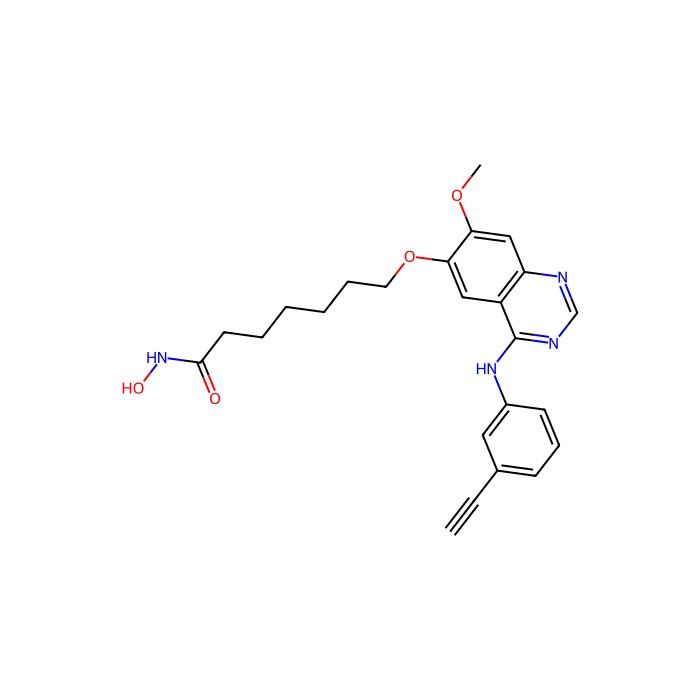
CUDC-101 - Moligand™, 10mM in DMSO , Histone deacetylase inhibitor, CAS No.1012054-59-9, Histone deacetylase inhibitor

CAS: 1012054-59-9 Cat. No.: C408504 Summenformel: C24H26N4O4 Molekulargewicht: 434.49
Zu bestellen verfügbar
QUALITÄT & REINHEIT Moligand™ ? Moligand™ — Aladdin's line of ligands and bioactive small molecules. Use for receptor, pathway, and binding studies needing defined small-molecule tools. 10mM in DMSO
Synonyms
7-(4-(3-ethynylphenylamino)-7-methoxyquinazolin-6-yloxy)-N-hydroxyheptanamide
Storage
Store at -80°C
Shipped In
Dry ice packs + Cold packs
★
Größe
Deutschland (EU)
USA*
Preis
Menge
1ml
C408504-1ml
—
1 Auf Lager

145,69€

169,99€
Speichern 24,30 € (14.29%)
Enter a quantity for the sizes you want to add.

Übersicht

Information

CUDC-101 is a potent multi-targeted inhibitor againstHDAC,EGFRand HER2 withIC50of 4.4 nM, 2.4 nM, and 15.7 nM, and inhibits class I/II HDACs, but not class III, Sir-type HDACs. Phase 1.
In vitro

Specific for class I and class II HDACs, CUDC-101 does not inhibit class III Sir-type HDACs. CUDC-101 displays weak activity against other protein kinases including KDR/VEGFR2, Lyn, Lck, Abl-1, FGFR-2, Flt-3, and Ret with IC50 of 0.85 μM, 0.84 μM, 5.91 μM, 2.89 μM, 3.43 μM, 1.5 μM, abd 3.2 μM, respectively. CUDC-101 displays broad antiproliferative activity in many human cancer cell types with IC50 of 0.04-0.80 μM, exhibiting a higher potency than erlotinib, lapatinib, and combinations of vorinostat with either erlotinib or lapatinib in most cases. CUDC-101 potently inhibits lapatinib- and erlotinib-resistant cancer cell lines. CUDC-101 inhibits the erlotinib-resistant EGFR mutant T790M although its effects are incomplete with an Amax of ~60% of peak enzyme activity after inhibition. CUDC-101 treatment increases the acetylation of histone H3 and H4, as well as the acetylation of non-histone substrates of HDAC such as p53 and α-tubulin, in a dose-dependant manner in various cancer cell lines. CUDC-101 also suppresses HER3 expression, Met amplification, and AKT reactivation in tumor cells.

In vivo

Administration of CUDC-101 at 120 mg/kg/day induces tumor regression in the Hep-G2 liver cancer model, which is more efficacious than that of erlotinib at its maximum tolerated dose (25 mg/kg/day) and vorinostat at an equimolar concentration dose (72 mg/kg/day). CUDC-101 inhibits the growth of erlotinib-sensitive H358 NSCLC xenografts in a dose-dependent manner. CUDC-101 also shows potent inhibition of tumor growth in the erlotinib-resistant A549 NSCLC xenograft model. CUDC-101 produces significant tumor regression in the lapatinib-resistant, HER2-negative, EGFR-overexpressing MDA-MB-468 breast cancer model and the EGFR-overexpressing CAL-27 head and neck squamous cell carcinoma (HNSCC) model. Additionally, CUDC-101 inhibits tumor growth in the K-ras mutant HCT116 colorectal and EGFR/HER2 (neu)-expressing HPAC pancreatic cancer models.
Cell Data

cell lines:

Concentrations:Dissolved in DMSO, final concentrations ~10 μM

Incubation Time:72 hours

Powder Purity:≥99%
Spezifikationen

Synonyme
7-(4-(3-ethynylphenylamino)-7-methoxyquinazolin-6-yloxy)-N-hydroxyheptanamide
Spezifikationen & Reinheit
Moligand™, 10mM in DMSO
Biochemische und physiologische Mechanismen
CUDC-101 is a potent multi-targeted inhibitor against HDAC, EGFR and HER2 with IC50 of 4.4 nM, 2.4 nM, and 15.7 nM, and inhibits class I/II HDACs, but not class III, Sir-type HDACs. Phase 1.
Storage
Store at -80°C
Verschickt in
Dry ice packs + Cold packs
Dieses Produkt erfordert Kühlkettenversand. Grundversand und andere Economy-Optionen sind nicht verfügbar.
Note
Moligand™
Aktionsart
INHIBITOR
Mechanismus der Wirkung
Histone deacetylase inhibitor
Produkteigenschaften
ALogP
4
Namen und Kennungen
Isomere SMILES
COC1=C(C=C2C(=C1)N=CN=C2NC3=CC=CC(=C3)C#C)OCCCCCCC(=O)NO
Molekulargewicht
434.49
Reaxy-Rn
13122626
Reaxys-RN_link_address
https://www.reaxys.com/reaxys/secured/hopinto.do?context=S&query=IDE.XRN=13122626&ln=

Erweiterte Daten

Zugehörige Ziele (menschlich)
ERBB2 Tclin Receptor tyrosine-protein kinase erbB-2 (5 Activities)
Activity TypeActivity Value -log(M)Mechanism of ActionActivity ReferencePublications (PubMed IDs)
EGFR Tclin Epidermal growth factor receptor (9 Activities)
Activity TypeActivity Value -log(M)Mechanism of ActionActivity ReferencePublications (PubMed IDs)
HDAC4 Tclin Histone deacetylase 4 (2 Activities)
Activity TypeActivity Value -log(M)Mechanism of ActionActivity ReferencePublications (PubMed IDs)
HDAC6 Tclin Histone deacetylase 6 (2 Activities)
Activity TypeActivity Value -log(M)Mechanism of ActionActivity ReferencePublications (PubMed IDs)
HDAC1 Tclin Histone deacetylase 1 (2 Activities)
Activity TypeActivity Value -log(M)Mechanism of ActionActivity ReferencePublications (PubMed IDs)
HDAC7 Tclin Histone deacetylase 7 (2 Activities)
Activity TypeActivity Value -log(M)Mechanism of ActionActivity ReferencePublications (PubMed IDs)
HDAC9 Tclin Histone deacetylase 9 (2 Activities)
Activity TypeActivity Value -log(M)Mechanism of ActionActivity ReferencePublications (PubMed IDs)
HDAC2 Tclin Histone deacetylase 2 (2 Activities)
Activity TypeActivity Value -log(M)Mechanism of ActionActivity ReferencePublications (PubMed IDs)
HDAC10 Tclin Histone deacetylase 10 (4 Activities)
Activity TypeActivity Value -log(M)Mechanism of ActionActivity ReferencePublications (PubMed IDs)
HDAC8 Tclin Histone deacetylase 8 (2 Activities)
Activity TypeActivity Value -log(M)Mechanism of ActionActivity ReferencePublications (PubMed IDs)
HDAC5 Tclin Histone deacetylase 5 (2 Activities)
Activity TypeActivity Value -log(M)Mechanism of ActionActivity ReferencePublications (PubMed IDs)
HDAC3 Tclin Histone deacetylase 3 (2 Activities)
Activity TypeActivity Value -log(M)Mechanism of ActionActivity ReferencePublications (PubMed IDs)
Zertifikate (CoA, COO, BSE/TSE und Analyse-Diagramm)
C of A & Other Certificates(BSE/TSE, COO):
Analytical Chart:
Chemische und physikalische Eigenschaften
LöslichkeitSolubility (25°C) In vitro DMSO: 38 mg/mL (195.6 mM); Ethanol: 38 mg/mL (195.6 mM); Water: Insoluble;
Citations of This Product
Lösungsrechner
Bewertungen

Kundenbewertungen

Benötigen Sie Hilfe bei der Auswahl der Qualität?

Unser Leitfaden zur Qualitätsauswahl behandelt Reinheit, Stabilisatorstatus und Anwendungseignung für alle Varianten in unserem Katalog.

Moligand™ Qualitätsleitfaden ansehen →

Dürfen wir Sie über Rabattaktionen informieren?

Später erinnern

Vielen Dank! Bitte überprüfen Sie Ihren E-Mail-Posteingang, um zu bestätigen.

Hoppla! Benachrichtigungen sind deaktiviert.