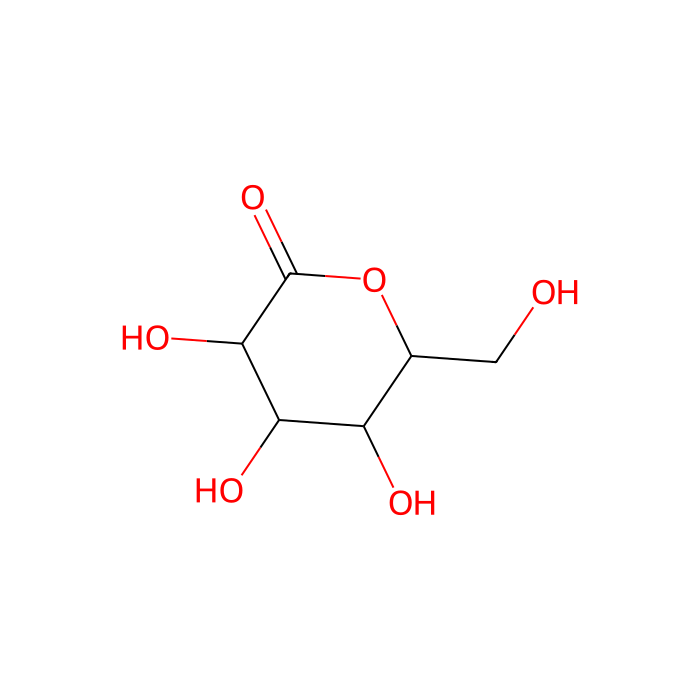
D-(+)-Gluconic acid δ-lactone - 10mM in DMSO , CAS No.90-80-2

CAS: 90-80-2 Cat. No.: D426861 Summenformel: C6H10O6 Molekulargewicht: 178.14 Beilstein Registry Number: 83286 EG-Nummer: 202-016-5
Zu bestellen verfügbar
QUALITÄT & REINHEIT 10mM in DMSO
Synonyms
1,5-D-Gluconolactone | D-(+)-Gluconic acid d-lactone | D-(+)-Gluconic acid-delta lactone | EINECS 202-016-5 | D-Gluconic acid lactone | delta-Gluconic acid lactone | UNII-WQ29KQ9POT | delta-Gluconic acid-delta-lactone | NSC34393 | NSC-34393 | Glucolactone
Storage
Store at -80°C
Shipped In
Dry ice packs + Cold packs
★
Größe
Deutschland (EU)
USA*
Preis
Menge
1ml
D426861-1ml
—
2 Auf Lager
23,34€
Enter a quantity for the sizes you want to add.

Übersicht

Product Application:

Glucono delta-lactone (GDL) is a kind of excellent multifunctional food additive. It is mainly used as protein coagulant, acidifier, pickling, or leavening agent. expander, preservative, seasonings, sequestrant, chelating agent, color-preserver, etc. it is widely applied to food, daily chemical industry, pharmaceuticals, cosmetics. Plastic and resinous modification, electrode position and polish, metal-surface cleaning and organic synthesis.

Spezifikationen

Synonyme
1,5-D-Gluconolactone | D-(+)-Gluconic acid d-lactone | D-(+)-Gluconic acid-delta lactone | EINECS 202-016-5 | D-Gluconic acid lactone | delta-Gluconic acid lactone | UNII-WQ29KQ9POT | delta-Gluconic acid-delta-lactone | NSC34393 | NSC-34393 | Glucolactone
Spezifikationen & Reinheit
10mM in DMSO
Biochemische und physiologische Mechanismen
Gluconolactone is a product of the oxidation of glucose by glucose oxidase. It has been found to be a mixed type, noncompetitive inhibitor for the hydrolysis of p-nitrophenyl alpha-D-glucoside by glucoamylase, an enzyme that breaks down starch into glucos
Storage
Store at -80°C
Verschickt in
Dry ice packs + Cold packs
Dieses Produkt erfordert Kühlkettenversand. Grundversand und andere Economy-Optionen sind nicht verfügbar.
Namen und Kennungen
Pubchem Sid
Kanonisches Lächeln
C(C1C(C(C(C(=O)O1)O)O)O)O
IUPAC Name
(3R,4S,5S,6R)-3,4,5-trihydroxy-6-(hydroxymethyl)oxan-2-one
InChIKey
PHOQVHQSTUBQQK-SQOUGZDYSA-N
INCHI
1S/C6H10O6/c7-1-2-3(8)4(9)5(10)6(11)12-2/h2-5,7-10H,1H2/t2-,3-,4+,5-/m1/s1
Isomere SMILES
C([C@@H]1[C@H]([C@@H]([C@H](C(=O)O1)O)O)O)O
WGK Deutschland
3
RTECS
LZ5184000
Molekulargewicht
178.14
Beilstein
83286
Reaxy-Rn
13905182
Reaxys-RN_link_address
https://www.reaxys.com/reaxys/secured/hopinto.do?context=S&query=IDE.XRN=13905182&ln=

Erweiterte Daten

Taxonomic Classification

Taxonomy Tree

KingdomOrganic compounds
SuperclassOrganic oxygen compounds
KlasseOrganooxygen compounds
SubclassCarbohydrates and carbohydrate conjugates
Intermediate Tree Nodes Monosaccharides - Hexoses
Direct ParentGluconolactones
Alternative Parents Delta valerolactones  Oxanes  Secondary alcohols  Carboxylic acid esters  Polyols  Oxacyclic compounds  Monocarboxylic acids and derivatives  Primary alcohols  Organic oxides  Hydrocarbon derivatives  Carbonyl compounds  
Molecular FrameworkAliphatic heteromonocyclic compounds
Substituents Gluconolactone - Delta valerolactone - Delta_valerolactone - Oxane - Carboxylic acid ester - Lactone - Secondary alcohol - Organoheterocyclic compound - Monocarboxylic acid or derivatives - Oxacycle - Carboxylic acid derivative - Polyol - Hydrocarbon derivative - Organic oxide - Alcohol - Primary alcohol - Carbonyl group - Aliphatic heteromonocyclic compound
BeschreibungThis compound belongs to the class of organic compounds known as gluconolactones. These are polyhydroxy acids containing a gluconolactone molecule, which is characterized by a tetrahydropyran substituted by three hydroxyl groups, one ketone group, and one hydroxymethyl group.
External Descriptors aldono-1,5-lactone - gluconolactone
3D-Struktur
Interaktives chemisches Strukturmodell


Zugehörige Ziele (menschlich)
GBA1 Tclin Beta-glucocerebrosidase (14647 Activities)
Activity TypeRelationActivity valueUnitsAction TypeJournalPubMed IddoiAssay Aladdin ID
LMNA Tbio Prelamin-A/C (36751 Activities)
Activity TypeRelationActivity valueUnitsAction TypeJournalPubMed IddoiAssay Aladdin ID
SLCO1B1 Tchem Solute carrier organic anion transporter family member 1B1 (2672 Activities)
Activity TypeRelationActivity valueUnitsAction TypeJournalPubMed IddoiAssay Aladdin ID
SLCO1B3 Tchem Solute carrier organic anion transporter family member 1B3 (2517 Activities)
Activity TypeRelationActivity valueUnitsAction TypeJournalPubMed IddoiAssay Aladdin ID
Wirkungsmechanismen
Zertifikate (CoA, COO, BSE/TSE und Analyse-Diagramm)
C of A & Other Certificates(BSE/TSE, COO):
Analytical Chart:
Chemische und physikalische Eigenschaften
EmpfindlichkeitMoisture sensitive; light sensitive
Spezifische Drehung [α]63.5 ° (C=10, H2O)
Schmelzpunkt (°C)160°C
Molekulargewicht178.140 g/mol
XLogP3-2.000
Hydrogen Bond Donor Count4
Hydrogen Bond Acceptor Count6
Rotatable Bond Count1
Exact Mass178.048 Da
Monoisotopic Mass178.048 Da
Topological Polar Surface Area107.000 Ų
Heavy Atom Count12
Formal Charge0
Complexity181.000
Isotope Atom Count0
Defined Atom Stereocenter Count4
Undefined Atom Stereocenter Count0
Defined Bond Stereocenter Count0
Undefined Bond Stereocenter Count0
The total count of all stereochemical bonds0
Covalently-Bonded Unit Count1
FAQs und Artikel
An Introduction to Research-Grade Carbohydrates: Decoding the “Glycan Language” and a Product-Selection Guide (with Tables 1–3)
How Organic Acids “Stabilize a System”: Selection Logic via the pH Window, Salt Forms, and Metal-Ion Management (with a navigation guide to Tables A–E)
Alginate : An Overview of Extraction and Purification Processes, Quality Identification, and Multidomain Applications
Galactose-Related Precursor Conversion and Redox Regulation in Plant Ascorbate Biosynthesis
The Dual-Targeted Skin-Brightening Mechanism of 4-MSK: Inhibiting Melanin Production and Reducing Epidermal Pigment Retention
Potential Mechanisms of Succinic Acid in Acne Care: From Dicarboxylic Acid–Base Equilibria to Metabolic Antagonism Among Skin Microorganisms
Structure, Stratum Corneum Distribution, and Stratum Corneum Conditioning Mechanism of Capryloyl Salicylic Acid: Barrier Effects and Safety Evaluation
Citations of This Product
Lösungsrechner
Bewertungen

Kundenbewertungen

Dürfen wir Sie über Rabattaktionen informieren?

Später erinnern

Vielen Dank! Bitte überprüfen Sie Ihren E-Mail-Posteingang, um zu bestätigen.

Hoppla! Benachrichtigungen sind deaktiviert.